zenpundit.com » movies

Archive for the ‘movies’ Category

On eating one’s enemy

Saturday, May 18th, 2013

[ by Charles Cameron — not good branding, not Islamic, dumbstruck? — not a whole lot else to say ]
.

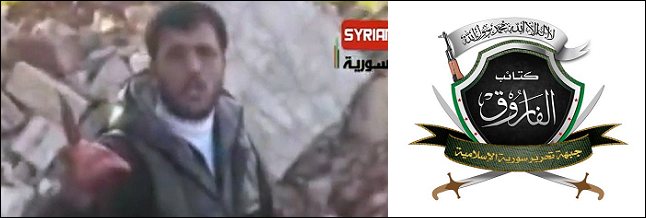
Commander Abu Sakkar / the Farouq Brigades logo


Let’s take the bald facts first:

Commander Abu Sakkar of the Farouq Brigades, Free Syrian Army, had himself videotaped this month cutting open and seeming to eat the flesh of a just-killed Syrian soldier loyal to President Assad — to send a message. According to a New York Times “Lede” blog-post, he preceded this act with the words:

I swear to God, soldiers of Bashar, you dogs — we will eat your heart and livers! … God is great! Oh, my heroes of Baba Amr, you slaughter the Alawites and take their hearts out to eat them!

His rhetoric as reported speaks of eating the heart: in the event, it is a portion of lungs that he eats, or mimics eating.

**

This has to be seen in many contexts — one of them, the branding of the Syrian rebels in general and the Farouq Brigades in particular.

This is taken from an article a couple of weeks ago on a WSJ blog titled For Some Syrian Rebels, It’s a Battle of the Brands:

Twelve activists in an office in Reyhanli, Turkey near the border run Farouk’s Facebook page, web site, and Twitter account. They’re working on the TV channel, which Mr. Awad says they’ve envisioned as a tool to resocialize fighters off the battlefield.

“The regime will fall one day,” he says. “We have 20,000 fighters–they all won’t stay fighters. They will put down their weapons, and need to integrate into the world. TV, radio, these things will help.”

The media office’s latest brand offering? A three-dimensional version of the Farouk logo, which will be used in videos and other online material.

“The guys complained the logo wasn’t nice enough,” Mr. Awad said, laughing. “They wanted a 3D one.”

**

Moralizing about someone eating the flesh of a deceased enemy is pretty easy to pull off — unless one still thinks it’s a potent way to acquire one’s enemy’s courage, which is now something of a curiosity in the anthropologist’s cabinet of concepts. Here, dug up from the section on Homeopathic Magic of a Flesh Diet in Sir JG Frazer‘s 1922 edition of The Golden Bough, now long out-dated, is the picture as it used to be seen:

When Basutos of the mountains have killed a very brave foe, they immediately cut out his heart and eat it, because this is supposed to give them his courage and strength in battle. When Sir Charles M’Carthy was killed by the Ashantees in 1824, it is said that his heart was devoured by the chiefs of the Ashantee army, who hoped by this means to imbibe his courage. His flesh was dried and parcelled out among the lower officers for the same purpose, and his bones were long kept at Coomassie as national fetishes. The Nauras Indians of New Granada ate the hearts of Spaniards when they had the opportunity, hoping thereby to make themselves as dauntless as the dreaded Castilian chivalry.

Even as a cannibal delicacy, the white man’s heart seemed to have special virtue! As I say, though — that’s all a little out of date.

**

Eating one’s enemy, however, is a distinctly un-Islamic behavior, whatever century we’re in. One early Islamic narrative concerns Hind bint ‘Utbah avenging deaths in her own family by eating the heart of a great Muslim warrior, dear to the Prophet — far from being an example of what is permitted in Islam, she’s an example of what Muhammad was up against by way of enemies in the early days of his preaching:

Hind Bint `Utbah, the wife of Abu Sufyaan, ordered Wahshiy to bring her Hamzah’s liver, and he responded to her savage desire. When he returned to her, he delivered the liver to her with his right hand, while taking the necklaces with the left as a reward for the accomplished task. Hind, whose father had been killed in the Battle of Badr and whose husband was the leader of the polytheist army, chewed Hamzah’s liver hoping to relieve her heart, but the liver was too tough for her teeth so she spat it out and stood up shouting her poem:

                    For Badr we’ve paid you better
                    In a war more flaring than the other.
                    I was not patient to revenge the murder of
                    `Utbah, my son, and my brother.
                    My vow’s fulfilled, my heart’s relieved forever.

Hind did eventually become a Muslim — but on account of this very event, was never fully included among “the Companions of the Prophet”.

**

I don’t want to moralize over Commander Abu Sakkar‘s act, not having been in his shoes — but it is vile under pretty much any moral standard you might choose. A problem arises, though, when one attempts to use it to justify one side or another, in a conflict in which brutality of one kind or another seems to be present on both sides. As Sakkar himself told a Time correspondent:

You are not seeing what we are seeing, and you are not living what we are living. Where are my brothers, my friends, the girls of my neighborhood who were raped?

**

Peter Bouckaert of Human Rights Watch is quoted giving another kind of context to the affair:

Abu Sakkar is just one man, and there are many other armed fighters in Syria who reject such sectarian actions and would be horrified by the mutilation and desecration of a corpse — let alone an act of cannibalism. But he is a commander in a decisive battle in Syria — hardly a marginal figure.

**

Not without reason did Kurtz whisper at the end of Joseph Conrad‘s Heart of Darkness, as in Francis Ford Coppola‘s Apocalypse Now:

The horror! The horror!

Jottings 3: Espionage on the chess board

Friday, May 3rd, 2013

[ by Charles Cameron — playing the two great games, from Caxton to Le Carré ]
.

.

Karla, the Russian spymaster in John Le Carré‘s Smiley novels, is represented as the white queen in the 2011 Tomas Alfredson / Gary Oldman film of Tinker Tailor Soldier Spy (lower panel, above).

In chess terms, that’s quite a step up for spies — pawn promoted to queen.

**

Before the digital age, in the early years of printing, way back in 1474, Thomas Caxton‘s press issued the second book ever printed in England — his Game and Playe of the Chesse — and things were subtly different. The eight pawns, for instance, differed one from another, each representing a different human type or craft, and named accordingly: “Labourer, Smith, Clerk, Merchant, Physician, Taverner, Guard and Ribald.”

It’s the Ribald (in the upper panel, above) who interests us here — for he’s the spy on the chessboard, as surely as Joshua the son of Nun and Caleb the son of Jephunneh were spies in the land of milk and honey. Caxton describes the Ribald, stationing him in front of the Rook, thus:

The rybaulders, players of dyse and of messagers and corrours ought to be sette to fore the rook/ For hit apperteyneth to the rook whiche is vicayre & lieutenant of the kynge to haue men couenable for to renne here and there for tenquyre & espie the place and cytees that myght be contrarye to the kynge/ And thys pawn that representeth thys peple ought to be formed in this maner/ he must haue the forme of a man that hath longe heeris and black and holdeth in his ryght hand a lityll monoye And in his lyfte hande thre Dyse And aboute hym a corde in stede of a gyrdell/ and ought to haue a boxe full o lettres

And what should be the appearance of such a one?

And thys pawn that representeth thys peple ought to be formed in this maner/ he must haue the forme of a man that hath longe heeris and black and holdeth in his ryght hand a lityll monoye And in his lyfte hande thre Dyse And aboute hym a corde in stede of a gyrdell/ and ought to haue a boxe full o lettres

Let’s go over that first part one more time, and make sure we understand it:

It pertains to the Rook, which is vicar and lieutenant of the King, to have men available to run hither and yon to make inquiries and spy out the place and cities that might be contrary to the King.

**

And isn’t that precisely what Moses sent Joshua and Caleb out to do, when he instructed them in Numbers 13.17-20:

Get you up this way southward, and go up into the mountain: And see the land, what it is, and the people that dwelleth therein, whether they be strong or weak, few or many; And what the land is that they dwell in, whether it be good or bad; and what cities they be that they dwell in, whether in tents, or in strong holds; And what the land is, whether it be fat or lean, whether there be wood therein, or not. And be ye of good courage, and bring of the fruit of the land.

**

Espionage has been around longer than chess: some things never change — and some things have changed significantly.

Today, you can’t tell one pawn from the next…

Furnish on Pew findings re: Islam

Thursday, May 2nd, 2013

[ Charles Cameron presenting guest-blogger Timothy Furnish ]
.

.

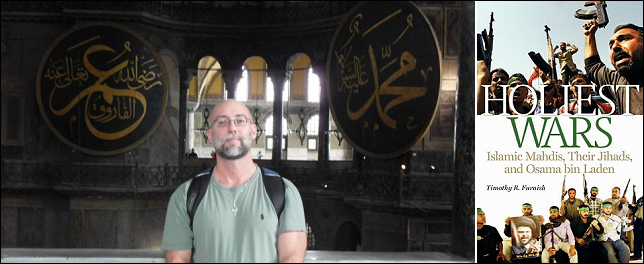
I’m delighted to welcome Dr Timothy Furnish as a guest-blogger here on Zenpundit. Dr Furnish has served as an Arabic linguist with the 101st Airborne and as an Army chaplain, holds a PhD in Islamic history from Ohio State, is the author of Holiest Wars: Islamic Mahdis, Their Jihads, and Osama bin Laden (2005), and blogs at MahdiWatch. His extended piece for the History News Network, The Ideology Behind the Boston Marathon Bombing, recently received “top billing” in Zen’s Recommended Reading of April 24th.

**

Does This Paint It Black, or Am I A Fool to Cry? Breaking Down the New Pew Study of Muslims
by Timothy R. Furnish, PhD
.

Pew has released another massive installment of data from its research, 2008-2012, into Muslim attitudes, entitled “The World’s Muslims: Religion, Politics and Society.” Over 38,000 Muslims in almost 40 countries were surveyed, thus constituting a survey both statistically sound and geographically expansive. Herewith is an analysis of that information and what seem to be its major ramifications.

The first section deals with shari`a, usually rendered simply as “Islamic law” but more accurately defined as “the rules of correct practice” which “cover every possible human contingency, social and individual, from birth to death” and based upon the Qur’an and hadiths (sayings and practices attributed to Muhammad) as interpreted by Islamic religious scholars (Marshal G.S. Hodgson, The Venture of Islam, Vol 1: The Classical Age of Islam, p. 74). Asked “should sharia [as Pew anglicizes it] be the law of the land,” 57% of Muslims across 38 countries answered “yes” — including, most problematically for the US: 99% of Afghans, 91% of Iraqis, 89% of Palestinians, 84% of Pakistanis and even 74% of Egyptians. Should sharia apply to non-Muslims as well as Muslims? Across 21 countries surveyed on this question, 40% answered affirmatively — with the highest positive response coming from Egypt (its 74% exceeding even Afghanistan’s 61%). And on the question whether sharia punishments — such as whippings and cutting off of thieves’ hands — should be enacted, the 20-country average was 52%, led by Pakistan (88%), Afghanistan (81%), the Palestinian Territories [PT] (76%) and Egypt (70-%). On the specific penalty of stoning for adultery, the 20-country average was 51% — with, again, Pakistan (89%), Afghanistan (85%), the PT (84%) and Egypt (71%) highest in approval. Finally, 38% of Muslims, across those same 20 nations, support the death penalty for those leaving Islam for another religion.

Huge majorities of Muslims across most of these surveyed nations say that “it’s good others can practice their faith” — but Pew’s imprecise terminology on this topic makes possible that this simply mean many Muslims are willing to grant non-Muslims the tolerated, but second-class, ancient status of the dhimmi. Majorities, too, in most countries say that “democracy is better than a powerful leader;” however, the latter was actually preferred by most surveyed in Russia, Bosnia-Hercegovina, Kyrgyzstan, Afghanistan and Pakistan, as well as by 42% of Iraqis, 40% of Palestinians and 36% of Egyptians. Most Afghans, Egyptians and Tunisians (and even 1/3 of Turks) believe that “Islamic political parties” are better than other ones, although 53% of Indonesians and 45% of Iraqis are also worried about “Muslim extremists.” (Curiously, 31% of Malaysians are, on the other hand, worried about “Christian extremists” — although evidence of such existing in that country is practically non-existent.) There is good news on the question of suicide bombing, however: across 20 countries, only 13.5% think it is ever justified — although the support is much higher in the PT (40%), Afghanistan (39%) and Egypt (29%).

In terms of morality, large majorities in most Muslim countries (especially outside Sub-Saharan Africa) think drinking alcohol is morally repugnant, notably in Malaysia (93%), Pakistan and Indonesia (both 91%). Most Muslims in most countries surveyed consider abortion wrong, as well as pre- and extra-marital sex and, almost needless to say, homosexuality. (Although one wishes Pew had asked about mu`tah, or “temporary marriage” — a practice originally Twelver Shi`i which has increasingly become used by Sunnis.) Yet, simultaneously — following Qur’anic rubrics — some 30% of Muslims in 21 countries support polygamy, including almost half of Palestinians, 46% of Iraqis and 41% of Egyptians. There is also significant support for honor killings in not just Afghanistan and Iraq but also Egypt and the PT. Over ¾ of Muslims across 23 countries says that “wives must always obey their husbands:” an average of 77%. And Pew notes that there is a statistically very significant correlation between sharia-support and believing women have few(er) rights.

Asked whether they believed they were “following Muhammad’s example,” 75% of Afghans and 55% of Iraqis answered affirmatively — although most Muslims were not nearly so confident. On the question “are Sunni-Shi`i tensions a problem,” 38% of Lebanese, 34% of Pakistanis, 23% of Iraqis and 20% of Afghans said “yes.”

It is no surprise that huge majorities of Muslims in most surveyed countries believe that Islam is the only path to salvation, nor that most also say “it’s a duty to convert others” to Islam. It is somewhat counterintuitive, however, that many Muslims say they “know little about Christianity” — even in places with large Christian minorities, such as Egypt. Muslims in Sub-Saharan Africa are the most likely to agree that “Islam and Christianity have a lot in common,” and so are 42% of Palestianians, as well as some 1/3 of Lebanese and Egyptians. But only 10% of Pakistanis agree. Asked whether they ever engaged in “interfaith meetings,” many Muslims in Sub-Saharan Africa said that they did (with Christians), and a majority of Thais said likewise (albeit with Buddhists). But only 8% of Palestinians, 5% of Iraqis, and 4% of Egyptians said they ever do so—despite substantial Christian populations in each of those areas.

Regarding the question “are religion and science in conflict,” most Muslims said “no” — with the exceptions of Lebanon, Bangladesh, Tunisia and Turkey where over 40% in each country (and, actually, a majority in Lebanon) said that they were at loggerheads. Most Muslims also say they have no problems with believing in Allah and evolution — the exceptions being the majority of Afghans and Indonesians. Regarding popular culture, clear majorities of Muslims in many countries say they like Western music, TV and movies—but, at the same time, similar majorities say that such things undermine morality (although Bollywood less so than Hollywood).

Observations:

1) The high degree of support for sharia is the red flag here. Contra media and adminstration (both Obama and Bush) assurances that most Muslims are “moderate,” empirical data now exists that clearly shows most Muslims, in point of fact, support not just sharia in general but its brutal punishments. Perhaps just as disturbing, almost four in ten Muslims are in favor of killing those who choose to follow another religion. And countries in which the US is heavily involved either diplomatically or militarily (or both) are the very ones where such sentiments run most high: Pakistan, Afghanistan, Egypt, the Palestinian Territories. So are the “extremists” these very Muslims who want to follow, literally, the Qur’an and hadiths? Messers Brennan, Holder and Obama have some explaining to do.

2) Afghanistan would appear to be a lost cause. Afghans are at the top of almost every list in support for not just sharia, suicide bombing, honor killing and — ironically (or perhaps not) — confidence that they are emulating Islam’s founder, as well as dislike for democracy. In light of this clear data, two points about Afghanistan become clear: tactically, ostensible American befuddlement as to the causes of “green on blue” attacks and the continuing popularity of the Taliban in Afghanistan appears as willful ignorance; strategically, the US decision to stay there after taking out the al-Qa`ida [AQ] staging, post-9/11, and attempt to modernize Afghanistan was a huge, neo-Wilsonian mistake. 2014 cannot come soon enough.

3) In some ways Islam in Southeastern Europe, and to a lesser extent in Central Asia, seems to be a more tolerant brand of the faith than the Middle Eastern variety. For example, the SE European and Central Asian Muslims are the least likely to support the death penalty for “apostasy,” and the most supportive of letting women decide for themselves whether to veil. And Muslims in Sub-Saharan Africa are the most likely to know about Christianity, and to interact with Christians. On the other hand, African Muslims are among the most enamored of sharia, and Central Asian ones fond of letting qadis (Islamic judges) decide family and property disputes. So there does not seem to be a direct link between Westernization and moderation; in fact, the influence of Sufism — Islamic mysticism — in the regard needs to be correlated and studied (beyond what Pew did on the topic in last year’s analysis).

4) One bit of prognostication based on this data: Malaysia may be the next breeding ground of Islamic terrorism. It’s home to some 17 million Muslims (61% of its 28 million people), who hold a congeries of unsettling views: 86% want sharia the law of the land; 67% favor the death penalty for apostasy; 66% like sharia-compliant corporal punishments; 60% support stoning for adultery; and 18% think suicide bombing is justified. PACOM, SOCOM and the intelligence agencies need to ramp up hiring of Malay linguists and analysts.

5) Finally, some words for those — like FNC’s Megyn Kelly and Julie Roginsky (on the former’s show “American Live,” 4/30/13) — who pose a sociopolitical and moral equivalence between Muslim support for sharia and Evangelical Protestant Christian support for wives’ obedience to husbands: that’s a bit too much sympathy for the devil. Yes, Evangelical Christian pastors hold some pretty conservative views of the family, as per a 2011 Pew study of them; for example, 55% of them do agree that “a wife must always obey her husband” (compared to 77% of Muslims). And, ironically, many such Evangelicals agree in large measure with Muslims on issues such as the immorality of alcohol, abortion and homosexuality. However, one searches in vain for any Evangelical (or other) Christian support for whippings, stonings, amputation of thieves’ limbs, polygamy or suicide bombing.

Islam is the world’s second-largest religion, numbering some 1.6 billion humans (behind only Christianity’s 2.2 billion). There is, thus, enormous diversity of opinion on many issues of doctrine and practice, and essentializing Islam as either “peaceful” or “violent” is fraught with peril. Nonetheless, this latest Pew study provides empirical evidence that many — far too many — Muslims cling to a literalist, supremacist and indeed brutal view of their religion. Insha’allah, this will change eventually — but time is not necessarily on our side.
Chechnya: of flags, prayers and swords, wolves, dogs, and hyenas

Thursday, April 25th, 2013

[ by Charles Cameron — powered by a 2009 post from Ibn Siqilli ]

**

As you know by now, I am fascinated by the oblique-angled windows on current affairs offered us by mythology, folklore, iconography… and for the record, I’ll specifically include flags under iconography.

Thus Amjad Jaimoukha‘s The Chechens: A Handbook (available here for Kindle at $135, a price every scholar can surely afford) caught my eye with the following quote:

The wolf (borz) is a potent national symbol, and its character traits are considered paragons to be emulated. Chechen men would be proud to be compared to wolves. ‘He was nursed by the She-Wolf,’ is a compliment implying adroitness and courage. Legend has it that it was the wolf that redeemed the world by standing heroically in face of the fury unleashed on doomsday. According to the Chechen ethos, the wolf is the only animal that would enter into an unequal match, making up for any disadvantage by its agility, wit, courage and tenacity. If it loses the battle, it lies down facing the foe in full acceptance of its fate — Chechen poise equivalent to the famed British ‘stiff upper lip’. This wolfish analogy is a depiction of how the Chechens have dealt with outside invaders for millennia.

According to mythology, god had created sheep for the wolf to enjoy, but man tricked it out of its ‘patrimony’, so it had to resort to ruse and robbery to reclaim its right.

That’s Chechen wolf-imagery in the upper flag, above.

**

Three things to note in those two paragraphs from Jaimoukha:

What calling a Chechen a “lone wolf” does to self-esteem:

Chechen men would be proud to be compared to wolves.

the deft touch of apocalypse:

Legend has it that it was the wolf that redeemed the world by standing heroically in face of the fury unleashed on doomsday.

and asymmetric warfare:

According to the Chechen ethos, the wolf is the only animal that would enter into an unequal match, making up for any disadvantage by its agility, wit, courage and tenacity.

**

As to prayers, the use of the takbir, “Allahu Akbar” above the swords in the lower flag is part of the muezzin’s call to prayer, and recited during the prayers themselves.

**

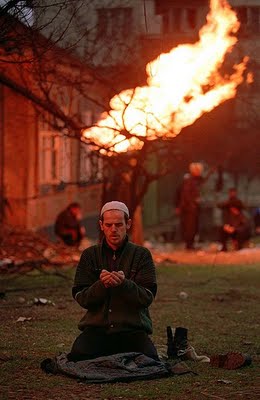
It was Ibn Siqilli‘s post, Portraits of Resistance & Jihad in Chechnya & the Islamic Emirate of the Caucasus with its three flags at the head of the post that set me off on this pilgrimage — and I’d also like to pay tribute to the sincerity of belief which gives rise to such a photo as this one, also taken from that post:

We’re back at prayer again…

**

On the topic of lone wolves — as I hope the quote above illustrates, word choices can have unintended impacts! Of note, Brian Michael Jenkins in Stray Dogs and Virtual Armies: Radicalization and Recruitment to Jihadist Terrorism in the United States Since 9/11 makes a distinction between stray dogs and lone wolves:

Analysts have tended to call such individuals “lone wolves,” in my view, a romanticizing term that suggests a cunning and deadly predator. A few of those recorded here display this kind of lethal determination, but others, while still dangerous, skulk about, sniffing at violence, vocally aggressive but skittish without backup. “Stray dogs,” not lone wolves, more accurately describes their behavior.

JM Berger talks about lone wolves in The Utility of Lone Wolves, or lack thereof:

If there were any doubts that lone wolves can be deadly, they were dispelled by Anders Breivik, the Norwegian anti-Muslim crusader who in July killed 69 young people in a coordinated attack using guns and a car bomb.

and again in The Boy Who Cried Lone Wolf:

Does it matter that some (but not all) of the terrorist network members described above were actually undercover law enforcement agents or informants? It doesn’t change the fact that none of these individuals was working alone. They were receiving advice, concrete assistance, and passive reinforcement from people they believed — rightly or wrongly — to be part of larger terrorist organizations.

None of this means that these guys aren’t dangerous, and none of this is to argue that they shouldn’t have been arrested. But they are not lone wolves. They are essentially al Qaeda volunteers …

But I’ll let Tim Furnish have the last word on nomenclature. In a comment here on Zenpundit he told us he’d originally entitled his HNN blog post “The Brothers Tsarnaev: Hyenas in the Service of the Mahdi” — and in the post itself he writes:

But viewing them from outside, analytically, as lone wolves may give them too much credit; while classifying them as stray dogs neutered of religious ideology gives the Islamic element too little. Perhaps a new paradigm, one of roaming hyenas, best describes the Tsarnaevs — characterized by anomie (fitting into neither domestic nor foreign contexts), the ability to feign surrender when necessary, and a propensity for attacking only the defenseless.

**

And oh, by way of cosmic irrelevance, my googling brought me here:

It’s a web-wild-world we live in!

Tamerlan Tsarnaev end times videos I: the Mahdist video, pt 3

Monday, April 22nd, 2013

[ by Charles Cameron — closing out my account of the Mahdist video — with much from Tim Furnish, and pointers to Wajahat Ali and JM Berger ]
.

Blog-friend Dr Timothy Furnish covers most of what I’d wanted to say about the final section of the Mahdist video I’ve been on about lately [1, 2, 3] — its last section is largely devoted to footage of jihadists-in-training — so I’ll save myself time and effort and simply drop in five (of Tim’s thirteen) paragraphs that deal with the video below… But first..

Here’s the woman taken in adultery clip from Mel Gibson‘s Passion, which the Mahdist video adapts to its own dramatic purposes:

**

As I indicated above, Tim Furnish has a long and detailed post up at History News Network — here are those five paragraphs:

The video that Tamerlan Tsarnaev had linked on his social media sites has been described (by “Mother Jones,” among others) as an “Al Qaeda prophecy” — but that observation, while perhaps necessary, is woefully insufficient. The idea of forces bearing “black banners” coming from the eastern part of the Islamic world into the Middle East proper (and further West) to conquer fi sabil Allah, “in the path of Allah,” is almost as old as Islam itself — enshrined in a number of hadiths, “sayings” attributed to Islam’s founder Muhammad. There are literally thousands of hadiths, in both Sunni and Shi`i collections, second in Islamic doctrinal authority only to the Qur’an itself, dealing with topics ranging from the mundane (how to bathe like Muhammad) to the bizarre (drinking camel urine is recommended). Much of Islamic eschatology — theorizing about the end of the world — derives from these alleged sayings of Muhammad; in particular those dealing with al-Mahdi, “the rightly-guided one” sent by Allah to make the entire world Muslim (with help from the returned prophet `Isa, or Jesus) before the end of time by militarily establishing a global caliphate. (I examine these subjects in my book Holiest Wars, pp. 11ff, as well as, with even more detail, in my doctoral dissertation “Eschatology as Politics, Eschatology as Theory: Modern Sunni Arabi Mahdism in Historical Perspective,” Ohio State University, 2001, pp. 68ff.)

The video which Tamerlan Tsarnaev favored specifically draws upon this tradition — which, again, is not particular to al-Qaeda [AQ] but, rather, is part of the entire Sunni world’s patrimony. (The Twelver Shi`is, while believing even more fervently in the Mahdi, have different hadiths and beliefs about him — most notably, that he has already been here as the 12th Imam descended from Muhammad, disappeared but never died in the 9th c. AD, and will return, perhaps soon).

This video — almost the entirety of which is backgrounded with a soundtrack of Arabic Muslim chanting — is entitled “The Emergence of Prophecy: Black Flags from Khorasan” and opens, unsurprisingly, with the flag (or banner) in question: a jet-black one emblazoned in white with the shahada, the Islamic “profession of faith” which says “there is no god but Allah and Muhammad is his messenger.” This is followed by slow-motion clips of marching jihadists with AK-47s as the voice over by Imran Hosein Nasr — a prominent cleric who opines often on Islamic eschatology and Mahdism — warns that “they demonize as a terrorist anyone who supports Allah.” A disclaimer then appears, cautioning that “the Muslims pictured herein may not be the people of prophecy” but rather images (or, presumably, types) thereof as well as that some of the sourced hadiths are authentic, but some are weak. (Hadiths are classified, by Muslim scholars, as: sahih, “verified;” hasan, “sound” but not certain; and da`if, “weak,” and quite possibly fabricated.) A hadith from Abu Huraira that “great wars will occur” is illustrated with shots of what appear to be U.S. airstrikes on Iraq. Ibn Majah’s hadith that “Allah will raise a non-Arab army with better weapons who are better riders” is then adduced, followed by a gloss that these will conquer “Constantinople.” Since a great non-Arab Muslim army already conquered that city in 1453 — the Ottoman Turks — one is hard pressed to see how this “prophecy” is still to be fulfilled. Then a hadith from Muslim b. al-Hajjaj is cited: “some will come from the east who will make the caliphate … easy for Imam Mahdi,” as well as one from Ibn Hanbal advising that “if you see black banners from Khurasan, go to them because the Mahdi will be among them.” This is followed by several minutes explicating, with maps, Khurasan as an area encompassing eastern Iran, western and northern Afghanistan, as well as portions of Turkmenistan, Uzbekistan, Tajikistan and, most notably for the Tsarnaevs, Kyrgyzstan (but not, at least, Secretary of State Kerry’s “Kyrzakhstan”).

There is also a fascinating exegesis of another hadith from al-Hajjaj that “the last hour will not come until 70,000 from Bani Ishaq will attack and conquer Constantinople,” after which al-Dajjal — the Islamic “Deceiver,” or leader of evil, who will be killed by Jesus — will emerge: these “sons of Isaac” are said to be Jews who had relocated to Khurasan at some point, and proof for this is provided via the “Jewish scholar” Simcha Jacobovici, former host of the TV show “The Naked Archaeologist.” (Why an Islamic eschatological film would attempt to include Jews — usually depicted in such venues as, at best, nefarious — in the Mahdi’s army is curious. Perhaps the intent is more to stress Islam’s link to the Hebrew Scriptures, and thus attract Christians? Or could it be a way of ameliorating Islamic anti-Jewish tendencies?)

In perhaps the same vein, al-Hajjaj is cited to the effect that Jesus will join the Mahdi’s ranks. This is illustrated with a (pirated?) clip from the movie “The Passion of the Christ” — namely, the scene where Jesus saves the woman caught in adultery, a rather counterintuitive choice. Following Jesus (or at least his sandal, which is all we see), clips resume of marching jihadists brandishing weapons and carrying the black flag. Then a hadith from al-Tirmidhi is proffered, to the effect that these black banners will, eventually, reach Jerusalem; curiously, however, the Dome of the Rock rather than al-Aqsa mosque is shown. This is immediately followed by the hoary video, from shortly after 9/11, of AQ jihadists running an obstacle course in their Converse, embellished with more Imran Hosein Nasr voice-over, asserting that “no one can stop that jihad. When you see that army coming from Khurasan, [like] the Prophet said, go and join that army — even if you have to crawl over ice.” Then a smorgasboard of jihadist eschatological imagery follows: Taliban or Uzbek tribesmen on horses; black banners; jihadists praying with weapons shouldered. As the video winds down, an unidentified, black-clad, bearded Muslim — likely intended as a Mahdist figure — intones “the flags from Khurasan are on their way. Allah will honor his religion and demean the disbelievers. History is repeating itself, as with Muhammad conquering [pagan] Mecca. The polytheists hate it.” (Polytheists, in this Islamic worldview, include Christians — for the Trinity is mischaracterized as three deities.) The very final screen shot informs the viewer that the “real undercover enemies” are the Illuminati, the Freemasons and the New World Order.

**

Furnish titles his HNN post — which I recommend you read in full — The Ideology Behind the Boston Marathon Bombing. It’s not entirely clear to my eye whether that ideology (for Dr. Furnish) is Islam as a historical phenomenon, contemporary political Islamism of the jihadist kind, or its specifically Mahdist expression — I believe he sees all three as intricately inter-related.

That’s an extremely nuanced issue, and not one that can be fully addressed by either one of us in a single blog-post, as I think Dr Furnish would agree. By way of showing that Islam by no means begins and ends with the Tsarnaev brothers, I’d suggest you also read playwright Wajahat Ali‘s I am not the Tsarnaevs. The reality is that Islam is as varied as the people, places and times in which it is practiced.

Christians too, in times past, had their Crusaders — and their St Francis.

**

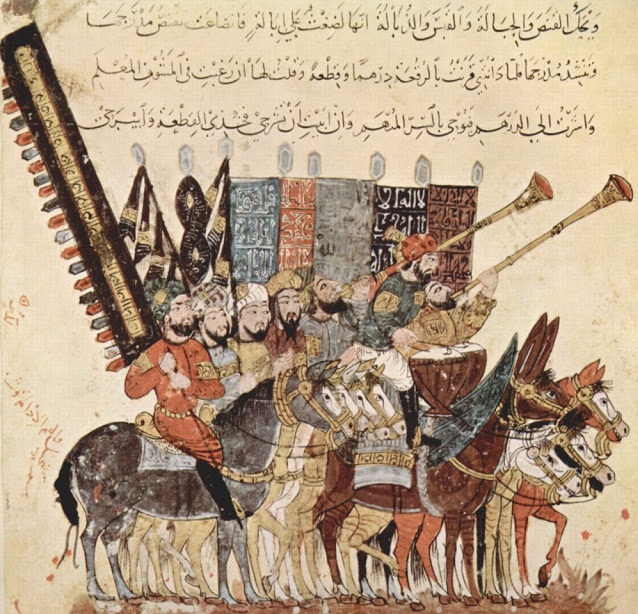
Tim Furnish also has a brief post on his MahdiWatch blog, pointing to his HNN piece — and I could only wish HNN permitted him to post illustrations, since the image of Abbasid “black banners” he posts at MahdiWatch is definitely of interest…

A stunning find!!

**

One other article appeared recently that I’d like to draw your attention to.

JM Berger, another friend of this blog, has an important extended piece on Chechnya-related radicalism in Boston over several decades, now up at Foreign Policy: Boston’s Jihadist Past.

Again, highly recommended.


Switch to our mobile site