zenpundit.com » movies

Archive for the ‘movies’ Category

Lost and found in translation

Saturday, December 15th, 2012

[ by Charles Cameron — first of two quick posts, this one’s about when the same is the same and when it isn’t quite ]
.

Dahlia Iyad, a member of Black September in the Thomas Harris novel, Black Sunday, is portrayed (above) in John Frankenheimer‘s 1977 movie of the same name by Marthe Keller. At this point, very early in the movie, Iyad is recording her speech to the Americans, which will accompany the act of terrorism she is master-minding:

The American people have remained deaf to all the cries of the Palestinian nation. People of America, this situation is unbearable for us. From now on, you will share our suffering. The choice is yours. Salaam aleikum.

Did you get that? The soundtrack says salaam aleikum, the subtitles read shalom aleichem.

Either way, in Latin it would be pax vobiscum.

**

Peace be upon you.

My question, of course, has to do with the juxtaposition of the two words in two Semitic languages, sharing the same consonantal roots. Are they the same, or do they mean very different things?

Obviously they’re the same phrase, obviously the subtitle is mistaken in putting a Hebrew salutation on aa Arab terrorist’s lips.

But here’s the thing: strung between these two so similar phrases — or between Beit Ha’Mikdosh and Bayt al-Muqaddas — is the entire spectrum of ways in which translation can and cannot carry meaning over from one context into another. And we can locate it, right in the first words a child might learn, the greeting of one to another…

As the Italians say, traduttore, traditore — translator, traitor.

**

But that’s enough foreign for one day — I don’t speak it very well.

I do have to admit I jumped when I saw that subtitle, though. No big deal — and all the difference in the world.

The Deep Shadow of Abraham Lincoln

Monday, November 26th, 2012

Just saw the Steven Spielberg epic Lincoln.  

The performance of Daniel Day-Lewis as Abraham Lincoln was titanic; all the anger and villainous darkness he channeled into his earlier memorable characters Bill “the Butcher” and Daniel Plainview are eclipsed in his Lincoln by wisdom and a transcendent, melancholic grace. The supporting cast was equally strong, with Sally Fields alluding in word and deed to the shrewish madness that troubled First Lady Mary Todd Lincoln; Tommy Lee Jones humanized – probably more than is historical – the implacable political ferocity of Radical Republican leader Representative Thaddeus Stevens; and James Spader added lighthearted realism as Secretary of State Seward’s cagey political fixer and bagman, William N. Bilboe.

Spielberg has done a magnificent storytelling of the passage of the 13th Amendment to abolish slavery in the United States and he has done even better at capturing Lincoln’s towering stature as a statesman. Day-Lewis’ Lincoln is Periclean – in possession of heroic, historical vision and mastery of grand strategy along with an intimate grasp of the granular, grubby mechanics of political deal making and a humane tolerance of other’s frailties needed to make things happen.  The scene where Day-Lewis explains to his squabbling Cabinet Lincoln’s coup d’oeil –  the real Constitutional, moral, military and political exigencies of emancipation governing the imperative questions of the 13th Amendment –  is one of the most brilliant expositions of strategy in the fusion of policy, politics and war that I have ever seen on screen.

In a sense, that was the genius of Abraham Lincoln – surpassing his own humble origins to solve herculean problems without ever losing sight that lasting resolution of Civil War and slavery were going to have to occur on Earth with fallible human beings, operating in a political reality that would never be ideal. The limits of vision of Lincoln’s contemporaries, copperhead and abolitionist, is marked but the comparison between Abraham Lincoln and politicians of our own day is yet for the worse.  Our problems are so much smaller, our resources and capabilities infinitely vaster than the severe test the Republic faced in Lincoln’s time, yet our leaders are grossly inadequate even to these.

Martyrdom naturally magnified the legacy of Abraham Lincoln, but even without the assassination he would have still been reckoned our greatest president, one of the rare individuals whose leadership made an irreplaceable mark upon history. If one of Lincoln’s rivals for the Republican nomination had become president in 1860 instead, or had Lincoln not been re-elected in 1864, the Union cause would have failed.  We would not be who we are nor the world what it is without a United States in the 20th century to stem the tide of  first German domination, then Fascism and then Soviet Communism. The world would be a poorer, darker place and we would be lesser peoples of lesser nations of the former United States.

Lincoln’s shadow is not merely long, it is deep.

Seal Team Six: asymmetries and symmetries

Thursday, November 22nd, 2012

[ by Charles Cameron — we just might want to understand the Quranic ROE — or at least its OBL and SK Malik versions ]
.

.

I was watching Seal Team Six: The Raid on Osama Bin Laden, the TV movie aka Code Name: Geronimo last night [okay, okay], and one phrase early on caught my attention and sent me, first to the OBL Letters from Abbottabad and Nelly Lahoud‘s commentary, and then to the always useful Brig. SK Malik‘s Quranic Concept of Power.

**

Here then, from Prof: (Brig: Retd.) S.K. Malik’s The Quranic Concept of Power, published in an edition of 500 by Progressive Publishers, Lahore, in 1991, pp. 303-04, is a brief outline of the Rules of Engagement for jihad as presented in the Quran and Sunna, and understood by the late Pakistani Brigadier and professor in the Defence & Strategic Studies department of Quaid-i-Azam University, Islamabad:

The Holy Quran also directs us to observe its ethics during the application of the military instrument. The divine ethics are gracious, liberal and generous. With regards to fighting in the Prohibited Months and in the Sacred Area, our Lord has prescribed for us a law based on quality and reciprocity, We are forbidden from fighting in this period and place for as long as the enemy also observes these limits. If the enemy transgresses these limits, we are permitted to transgress the limits to the extent he does. Even I such situations, our Mighty Lord has commanded us to prefer patience and restraint. Under no circumstances, however, can we transgress the clear and well-defined limits set forth for us by our Lord.

According to the studies carried out by the Muslim jurists on the subject, we are prohibited from cruel and torturous ways of killing the enemy during war. The killing of women, minor, servants and slaves is also forbidden. We are also to spare the blind, the monks, the hermits, the old, the physically-deformed and the insane or mentally-deficient. For bidden for us also is the decapacitation of the prisoners; the mutilation of the men and the beasts; devastation and destruction of harvests; excesses and wickedness; and adultery or fornification with captive women. We are also forbidden to kill hostages and taking to massacre to vanquish the enemy. Muslim soldiers are not permitted to kill their parents in the enemy forces except in absolute self-defence. Prohibited similarly is the killing of peasants, traders, merchants, contractors and the like who accompany the enemy forces to the battle field but do not take part in actual fighting.

The checks and controls imposed by the Holy Quran on the use of force have no parallel in the annals of human history In practice, there were very few occasions on which the Faithful transgressed these limits and they were duly reprimanded for it. It must, however, be understood that the exercise of restraint in the use of force in inter-state relations is essentially a two-way affair. It is not possible that one side goes on exercising restraint while the other goes on committing excesses. Nor doe the Holy Quran approve of such a restraint. In such situations, the very injunction of preserving peace demands the use of limited force. The Holy Quran commands us to use force for just such a purpose.

**

I am sure Brig. Malik’s work [most accessible: his Qur’anic Concept of War] is only the tip of the iceberg here, and I’d certainly advise reading western analysts (eg Cook, Firestone, and Bonner) on the topic, too — but it would surely be helpful to know what ROE jihadists are in fact supposedly following.

The Battle of Algiers / Black Friday koan

Saturday, November 17th, 2012

[ by Charles Cameron — a tale of two films, two conflicts, two cities ]
.
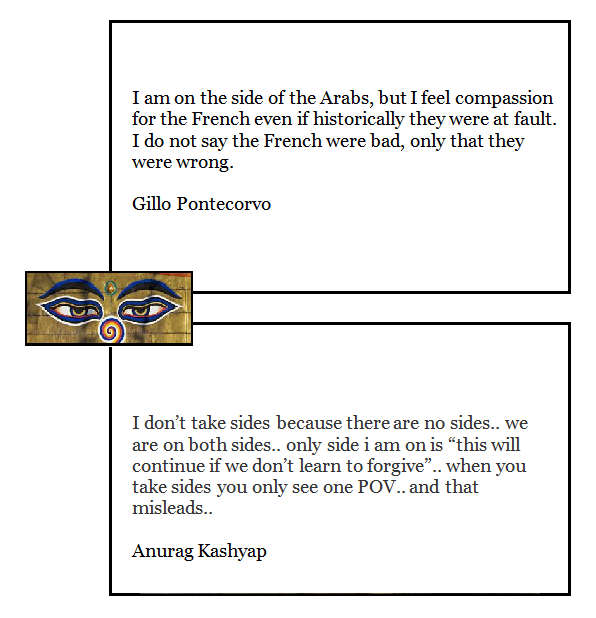
Are these two positions — take one side, take both sides — reconcilable?

That’s the koan, the paradox that’s facing me, after seeing two terrific films by these two directors again, this time back-to-back. The two films their respective directors are discussing are Gillo Pontecorvo‘s Battle of Algiers and Anurag Kashyap‘s Black Friday.

Elie Weisel triggered this set of reflections for me when I saw his stark statement of the “one side” position:

We must always take sides. Neutrality helps the oppressor, never the victim. Silence encourages the tormentor, never the tormented.

Let’s turn to the films.

**

Pontecorvo’s Battle for Algiers is a rightly-celebrated classic, and it’s opening shot confirms the director’s claim to show compassion for both sides:
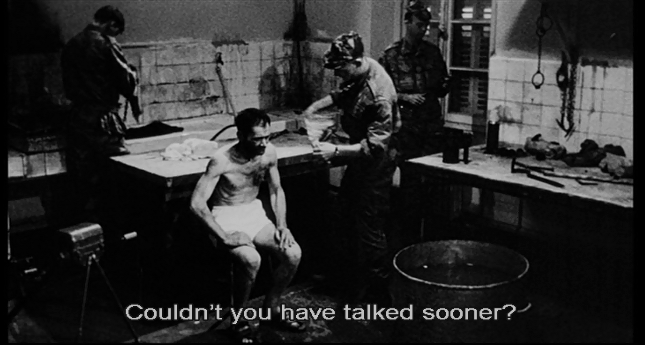
That’s an unexpected question from torturer to the victim he has just “broken”, and speaks volumes about the director’s intent — as does this quote from the french paratroop commander, Col. Mathieu, speaking of Larbi Ben M’Hidi, a leader of the National Liberation Front (FLN) whom he has captured and questioned — and who in “RL” was in fact murdered, though his death was reported at the time as a suicide:

Pour ma part, je peux seulement vous dire que j’ai eu la possibilité d’apprécier la force morale, le courage et la fidélité de Ben M’Hidi en ses propres idéaux. Pour cela, sans oublier l’immense danger qu’il représentait, je me sens le devoir de rendre hommage à sa mémoire.

For my own part, I can only tell you that I had the opportunity to appreciate Ben M’Hidi’s moral strength, his courage and his loyalty to his own ideas. On that account, and without overlooking the immense danger he represented, I feel obliged to salute his memory.

That reads to me as the respect of courage for courage.

The Pentagon, FWIW, held a screening of Battle for Algiers in September 2003, issuing a flyer indicating their reason to be interested in the film:

How to win a battle against terrorism and lose the war of ideas. Children shoot soldiers at point-blank range. Women plant bombs in cafes. Soon the entire Arab population builds to a mad fervor. Sound familiar? The French have a plan. It succeeds tactically, but fails strategically. To understand why, come to a rare showing of this film.

Yes indeed, it does sound a tad familiar.

**

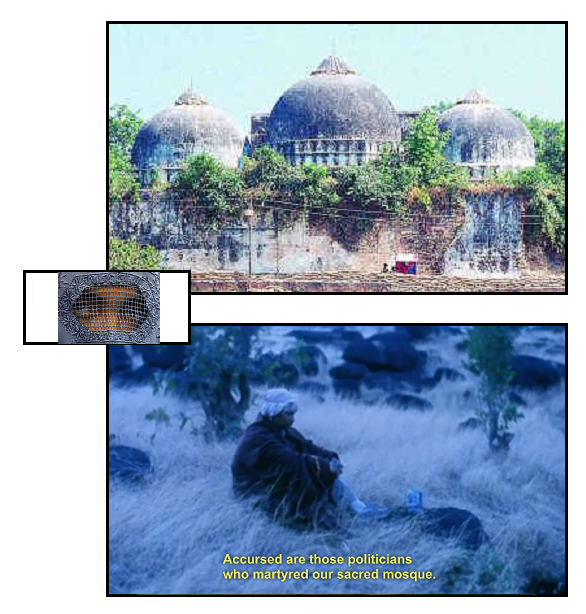
I’ll represent Kashyap’s Black Friday visually with a pair of images, the top one showing the Babri Mosque in Ayodhya / Oudh, which was leveled in December 1992 by an angry Hindu mob who claimed it had been built on the birthplace of Lord Rama, the avatar of Vishnu whose story is told in the Mahabharata

while the lower one represents Muslim rage at that event, making use of voice-over and that remarkable phrase, “martyred our sacred mosque”, to good effect.

Kashyap, then, can understand the feelings behind the horrific series of terrorist bombings that shook Bombay — as well as those of the bombed and terrorized population of that city. As Oorvazi Irani explains in her commentary on the film, Kashyap’s own views are expressed in the voice of DCP Rakesh Maria in the “chapter” on the interrogation of Badshah Khan:

Badshah Khan very proudly takes credit for the bombings and says Muslims have taken the revenge for the atrocities done to their Muslim brothers. That’s when Kay Kay Menon who plays the cop says and speaks in the voice of the director “…Allah was not on your side, on your side was Tiger Memon. He saw your rage and manipulated you. He was gone before the first bomb was even planted. ..he fucked you over. you know why? Because you were begging for it. All in the name of religion. You are a fucking idiot. You are an idiot and so is every Hindu, who murders one of you. Everyone who has nothing better to do … but to fight in the name of religion is a fucking idiot.”

**

Can there be a right side and a wrong side in a game? There can certainly be a winning side and a losing side — but a right side and a wrong side?

I ask, because the connection between wars and games is an ancient one. Can there be a right side and a wrong side in war? Looking at World War II, which was almost certainly the war that Elie Weisel was thinking of, the answer is pretty obviously yes. But what about the reasons given for “our side” being the right side?

Is our cause just because God is on our side? Because might makes right, and the big battalions are on our side? Or simply because it is our side — my country, right or wrong?

And then there is civil war to consider — for all wars are civil wars, when seen within the context of that greater “nationality”, the human race.

Abraham Lincoln, from his Second Inaugural:

Both parties deprecated war, but one of them would make war rather than let the nation survive, and the other would accept war rather than let it perish, and the war came. … Neither party expected for the war the magnitude or the duration which it has already attained. Neither anticipated that the cause of the conflict might cease with or even before the conflict itself should cease. Each looked for an easier triumph, and a result less fundamental and astounding. Both read the same Bible and pray to the same God, and each invokes His aid against the other. … The prayers of both could not be answered. That of neither has been answered fully. The Almighty has His own purposes…

The whole issue of the just war — or of jihad, its Islamic approximate equivalent — revolves around the question of whether there can be a wrong side in war.

**

If there can be a wrong side, it may be shredded. As Mark Twain once prayed:

O Lord our Father, our young patriots, idols of our hearts, go forth to battle — be Thou near them! With them — in spirit — we also go forth from the sweet peace of our beloved firesides to smite the foe. O Lord our God, help us to tear their soldiers to bloody shreds with our shells; help us to cover their smiling fields with the pale forms of their patriot dead; help us to drown the thunder of the guns with the shrieks of their wounded, writhing in pain; help us to lay waste their humble homes with a hurricane of fire; help us to wring the hearts of their unoffending widows with unavailing grief; help us to turn them out roofless with little children to wander unfriended the wastes of their desolated land in rags and hunger and thirst, sports of the sun flames of summer and the icy winds of winter, broken in spirit, worn with travail, imploring Thee for the refuge of the grave and denied it — for our sakes who adore Thee, Lord, blast their hopes, blight their lives, protract their bitter pilgrimage, make heavy their steps, water their way with their tears, stain the white snow with the blood of their wounded feet! We ask it, in the spirit of love, of Him Who is the Source of Love, and Who is the ever-faithful refuge and friend of all that are sore beset and seek His aid with humble and contrite hearts. Amen.

**

There are things to be said for being on the winning side of a conflict: you get to write history. There may be things to be said for being on the losing side: you gain the sympathy that accrues to the underdog. There are things to be said for supporting neither side, for being on the sidelines to pick up the pieces.

Then again, as Buddha observed in the Dhammapada, there are disadvantages to being on either side —

Victory breeds hatred. The defeated live in pain. Happily the peaceful live giving up victory and defeat.

while Christ muddies the simplicity of the whole business with a further contrarian note:

love your enemies.

Peace is not a bad side to be on, but perhaps love is more nuanced.

**

To bring us full circle, here’s another statement of the Elie Weisel position, this time in the words of Dietrich Bonhoeffer, the Lutheran pastor and theologian involved in the plot to assassinate Hitler and executed in one of the concentration camps — together with a response to the question I’ve been posing for myself here which may perhaps providinge some measure of reconciliation, this one from a contemporary Zen Buddhist, someone for whom the appreciation of koans is a way of life:
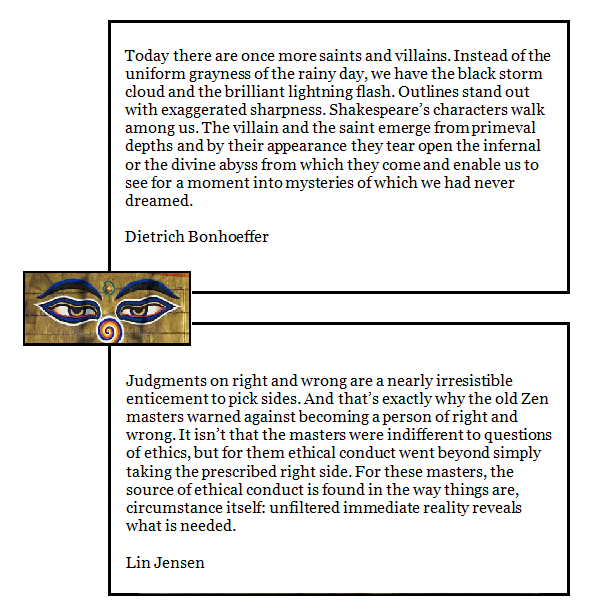
Wei Wu Wei, or the inactionable option

Tuesday, November 13th, 2012

[ by Charles Cameron — the excellence of today’s piece by Joshua Foust and the importance of intelligence that is not actionable, with illustrations from Zenpundit, Dickens and Shakespeare ]
.

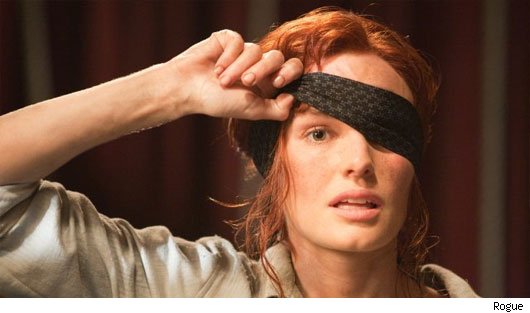
Kate Bosworth peers out from under a blindfold in the 2010 movie, Warrior's Way

**

Josh Foust just posted an important piece in his Atlantic column and on his American Security Project blog titled Myopia: How Counter-Terrorism Has Blinded Our Intelligence Community, with the subtitle:

The United States’ overriding interest in “actionable” information on terrorists has produced a dangerous form of tunnel vision.

Bingo.

This is important, and I’ll circle back to it. But first, please follow the full arc of the circle…

**

I post little headers at the top of all my Zenpundit posts these days, to let people know where on the irrelevance scale my latest offering should be placed — I guess the idea came from the 19th century practice of offering “synoptic chapter headings” to titillate the reader of novels, as when Mr Dickens titles one chapter of The Pickwick Papers:

Chapter XVIII. Briefly illustrative of two points; first, the power of hysterics, and, secondly, the force of circumstances

I digress.

Some while back, I posted a piece called The Haqqani come to high Dunsinane here on Zenpundit, and gave it the header:

why is non-actionable (useless) intelligence sometimes the most intelligent (useful)? – importance of multiple frames for complex vision

The piece was about the Haqqani network, but obliquely so — I was leaping from an image in a video where a cluster of Haqqani-guys in training were running around dressed as trees, to a similar image in Shakespeare‘s Macbeth:

Macbeth shall never vanquish’d be until
Great Birnam wood to high Dunsinane hill
Shall come against him.

Well, that was the prophecy, and Macbeth took it to mean he’d never be defeated in battle:

That will never be.
Who can impress the forest, bid the tree
Unfix his earthbound root? Sweet bodements! Good!

Prophecies and portents are notorious for their double meanings, however, and this one’s fulfillment comes when Malcolm gives the order to his men:

Let every soldier hew him down a bough
And bear’t before him. Thereby shall we shadow
The numbers of our host and make discovery
Err in report of us.

Heh — “discovery” here means what today we’d call “intelligence” — and notice the importance here of reading multiple meanings out of a single sign.

A while later, a messenger arrives, and declaims:

As I did stand my watch upon the hill,
I look’d toward Birnam, and anon, methought,
The wood began to move.

This turns out to be true enough, for in the next scene Malcolm, now before Dunsinane, gives the order:

Now near enough: your leafy screens throw down.
And show like those you are.

and:

Make all our trumpets speak; give them all breath,
Those clamorous harbingers of blood and death.

And so it goes.

**

Let me emphasize, this is not, definitively not, actionable intelligence that I am in any way attempting to offer as such to anyone engaging in close-quarters combat with the Haqqanis.

Our arc is almost complete at this point, so let’s take a closer look at Josh Foust’s piece:

Large areas of the IC have move away from their traditional role of analyzing a broad range of current events for policymakers and toward supporting the global counterterrorism mission. News stories about this shift suggest the counterterrorism mission has become the overarching concern of the national security staff.

This shift in focus can create blind spots that pose unique challenges for the president. If branch chiefs and the policymakers they support value “exploitable” information over deep understanding, they might be ignoring potentially vital information that doesn’t seem immediately of interest.

Imagine an analyst finding reports of a growing discontent in a Middle Eastern country’s politics; if that does not provide immediate benefit for a decision-making process for targeting suspected terrorists, it can easily be ignored in the avalanche of targeting information.

Blind spots, eh?

Those would be “the dots” in the “larger picture” that you can’t “connect” until it’s too late. And where are they found? In “information that doesn’t seem immediately of interest” — intelligence that’s not “actionable” in other words.

Or to put that another way, what Josh calls “tunnel vision” comes from staring at what’s “actionable” — whereas vision that’s “out of the tunnel” comes from noticing what’s in peripheral vision.

**

Wei wu wei? It’s a Taoist motto: literally, it means “action without action” though it can also be translated “effortless action”.

I know, I know, this is a useless post. But you know what Hui Tzu said to Chuang Tzu?

I have a big tree of the kind men call shu. Its trunk is too gnarled and bumpy to apply a measuring line to, its branches too bent and twisty to match up to a compass or square. You could stand it by the road and no carpenter would look at it twice. Your words, too, are big and useless, and so everyone alike spurns them!

And you know what Chuang Tzu said in response?


Switch to our mobile site