zenpundit.com » movies

Archive for the ‘movies’ Category

Of railroad tracks and coming to a conclusion

Monday, April 2nd, 2012

[ by Charles Cameron — playing off the new George Smiley movie ]
.

Yes!

This is George Smiley‘s mind, just that moment before he understands who the mole in the Circus must be, at the 1.36.27 point in Tomas Alfredson‘s Tinker Tailor Soldier Spy.

A moment before that, the light was green:

Moments later, the points slam into their new configuration, Smiley’s train of thought is shunted along a new track, and all is understood.

*

It’s a beautiful, subtle illustration of the idea that the mind “knows” that it has decided, some moments before a conscious intent registers – in line with the general idea suggested, not as proven but as fascinating speculation, in Nature last August:

The conscious decision to push the button was made about a second before the actual act, but the team discovered that a pattern of brain activity seemed to predict that decision by as many as seven seconds.

And it makes graphical use of the same changing points idiom I used myself in my post Of railroad tracks and polyphonic thinking here on ZP, not so very long ago.

More “night watch” than “guardian angels” perhaps?

Thursday, March 29th, 2012

[ by Charles Cameronguardian angels, really? — or a surface use of in-depth terminology? ]
.

.
Just two days ago I posted Quantity and Quality: angelic hosts at Badr and / or Armageddon, and noted in a comment that “the Counterinsurgency Manual, FM 3-24 makes no mention of angels” — whereas “Brigadier Malik’s Qur’anic Concept of War does.

1.

Has someone in ISAF been reading ZP? Two days later, we have this AP report:

U.S. military commanders in Afghanistan have assigned “guardian angels” — troops that watch over their comrades even as they sleep — and have ordered a series of other increased security measures to protect troops against possible attacks by rogue Afghans.

A bit further down, we read:

According to the senior military official, the so-called guardian angels provide an extra layer of security, watching over the troops as they sleep, exercise or go about other daily activities.

Allen noted that the Afghans also have taken some similar steps to provide guards for their own forces.

2.

Just for the record, that’s not quite what I had in mind.

Specifically — and only half-joking — it’s an instance of what Sri Krishna Prem termed “the degradation of spiritual concepts” in his Yoga of the Bhagavat Gita (original Penguin edition, p. xxv. if my notes are to be believed):

There is a law, which may be termed the law of the degradation of spiritual concepts, by which terms originally used by Seers to express levels of supernormal spiritual experience become in the hands of later and purely scholastic exponents terms for elements in purely normal mental life.

Or as TS Eliot puts it in Burnt Norton: V (in Four Quartets):

Words strain,
Crack and sometimes break, under the burden,
Under the tension, slip, slide, perish,
Decay with imprecision, will not stay in place,
Will not stay still.

3.

Where does the idea of a guardian angel come from — and what did it mean before it meant some poor sod who’s on night watch?

4.

Anyway.

Best night watch ever? Rembrandt‘s, in the Rijksmuseum in Amsterdam:

The brilliant Peter Greenaway has made two quirky films [link to Amazon boxed set] about the painting. Wikipedia describes them well enough that I’ll simply use their phrasing:

The Night Watch is the subject of a 2007 film by director Peter Greenaway called Nightwatching, in which the film posits a conspiracy within the musketeer regiment of Frans Banning Cocq and Willem van Ruytenburch, and suggests that Rembrandt may have immortalized a conspiracy theory using subtle allegory in his group portrait of the regiment, subverting what was to have been a highly prestigious commission for both painter and subject. His 2008 film Rembrandt’s J’Accuse is a sequel or follow-on, and covers the same idea, using extremely detailed analysis of the compositional elements in the painting…

I was certainly richly educated and entertained by both films — and am a great admirer of his The Draughtsman’s Contract — but not quite convinced.

________________________________________________________________________________________

h/t @peterjmunson.

Iconic: compare and contrast III

Saturday, December 24th, 2011

[ by Charles Cameron – Iraq war, beginning and ending, analytic power of similarity ]

.

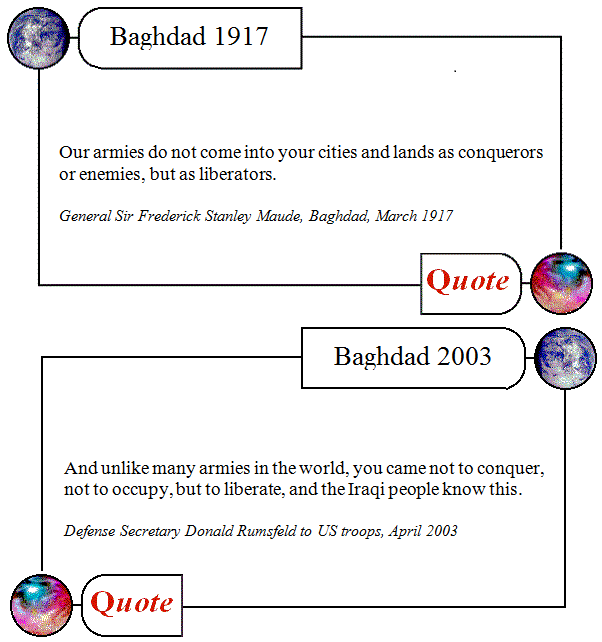
I’ve thanked Zen for his Iconic Compare and Contrast post already, but I’d like to run with his juxtaposition of images from the end of the Iraq war, and book-end it with an early DoubleQuote of mine from the beginning, thus:

That’s the beginning of the war, as I saw it “binocularly” — and here’s its ending, as Zen captured it:

Different though they are — one verbal, one visual — I think they go well together. I think they belong together.

But that’s essentially an aesthetic intuition.

*

And — apart from thanking Zen — that’s the thing I want to talk about.

The two quotes, eighty-six years apart, about an (anglophone) army in Baghdad coming there to liberate, not to conquer, are similar enough that they should give us pause for thought. They challenge us to think long and hard about the similarities between the two situations — and they challenge us to think no less hard and long about their differences.

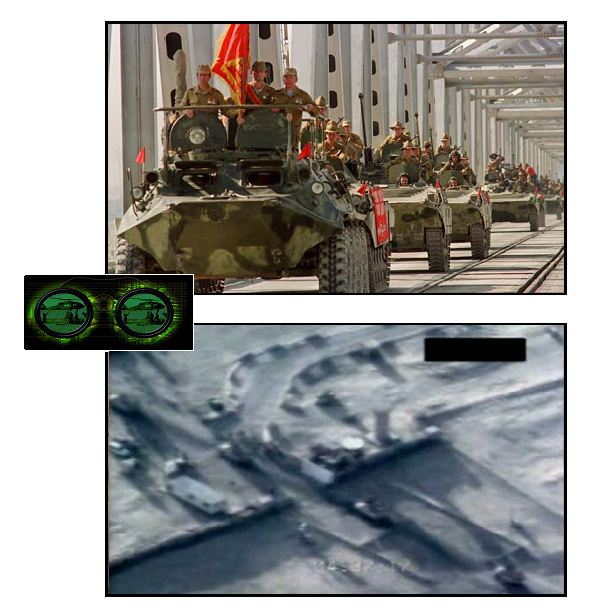
Likewise, it’s the similarities between the two images Zen chose — of the Soviet withdrawal from Afghanistan and the US exit from Iraq — that give that juxtaposition its power.  And Zen has chosen very carefully:

Not only are there two lines of vehicles stretching back from the foreground away into the distance in each image, but the angle from which the two columns are seen is about the same — and there are even two “tracks” in each photo reinforcing the vanishing point — two tracks to the right of the vehicles in the Afghan photo, the edge of the road and a what looks like the shadow of an overhead cable in the photo from Iraq.

*

But let’s take this a bit further. The following juxtaposition is every bit as much a juxtaposition of the Soviet and American withdrawals as the pair of images Zen picked, but this time we have an aerial view of the US convoy — so the visual “rhyme” between the two images is no longer there — and even though the aerial shot is an intriguing one, what a difference that makes!

There’s nothing in that juxtaposition to make you go, yes!

On the level of what’s being referred to, the troop withdrawals from Afghanistan and Iraq,  this pair of images has the same properties as the two images that Zen selected.  But it doesn’t capture our attention in nearly the same way.

And the same would have been true if I’d picked a different sentence from Rumsfeld‘s speech to juxtapose with General Maude‘s “not as conquerors or enemies but as liberators” — such as, “You’ve unleashed events that will unquestionably shape the course of this country, the fate of the people, and very likely affect the future of this entire region.” I’d still be comparing and contrasting two speeches from the beginnings of two occupations of Baghdad.  But there’d be no oomph to the comparison.

*

Because — and this is what I am trying to get at, the basic principle of HipBone analysis and what distinguishes it from otherwise similar modes of brainstorming and mind-mapping — the recognition of pattern, of salient sameness, of close parallelism or opposition is the criterion for success or failure in a HipBone-style juxtaposition.

Zen’s graphic example has that closeness — even down to those two parallel tracks beside and to the right of the vehicles.  My two quotes from Maude and Rumsfeld have that.  And it’s that closeness of match that makes a juxtaposition powerful.

Analogy works this way, rhyme works this way, fugue works this way, graphic match (in cinematography) works this way — it’s basic to the arts, basic to rhetoric, and basic to the way our analogically-disposed minds think.

It is not a method for arriving at conclusions, it’s a method for posing questions. And it sits right at the juncture where analysis admits it is not a science but an art.

The Said Symphony: move 12

Thursday, July 21st, 2011

[ by Charles Cameron – extended analytic game on Israeli-Palestinian conflict — continuing ]

.

I am titling my next move “Moral Equivalence?” with the question mark as the crux of the title, and I am posting it separately since it (a) raises a central question with regards to the entire project and (b) plunges us directly into the twin narratives of Palestinian and Israeli… in parallel, in counterpoint… perhaps in…

Move 12: Moral Equivalence?

move-12.gif

Move Content:

In President Obama‘s address at Cairo University on June 4, 2009, the President presents the two narratives, Israeli and Palestinian, side by side:

America’s strong bonds with Israel are well known. This bond is unbreakable. It is based upon cultural and historical ties, and the recognition that the aspiration for a Jewish homeland is rooted in a tragic history that cannot be denied.

Around the world, the Jewish people were persecuted for centuries, and anti-Semitism in Europe culminated in an unprecedented Holocaust. Tomorrow, I will visit Buchenwald, which was part of a network of camps where Jews were enslaved, tortured, shot and gassed to death by the Third Reich. Six million Jews were killed — more than the entire Jewish population of Israel today. Denying that fact is baseless, it is ignorant, and it is hateful. Threatening Israel with destruction — or repeating vile stereotypes about Jews — is deeply wrong, and only serves to evoke in the minds of Israelis this most painful of memories while preventing the peace that the people of this region deserve.

On the other hand, it is also undeniable that the Palestinian people — Muslims and Christians — have suffered in pursuit of a homeland. For more than 60 years they’ve endured the pain of dislocation. Many wait in refugee camps in the West Bank, Gaza, and neighboring lands for a life of peace and security that they have never been able to lead. They endure the daily humiliations — large and small — that come with occupation. So let there be no doubt: The situation for the Palestinian people is intolerable. And America will not turn our backs on the legitimate Palestinian aspiration for dignity, opportunity, and a state of their own.

For decades then, there has been a stalemate: two peoples with legitimate aspirations, each with a painful history that makes compromise elusive. It’s easy to point fingers — for Palestinians to point to the displacement brought about by Israel’s founding, and for Israelis to point to the constant hostility and attacks throughout its history from within its borders as well as beyond. But if we see this conflict only from one side or the other, then we will be blind to the truth: The only resolution is for the aspirations of both sides to be met through two states, where Israelis and Palestinians each live in peace and security.

Insult #3 in Nile Gardiner‘s piece, “Barack Obama’s top ten insults against Israel,” from the Telegraph blog of April, 2010, consists of the comment:

In his Cairo speech to the Muslim world, President Obama condemned Holocaust denial in the Middle East, but compared the murder of six million Jews during World War Two to the “occupation” of the Palestinian territories, in a disturbing example of moral equivalence:

followed directly by the third paragraph above from Obama’s speech.

The question raised by this move is that of “moral equivalence”. Specifically, I am raising the question of whether Obama’s four paragraphs do indeed contain “a disturbing example of moral equivalence”. More generally, I am asking whether juxtaposition — which is one of the central features of analogical thought, and thus of this game – implies equivalence.

Link claimed:

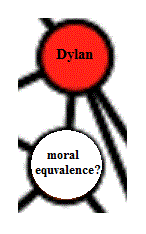
To Bob Dylan, “One too many mornings” and the lines “You’re right from your side / I’m right from mine” – juxtaposing them like that, is there a moral equivalence implied?

Dylan’s overview doesn’t sound too optimistic about the possibility of any kind of reconciliation of the opposites: “We’re both just one too many mornings / An’ a thousand miles behind…”

Accordingly, this may be an appropriate point at which to note that Edward Said thought the conflict between Israelis and Palestinians was asymmetrical and irreconcilable.

In the interview from which I borrowed Said’s notion of a “symphonic” reading of the conflict, the question and answer immediately following that paragraph reads thus:

Q: Is this a symmetrical conflict between two peoples who have equal rights over the land they share?

A: There is no symmetry in this conflict. One would have to say that. I deeply believe that. There is a guilty side and there are victims. The Palestinians are the victims. I don’t want to say that everything that happened to the Palestinians is the direct result of Israel. But the original distortion in the lives of the Palestinians was introduced by Zionist intervention, which to us – in our narrative – begins with the Balfour Declaration and events thereafter that led to the replacement of one people by another. And it is continuing to this day. This is why Israel is not a state like any other. It is not like France, because there is continuing injustice. The laws of the State of Israel perpetuate injustice.

This is a dialectical conflict. But there is no possible synthesis. In this case, I don’t think it’s possible to ride out the dialectical contradictions. There is no way I know to reconcile the messianic-driven and Holocaust-driven impulse of the Zionists with the Palestinian impulse to stay on the land. These are fundamentally different impulses. This is why I think the essence of the conflict is its irreconcilability.

Comment:

Are the two narratives symmetrical? Is there a moral equivalence between them?

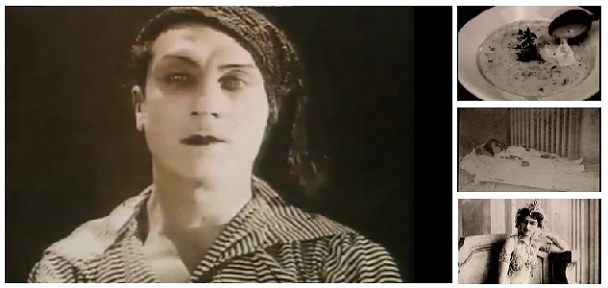
The great early Russian film director Sergei Eisenstein wrote that “the juxtaposition of two shots by splicing them together resembles not so much the simple sum of one shot plus another — as it does a creation.”

mosjukhin.jpg

His colleague Vsevolod Pudovkin goes further:

Kuleshov and I made an interesting experiment. We took from some film or other several close-ups of the well-known Russian actor Mosjukhin. We chose closeups which were static, and which did not express any feeling at all-quiet close-ups. We joined these close-ups, which were all similar, with other bits of film in three different combinations. In the first combination the close-up of Mosjukhin was immediately followed by a shot of a plate of soup standing on a table. It was obvious and certain that Mosjukhin was looking at this soup. In the second combination the face of Mosjukhin was joined to shots showing a coffin in which lay a dead woman. In the third the close-up was followed by a shot of a little girl playing with a funny toy bear. When we showed the three combinations to an audience which had not been let into the secret the result was terrific. The public raved about the acting of the artist. They pointed out the heavy pensiveness of his mood over the forgotten soup, were touched and moved by the deep sorrow with which he looked on the dead woman, and admired the light, happy smile with which he surveyed the girl at play. But we knew that in all three cases the face was exactly the same.

What I am getting at here is, first and foremost, that juxtaposition is a rhetorical and aesthetic device, and that how to “read” a given juxtaposition is not necessarily obvious.

In a subsequent move, I shall discuss the specific philosophical problem involved in weighing one body of suffering against another

Sacred Things

Thursday, June 23rd, 2011

[ post  by William Benzon cross-posted from his New Savanna blog with Intro by Charles Cameron — nature, arts, the sacred ]

.

Intro

.

This strange category, the sacred, strikes me as important because it intensifies.

It gives rise to beauty, terror, repulsion, love.  It empowers whatever vision, ideology, mission, crusade, jihad, movement, or tendency it touches.  And our society has in some ways lost touch with it so completely that we think it is found in the outward forms of piety, and miss its secular manifestations, its manifestation in religions other than our own, and most significantly and disastrously the groundswell of feeling it gives rise to in unexpected places.

It is a haven for many in an unlovely or uncertain world, a dwelling-place for saints, idealists, artists and — who knows? — perhaps the mad. And it catches us up when we least expect it — when the lights go down low in a cinema or at the opera, the curtain parts, and we enter another world whose rules are not our own.

We need to understand this.

.

In my post on Sacred space and the imagination, I tried to give a feel for the sacred without focusing on places of official worship, where it may be so expected as to be missed elsewhere, and I headed that post “no mil/intel stuff” because “this blog is dedicated to exploring the intersections of foreign policy, history, military theory, national security,strategic thinking, futurism, cognition and a number of other esoteric pursuits” — and my post clearly fell under the “other esoteric pursuits” part of the rubric.

But pattern pervades all, and the arts are prime sources for an understanding, a grasp, an accurate intuition of patterns in general. So we are not so far from strategy after all…

William Benzon responded to that post of mine, which he’d cross-posted on his own blog, with a post of his own, which I am cross-posting here. By way of introducing Benzon himself, then —

Benzon is a scientist (he led the information systems group at NASA in 1981, developing strategic recommendations about NASA-wide computer use and acquisition, and in conjunction with David G. Hays, published a series of articles in the Journal of Social and Evolutionary Systems covering the development of cognition in the brain from primitive vertebrates through primates and in human culture from the preliterate world through the development of computing) with wide cross-disciplinary interests (he’s played concerts with the likes of Dizzy Gillespie and B.B. King), either the first or one of the very first independent scholars invited by the National Humanities Center to lead off a topic of his choice on their blog, the author of a brilliant book on music and the brain, Beethoven’s Anvil: Music In Mind And Culture, and my friend.

Here, then, is his response to my post. Take it away, Bill…
.

Sacred Things

.

IMGP0005rd

… that still roaring dell, of which I told;
The roaring dell, o’erwooded, narrow, deep,
And only speckled by the mid-day sun;
Where its slim trunk the ash from rock to rock
Flings arching like a bridge;–that branchless ash,
Unsunn’d and damp, whose few poor yellow leaves
Ne’er tremble in the gale, yet tremble still,
Fann’d by the water-fall! and there my friends
Behold the dark green file of long lank weeds,
That all at once (a most fantastic sight!)
Still nod and drip beneath the dripping edge
Of the blue clay-stone.

— Coleridge, This Lime-Tree Bower My Prison

This post began, I suppose, when, upon reading Charles Cameron’s post, Sacred space and the imagination, the “graffiti!” light went off in my brain. Not just any graffiti light, but this one:
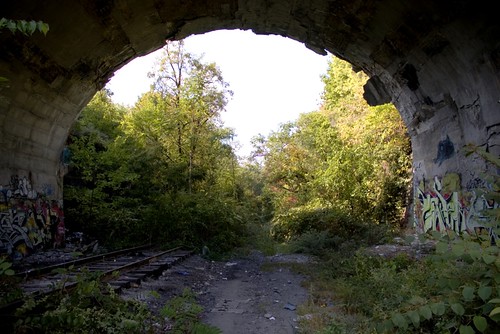
westward ho.jpg

Well, not that exact one, but it was a photograph of that same arch, a different photograph. This one shows the graffiti a little more clearly, but it’s not the same graffiti, as graffiti often changes over time, in some places more rapidly than others.

If you look back over Cameron’s images, you’ll see that it’s of a piece with them. And I’ve got dozens of photos of that arch: different times of the day, different seasons, different years, different graffiti, different angles. And that’s not all.

Graffiti and the sacred is a natural, one that hadn’t quite hit me full-on until I’d read Cameron’s post. You see, my first post about graffiti (the images, alas, are gone) was about this piece, which I called the Shrine of the Triceratops:

dino_train_872

It’s not that I believe, mind you, that there’s a triceratops cult in Jersey City and that this is where they meet. Nothing like that. Rather, that that image seemed to embody of the spirit of the place, the Japanese word is kami. (That triceratops is now gone. First, eroded by the weather, then other writers went over it.)

I could go on and on about graffiti, but I won’t, because this post isn’t just about graffiti. But I’ll leave you with one last graffiti thought. Graffiti is often likened to cave art. Well, cave art, some of it, perhaps all of it, is sacred art. Not mere pictures, but spirits bodied forth on walls.

*

And then there’s my current film project, Apocalypse Now. And that is deeply intertwined with the sacred. Not that it presents itself as a sacred story, nothing so straight-forward, but that it deals with ultimate things in a secular way.

Ultimate things in a secular way! – now there’s a fine kettle of fish for you. Just what does that mean? I suppose, for example, that that physicist’s dream, the grand unified theory, is a secular run on ultimate things. But is that secular the same secular as is appropriate to Appocalypse Now? I think not. Are we then confronted with the varieties of secular experience, mingling next to the varieties of religious experience? And where’s the boundary?

But, no, the film doesn’t present itself as religious in the way that Tree of Life presents itself as religious. But the caribao sacrifice at the end, that’s a real sacred ritual, not an enactment. Coppola shot the real thing, not that you’d know that from watching the film, though you could see that the caribao was really hacked to death. And the final third of the film takes place in a liminal no man’s land. It’s sacred territory, for some (nontrivial) meaning of sacred.

Anyhow, it looks like I’m going to argue that Apocalypse Now is an ontological text. That it is about the moral structure of the world rather than conveying this or that moral (or immoral) action. It’s about how things are through the ends of time, not about how this or that person gets from here to there.

*

And that certainly seems to be what’s going on in Malick’s very different The Tree of Life. We have the trials of the O’Brian family, daddy’s something of a dick, though a music-loving dick, mommy’s kind but a flake, and one kid dies – whether by suicide or not, that’s not clear from the film itself (I’ve seen it only once — shouldn’t have to see it more than once on such a plot point). But god’s creation is magnificent. As if that had anything to do with the O’Brian’s afflictions. Well, it does. It doesn’t.

In any event, it seems that this film, that as a film must unfold in time, minute by minute by (often tedious) minute, blasts time to smithereens. It opens with a verse from Job and then a flickering shimmering light that’s supposed to be, I guess, a Supreme Something Or Other in the Universe, but isn’t this dew-flecked dandelion more elegant?

dandilion

And then, I think, some story in the more or less present. Yes, that’s it, she gets the telegram. The news is not good, not good at all. Things fall apart. A plane. At the airport. And somewhere in there not too far into the film we get this sequence in which the world and all the life in it gets created, ending with some dinosaur killing some other dinosaur. Live action and CGI special fx. Wonderful imagery. Wonderful.

And slices of that imagery get cut into the rest of the film as life goes on, backwards and forwards. It’s as though the world didn’t get created by once, but always and ever, created and recreated, recreating.

*

And behind it all there’s Uncle Walt. Uncle Walt’s the first one who gave us a vision of the creation of the world, a cinematic vision that is, one we can see with our own eyes and hear with our own ears. All in less than half an hour. And it’s got dinosaurs!

I’m talking, of course, of “The Rite of Spring” episode in Disney’s Fantasia. He got the science wrong, even then they knew that the T. Rex and the Stegosaurus never co-existed, but he showed us the whole solar system, and seismic activity, and crashing dashing oceans, then life originating in the ocean, coming on land. And dinosaurs!
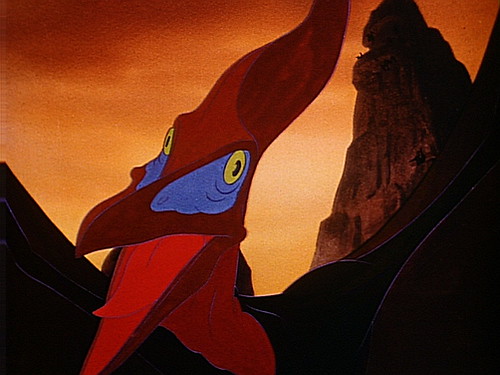
pterodactyl.jpg

Disney’s the one who had the genius to visualize THE WHOLE THING. We who’ve grown up in the shadow of Disney now take it for granted that such things are seeable, but Disney was there first. If Disney hadn’t done it, Malick would have had to figure it out from scratch. As it is, Disney’s imagery has so permeated the culture than one can do (and see) a film like Tree of Life without once thinking of Fantasia.

In fact, the cultural coding against cartoons is so deep that I hesitate ever so little to put Fantasia in the same paragraph with Tree of Life. How could these films possibly have anything in common much less be the same thing: entertainment. Yikes! I mean, Tree of Life is so freakin’ serious. And Fantasia is so, well, gorgeous, and rather annoyingly cutesy at times.

And it ends in a forest glade:
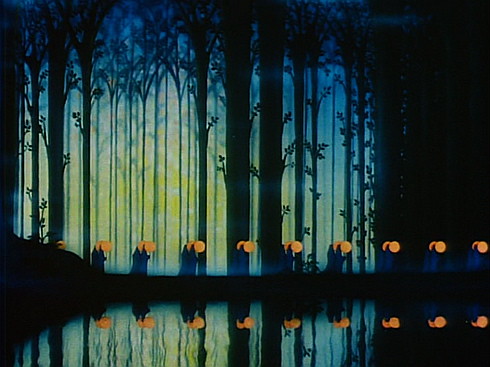
ave maria

The music is a rather fruity arrangement of Schubert’s Ave Maria. The motion: slow, stately, rigorous, restrained, austere.

— Bill Benzon.


Switch to our mobile site