zenpundit.com » judaism

Archive for the ‘judaism’ Category

Video clips I: Torah, Theonomy, Sharia?

Saturday, June 16th, 2012

[ by Charles Cameron — religious law espoused in Judaism, Christianity and Islam ]
.

I came across this first video, featuring Dov Lior, Chief Rabbi of the Kiryat Arba settlement outside Hebron, yesterday, and thought it would be worthwhile to seek out companion pieces proposing divinely sanctioned legal systems in the two other Abrahamic traditions:

There are naturally differences as well as similarities between the three messages and the relative levels of influence of their respective messengers. A scholar of comparative religion might be concerned with their selections of canonical texts to enforce and the techniques of interpretation variously applied to them, an historian might compare our second speaker, the Chalcedon Institute’s (late) RJ Rushdoony‘s view of the applicability of Biblical law with that of Calvin in Geneva, a strategist consider the groundswells of popular opinion attaching to each of these speakers, their political and military potentials…

All three speakers claim that law should be based on a divinely authored and thus authoritative text — but the books so considered differ. Anjem Choudary, the third speaker, brings vividly to mind the impact that such doctrines can have on those who do not share his religious convictions when he proposes that Buckingham Palace could become a mosque…

I think it important to be aware that such men exist, and have followings. There are members of all three religions that I count as friends, events of horrific, divinely sanctioned violence in the histories of all three religions, and figures in the history of each religion from whom I take inspiration. I would not wish to live in a land where any one of these three men wielded power, and I do not believe that any one of them is fully representative of the grand sweep of his own tradition.

My intent in posting these three videos is to inform, not to inflame, and I invite you to view them in that spirit.

Of Quantity and Quality II: Holocaust, torture and sacrament

Thursday, April 19th, 2012

[ by Charles Cameron — Yom HaShoah, quality vs quantity, sacramental value of life, continuing from Q&Q I, long, intense ]
.

Today is Yom HaShoah, Holocaust Remembrance Day.
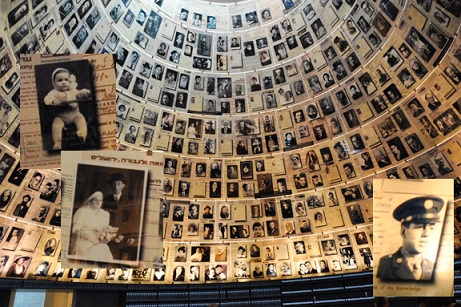

photo credit: Joni B Hannigan

The mind is struck dumb.

Six million individuals is too vast a gathering to contemplate. Even to think of ten people we know well if they are in the room with us requires us to move from face to face, person to person, picking up where we left off with each one, perhaps with this couple or these four colleagues from a remembered journey or project.

Six million.

Six million people is more than a crowd, it’s a blur — it is, approximately, the entire population of Arizona, of Rio or Lahore, of entire nations, El Salvador, Libya or Sierra Leone.

Today we remember those who died in the Shoah, as individuals and together.

*

I believe the Shoah to be one of those topics where we humans need to use the cognitive equivalent of a zoom lens – the capacity to hold magnitude in mind while exploring at the level of the individual, and to feel for the individual while not losing sight of the magnitude of the larger picture.

Consider the rabbinic opinion given in the Babylonian Talmud, Sanhedrin 37a:

For this reason was man created alone, to teach thee that whosoever destroys a single soul of Israel, scripture imputes [guilt] to him as though he had destroyed a complete world; and whosoever preserves a single soul of Israel, scripture ascribes [merit] to him as though he had preserved a complete world.

How do you magnify that “complete world” by six million?

*

Another such topic involving the individual and the group is torture.

Here the issue is, at best, not one of innate cruelty or hatred or disregard for values, but a considered weighing of alternatives — the brutal interrogation of a Khalid Sheikh Mohammed, say, against the chance to avoid a second 9/11. Torture, too, is a matter of the relationship of the many to the one, and I suspect people’s opinion of torture pretty much rests on each person’s understanding of when and indeed whether the need of the group ever trumps that of the individual.

Again, I think we need a cognitive zoom capability, if we are to begin to grasp the subtlety of the issue — and to be able to countenance those who see it differently from ourselves.

*

I suggest that the core question is that of the relationship of quality to quantity — which I have argued before, is essentially the same as the deep question in consciousness, that of the relationship between (subjective) mind and (objective) brain.

Can a sheer quantity of people saved from some hateful end ever really compare to the quality — radiant suchness of the Tathagata (Diamond Sutra), image and likeness of God (Genesis) — of a single willfully tortured human?

For some people this is a no-brainer. Of course: you weigh the likely impacts, and on occasions when torturing one is liable to reveal information that saves thousands of others, do it. Reuel Marc Gerecht, lately of the CIA, posed the issue this way:

… if you had been confronted on 7 September 2001 with a captured Khalid Shaykh Muhammad or Abu Zubaydah and you knew that a major, mass-casualty terrorist strike was about to go down in the United States, and you had plenipotentiary authority for the nation’s security …

For some, it is a no-brainer. Of course not: if you treat others that way, even in the heat of battle, you’ve lost already — you’ve become what you hate. John Kiriakou, lately of the CIA, wrote:

even if torture works, it cannot be tolerated – not in one case or a thousand or a million. If their efficacy becomes the measure of abhorrent acts, all sorts of unspeakable crimes somehow become acceptable. … There are things we should not do, even in the name of national security.

*


.

In the Egyptian scene above — taken from the Papyrus of Ani in the British Museum — judgment is rendered on a single human soul when it is weighed against the feather of Maat:

The goddess Maat, shown as a feather in the scale pan, is the deification of the concept of maat: truth, justice and cosmic order.

Is the heart light enough to balance justice herself?

The jackal-headed Anubis is weighing the heart of the supplicant as the ugly beast Ammit, known as “The Devourer,” “Bringer of the Second Death” — a hybrid monster, part lion, part hippopotamus, part crocodile — crouches by the scales drooling, waiting to gulp down the failed soul. The ibis-headed Thoth is poised to record the verdict on his slate. Various deities are ranged around the scene, serving as Judges or in other roles important to the ritual or the ideology that had developed over the span of many centuries. Overlooking this scene is the Ba — the winged representation of the personality of the deceased — perched and ready but not yet able to take flight as a risen being.

Even though Osiris is pictured at the far end of the Judgment scene, indicating the conclusion of the proceedings, his presence nonetheless dominates the scene, as a confirmation of the ultimate purpose of all this.

*

Mary Qualit and Martha Quant…

A number of significant thinkers have weighed in on the scales which measure human lives… basically asking if a quality can be quantified, added, multiplied.

The philosopher Wittgenstein, in a selection of his posthumous writings, says:

The whole earth cannot be in greater distress than one soul.

The writer CS Lewis concurs:

We must never make the problem of pain worse than it is by vague talk about the “unimaginable sum of human misery.” … There is no such thing as a sum of suffering, for no one suffers it. When we have reached the maximum that a single person can suffer, we have, no doubt, reached something very horrible, but we have reached all the suffering there ever can be in the universe. The addition of a million fellow-sufferers adds no more pain.

And Arne Naess, the “father” of Deep Ecology, in his Philosophy of Wolf Policies says:

We should be careful when talking about greater suffering. Referring to a consciously experienced suffering, including simple pain, we have to do with a quality admitting degrees of intensity, but in an important sense unquantifiable and nonadditive.

Strictly speaking, experienced suffering is not additive.

In my view — or perhaps I should say, with my mind — it is hard even to fully grasp what these three distinguished and diverse folk are saying. And yet I feel as if they are bringing me a truth, bringing it right to the edge of my awareness.

*

Tarek Mehanna wrote in his sentencing statement, given in court last week:

I learned about the American-led sanctions that prevented food, medicine, and medical equipment from entering Iraq, and how – according to the United Nations – over half a million children perished as a result. I remember a clip from a ’60 Minutes’ interview of Madeline Albright where she expressed her view that these dead children were “worth it.”

I can understand that, the reluctance to accept that particular policies are “worth” the loss of children. Where is Maat, to weigh such matters for us?

*

Here are four quotations having to do with the value of sparrows, one way or another:

Are not two sparrows sold for a farthing? and one of them shall not fall on the ground without your Father. But the very hairs of your head are all numbered. Fear ye not therefore, ye are of more value than many sparrows. — Matthew 10.29-31.

Whoever uselessly kills a sparrow, on the Day of Judgment, it will come and shout in front of the throne and say, “Oh my Lord, ask this person why he uselessly killed me.” — Hadith of the Prophet, quoted in Kazemi, Environmental Rights and the Teachings of Mahdism

There is a special providence in the fall of a sparrow. — Shakespeare, Hamlet, V.2

If a sparrow dies in Central Park, I feel responsible. — Mayor Fiorello La Guardia

*

There’s a streak of paradox running through the heart of Christianity, in which two values are simultaneously present: one temporal and moral, the other atemporal / eternal and transcendent. Thus Christ can say “Before Abraham was, I am” — situating himself in both eternal and temporal realms simultaneously. Thus also, he can say of himself and his betrayal by Judas, “The Son of man goeth as it is written of him: but woe unto that man by whom the Son of man is betrayed! it had been good for that man if he had not been born.”

And thus also, in a masterful paradox, St John’s Gospel recounts how the High Priest Caiaphas argued for the death of Christ:

Then gathered the chief priests and the Pharisees a council, and said, What do we? for this man doeth many miracles. If we let him thus alone, all men will believe on him: and the Romans shall come and take away both our place and nation. And one of them, named Caiaphas, being the high priest that same year, said unto them, Ye know nothing at all, Nor consider that it is expedient for us, that one man should die for the people, and that the whole nation perish not. And this spake he not of himself: but being high priest that year, he prophesied that Jesus should die for that nation; And not for that nation only, but that also he should gather together in one the children of God that were scattered abroad. Then from that day forth they took counsel together for to put him to death.

On the one hand, Caiaphas is arguing that one troublesome young rabbi’s life is expendable if it will avoid a Roman crackdown not unlike the one that did in fact occur some forty years later, with the destruction of the Temple in 70 CE. This is, in Christian terms, a vile argument, and one respondible for the death by execution of the Christ.

On the other, though — and the brilliance of the paradox lies in the way that John weaves the two perspectives together — God thinks it preferable that he himself, incarnate, should die as a once-for-all sacrifice to save his many creatures who — and here I can’t help but hear the strains of Handel’s Messiah — like sheep have gone astray…

Putting it mildly.

So, whether you’re Christian or not — and I wouldn’t claim to be, though I’m clearly influenced — the notions of sacrifice and self-sacrifice belong in here somehow.

*

I quoted the Talmudic Tractate Sanhedrin at the top of this post. The Qur’an recalls this passage in Sura 5.32:

Therefore We prescribed for the Children of Israel that whoso slays a soul not to retaliate for a soul slain, nor for corruption done in the land, shall be as if he had slain mankind altogether; and whoso gives life to a soul, shall be as if he had given life to mankind altogether.

It is my suggestion that the difference between Quantity and Quality is as profound (in Bateson’s terms, makes as great a difference as) as the difference between mind and brain, subjective and objective or inner and outer worlds — which itself revovles around the “deep problem” in consciousness.

If I’m right about this — and “right” may not be the best term in any case — then the quality / quantity issue is one facet of the great mystery at the heart of things that religion approaches and derives from, but can never fully define or express.

Morality is our attempt to work in the world with some of the insight gleaned from that mystery, and it may well be that dualistic, propositional thinking is inherently unsuited to the task.

I’d like to return at this point to a quote I’ve used here before, and find very insightful. It’s from Lin Jensen, An Ear to the Ground: Uncovering the living source of Zen ethics, and it tells us:

Judgments on right and wrong are a nearly irresistible enticement to pick sides. And that’s exactly why the old Zen masters warned against becoming a person of right and wrong. It isn’t that the masters were indifferent to questions of ethics, but for them ethical conduct went beyond simply taking the prescribed right side. For these masters, the source of ethical conduct is found in the way things are, circumstance itself: unfiltered immediate reality reveals what is needed.

*

In closing, I would like to return to the issue of torture, and to offer you another quote, this one from one of the most powerful works of theology known to me, William T Cavanaugh‘s Torture and Eucharist: Theology, Politics and the Body of Christ:

by making the seeking of important answers seem like the motive for the torture, the torturer seems able to justify his brutality. No one would think of defending the sheer physical act of torture, the merciless inflicting of pain on a helpless victim. However, once we consider the verbal aspect, the question and answer which seem of such great urgency, the moral contours of torture seem less clear, and utilitarian justifications of torture become thinkable, provided the motive for the questions is of sufficient importance.

Cavanaugh is writing about those who were “disappeared” in Pinochet‘s Chile, and his broader argument is that torture is the antithesis of the sacramental nature of human identity — and here we return full circle to the “image and likeness” of the divine in the mortal, the human.

The deeper we can penetrate into the central mystery, it seems to me, the better we will be enabled to love, to understand, and to forgive.
Al-Awlaki and the former and latter rains

Saturday, March 31st, 2012

[ by Charles Cameron — former and latter rain in OT, NT and hadith, also YouTube eulogy for Anwar al-Awlaki ]
.

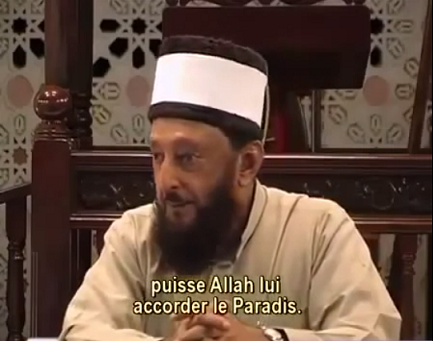
I’ve posted more than once about Sheikh Imran Nazar Hosein [eg: The United States of Islam and Iran or Afghanistan? The Black Flags of Khorasan]: today I saw a clip (screen-cap above) in which he eulogizes Anwar al-Awlaki.

What interests me in Sheikh Imran Hosein’s eulogy is that he references a hadith of the Prophet about the first and last showers of rain

*

So first, some background.

The imagery of “the first rain and the latter rain” dates back at least to the Torah.

In Deuteronomy 11.13-14, we read:

And it shall come to pass, if ye shall hearken diligently unto my commandments which I command you this day, to love the Lord your God, and to serve him with all your heart and with all your soul, that I will give you the rain of your land in his due season, the first rain and the latter rain, that thou mayest gather in thy corn, and thy wine, and thine oil.

That seems to be a fairly straight forward agricultural usage, although as I mentioned recently, scriptural exegesis under the PaRDeS system involves four levels of interpretation.

Joel 2.23 picks up the theme:

Be glad then, ye children of Zion, and rejoice in the LORD your God: for he hath given you the former rain moderately, and he will cause to come down for you the rain, the former rain, and the latter rain in the first month.

But this comes in a celebrated chapter which begins with the sounding of an apocalyptic trumpet and the declaration that “the day of the LORD cometh, for it is nigh at hand” – and which also contains the prophecy (verses 28-30):

I will pour out my spirit upon all flesh; and your sons and your daughters shall prophesy, your old men shall dream dreams, your young men shall see visions: And also upon the servants and upon the handmaids in those days will I pour out my spirit. And I will shew wonders in the heavens and in the earth, blood, and fire, and pillars of smoke…

By the time we reach the New Testament, the theme is clearly used (James 5.7) with a Christian eschatological implication:

Be patient therefore, brethren, unto the coming of the Lord. Behold, the husbandman waiteth for the precious fruit of the earth, and hath long patience for it, until he receive the early and latter rain

And indeed, the imagery of the Latter Rain as an outpouring of the Spirit to occur in the end times has given rise to a movement or series of Pentecostal movements going under the name of the Latter Rain, which have at times drawn the disapproval of apologetics scholars and even fellow Pentecostals.

*

Bearing that in mind, it is interesting to note the following hadith of the Prophet:

The Prophet, sallaallaahu `alaihi wa sallam, further said:

“The example of my Ummah is like that of rain. It is not known whether the initial part (of the rain) is good or the latter part.”

Ibn Taymiyyah, the medieval theologian whose previously somewhat obscure work strongly influenced ‘Abd al-Wahhab, and thus the modern Wahhabi current, commented on this hadith:

..what it means is that among those who come later there will be those who are similar to those who came before, and they will be so close that the one who tries to compare them will not know which is better, even though one of them is in fact better.

This is glad tidings for those who come later, that among them will be those who are close to those who came before them, as it says in another hadeeth: “The best of my ummah are the first and the last, and between them there will be some crookedness. Would that I could see my brethren.” They said, “Are we not your brethren?” He said, “You are my companions.” This shows that precedence was given to the Sahaabah, because they alone are his companions, which is a higher status than merely being brothers.”

*

In his tribute to “our brother Sheikh Anwar al-Awlaki” Sheikh Imran Hosein says “I don’t think there’s need to say more than one statement about Anwar al-Awlaki.” He then quotes the same hadith, repeating the first phrase for emphasis:

My Ummah is like the rain. My Ummah is like the rain: I do not know which shower is better, the first or the last.

And concludes:

Anwar Awlaki belongs to the last shower. That is his status, may Allah grant him Jannah.

— Jannah being the garden of Paradise.

*

But see for yourself — the video clip is only a minute long, and the hadith and commentary are provided below it on the YouTube site:

The Said Symphony: move 19

Sunday, March 18th, 2012

[ by Charles Cameron – extended analytic game on Israeli-Palestinian conflict — for those who wish to catch up, our game thus far consists of an intro to the game and game board, followed by moves 1-5, 6-9, then moves 10-11 which together constitute a meditation, moves 12, 13-15, 16-17, and most recently before this, move 18 with cadenza ]

Move 19: The view from above

Move content:

Discussing strategy, the very canny LTG (USMC, Ret’d.) Paul Van Riper had this to say:

What we tend to do is look toward the enemy. We’re only looking one way: from us to them. But the good commanders take two other views. They mentally move forward and look back to themselves. They look from the enemy back to the friendly, and they try to imagine how the enemy might attack them. The third is to get a bird’s-eye view, a top-down view, where you take the whole scene in. The amateur looks one way; the professional looks at least three different ways.

A bird’s-eye view, a hawk’s eye view, a top-down view, an overview, a view from 30,000 feet, a God’s eye view, a view from above, a zoom…

If move 18 and its cadenza gave us a view of the depth of vision or insight that is necessary for a full and rich understanding of the world we live in — its qualitative or spiritual scope, if you like — this next move, with its picnic and drone-sight, addresses its breadth in space and time — materially and quantitatively speaking.

The classic expression of the sheer material scope of the universe was put together by Charles and Ray Eames in their justly celebrated film, Powers of Ten, from which the lower of these two images is drawn:

Here are some other relevant scans of the scope of things, in terms of time and space:

The Scale of the Universe 2
A Brief History of The Universe
The Known Universe
A Time-Lapse Map of Every Nuclear Explosion Since 1945

These are impressive videos to be sure, but as an aside I’ll invite you to ask yourselves how well they compare with this zoom in words, a poem by the zennist, ecologist, essayist and poet Gary Snyder, from his book, Axe Handles: Poems:

Such breadth of vision, such craft.

*

If this “material scope of things” too has a cadenza, it would be that all of this is shot through with some primary oppositions, dappled as the poet Gerard Manley Hopkins would have it, with swift, slow; sweet, sour; adazzle, dim — as indicated in the drone-sight and picnic double image at the head of this move.

This dappling, this constant flux of opposites, takes many forms — day and night lead to the more abstract light and dark, which can then be interpreted morally as good and evil, to which we respond with repulsion and attraction as the case may be, building our worldviews from love or fear…

At different scales the opposites that matter most to us may have different names and shadings, but here I’d just like to draw attention to the dappling of our world with:

competition and cooperation
Darwin‘s natural selection and Kropotkin‘s mutual aid
duel and duet (ah! — a favorite phrasing of mine)
war and peace

Provocatively, we find this dappling in scriptures, too, wherein the ripples of such verses as “The LORD is a man of war: the LORD is his name” (Exodus 15.3) dropped like a stone into the pond of the human mind, meet with the ripples of other verses such as “God is love; and he that dwelleth in love dwelleth in God, and God in him” (I John 4.16).

There are times when we take such oppositions literally, perhaps too literally, and times when we begin to see oppositions as abstract and theoretical end-points to what is in fact a yin-yang process continually unfolding…

Which brings me by a commodius vicus of recirculation to this image of the great opposition between war and peace, its dappling, its unfolding:

Links claimed:

To the Lamb, move 18: this move presents the material scope of the universe in counterpoint to its visionary scope as laid out in move 18 with its cadenza.

To Revelation, move 17 — the word revelation means unveiling, as we have seen, and our sciences and technologies, with their spectra of telescopes, microscopes, cameras and zooms, are unveiling and revealing to us much about the physicality of the world we live in — much that was accounted for in other times and places through intuition, vision and poetry.

This scientific and technical revelation of material existence, for many of us moderns, has largely eclipsed the mode of visionary revelation of move 17 — yet it cannot eradicate it. Implicit in this move, then, is the sense that we carry with us both subjective and objective, inner and outer, qualitative and quantitative understandings — though the data that “sight” and “insight” provide us with may be different in kind, and resolving them may be something of a koan to us, the deep problem in consciousness as philosophers of science have named it — and that we can discount neither one if we are to have and maintain a rich sense of our situation.

Comment:

If the two previous moves have shown us the scope of the universe we co-inhabit, perhaps we should now make our own zoom in, much as James Joyce did when he had the schoolboy Stephen inscribe his name and address in his geography book as Stephen Dedalus, Class of Elements, Clongowes Wood College, Sallins, County Kildare, Ireland, Europe, The World, Universe – an address that Stephen then read both forwards and backwards, finding himself in one direction, and finding in the other that he had no means of knowing what might lie beyond the universe…

Imagine then, skipping rapidly from (unimaginable) cosmos via such things as the intriguingly named End of Greatness to galaxy or nebula…

…solar system and planet — whence we can slow down and zero gently in on the Middle (or as my friend Ralph Birnbaum would call it, the Muddle) East, Israel / Palestine, Jerusalem / Al Quds / the Temple Mount / Noble Sanctuary – and to such matters of contemplative vision and tribal passion as the first, second and projected third Temples, the al-Aqsa mosque.

Our increasing focus will bring us, then, to that the rock which Jews believe marks the place where Abraham bound his son Isaac (the Akedah), and which Muslims believe to be the place of ascent of the Prophet to the celestial realms (the Mi’raj) on his Night Journey (Qur’an, Al-Isra).

Here again myth and history collide, and both visionary and material considerations merge in the heart of the what my friend the Israeli journalist Gershom Gorenberg has justly called “the most contested piece of real estate on earth”.

Of Esther, Israel and Iran, pt. I – Purim

Thursday, March 8th, 2012

[ by Charles Cameron — Purim, the gift of a scroll ]

Today is the Festival of Purim in the year 5772 of the Jewish calendar, and in preparation for the event and in light of current geopolitics, PM Benjamin Netanyahu presented Pres. Barack Obama with a Megillah — a scroll containing the biblical Book of Esther, which it is a mitzvah for Jews to listen to on Purim — only last week.

Today is also International Women’s Day in the year 2012 of the Common Era.

*

Purim is a festive celebration, and while I hope to post follow ups on the tangled topics of scriptural interpretation and prophetic politics in the coming days, I thought it appropriate to open this series of posts with an image of an early Megillah from the Library of Congress (see above), to raise a glass of virtual wine in honor of the dual event, and to wish all ZP readers Chag Purim Sameach.


Switch to our mobile site