zenpundit.com » tao

Archive for the ‘tao’ Category

Encryption, the mind and voice

Monday, February 29th, 2016

[ by Charles Cameron — paging birds and fishes, Chuang Tzu and Wm Blake ]
.

Dwight Furrow, Wine Tasting and Objectivity:

The question is whether flavors are “in the wine” or “in the mind”. On the one hand, there are objectively measurable chemical compounds in wine that reliably affect our taste and olfactory mechanisms—pyrazines cause bell pepper aromas in Cabernet Sauvignon, malic acid explains apple aromas in Chardonnay, tannins cause a puckering response, etc. But we know that human beings differ quite substantially in how they perceive wine flavors. Even trained and experienced wine critics disagree about what they are tasting and how to evaluate wine. This disagreement among experts leads many to claim that wine tasting is therefore purely subjective, just a matter of individual opinion. According to subjectivism, each person’s response is utterly unique and there is no reason to think that when I taste something, someone else ought to taste the same thing. Statements about wine flavor are statements about one’s subjective states, not about the wine. Thus, there are no standards for evaluating wine quality.

**

Is each mind inherently closed to every other, much as the bird’s mind is closed to ours in Blake‘s aphorism —

How do you know but every bird that cuts the airy way, is an immense world of delight, closed by your senses five?

— albeit not always so joyful?

In more contemporary terms — Is there encryption of the mind?

**

I ask this in light of the DoubleQuote I posted a few days ago comparing Hesse and Hitchcock in terms of their metaphoric uses of “organ” — in, I hasten to add, the Bach sense of the word:
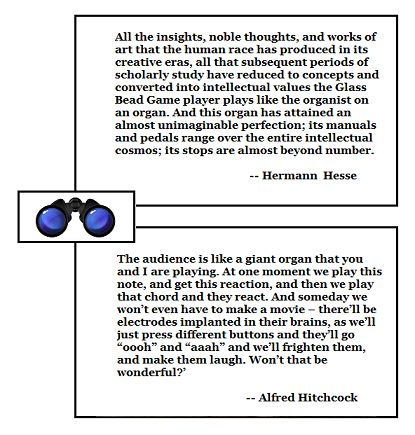
SPEC-Hesse-Hitchcock-organs sm

Here’s what I’m thinking. Hesse’s game influences the mind, as does art, but it is non-invasive; Hitchcock applauds the potential for art to move in a more invasive direction, as if by force rather than by enticement.

“”

Humans — or at least the philosophers and philosopher tagalongs among them — can’t even tell if what one human sees as “red” is what another sees as “red” — let alone what a given Burgundy tastes like on another’s palate.

If this means, more generally, that minds are effectively encrypted by virtue of their differences in wiring acquired with parentage, age and experience, then our communications media -– language, the arts, literature, number — would appear to be the available decryption keys, selectively available to the minds in question.

**

Chuang-Tsu has this tale to tell:

Men claim that Mao-ch’iang and Lady Li were beautiful, but if fish saw them they would dive to the bottom of the stream, if birds saw them they would fly away, and if deer saw them they would break into a run. Of these four, which knows how to fix the standard of beauty for the world?

And this..

Chuang Tzu and Hui Tzu were strolling along the dam of the Hao River when Chuang Tzu said, “See how the minnows come out and dart around where they please! That’s what fish really enjoy!”

Hui Tzu said, “You’re not a fish – how do you know what fish enjoy?”

Chuang Tzu said, “You’re not I, so how do you know I don’t know what fish enjoy?”

Hui Tzu said, “I’m not you, so I certainly don’t know what you know. On the other hand, you’re certainly not a fish – so that still proves you don’t know what fish enjoy!”

Chuang Tzu said, “Let’s go back to your original question, please. You asked me how I know what fish enjoy – so you already knew I knew it when you asked the question. I know it by standing here beside the Hao.”

**

Chuang Tzu said, “You’re not I, so how do you know I don’t know what fish enjoy?”

Blake said, “How do you know but every bird that cuts the airy way, is an immense world of delight, closed by your senses five?”

Dragging my tail in the mud

Thursday, February 18th, 2016

[ by Charles Cameron — i’m afraid this will be a very Thoreau-Taoist post for this electoral season ]
.

Two browsings recently set me thinking about politics in general — and dragging my tail in the mud in particular:

Shadi Hamid in What is Policy Research For? Reflections on theUnited States’ Failures in Syria

When the basic thrust of policy seems immovable irrespective of events on the ground, how should researchers respond? Should influencing policy be the animating objective of policy research?

and at the pointy end, Matt Cavanaugh at War on the Rocks, The Way Home from ‘a War’:

What is it like to make uncertain judgments with severe moral consequences? For military professionals, being the state’s lethal instrument necessarily entails ethically perilous, life-or-death choices.

**

Here’s the cntext, as I see it..

Wallace Black Elk:

The whole earth is an altar. In church, they have a little slab of marble which they call an altar. But our altar is Grandpa’s altar… Our carpet is the grass, the sacred altar; our ceiling is the stars; our night lamp is the moon; Grandpa the sun is our mystery power.

Thomas Traherne:

You never enjoy the world aright, till the Sea itself floweth in your veins, till you are clothed with the heavens, and crowned with the stars: and perceive yourself to be the sole heir of the whole world, and more than so, because men are in it who are every one sole heirs as well as you. Till you can sing and rejoice and delight in God, as misers do in gold, and Kings in sceptres, you never enjoy the world.

Till your spirit filleth the whole world, and the stars are your jewels; till you are as familiar with the ways of God in all Ages as with your walk and table: till you are intimately acquainted with that shady nothing out of which the world was made: till you love men so as to desire their happiness, with a thirst equal to the zeal of your own: till you delight in God for being good to all: you never
enjoy the world.”

Chuang Tzu:

I will have Heaven and Earth for my sarcophagus, the Sun and Moon shall be my burial insignia, the stars my coffin-jewels, and all Creation shall be mourners at my obsequies. Are not my funeral paraphernalia all in readiness?

Thoreau-Taoism, which she would spell Thurrodowism, is Ursula Le Guin‘s superlative confection.

**

Chuang Tzu:

From Chuang Tzu: Mystic, Moralist, and Social Reformer, tr. Herbert Giles, p. viii:

Prince Wei (B.C. 338-327) of the Ch’u State, hearing of Chuang Tzu’s good report, sent messengers to him, bearing gifts, and inviting him to become Prime Minister. At this Chuang Tzu smiled and said to the messengers, “You offer me great wealth and a proud position indeed; but have you never seen a sacrificial ox:-When after being fattened up for several years, it is decked with embroidered trappings and led to the altar, would it not willingly then change places with some uncared for pigling?

Or from Chuang Tzu, Basic Writings, tr. Burton Watson, p.108:

Once, when Chuang Tzu was fishing in the P’u river, the king of Ch’u sent two officials to go and announce to him: “I would like to trouble you with the administration of my realm.”

Chuang Tzu held onto the fishing pole and, without turning his head, said, “I have heard that there is a sacred tortoise in Ch’u that has been dead for three thousand years. The king keeps it wrapped in cloth and boxed, and stores it in the ancestral temple. Now would this tortoise rather be dead and have its bones left behind and honored? Or would it rather be alive and dragging its tail in the mud?”

“It would rather be alive dragging its tail in the mud,” said the two officials.

Chuang Tzu said, “Go away! I’ll drag my tail in the mud!”

What the PK Dickens?

Thursday, November 26th, 2015

[ by Charles Cameron — conceptual echoes in a PK Dick bio-flick ]
.

PKD covers 600

**

I have just been watching Mark Steensland’s movie, The Gospel According to PK Dick, and a couple of fine parallelisms – echoes, really – struck me.

I’m going to start with one quote from the Chuang Tzu which is so often quoted it has been dulled for me, like a few other very great very over-celebrated works, Beethoven’s Fifth, and Bach’s Toccata and Fugue in D minor BWV 565, among them. Finding its echo in the words of Robert Anton Wilson in this film breathes new life into it, at least for me, for this moment.

Chuang Tzu, then, from The Complete Works Of Chuang Tzu translated by Burton Watson:

Once Chuang Chou dreamt he was a butterfly, a butterfly flitting and fluttering around, happy with himself and doing as he pleased. He didn’t know he was Chuang Chou. Suddenly he woke up and there he was, solid and unmistakable Chuang Chou. But he didn’t know if he was Chuang Chou who had dreamt he was a butterfly, or a butterfly dreaming he was Chuang Chou. Between Chuang Chou and a butterfly there must be some distinction! This is called the Transformation of Things.

DoubleQuote that with Robert Anton Wilson in the movie:

In 1994, I think it was, somebody put up on internet a report of my death, and no matter how much I’ve denied it, it seems most people accept that I’m still alive, but there’s a die hard minority who insists I’m dead and the CIA has replaced me with an android. And I’d be much happier if I’d never read Philip Dick, because I would just think, “Well, I know I’m not an android,” but having read Philip Dick I realized if I was an android who’s properly constructed, I’d think I am Robert Anton Wilson. So that leaves me perpetually in a predicament of not being sure that I’m Robert Anton Wilson or an android programmed to think it’s Rob– to think, talk, and write like Robert Anton Wilson. I guess I’m really grateful to Phil for that, it gives me a certain agnostic detachment, which I think is necessary for mental health.

**

The echo of Chuang Tzu in the words of Robert Anton Wilson occurs towards the beginning of the movie. Towards the end of the movie, we have Paul Williams, the “father of rock criticism” also talking about his friend PK Dick, who was also the subject of his celebrated 1974 Rolling Stone article:

That particular, unique personality this is Philip K Dick arises, when you and I or the three of us, or any two or three readers of {Philip K Dick, or friends of his, or whatever, get together, then we have the opportunity, as in the ends of those stories, to actually experience his presence, and it’s uniquely him. And, uh, I appreciate that, and I appreciate that in that way, I still have him in my life. And that’s definitely quite a gift.

DoubleQuote those words of Williams with these, from Matthew 18.20:

For where two or three are gathered together in my name, there am I in the midst of them.

**

Gospel, indeed. and Tao, too.

An illustrated page from Lao Tzu

Monday, November 16th, 2015

[ by Charles Cameron — the street is almost certainly in Paris – photo by Charbonneau ]
.

SPEC DQ windows books

When the problem is a moving target

Saturday, September 19th, 2015

[ by Charles Cameron — the AUMF and “wickedness” ]
.

The essence of the insight that Horst Rittel and more recently Jeff Conklin bring to our attention under the rubric of “wicked problems” is the idea that what is viewed as a problem from one standpoint may be seen from another perspective as having a different emphasis, a different center of gravity — so that a move that solves a given problem from the first viewpoint may partially or wholly fail to solve it from that second perspective.

Add to that, the idea that the problem may itself morph as circumstances vary over time — as some interested parties drop out and others become interested, deadlines pass and new techniques and avenues of approach arise — and it becomes clear that the naive label “the problem” covers something far closer to an evolving and poorly defined entity than to one that is clearly defined and unchanging.

**

Gregory Johnsen had a fine piece on the Authorization for the Use of Military Force (AUMF) in Buzzfeed titled 60 Words And A War Without End: The Untold Story Of The Most Dangerous Sentence In U.S. History. Those sixty words say:

That the President is authorized to use all necessary and appropriate force against those nations, organizations, or persons he determines planned, authorized, committed, or aided the terrorist attacks that occurred on September 11, 2001, or harbored such organizations or persons in order to prevent any future acts of international terrorism against the United States by such nations, organizations or persons.

In his extensive commentary on how those words have been interpreteted, he writes:

Unbound by time and unlimited by geography, the sentence has been stretched and expanded over the past decade, sprouting new meanings and interpretations as two successive administrations have each attempted to keep pace with an evolving threat while simultaneously maintaining the security of the homeland. In the process, what was initially thought to authorize force against al-Qaeda and the Taliban in Afghanistan has now been used to justify operations in several countries across multiple continents and, at least theoretically, could allow the president — any president — to strike anywhere at anytime. What was written in a few days of fear has now come to govern years of action.

**

It seems to me somewhat naive as a general principle to think that words framing in a problem and or solution from one perspective, in one time, and under one set of circumstances, will necessarily “fit” it some later time, under changed circumstances and perhaps from a different perspective.

One could surely apply these words of Conklin’s in Wicked Problems & Social Complexity to the AUMF:

Moreover, the field is changing so fast that new options become available, and others drop into oblivion, almost every day.

**

My question is: what do we do about the fluidity of change in a world of verbally-fixed laws? And I see that as an inevitable question arising in light of Lao Tzu‘s twin dicta which I have variously phrased or seen phrased as:

  • The pronounceable name isn’t the unpronounceable name
  • The flow that can be capped isn’t the overflowing flow
  • The quantity that can be counted is not the unaccountable quality
  • No way the way can be put into words
  • The problem that can be described isn’t our actual situation
  • the path that can be mapped is not the pathless path
  • and so forth.. or as Korzybski has it:

  • the map is not the territory

  • Switch to our mobile site

