zenpundit.com » iran

Archive for the ‘iran’ Category

The End and Ends

Tuesday, March 13th, 2012

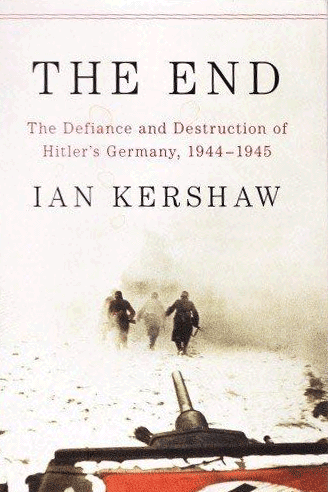
The End by Sir Ian Kershaw

I am currently reading The End, about the last year of the Third Reich and the Nazi death spiral toward Germany’s absolute destruction. It is a fascinating, mass suicidal, political dynamic that was mirrored to an even greater degree of fanaticism by Nazi Germany’s Axis partner, the Imperial Japanese. Facing the prospect of certain defeat, the Germans with very few exceptions, collectively refused every opportunity to shorten the agony or lighten the consequences of defeat and stubbornly followed their Fuhrer to the uttermost doom. It made no sense then and still does not now, seven decades later.

Adolf Hitler’s personal authority over the life and death of every soul in Germany did not end until his last breath. When surrounded by Soviet armies, trapped in his Fuhrerbunker in the ruin of Berlin, all it took for Hitler to depose his most powerful paladins, Hermann Goering and Heinrich Himmler was a word. They still commanded vast military and paramilitary security forces – Himmler had been put in charge of the Home Army as well as the SS, Gestapo and German police – but when Hitler withdrew his support and condemned them, their power crumbled. Goering, the glittering Nazi Reichsmarchal and second man in the state, was ignominiously arrested.

Even in Gotterdammerung, the Germans remained spellbound, like a man in a trance placing a noose around his own neck.

Currently, the chattering classes of the United States are uneasily working their way toward a possible war with Iran, or at least a confrontation with Teheran over their illegal nuclear weapons program (some people will object that, technically, we are not certain that Iran has a weapons program. This is true. It is also irrelevant to the diplomatic dynamic created by Iran’s nuclear activities which the regime uses to signal regularly to all observers that they could have one).  There is much debate over the rationality of Iran’s rulers and the likely consequences if Iran is permitted to become a nuclear weapons state. There is danger and risk in any potential course of action and predictions are being made, in my humble opinion, far too breezily.

In the run-up to war or negotiation, in dealing with the Iranians and making our strategic calculations, it might be useful to recall the behavior of the Germans.

Iran is a classic wicked problem

Saturday, March 10th, 2012

[ by Charles Cameron — Iran, unknown unknowns, Madhyamika philosophy and a blessed unknowing ]
.


.
image from Jackson Pollock / AustinKids
an artist’s representation of a wicked problem to be untangled?

1.

Dr. TX Hammes, who will need no introduction to most ZP readers, wrote a few days back in On Bombing Iran, A False Choice:

While there has been some discussion of Iran closing the Straits of Hormuz, there has been no consideration of other Iranian actions – mining harbors overseas (using merchant ships), major attacks on oil production chokepoints globally or major terror attacks using the nuclear equivalent explosive power inherent in many industrial practices. In short, bombing proponents assume Iran will be an essentially supine enemy and not attempt to expand the conflict geographically or chronographically.

Iran is a classic wicked problem. Any “solution” brings a new set of problems. Lacking a solution, the strategist’s job is to think through how to manage such a problem.

My train of thought now departing the National Defense University on Dr Hammes’ platform will make its way with stops at Hans Morgenthau, Jeff Conklin and Richard Feynman to a final destination deep in the heartland of Buddhist Madhyamika philosophy with Elizabeth Mattis-Namgyel.

2.

Drs. Francis J. Gavin and James B. Steinberg‘s recent Foreign Policy piece The Unknown Unknowns carried the subtitle:

If the past half-century of American political history has taught us anything, it’s that we can’t possibly know the consequences of bombing — or not bombing — Iran

and opined:

Based on our experiences — one of us a former senior policymaker, the other a historian of U.S. foreign policy — we are convinced that the “right” answer, but the one you will never read on blogs or hear on any cable news network, is that we simply cannot know ahead of time, with any degree of certainty, what the optimal policy will turn out to be. Why? Even if forecasters could provide probabilities about the likelihood of a narrow, specific event, it is simply beyond the capacity of human foresight to make confident predictions about the short- and long-term global consequences of a military strike against Iran.

3.

It appears that this sense of unknowing has application beyond the specific question of whether or not to bomb Iran. Blog-friend Peter J Munson just the other day quoted Hans Morgenthau in a short SWJ piece titled Gentile: Realities of a Syrian Intervention — using a Morgenthau quote that he also features as an epigraph to his book, Iraq in Transition: The Legacy of Dictatorship and the Prospects for Democracy.

So that’s Iran, Iraq and Syria — but the Morgenthau quote itself, from his Politics among Nations, is even more general in application:

The first lesson the student of international politics must learn and never forget is that the complexities of international affairs make simple solutions and trustworthy prophecies impossible.

Okay?

4.

And it goes further. Love that quote from Laurence J Peters that Jeff Conklin uses as the epigraph to his seminal paper on Wicked Problems:

Some problems are so complex that you have to be highly intelligent and well informed just to be undecided about them

Next up, here’s the Nobel physicist Richard Feynman speaking in The Pleasure of Finding Things Out, a Horizon / Nova interview, illustrating the approach Morgenthau takes to international relations as applicable to the grand issues of philosophy, religion and science:

I can live with doubt and uncertainty and not knowing. I think it’s much more interesting to live not knowing than to have answers which might be wrong. I have approximate answers and possible beliefs and different degrees of certainty about different things, but I’m not absolutely sure of anything and there are many things I don’t know anything about, such as whether it means anything to ask why we’re here, and what the question might mean.

5.

And how far is that from Elizabeth Mattis-Namgyel, student and wife of the lama Dzigar Kongtrul Rinpoche, writing in her book on Madhyamika, The Power of an Open Question (p. 58):

Maybe experiencing complexity brings us closer to reality than does thinking we’ve actually figured things out. False certainty doesn’t finalize anything. Things keep moving and changing. They are influenced by countless variables, twists and turns … never for a moment settling into thingness. So maybe we should question the accuracy or limitations of this kind of false certainty. Conflicting information confuses us only when we’re trying to reach a definite conclusion. But if we’re not trying to reach a conclusion in the first place — if we just observe and pay attention — we may actually have a fuller, more accurate reading of whatever we encounter.

6.

Zen, too, welcomes this “open ended” approach in its working with koans, those mysterious and / or paradoxical riddles and / or poetic statements and / or legal cases for which such teachers as Dogen Zenji had such affection. In the words of Shozan Jack Haubner:

The searching, open-ended nature of koan work yields the kind of answer, however, that frustrates easy analysis, not to mention that most exquisite of all human pleasures: being “right.” For, ultimately, koan practice teaches that as long as a question is alive in the world around us, it should not — indeed, cannot — be settled once and for all within us. Koan practice does not put life’s deepest issues “to bed.” It wakes these issues up within us, waking us up in the process.

or consider this, from Lin Jensen, An Ear to the Ground: Uncovering the living source of Zen ethics:

Judgments on right and wrong are a nearly irresistible enticement to pick sides. And that’s exactly why the old Zen masters warned against becoming a person of right and wrong. It isn’t that the masters were indifferent to questions of ethics, but for them ethical conduct went beyond simply taking the prescribed right side. For these masters, the source of ethical conduct is found in the way things are, circumstance itself: unfiltered immediate reality reveals what is needed.

Policy-makers, of course, can’t suspend judgment indefinitely — but maybe a contemplative approach in general would make them better prepared for snap judgments and sound intuitions when such are called for. Clausewitz [grinning, with an h/t to Zen here]:

When all is said and done, it really is the commander’s coup d’œil, his ability to see things simply, to identify the whole business of war completely with himself, that is the essence of good generalship. Only if the mind works in this comprehensive fashion can it achieve the freedom it needs to dominate events and not be dominated by them.

7.

And let’s go the distance…

Here’s Elizabeth Mattis-Namgyel again, from an online retreat she gave last year for subscribers to Tricycle magazine:

We need to ask, what is love or beauty or pain before we objectify it? what happens when we can abide without conclusions? you know, these are questions for the practitioner, practitioners questions… and I wanted to use one word in Tibetan that I’ve found very useful for myself… and this is the word zöpa.. this translates usually as patience or endurance or tolerance, but there’s this very subtle translation of zöpa, which is the ability to tolerate emptiness basically, which is another ways of saying the ability to tolerate that things don’t exist in one way, that things are so full and infinite and leave you so speechless, and so undefinably grand – and these are just descriptive words, but you have to use some words to communicate, I guess — the ability to bear that, that fullness, like we’ve been talking about, not turning away, not turning away.

Of Esther, Israel and Iran, pt. I – Purim

Thursday, March 8th, 2012

[ by Charles Cameron — Purim, the gift of a scroll ]

Today is the Festival of Purim in the year 5772 of the Jewish calendar, and in preparation for the event and in light of current geopolitics, PM Benjamin Netanyahu presented Pres. Barack Obama with a Megillah — a scroll containing the biblical Book of Esther, which it is a mitzvah for Jews to listen to on Purim — only last week.

Today is also International Women’s Day in the year 2012 of the Common Era.

*

Purim is a festive celebration, and while I hope to post follow ups on the tangled topics of scriptural interpretation and prophetic politics in the coming days, I thought it appropriate to open this series of posts with an image of an early Megillah from the Library of Congress (see above), to raise a glass of virtual wine in honor of the dual event, and to wish all ZP readers Chag Purim Sameach.

Some unknown calculus

Thursday, March 1st, 2012

[ by Charles Cameron — thinking inside and outside the pack, Robert Wright, John Robb, Iran, outliers ]
.

1.

Robert Wright just closed his Atlantic piece on Why Bombing Iran Would Mean Invading Iran with an exchange from a couple of years back between Gen. James Cartwright, then Vice-Chairman of the Joint Chiefs, and Sen. Jack Reed:

Senator Reed: I presume that [a bombing campaign] would not be 100 percent effective in terms of knocking them out. It would probably delay them, but that if they’re persistent enough they could at some point succeed. Is that a fair judgment from your position?

General Cartwright: That’s a fair judgment.

Senator Reed: So that the only absolutely dispositive way to end any potential would be to physically occupy their country and to disestablish their nuclear facilities. Is that a fair, logical conclusion?

General Cartwright: Absent some other unknown calculus that would go on, it’s a fair conclusion.

2.

Look, I’m way outside my zone of focus here, but that phrase “some unknown calculus” intrigues me.

Maybe Robert Wright should read John Robb. Maybe that “unknown calculus” is in Robb’s post, Israel, Iran and the Poor Man’s Cruise Missile:

One of the Stratfor research “findings” (culled from the Wikileaks stockpile) is that Israel claimed its upcoming strike on Iran would be “catastrophic enough” to cause a regime change. This claim was made both to dissuade Iran from going forward with its program, physically eliminating their ability to move forward with the program, and persuade the US to act instead of Israel.

Running through all of the potential scenarios, only one emerges that makes sense.

A strike on Iranian oil facilities. A strike so devastating that it disrupts all of its oil production, currently at 4 million barrels a day.

How to do that? Drones.

Look, Robb’s piece came out yesterday, Wright’s piece came out today — and who knows how long the editorial process might have taken. So I don’t blame Wright.

3.

The point is, Robb doesn’t think with the pack. And that means he comes up with ideas the pack is blind to.

Outliers.

Syria, Iran and the Risks of Tactical Geopolitics

Monday, February 13th, 2012


Mr. Nyet 

World affairs are much more like spider’s web than the neat little drawers of an apothecary’s cabinet. In the latter,  the contents of each drawer are cleanly isolated and conveniently compartmentalized. What you do with the contents of one drawer today has no bearing on what you do next week with those of another. By contrast, with a spider’s web, when you touch a web at any point, not only do you find it to be sticky in a fragile sort of way, but your touch sends vibrations through every centimeter of the lattice.

Which alerts the spiders.

The great foreign policy panjandrums of the United States and the Western allies – with assorted Middle-Eastern clients who have real skin in the game-  are attempting to muddle through two overlapping but different crises with Syria and Iran through the medium of international diplomatic organizations. In the case of Syria, whose Baathist-Alawite dictatorship of Bashar Assad is trying to crush a widespread uprising by pacing the body count of their atrocities to what CNN viewers can tolerate, the effort by SECSTATE Clinton and Ambassador Rice to rally the UN Security Council to issue a forceful resolution against Syria was itself forcefully rebuffed by the double-veto of Russia and China. A highly predictable event that left Ambassador Rice “disgusted” but we hope, not surprised.

The case of Iran, which incidentally is one of Syria’s few allies, involves the long-running dispute over Iran’s complex and semi-clandestine nuclear activities which, in violation of the NPT and IAEA agreements, appear designed to pressure the West by giving Iran, at a minimum, a “breakout” capacity to make some nuclear weapons.  This decade long “crisis” has recently escalated, with the EU and United States applying punishing new economic sanctions while an unknown party that everyone knows to be Israel is engaging in a campaign of  sabotage and assassination against Iran’s IRGC-run nuclear establishment. Iran for it’s part has taken hostages, blustered about closing the straits of Hormuz and threatened unspecified new breakthroughs in nuclear activities.

To say that Russia and China have been less than helpful in halting Iranian nuclear weapons-related activity is like saying Pakistan’s ISI might be involved with assisting the Taliban.  Another situation the American foreign policy establishment consistently has trouble puzzling out.

The problem with current US policy or it’s advocates is not target selection. Syria, Iran, Libya and various other states have nasty, disruptive and anti-Western regimes. Giving them the heave-ho, in the abstract, makes sense if advancing American interests  (or basic decency in governance) is the objective. However, unlike the aforementioned apothecary cabinet drawers, states and their regimes do not exist in the abstract, moving according to arid principles of conduct, but in the real world with a society of states which constantly are evaluating and re-evaluating each other’s conduct in light of interest. Which means, as with many things, in foreign policy, timing matters.

The West recently dispatched over the objections of two great powers, Colonel Gaddafi, a ruler who was also an unpopular and violent lunatic with a long pedigree of terrorism and cruelty.  That in itself was tolerable and comprehensible, if not welcome, to Moscow and Beijing, but we rubbed salt in the wound in two ways. First, simply stomping on the Realpolitik economic interests of Russia and China in Libya, as Walter Russell Meade eloquently put it:

….Russia has some specific grievances connected to Libya.  What seems to really enrage the Russians is less the overthrow of the Great Loon than the cancellation of his many contracts with Russia and the refusal of the new government to give Russia a slice of the Libyan pie.  Russia always thought the west’s democratic agenda in Libya was a laugh — and the antics of the thuggish new regime and the array of torturers and thieves now running rampant in that country has done little to dispel that view. (Again, the Putin/KGB worldview would suggest that the hard realists at the core of Washington’s power structure released the ninnies to dance themselves into a frenzy of humanitarian and democratic ecstasy while the cold purposes of the DC machine were advanced.)

But what Russia thought it expected and deserved in return for its abstention on the Libya vote was due consideration for its commercial interests in Libya.  France, Britain and Qatar seem to be dividing that pie enthusiastically among themselves and nobody is thinking about Russia’s share and Russia’s price.

Secondly, was icing Gaddafi under the moral banner of R2P, which would seem – in theory of course – to be applicable to governments very much like those run by the allies of….Moscow and Beijing. To say nothing of , Moscow and Beijing themselves, which already see the “color revolutions” as subversive Western elite sock puppets with a democracy stage show kit.  To be frank, Russian and Chinese leaders see R2P as a doctrine or policy that potentially can be used not only against their nation’s interests, but their own hold on power, which they view, accurately, as a violation of sovereignty.

So it can hardly be reassuring to Moscow or Beijing that when the dust has yet to settle in Libya, that the United States and it’s NATO allies are now pressing for new UN resolutions designed to justify military intervention in Syria to overthrow Bashar Assad. Like the late and unlamented Colonel Gaddafi, Bashar Assad is a cold-blooded murderer, but unlike the crazy Colonel, Assad is a client of Russia and close Syrian ties to Moscow go way back to the earliest days of his father’s dictatorship. There’s no way, in such a short amount of time, that an American effort to topple Assad – however justified morally – that Vladimir Putin and to be truthful, many ordinary Russians, would not view that as a Western attempt to humiliate Russia. And R2P would indicate still more humiliations to come! As Dan Trombly wrote:

….that is precisely why the United States should drop even lip service to the Responsibility to Protect. Honestly stayed, the doctrine requires intervention after intervention, and its strategic advantage to the United States relies on consistency, because without consistency the supposed normative benefits it creates quickly evaporates. Yet R2P, far from strengthening the international order, actually demands continually more resources and, each time it is employed or contemplated, calls into question the rest of the international order the United States promulgates. If the goal is to “expand and strengthen an effective international order,” why would increasing the visibility of Responsibility to Protect, a doctrine that divides the United States and Western Europe from Central Europe, the rising democracies of Brazil, South Africa, and India – not to mention, of course, the major powers China and Russia and exhausts an already overburdened and shrinking Western military capability? 

In that context, the idea that Russia and China would support a UNSC resolution to intervene in Syria and depose Assad borders on the bizarre.  Advocates of R2P, like Anne-Marie Slaughter, would counter here, arguing that both Russia and China previously accepted R2P, so their cooperation in support of a UNSC resolution on Syria should have been a manageable enterprise. It wasn’t, largely because the Russians do not seem to give R2P much weight as a part of international law, the Russian Defense Ministry being even more blunt than their diplomatic counterparts:

….Russia’s Defense Ministry on Thursday reiterated its position stated earlier by the Foreign Ministry: Russia will do its best to avoid military intervention in Syria.

 “As for Syria, we see that harsh discussions are going on in New York and we are just giving backup to our colleagues from the Foreign Ministry who are tackling these problems. Of course, we think it is necessary to prevent military intervention in Syria,” Deputy Defense Minister Anatoly Antonov told Vesti 24 TV channel.

 Russia has firmly supported Syrian President Bashar al-Assad during the uprising against his regime. Russia and China vetoed a UN Security Council resolution on Syria, backed by the Arab League and Western nations, to prevent a repetition of “the Libyan scenario.

Joshua Foust, writing in The Atlantic, addressed the situation with admirable clarity:

….A big reason for Russia and China’s intransigence is the NATO coalition that led the intervention, which badly overstepped the range of permissible actions stipulated in the UN Security Council Resolution that authorized intervention. Russia was an early critic of such actions as France’s weapons shipments to the rebels — criticism that could have been accounted for (Moscow never made any secret of its concerns) but which seemed to be ignored in the rush to intervene. President Obama made a rapid transition from saying “regime change is not on the table” last March (part of the bargain to get Russian abstention from the UNSC vote) to publicly calling for his ouster. France and the UK used similar language, ignoring the politics of getting UN approval for intervention.

….Many states, none of whom are free, worry that the West’s renewed love of intervention might one day be focused upon them. This is a critical consequence of rejecting sovereignty and declaring governments unfit to rule through a mixture of expediency and opportunity. Powerful states with poor human rights records — Russia and China included — look at what happened in Libya and see disaster, not freedom. And they are taking steps to avoid it.

The problem is not  intervention per se but an otherworldly posture of Western policy makers that embraces tactical geopolitics – i.e.  each intervention (Libya, Syria, Afghanistan, Iraq), undertaken whenever chance arises somehow exists on it’s own terms, in splendid isolation. It doesn’t, except in NATO capitols. Any nation not seeing itself as safe and impregnable is constantly calculating their opportunities and dangers based on our actions. If we continue to pursue intervention at the current tempo, blind to the perspectives and interests of others, we will get pushback on a more strategic level. And we will rue it.

NATO has been around so long, it is so enshrouded in hazy nostalgia and circumlocational love of diplomatic process, that we forget it was originally a radical departure for Americans and Europeans alike. Soviet postwar behavior under Stalin was so menacing, so intransigent, so relentlessly pressuring that the US set aside it’s traditional isolationism and the French and British their justified loathing of the defeated Germans, to make common cause against Soviet Communism. The West, on the defensive and backed into corner after corner in one tactical scenario after another by Moscow – Poland, Czechoslovakia, Greece, Iran, Berlin – took the conflict with the Kremlin to the next level by forming an enduring supranational, nuclear-armed, military alliance that ensured the next war in Europe meant WWIII.

That turned out to be more conflict than Uncle Joe Stalin was eager to buy.

We are now the ones backing others into corners. Iran, North Korea, Syria, Zimbabwe and other states ruled by kleptocrats and monsters act as buffers for China and Russia. Aside from the benefits these failed states can bring as customers for military hardware or sellers of raw materials, the attention of Western statesmen and human rights activists are diverted by the cause du jour in these hellholes, rather than being focused on what Beijing and Moscow might be up to at home or abroad.  Every dismantling of an anti-Western dictatorship, from their perspective, is a step closer to their direct confrontation with the West’s hyperactive, erratic, morally hypocritical, meddling, ruling elite who will be no more able to ignore “grave injustices” in Wuhai or Kazan than they could in Aleppo or Benghazi.

This is not an argument that we should not press our claims, or not try to keep nukes out of the hands of religious fanatics or refrain from crushing states that attack us with terrorist proxies; we can and should do all of these things with vigor. But when possible, much is to be gained by pursuing our interests in a manner that permits other great powers to at least save face. Destroying Iran’s government because of it’s nuclear activities, for example, is not a strategic “win” if  the way we do it convinces China and Russia to form a military alliance against the United States.

There is no need to forge ahead stupidly just because it is faster not to think matters through to their logical conclusions. America is heading down a road, led by an insular foreign policy clique of lawyers, activists and ex-academics, that eschews the need for maps because all that matters is that we drive well enough to take every short-cut.

Switch to our mobile site