zenpundit.com » iran

Archive for the ‘iran’ Category

Bin Laden’s death and a White House or Palace

Tuesday, May 3rd, 2011

[ by Charles Cameron ]
.

Okay, you may groan and skip quickly to the next post or perhaps read with bemused interest every time I post here about Islamic eschatology — but in either case you might have hoped that the death of bin Laden would have no apocalyptic resonance whatsoever.

Sadly enough, Anjem Choudary — co-founder with Omar Bakri Muhammad of the UK’s Islamist group al-Muhajiroun – has a press release posted on his website today titled May Allah grant Sheikh Usama Martyrdom. It begins:

The announcement this morning of the death of Sheikh Usama Bin laden has been met with joy in the United States and by other enemies of Islam and Muslims. I would like remind everyone that someone much better and much more significant then Sheikh Usama Bin laden passed away in the past, namely the Messenger Muhammad (saw) and that this never stopped the Jihad nor the spread of Islam to the East and West. Indeed the Messenger Muhammad (saw) said that the day of judgement will not come until a group of Muslims conquer the White House.

The hadith in question comes from Sahih Muslim, Book 19, On Government (Kitab Al- Imara) 4483, and reads as follows:

Narrated Jabir ibn Samurah:
.
It has been narrated on the authority of Amir ibn Sa’d ibn AbuWaqqas who said: I wrote (a letter) to Jabir ibn Samurah and sent it to him through my servant, Nafi’, asking him to inform me of something he had heard from the Messenger of Allah (peace_be_upon_him). He wrote to me (in reply): I heard the Messenger of Allah (peace_be_upon_him) say on Friday, the day on which al- Aslami was stoned to death (for committing adultery): The Islamic religion will continue until the Hour has been established, or you have been ruled by twelve Caliphs, all of them being from the Quraysh. I also heard him say: A small force of the Muslims will capture the white palace, the palace of the Persian Emperor or his descendants. I also heard him say: Before the Day of Judgment there will appear (a number of) imposters. You are to guard against them. I also heard him say: When God grants wealth to any one of you, he should first spend it on himself and his family (and then give it in charity to the poor). I heard him (also) say: I shall be your forerunner at the Cistern (expecting your arrival).

I suppose I should apologize, but “until the Hour has been established” and “Before the Day of Judgment” are both clear “end times” references.

A poster on SunniForum quotes this hadith from Muslim, one of the two hadith collections regarded as most reliable and given the epithet “sahih” (authentic), and follows it with another, citing Al-Tabarani, Al-Mu’jam al-Kabeer 2.198:

Jabir b. Samura said: I heard the Messenger of Allah (may peace be upon him) say on Friday evening, the day on which Ma’ez al-Aslami was stoned to death (for committing adultery): A small force of the Muslims will capture the white house. I said: Kisra? he replied Kisra.

Be it noted that while “white palace” or “white house” would both be appropriate translations of the term used, Kisra clearly refers not to the house of the US President in Washington DC, but to the palace of Khosrau (Chosroes) I of Persia in Ctesiphon (now an impressive ruin in Iraq).

*

I expect I found the Anjem Choudary press piece following a lead from Aaron Zelin, and if so I owe him double thanks – because he also pointed me to this quote from a member of the Ansar Forum:

al-Qaeda are the people of the Victorious Sect, which recognizes the last of the banner to the Mahdi

The victorious sect is the one sect of Islam out of very many that holds fast to the Prophet’s teaching, see the hadith collected here. As UCLA historian Jean Rosenfeld noted in a comment on the al-Sahwa blog:

Al-Qaida took the Salafi myth of the Saved Sect and the Victorious Group and applied it to themselves. This is in line with the need for converts to see themselves as heroes carrying out a transcendent purpose.The Saved Sect was turned into an eschatological myth by bin Ladin and his compatriots. It is a group of warriors who sacrifice themselves for the Din, the Land, and the people. The members of the Sect are a vanguard and they are few. Not only are they attacked by their opponents, but fellow Muslims may persecute them. Thus, if the group remains small and is regarded as practicing fitnah and is denounced, that only validates the group’s certitude that it is the Saved Sect. Only this sect — out of “72 sects” (note: this is probably a symbolic number meaning “many”) — will attain paradise at the end time.

*

A couple more clear instances of end-times associations in the (Sunni) jihadist current…
A two part meditation, part i: scenario planning the end times

Wednesday, April 13th, 2011

[ by Charles Cameron ]
.

Some people like banking, I prefer religion.

I’m perennially fascinated by the way myths and rituals, meditations and sacraments can not just motivate and move people but change them. That’s just the way I am. I spent ten minutes this morning listening to a zen nun explaining on YouTube how to strike a bell (she preferred to think of it as “inviting” the bell), how to listen to it, how to wake up.

So when it comes time for scenario planning, I find the logistical and economic side of things less interesting than the tada! End of the World! excitement that seems to pop up all over the place from time to time. On billboards here in California (with a date certain: May 21st, 2011), for instance. In videos from Iran (coming soon to a theater of war near Jerusalem). And on Glenn Beck (ditto).

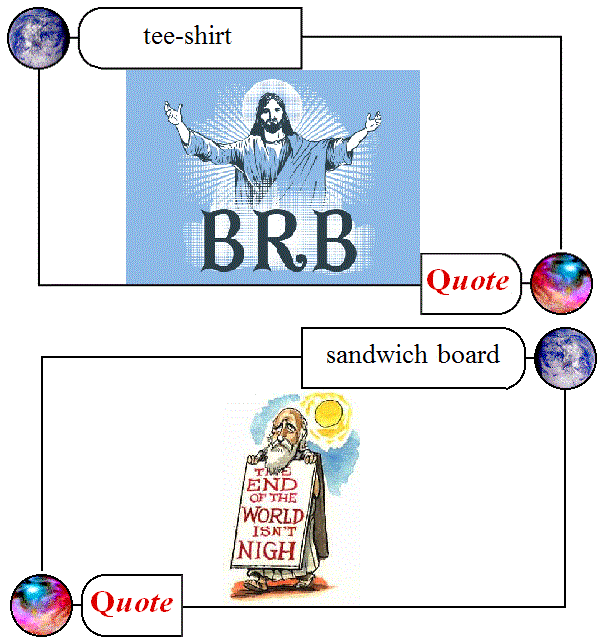
It seems to be a meme that cartoonists and satirists enjoy, too…

.

quo-end-times.gif

*

The thing is, there are two worldviews here, which we could conveniently label sacred and secular – though there’s no reason why one can’t hold a “sacred” view of the world (as I do) and not expect it to end any time soon (I don’t), or a “secular” view, and expect a new ice age or terminal global warming around the next bend in the road…

Two worldviews. And here’s where we get a “clash of cultures”.

Either there exists a definitive blueprint for the future of geopolitics – in Daniel, Ezekiel, and Revelation — or the future of geopolitics is something we’ll have to wrangle ourselves, using our best intelligence, wisdom and material resources.

On Sunday, you can go learn about the blueprint in an evangelical church – or you can kick back with the Sunday supplements and “Meet the Press”. And nobody much minds if you do one thing, and your neighbors do the other.

Things get interesting, however, when geopolitical decision times come around, and a great nation must decide what to do about the Palestinians, say, or Iran.

*

Okay.

Joel Rosenberg is a writer of popular, well-crafted thrillers – a Tom Clancy for the end times set.

Since his books are engaging, and since Glenn Beck frequently features Rosenberg on his show, his most recent novel, The Twelfth Imam, has been enjoying pretty decent sales, making it to #8 on the NYT best-seller list, #8 on Publisher’s Weekly and #10 on the WSJ hard-cover fiction lists in one week, not so long ago. And since I’m a student of comparative eschatology, I read his work with considerable interest, and follow his blog.

Today, he wrote:

As international support builds for the Palestinians to unilaterally declare their own state at the U.N. General Assembly opening session in September, I am growing increasingly concerned the President Obama is preparing to endorse such a move and even push for it. This would be a terrible mistake.Bible prophecy makes it clear that in the last days the nations of the world will divide up the land of Israel. But the Scriptures are also crystal clear that the nations will face the judgment of Almighty God for doing so. “For behold, in those days and at that time, when I restore the fortunes of Judah and Jerusalem, I will gather all the nations and bring them to the Valley of Jehoshaphat [“the Lord judges”]. Then I will enter into judgment with them there on behalf of My people and My inheritance, Israel, whom they have scattered among the nations; and they have divided up My land.” (Book of Joel 3:1-2).

Let the nations be warned by the God of Israel: they are on a dangerous and disastrous road. Let us pray they turn around before it is too late.

*

That’s actually a pitch for geopolitics by Biblical fiat — as Rosenberg explicitly points out:

One could wish the clear warning of the Bible would be enough to dissuade the President from dividing the land of Israel. I am not sure it will. Perhaps sheer politics will help.

If you believe in the sacred “Biblical blueprint” theory, and believe that the end times are very rapidly approaching, this should encourage you. If you believe in the secular “let’s hope our politicians don’t fubar this one” it might worry you – because you don’t trust some writers a couple of millennia ago to have an accurate appraisal of today’s Middle East, when even our intelligence services don’t claim to be able to predict the outcomes of various interventions in a complex situation, with unknown unknowns to boot.

And of course you might also be Israeli (and hold a sacred or secular viewpoint), Iranian (secular or sacred), or just not interested in geopolitics.

In Iran, the holders of a sacred, end times tradition are in power. In the US, the holders of a sacred, end times tradition exert some political influence. If you’re in Israel, you may hope and / or pray the Iranian end timers don’t visit their scenario on your head. If you’re a Palestinian, you may hope and / or pray the American end timers don’t visit theirs on yours.

I think it’s good to be aware of these things, but not get too excited.

*

More to follow in A two part meditation, part ii: of monks and maniacs.

The Year of Living Memory

Wednesday, April 6th, 2011

[ by Charles Cameron ]

*

Some people’s — and more to the point, some peoples’ — living memory appears to be longer than others. China, for instance, has what you might call long term living memory.

*

But first, the Crusades. When Bush 43 first used the word “crusade” in reference to the US response to 9/11, I went to Google and checked, and the first listing for “crusade against” that came up was to The Crusade Against Dental Amalgam. I’m the suspicious type, and as I suspected, the word “crusade” simply doesn’t have the same valence for most twenty-first century Americans that it has for many in the twenty-first century Arab world. In the US, a crusade is a concerted effort to change just about anything, the use of mercury in dental fillings being just one example.

Across the Arab world, however, the word has very different connotations: thus Amin Maalouf writes in The Crusades through Arab Eyes:

The Turk Mehmet Ali Agca, who tried to shoot the pope on 13 May 1981, had expressed himself in a letter in these terms: I have decided to kill John Paul II, supreme commander of the Crusades. Beyond this individual act, it seems clear that the Arab East still sees the West as a natural enemy. Against that enemy, any hostile action — be it political, military, or based on oil — is considered no more than legitimate vengeance. And there can be no doubt that the schism between the two worlds dates from the Crusades, deeply felt by the Arabs, even today, as an act of rape.

That’s long term living memory for you.

*

I’m writing this because I just read a fascinating article by Robert Barnett on the New York Review of Books blog titled The Dalai Lama’s ‘Deception’: Why a Seventeenth-Century Decree Matters to Beijing — need I say more?

The title will suffice for those who don’t have much time today — I understand, we’re all under the fire-hose one way or another — while those with the ability to sneak in ten or fifteen minutes laterally while the clock’s not watching can and should definitely read the whole thing…

*

I have just one side-observation though — the article tells us, among many other things directly relating to Tibet and the history of the Dalai Lamas:

And again, when Jiang Zemin made a brutal decision to annihilate the basically harmless Falungong cult in 1999, it is believed that he saw it as analogous to the religious movement that had started the Taiping Rebellion and nearly toppled the Qing in the mid-19th century.

I think that’s right — but what Barnett doesn’t mention, since Taiping is only an aside for him, is that the rebellion was only eventually quelled at the cost of between twenty and thirty million lives…

I mentioned my own hunch that memories of Taiping were behind the Chinese government’s fierce response to Falun Gong in question time after Ali A Allawi‘s talk on Mahdist movements in Iraq at the Jamestown Foundation a few years back, and he responded that similarly, the reason the Iraqi government took such fierce action against a small Mahdist uprising near Najaf — even calling in US air support as I recall, for an incident perhaps best compared in US terms with Waco — was that they remembered the Babi movement in their own neck of the woods, and the tens of thousands who died back in the 1850s, around the same time as the Taiping in China.

*

Living memory — which could almost be a definition of history, or at least of what historical research aims to create — can itself be long term or short, perishable or perennial.

And then there’s Psalm 90, which declares “For a thousand years in thy sight are but as yesterday when it is past, and as a watch in the night.”

Now (and I’m being playful here, albeit with a touch of serious intent) does that suggest a Memory that reaches back in perfect detail through the eons to the Big Bang and perhaps before it? Or … “twentieth century? nineteenth? the Crusades?.. it’s all a bit of a blur, I’m afraid — it all rushes by so fast…”

*

There seems to be a choice set before us as individuals — and more to the point, as peoples:

Shall we choose Lethe, and the restfulness of oblivion, or Mnemosyne — the mother of all Muses? There are, you know, immediate educational implications, and serious geopolitical implications down the road, for the choice we make…

Of the Mahdi and the Matrix

Saturday, April 2nd, 2011

[ by Charles Cameron ]

*

There’s a book by Douglas Harding that I very much doubt Samir Khan has read, which may still be relevant to the ad in Inspire #4 that Jarret Brachman pointed to in this piece on Cronus Global — in which he notes the parallel between Inspire‘s ad featuring the choice between paradise and hell, and the choice featured in The Matrix between the blue and red pills…

jarret.jpg

That image, with its headless figure, put me in mind of another image that greatly interests me — a portrayal of the Imam Mahdi by Mahmud Farshchian — so I rescued it from my files to see if it was a good enough match with the ad for me to suggest a possible second graphic influence to Jarret:

16_imam-zaman2.jpg

Not surprisingly perhaps — considering that Samir Khan’s work is, putting it crudely, an advertising graphic, whereas Farshchian’s is a work of devotional art, and that furthermore Inspire is a Salafi-jihadist journal while Farshchian is a pious Shi’ite — the match isn’t close enough for me to argue influence…

But it did set me thinking.

*

The title of the Harding book to which I referred above is On Having no Head, and although it now carries the subtitle Zen and the Rediscovery of the Obvious it actually draws on Islamic traditions quite a bit, quoting Rumi:

Behead yourself! … Dissolve your whole body into Vision: become seeing, seeing, seeing!

and Attar:

Cover your breast with nothingness, and draw over your head the robe of non-existence.

and proposing — I’m putting this into my own words, now — the notion that the physical form of a human face is in some sense no more than a mask, veil or hijab over that light “which lighteth every man that cometh into the world” (John 1.9) — a light too profound for the conventional gaze.

And it is this profundity, attributed in Islam to the prophets in general and superlatively to Muhammad, which makes their literal portrayal a matter of some controversy…

*

Farshchian’s Imam Mahdi, like Khan’s Islamist Morpheus, is headless, I’m suggesting, because, to speak figuratively, radiance has taken the place of the face.

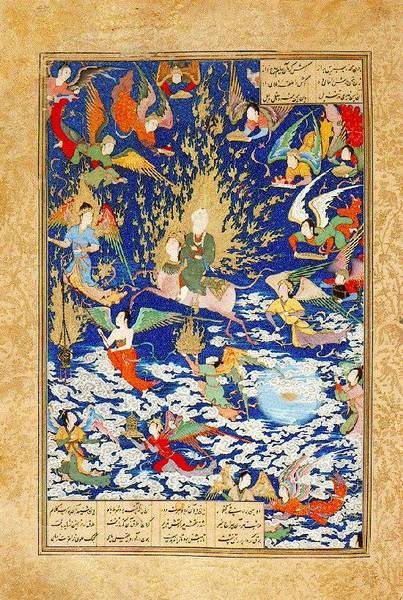
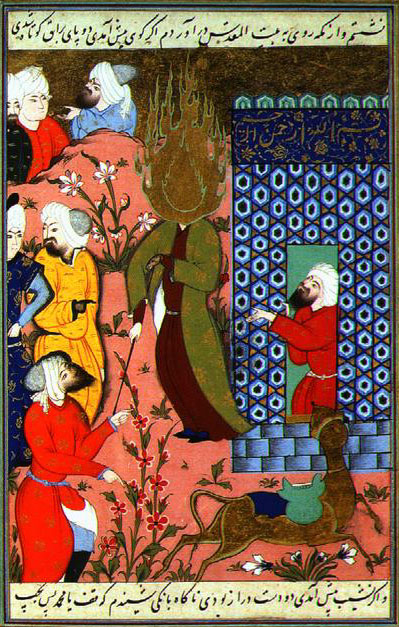
Which is also why, in this image of what must be for Muslims one of the holiest nights in the history of the world, the Night of the Mi’raj, the Prophet is portrayed without a face — or veiled — in this Persian miniature:

miraj_by_sultan_muhammad.jpg

and transfigured by his own fiery “halo” of illumination in this one:

muhammad_miraj1.jpeg

Soon soon coming of the Mahdi?

Monday, March 28th, 2011

[ by Charles Cameron ]

*

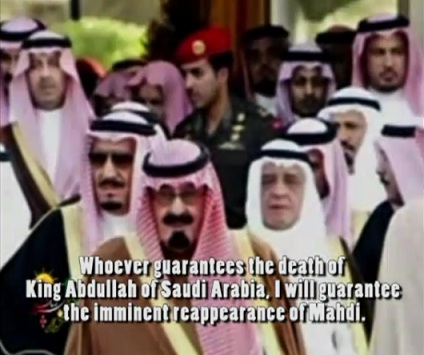
Okay, I’d say things are heating up. Here’s a screen grab from what we are led to believe is a recent video from Iran, made with government backing as described below the fold.

death-of-abdullah-sign-of-mahdi.jpg

This does not bode well…

*

The Christian thriller novelist Joel Rosenberg (author of The Twelfth Imam) has a new blog post up, in which he cites a Christian Broadcasting Network story — which in turn refers to a video posted with some introductory materials on his blog by Reza Kahlili (author of A Time to Betray: The Astonishing Double Life of a CIA Agent Inside the Revolutionary Guards of Iran).

According to Kahlili, who has also posted the full video to YouTube, it is a half-hour long program sponsored by the Basij militia and the Office of the President of Iran, affirming the soon-return of the Mahdi.

And containing “inflammatory language” about King Abdullah of Saudi Arabia (see subtitle above)?  Can I say that?

For what it’s worth, the supposed “hadith” about the death of King Abdullah is discussed in some detail at The Wake-Up Project, so it’s definitely “in the air” — but I don’t recall seeing any references to it in Abbas Amanat, Abdulazziz Sachedina, or any of the lists of Signs of the Coming I’ve read, so my suspicion is that this is an opportunistic addition to the corpus rather than a reliable hadith.

Which brings me to my last point:

I am not posting these materials to encourage panic — that’s what terrorism strives for, and it is the very opposite of what I would wish to see.  If anything, these stirrings of Mahdist sentiment should make us more careful and attentive to the serious scholarly work that has been done in this area.  Jean-Pierre Filiu‘s book Apocalypse in Islam, which I reviewed for Jihadology, would be an excellent place to start.

*

There are plenty of other things going on that I would love to track, blog about or comment on these days, but for the next while I shall try to restrain myself and focus in on this particular issue and its ramifications:

  • Contemporary Shi’ite Mahdist expectation
  • The Iranian nuclear program in the light of Mahdist expectation
  • Iranian attempts to use Mahdism to unite Sunni and Shi’a
  • Mahdism and jihad
  • The role of Khorasan in Mahdist rhetoric
  • Christian apocalyptic responses to Mahdist stirrings
  • Joel Rosenberg‘s book, The Twelfth Imam
  • Joel Richardson‘s book, The Islamic Antichrist
  • Glenn Beck‘s increasing focus on Iranian Mahdism
  • The increasing influence of Islamic and Christian apocalyptic on geopolitics

This is a pretty complex and potent mix of topics, and while I’ll post some individual pieces of the puzzle as I see it, I shall also try to put together a “bigger picture” piece with the whole mosaic laid out.

*

Apart from that, I remain deeply committed to questions of chivalry and peace-making, and will continue to monitor developments and write what I can on those topics as time allows…


Switch to our mobile site