zenpundit.com » 2011 » October » 26

Archive for October 26th, 2011

Boyd & Beyond 2011 Reading List

Wednesday, October 26th, 2011

[by J. Scott Shipman]

As promised in the original review, the following books and articles were recommended during the Boyd & Beyond 2011 event. Some of these titles are well-known in Boydian circles, others are new to me.

TEMPO Venkatesh Guru Rao [Zen reviewed this book here. Chet Richards here, and Fred Leland here. This is the most anticipated book in my anti-library, but I don’t want to read it until my book is finished and with the publisher.]

Sound Doctrine by Sid Heal

The Monks of War Esquire

The Mind of War Grant Hammond

The Talent Code Daniel Coyle [This was the lone book that I recommended this year. I read The Talent Code a few years ago and must say, Coyle makes a compelling case for the power of what he calls “deep practice.” His deep practice tracts nicely with Polanyi’s ideas of “indwelling” and tacit knowledge.

Strategic Intuition William Duggan

Unity of Mistakes Marianne Paget

Sensemaking Karl Weick

Sources of Power Gary Klein

Streetlights and Shadows Gary Klein

Heavy Matter Russell Glenn

On Combat Dave Grossman

Bond-Relationship Targeting Dr. Robert J. Bunker (this may not be the precise reference, the topic seems to be within an essay Higher Dimensional Warfare)

Blink Malcolm Gladwell

Descarte’s Bones Russell Shorto

Unrestricted Warfare Qiao Liang & Wang Xianqsui

How to Be Your Own Best Friend Berkowitz and Newman

The Logic of Failure Dietrich Dorner

The Psychology of Personal Constructs GA Kelly

The Unity of the Philosophical Experience, Etienne Gilson

Geography of Thought Richard Nisbett

The classes conducted by Edward Tufte were recommended for visualizing information.

I could not find the following references, so if you have them, please feel free to add a link in the comments or send an email and I’ll add.

1955 Hogenboom Report

Field Command

1970’s Urban Planning/Wicked Problems Rittel and Webbes

Swarming Cato

This is an excellent video series on US Strategic Nuclear Policy.

One closing note, Cameron Schaefer at his blog recommended a healthy dose of fiction for the strategic practitioner, and I agree—here is a link to his list of fiction.

UPDATE 10-29-2011

I did recommend Melanie Mitchell’s book Complexity A Guided Tour, but never managed to write it on the white board—best book I’ve read on the topic.

[Reposting] Talking the audible talk

Wednesday, October 26th, 2011

[ previous version deleted for tech reasons, now reposted — pls comment if you were unable to do so before ]

[ by Charles Cameron — importance of suiting language to intended audience, importance of graphics, Tajikistan, Yemen, importance of poetry in conflict and conflict resolution ]

.

talking-the-talk.jpg

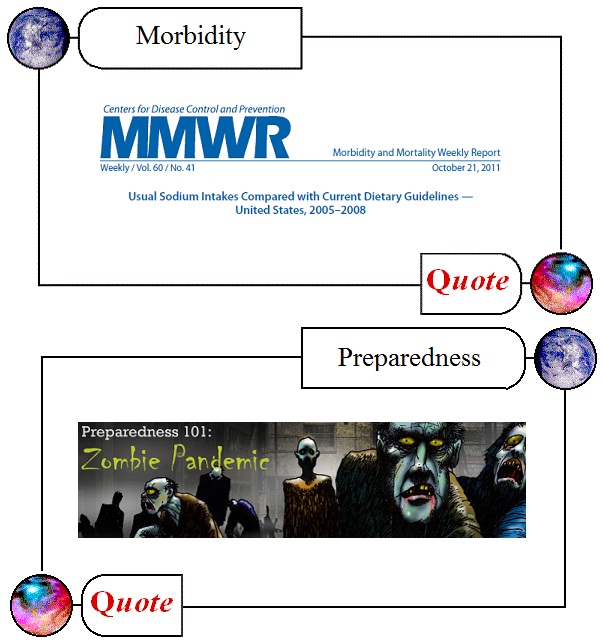
Et voila! Two publications issued this month by the Centers for Disease Control.

I’ve already stated the two lessons that I think we can draw from these, in the parenthetical header where I try to warn ZP readers of the approximate through-line and likely detours of each of my posts:

  • graphics, graphics, graphics!
  • talk the talk your intended audience can hear!

But why?

Of course I’m mildly amused at the CDC using zombies — just like Daniel Drezner — to get a serious point across. And I like the play between the seriousness of the Morbidity Report and the morbid fascination of the undead…

But I am going somewhere with all this, and on this occasion the CDC’s sense of presentation is the detour, and my through-line leads to the importance of poetry in conflict resolution.

*

I want to borrow a story from the keynote speech delivered by John Paul Lederach at the Association for Conflict Resolution’s 2004 Conference, as told to him by a Tajik professor named Abdul:

“I was tasked by the government to approach and convince one of warlords, a key Mullah-Commander located in the mountains to enter negotiations,” Abdul begins. “This was difficult if not impossible, because this Commander was considered a notorious criminal, and worse, he had killed one of my close friends.” Abdul stops while the translation conveys the personal side of his challenge.

When I first got to his camp the Commander said I had arrived late and it was time for prayers. So we went together and prayed. When we had finished, he said to me, How can a communist pray?

I am not a communist, my father was, I responded.

Then he asked what I taught in the University. We soon discovered we were both interested in Philosophy and Sufism. We started talking Sufi poetry. Our meeting went from twenty minutes to two and half hours. In this part of the world you have to circle into Truth through stories.” In the hallway Abdul’s gold capped teeth sparkle with a smile as he relays his message: “You see in Sufism there is an idea that discussion has no end.”

His point well conveyed, the Professor picks up the story again.

“I kept going to visit him. We mostly talked poetry and philosophy. Little by little I asked him about ending the war. I wanted to persuade him to take the chance on putting down his weapons. After months of visits we finally had enough trust to speak truths and it all boiled down to one concern.”

“The Commander said to me, ‘If I put down my weapons and go to Dushanbe with you, can you guarantee my safety and life?'” The Tajik storyteller pauses with the full sense of the moment. “My difficulty was that I could not guarantee his safety.”

He waits for the translator to finish making sure I have understood the weight of his peacemaking dilemma and then concludes.

“So I told my philosopher warlord friend the truth, ‘I cannot guarantee your safety.'” In the hallway Professor Abdul swings his arm under mine and comes to stand fully by my side to emphasize the answer he then gave the Commander.

“But I can guarantee this. I will go with you, side by side. And if you die I will die.’ The hallway is totally quiet.

“That day the Commander agreed to meet the Government. Some weeks later we came down together from the mountains. When he first met with the Commission he told them, ‘I have not come because of your Government. I have come for honor and respect of this Professor.’ “You see, my young American friend,” Abdul taps my arm lightly, “this is Tajik mediation.”

Think about it. Think about the Yemen.

Consider that Steven C. Caton of the Center for Middle Eastern Studies at Harvard suggests:

Every day in the Middle Eastern country of Yemen, battles are being waged that don’t involve bombs, guns or even a raised fist. Rather in Yemen, where physical violence is considered an inferior form of honor-conflict, poetry is one of the preferred weapons of choice.

If Yemen is important to you — or conflict resolution — I have a question for you:

Are you fluent in poetry?

*

Your copy of the Zombie Pandemic awaits you here. For those more interested in Morbidity and Mortality Weekly, here’s the report.

Hat-tip to Tony Judge for his paper, Poetic Engagement with Afghanistan, Caucasus and Iran: an unexplored strategic opportunity?


Switch to our mobile site
