zenpundit.com » 2012 » June » 19

Archive for June 19th, 2012

Of games IV: the apocalyptic touch

Tuesday, June 19th, 2012

[ by Charles Cameron — some recent game references with seriously playful intent ]
.

Two things, really.

If you read the Jerusalem Post, you’ll likely have seen that:

Iran, Russia, China and Syria will hold the Middle East’s largest ever war game, Iranian news outlets reported quoting unnamed sources.

According to the report, 90,000 troops, 400 warplanes and 1,000 tanks from the four countries will take part in land and sea exercises. The war games will feature Russian atomic submarines, according to Iranian media, as well as warships, aircraft carriers and mine-clearing destroyers. Semi-official Iranian FARS news agency stated that the exercise was being planned in coordination with Egypt, which recently acceded to grant the passage of 12 Chinese warships through the Suez Canal. The report stated that the Chinese naval convoy is due to dock in Syrian harbors within the next two weeks.

That’s pretty much on the materiel side of things, IMO.

*

On the other hand, if you read Joel Rosenberg, you’ll have seen all that and more — and then this:

The story is particularly intriguing — and disturbing — in light of Bible prophecies in Ezekiel 38-39 that indicate a Russian-Iranian military alliance will develop in the “last days” to attack the nation of Israel. In my first nonfiction book, Epicenter, and in my novel, The Ezekiel Option, I describe these prophecies in detail. While it remains too early to know for certain if the “War of Gog and Magog” prophecies are going to be fulfilled in the near future, geopolitical trends in recent years and even in recent months have been curiously consistent with the ancient Biblical text. A militaristic Czar — Vladimir Putin — has risen to power in Russia. Putin is the only Russian leader in history to visit Israel (7 years ago), and is preparing to visit again on June 25, trying to make the Israelis feel comfortable with him. Yet Russia has been selling billions of dollars in arms to Iran and other nations described in the prophecies. Russia is currently sending naval ships and forces to Syria. Israelis are living more securely in the land, and are more prosperous, than ever in their modern history, also consistent with the prophecies.

Followed without a paragraph break by:

To learn more about the prophecies of Ezekiel 38-39, please click here.

And the headline?

That’s more morale than materiel, I’d say!

*

So that’s Thing One, as Dr Seuss might put it. But what about Thing Two?

The big, apocalyptic war games are for big fellows like Gog, Magog and Putin, guys who can afford to wear the big-boy pants.

What about the little guys and gals?

That, YNet tells us, is where a spot tourism might come in handy…

Gush Etzion has become a hot destination in recent months for tourists seeking an Israeli experience like no other: The opportunity to pretend-shoot a terror operative. Residents of the nearby settlements, who run the site, offer day-trippers a chance to hear stories from the battleground, watch a simulated assassination of terrorists by guards, and fire weapons at the range.

The fact that the tourist attraction is located beyond the Green Line only intensifies the thrill for the visitors, who often appear disappointed when told by their guides that they are not in any danger.

That strikes me as just a tad messianic, too… in a very post-modern sort of way.

Cute pic from that YNet article, photo credit Alex Kolomoisky:

To judge by the surrounding text, that young lady’s from Miami. She’s five.
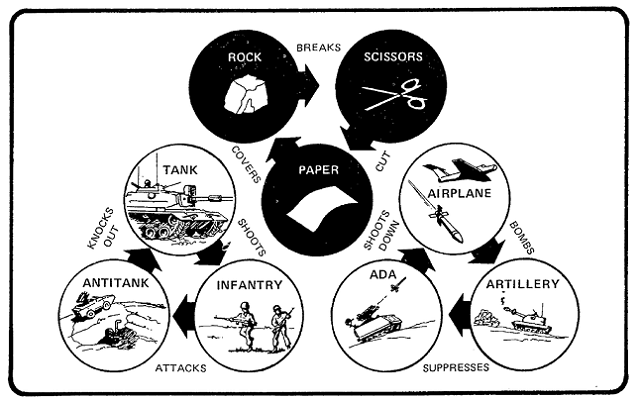
Of games III: Rock, Paper, Tank

Tuesday, June 19th, 2012

[ by Charles Cameron — some recent game references with seriously playful intent ]
.


Image from a 1975 TRADOC bulletin, now declassified

*

I thought we should check out the “strategy” section of ChaCha’s How Do I Win Rock Paper Scissors Every Time?

Good. Well that’s settled, then?

Of games II: Unified Quest — more about materiel or morale?

Tuesday, June 19th, 2012

[ by Charles Cameron — some recent game references with seriously playful intent ]
.


.

Jihadists and RAND agree. As Omar Hammami puts it:

I believe that these kuffar, despite being from amongst the most misguided of creation, have actually put their finger on something that is extremely beneficial for us to ponder. This important idea that I am referring to here is found in the beginning of the long quote I just read to you all … The authors of this RAND research stated that the ideology of al-Qaida is in reality its center of gravity…

On the US side of things, DangerRoom tells us a report recently requested by the Chairman of the Joint Chiefs considers the battle of minds to be pretty important, too:

Ten years of war have given the U.S. military more than its share of frustrations. According to an internal Pentagon study, two of them were as fundamental as they were related: Troops had terrible intelligence about Iraq and Afghanistan, and they told their own stories just as badly.

Those are some preliminary conclusions from an ongoing Pentagon study into the lessons of a decade of combat, authorized by Gen. Martin Dempsey, the multi-tour Iraq veteran and chairman of the Joint Chiefs of Staff. The study doesn’t single out any sensor or spy platform for criticism. Instead, it finds that U.S. troops didn’t understand the basic realities of society, culture and power structures in Iraq and Afghanistan, and couldn’t explain what they were doing to skeptical populations.

“We were slow to recognize the importance of information and the battle for the narrative in
achieving objectives at all levels,” according to a May 23 draft of the study, which InsideDefense
obtained, “[and] we were often ineffective in applying and aligning the narrative to goals and
desired end states.”

Okay?

Ideology, thought, aqueedah, narrative, mind, mind, mind. That’s — what can I say — a hugely influential consideration regarding whether the war is won or lost…

*

So when GEN Robert Crone visited Small Wars Journal ahead of the Unified Quest Army Future Game, I posted a comment quoting Hammami as saying “the war of narratives has become even more important than the war of navies, napalms, and knives” and posed my question:

how will words and narratives – not so much in terms of propaganda and deception but as recruitment lit, as moral suasion, as scripture, and as poetry and song — figure into your game?

*

How did that go, guys?

I know public relations figured into the game, one of the reports I’ve seen tells me that:

Though the wargame addressed issues ranging from cyberwar to terrorism, from interagency coordination to public relations, central to the scenario was the challenge of deploying US forces to countries where they have not operated before.

But that’s about it — the rest seem to be all about things like seabasing — “putting an entire Army Stryker brigade afloat on ships and then landing them at minor harbors” — and AirSea Battle — “the Air Force and Navy concept for projecting US power overseas in the face of increasingly sophisticated defenses”…

Materiel, not morale…

And besides, this goes far deeper than PR, doesn’t it?

The respective “force multiplying” impacts of martyrdoms and rumors of martyrdoms, of sacrileges and rumors of sacrileges, of bombed out weddings, poetry, ahadith — such things are difficult to assess, aren’t they? And as Klaus Klostermeier observed, “Theology at 120 degrees Fahrenheit in the shade seems after all, different from theology at 70 degrees Fahrenheit…” — even the weather can make the difference between a few stragglers and an enraged crowd…

So. Take a look at those guys around the table (above).

In game terms: have the game designers figured out an impact ratio for bullets to beliefs yet?

Of games I: Lobs over the net

Tuesday, June 19th, 2012

[ by Charles Cameron — some recent game references with seriously playful intent ]
.

Marc Lynch had an amusing post about Egypt the other day, in which he talked about Calvinball:

For those who don’t remember Bill Watterson’s game theory masterpiece, Calvinball is a game defined by the absence of rules — or, rather, that the rules are made up as they go along. Calvinball sometimes resembles recognizable games such as football, but is quickly revealed to be something else entirely. The rules change in mid-play, as do the goals (“When I learned you were a spy, I switched goals. This is your goal and mine’s hidden.”), the identities of the players (“I’m actually a badminton player disguised as a double-agent football player!”) and the nature of the competition (“I want you to cross my goal. The points will go to your team, which is really my team!”). The only permanent rule is that the game is never played the same way twice. Is there any better analogy for Egypt’s current state of play?

Let me do a DoubleQuote on that. The philosopher Alasdair MacIntyre wrote a while back:

Not one game is being played, but several, and, if the game metaphor may be stretched further, the problem about real life is that moving one’s knight to QB3 may always be replied to by a lob over the net

GMTA?

In any case, Calvin had it first:


Switch to our mobile site

