zenpundit.com » 2012 » August

Archive for August, 2012

AQ wants the SEAL dead, Rev Jones wants…

Saturday, August 25th, 2012

[ by Charles Cameron — miscellaneous appearances today of the traditional “Wanted” motif ]
.

Just another instance of the close proximity of opposite ends of a spectrum…

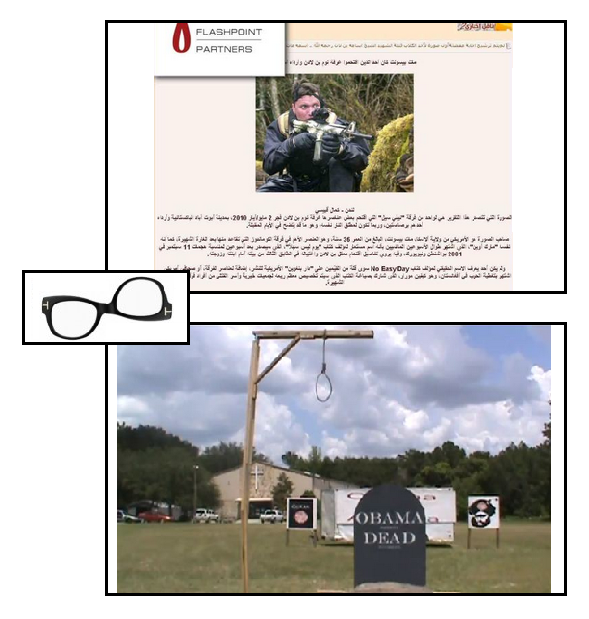
A poster on one of the Al-Qaida forums would like to see the SEAL who was on the raid that killed bin Laden dead, while the Reverend who delights in burning other people’s scriptures appears to want the head of his President in a noose… metaphorically, perhaps?

Sources:

Screenshot of threat to Navy SEAL author posted on “Al-Fidaa”, an officially-sanctioned Al-Qaida web forum, with h/t Evan Kohlmann @IntelTweet
Dr Terry Jones says Obama dead in 2012, with h/t JM Berger @intelwire…

As JM says: Stay classy, Terry Jones.

Yiddish humor, US Presidential Election

Friday, August 24th, 2012

[ by Charles Cameron — Jewish Democrats suggest humorous barbs for Jewish Republicans to digest ]
.

As those who follow my strand of posts her on Zenpundit know by now, I’m not a great one for taking sides: I imagine very few bridge builders are, and my real interest is in building bridges.

I am also, in general, interested in the ephemeral signals that go on between and within opposing camps — because they’ll often portray a different side of things from what’s in the official pronouncements.

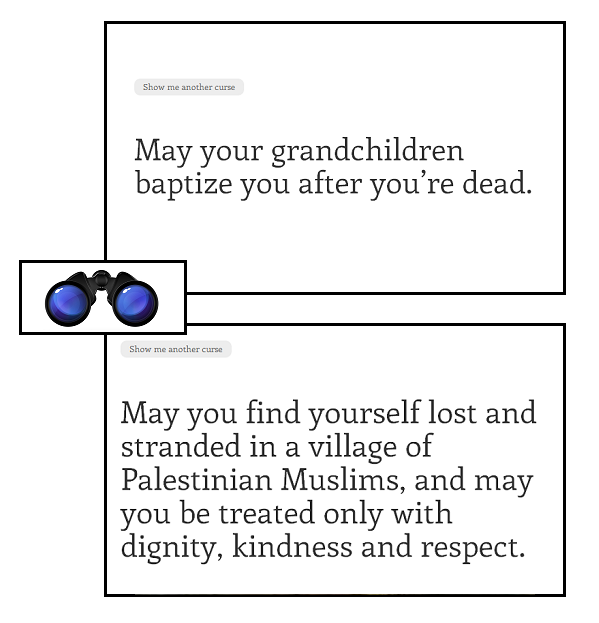
What I’m offering here, then, is a fleeting glimpse into some Jewish humor from the Democratic side of things:

.
— two “curses” from the from the Yiddish Curses for Republican Jews website.

As wry humor, I’m okay with these. As embittered humor, not so much.

And I don’t know the people who posted these “curses” — though I’m reasonably sure they didn’t intend them as actual, may G*d do this to you and I mean it, curses.

Frankly, I’m interested in the religious content.

**

I’m interested in the jokes.

I’m interested in the leaflets, the comments in the comment sections of websites — and in the winks, the nudges and the nods.

I’m interested in the differences between “in-house” and “external” explanations of things, what the differences may actually mean, and what they may get interpreted to mean. I’m interested in the asides, the sneers and smears, the jokes, the ambiguous threats, the real hatreds, the moments of reflection, the metanoias, changes of heart, repentances.

At times, the materials I run across are threatening, at times witty or droll, at times insightful, and at times completely unhinged from reality, but they usually have something to teach us about undercurrents — about the variousness of human thoughts and feelings.

We humans are a strange lot, each one of us so singular that we have a hard time getting our heads around the differences between us — differences that can make all the difference between peace and war, life and death.

**

I’m not going to explain the jokes, but I am going to take just a quick look at their religious content.

One of the qualities that is, IMO, most likeable about Jewish culture is that it delights in self-mockery. The New York Times journalist Michelle Goldberg tweeted a Jewish joke yesterday, to which I responded with a quote from Martin Luther:
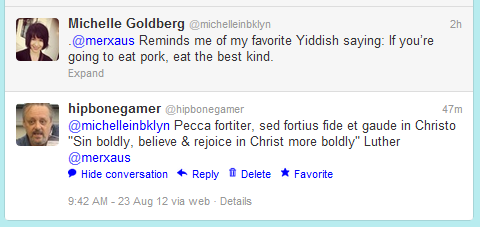
Now I don’t know about Michelle, but I didn’t intend my quote from Luther — “sin boldly” — as representing either my personal advice to the world at large, or Luther’s, except perhaps in a very limited sense such as the one Dietrich Bonhoeffer offered as his explanation of Luther’s meaning.

Bonhoeffer’s question is the obvious one:

Is this the proclamation of cheap grace, naked and unashamed, the carte blanche for sin, the end of all discipleship? Is this a blasphemous encouragement to sin boldly and rely on grace? Is there a more diabolical abuse of grace than to sin and rely on the grace which God has given?

And his response?

Take courage and confess your sin, says Luther, do no try to run away from it, but believe more boldly still. You are a sinner, so be a sinner, and don’t try to become what you are not. Yes, and become a sinner again and again every day, and be bold about it. But to whom can such words be addressed, except to those who from the bottom of their hearts make a daily renunciation of sin and of every barrier which hinders them from following Christ, but who nevertheless are troubled by their daily faithlessness of sin? Who can hear these words without endangering his faith but he who hears their consolation as a renewed summons to follow Christ? Interpreted in this way, these words of Luther become a testimony to the costliness of grace, the only genuine kind of grace there is.

**

So no, I don’t think all religiously-themed tweeting and web-based cursing is to be taken literally.

But I do find it interesting that Michelle jokes about kosher, and I joke about sinning boldly — and that the Yiddish humor displayed on the “curses” website includes references to the LDS practice of proxy baptism for the dead and an indication that it might be uncomfortable for those with strong anti-Muslim feelings to meet the generous hospitality that so often characterizes Muslim cultures.

So let’s dig into those two themes in a little more depth.

**

Official Latter-day Saints doctrine teaches:

Jesus Christ taught that baptism is essential to the salvation of all who have lived on earth (see John 3:5). Many people, however, have died without being baptized. Others were baptized without proper authority. Because God is merciful, He has prepared a way for all people to receive the blessings of baptism. By performing proxy baptisms in behalf of those who have died, Church members offer these blessings to deceased ancestors. Individuals can then choose to accept or reject what has been done in their behalf.

And while the practice of baptizing the dead by proxy may seem strange to most Christians, the Latter-day Saints can point to I Corinthians 15.29:

Else what shall they do which are baptized for the dead, if the dead rise not at all? why are they then baptized for the dead?

and I Peter 4.6 for precedent:

For for this cause was the gospel preached also to them that are dead, that they might be judged according to men in the flesh, but live according to God in the spirit.

Maybe so — but Saints Peter and Paul, though Jewish by birth, are now generally reckoned Christians, having accepted the belief that Jesus was the awaited Jewish Messiah, the Christ — so their epistles are not canonical texts for mainstream Judaism.

**

Feelings in the Jewish community can run pretty strongly on the issue of Mormon believers’ baptisms of Jewish believing dead:

The wrongful baptism of Jewish dead, which disparages the memory of a deceased person is a brazen act which will obscure the historical record for future generations. It has been bitterly opposed by many Jews for a number of years. Others say they will never stop being Jews, simply because there is a paper saying they had been baptized, that the act of posthumous baptism is unimportant and should be ignored. We think this to be a narrow, parochial, and shallow view. We will continue opposing this wrongful act which assimilates our dead to the point where it will not be possible to know who was Jewish in their lifetimes.

[ … ]

A protest drive initiated by Jewish genealogists escalated it to a nationally publicized issue that was followed by public outcry. American Jewish leaders considered it an insult and a major setback for interfaith relations. They initiated discussions with the Mormon Church that culminated in a voluntary 1995 agreement by the Church to remove the inappropriate names. Activists continue to monitor Mormon baptismal lists, seeking removal of inappropriate entries.

Indeed, in February of this year it was discovered that the Holocaust victim Anne Frank had been baptized by proxy — for what one researcher said was the ninth time.

The Nobel laureate Elie Wiesel responded with passionate anger, and the Mormon Church with an apolpogy and a firm statement that the practice was prohibited.

LDS spokesman Michael Purdy made it clear that the Church “is absolutely firm in its commitment to not accept the names of Holocaust victims for proxy baptism.”

There are serious issues here: as humans, we can listen to one another with respect, and work them out.

**

Palestinian Muslim hospitality towards Jews?

Miftah is an Ethiopian who visited some Palestinian shepherds in company with people sympathetic to the Palestinian cause:T

he group I went with was a mostly Israeli – international activists’ group that accompanies shepherds in the village as they graze their herds. Since these shepherds face attacks from settlers and soldiers frequently, the purpose of the trip was to document and confront the settlers or soldiers if they try to harass the shepherds.

These were people the Palestinians had reason to respect, Israelis and foreign activists sympathetic to their cause — but the degree of hospitality they were shown nicely illustrates the innate courtesy of so many pastoral peoples…

As we were heading back from the hills to where our mini-van was, these shepherds we had met offered to take us home for some tea and coffee. Mind you, it’s the Ramadan fasting season and all of them were fasting. They would offer us water, coffee and bread even though the last meal they had was at dawn that morning and would not have any food or water until dusk that evening. In Ramadan, even people who don’t fast don’t eat in public or in front of people who fast. But out of true hospitality, they extended their “‘Mitzvah’ – their act of kindness” to us, as one of the Israeli activists put it

**

The story is an old one: the person of few possessions who will kill one of their handful of sheep to feed the passing stranger…

In this second “curse” we glimpse the long tradition of hospitality to strangers without which the great trade routes of the ancient would would not have permitted China to supply Europe with silks, nor Roman jewelry to have found its way into Japanese tombs

The First Battle — a review

Friday, August 24th, 2012

[by J. Scott Shipman]

The First Battle, Operation Starlite and the Beginning of the Blood Debt in Vietnam, by Otto J. Lehrack, Lt.Col., USMC, Ret.

This is an older book, but important. A few weeks ago I was having lunch with a good friend, Bruce. Bruce is a Vietnam veteran and since both of us are readers many of our lunch conversations revolve around the books we have read, and this meeting was no exception. Bruce enthusiastically recommended The First Battle and No ShiningArmor, both by Lt.Col. Lehrack, and Last Men Out, by Bob Drury and Tom Clavin. He said Lehracks first twenty pages of The First Battle was the best description of the situation that led the United States to become involved in Vietnam. Since my knowledge of Vietnam is embarrassingly meager, I ordered all three when I returned home from lunch. Given Bruce’s descriptions, The First Battle was first up. Lehrack begins the first chapter, Inching Towards the Abyss, with a profound first sentence:

The United States came to this pass in baby steps, characterized more by Cold War fears, hubris, and inattention than by level-headed policy examination.

(Sounds familiar doesn’t it?)

The result of Lehrack’s effort is a readable and powerfully inspiring story of the first battle of the Vietnam War fought only by Americans, specifically, the United States Marine Corps. Code named, Operation Starlite, this “first battle” was a coordinated air, sea, and land attack, but to the green, untested Marines fighting battle-hardened Viet Cong troops nothing about this first encounter was typical or routine.

Lahreck, drawing on interviews with warriors from both sides, provides the reader an up-close view of the savagery and the valor of this battle that resulted in two Americans receiving the Congressional Medal of Honor. The prose is fast paced and detailed, but not so detailed one with no experience/knowledge of Marine Corps jargon can’t keep up. Lehrack includes a fairly exhaustive glossary of the unique terms used, so the military/USMC novice will have a ready guide close-by.

The book is divided in three parts. Part 1 describes general attitudes of the American public, politicians, and military personnel with respect to Vietnam. Part 1 also provides a description of the planning process for the battle and the rationale. Also included is an assessment by the Viet Cong of their American opponents, dated 3 July 1965 (about a month prior to Operation Starlite):

American strong points

  • The have reached the training level of an expeditionary force.
  • Armed with modern weapons, lighter than French expeditionary forces, they have quick transportation, quick movement, have capability of quick reinforcement, thanks to vehicles, aircraft, boats.
  • Usually concentrated in groups.

Weak points compared with French

  • No spirit of combat; afraid of guerillas; always rely on modern weapons, so they lose initiative and self-confidence (when in contact, they call fire for support and reinforcement); sometimes artillery must conduct fire support for the whole period of operation.
  • Lack of combat experience, just know combat in theory only (through field manuals). Moreover, on a strange terrain, they usually walk in the open, bewildered like ducks (we say that American troops are most opportune targets for guerrillas).
  • Much effort required for messing; and water. Food must be supplied for each meal by helicopters. When moving to any place they must use helicopters and artillery fire support, so objective will always be disclosed, brining good opportunity for guerrilla follow up.
  • Cannot undergo long and hard operations. When operating far from base, about seven kilometers, must use vehicles.
  • Not able to bear local weather and climate, so troops will fall ill.
  • Defensive positions sometimes well organized but they are slow to get that way. In one instance it took ten days to organize defenses and thirty to install mines.
  • They do not know the terrain well.
  • They run slowly.

(This list is offered for those readers who have insight into whether these weaknesses persist in our military—I do not know.)

In Part 2, Lehrack describes the battle, and the aims of the American commander “to isolate, and then destroy the enemy.” Lehrack follows individuals and units through the battle, and spares no detail in the hardships, risks, and depravations endured by the participants. He offers a gripping and realistic description of the “fog of war:”

The Marines quickly learned a practical lesson that all warriors have known since ancient times. Theoretically, one is supposed to line up in an assault or other planned formation and fight that way. But once battle is joined the formation rapidly degenerates into a series of isolated small actions. In Starlite, as in most battles, it seemed that the fights generally meant that four or five men on one side would be heavily engaged with a similar number on the opposite side. Each combatant became so preoccupied with taking care of his situation that he often had little knowledge of and didn’t really care what was going on a few yards away. Throw in the sounds, the smells, and the fear and you have the notorious “fog of war” that explains why such widely differing accounts describe the same battle.

Good friend of this blog, Lynn Wheeler adds this observation in another forum on the effect Starlite had on Viet Cong planning/tactics::

Perhaps the most important reason for the so-so result was that the Viet Cong had gained an enormous appreciation of the Marines’ ability to project power from the sea as a result of Starlite. Never again in the course of the war did they permit their units to tarry on the coastal plain. When they had a job to do near the water, they came in and did it, and then they fled inland again. Although they developed good antiaircraft techniques and weaponry during the war they had neither the ordnance nor the expertise to thwart an amphibious landing force.

Part 3 is titled The Blood Debt. As eloquently as Lehrack introduced the reader the to attitudes and assumptions of most Americans in his opening chapter, so he concludes. Fifty-four Americans died and an estimated six hundred of the enemy perished in Operation Starlite. By the numbers and a “body count” mentality, we “won” the battle, but in 1965 the Vietnam War was just getting started, and we know how it ended. Lehrack writes:

America spent another ten years, and more than 56,000 additional lives, to follow a failed policy. Like gamblers who have already lost their gambling money, and then the rent money, and the car payment, and then the grocery money, and then borrowed or stole in the hope of changing their luck, the Johnson and Nixon administrations kept signing markers to America for a debt in gore that they hoped a reversal of fortune would justify.

The criminal portion of this gut wrenching conclusion is that American political leaders had no confidence in a military solution in Vietnam. Lehrack quotes President Johnson speaking with a senator, “They hope they will wear us out. And I really believe they’ll last longer than we do.” Eventually, and thankfully, the American public said, “no more.” Amazingly, Lehrack citing Hugh M. Arnold‘s examination found that of an official justification of the war there “were a total of twenty-two separate American rationales: From 1949 to 1962, the emphasis was on resisting communist agression; from 1962 to 1968, it was on counter-insurgency; after 1968, it was on preserving the integrity of American commitments.”

Lehrack correctly laments American unfamiliarity with Vietnamese culture and their visceral attitude towards foreign invaders. We were making the world safe for democracy, and the Vietnamese fell back on nationalism as a recruiting tool and justification for feeding over a million people into the maw of war. Lehrack also points out that Marine leadership knew early on “that Vietnam was more a political war than military.” The Marines had the Small Wars Manual derived from their actions in the Philippines, Nicaragua, and Haiti while the U.S. Army had four pages in their Field Regulations on guerilla warfare. Lehrack speculates a pacification effort, something the Marines knew well, may have been successful if properly applied to good governance on the part of the South Vietnamese government.

Of course these speculations are just that, and there is little evidence given our current predicament in Afghanistan that we learned our lessons. The shelf-life of hubris is eternal.

Bruce was right; this is a powerful little book, and comes with my highest recommendation.

Addendum: LCDR B.J. Armstrong has an enlightening essay on rotary aircraft, which includes Operation Starlite here.

Cross-posted at To Be or To Do.

Game On, Face Off, Onion

Friday, August 24th, 2012

[ By Charles Cameron — with almost no effort & no comment — games, war, realism, Onion ]
.

Modern Warfare 3:

Modern Warfare 3 — Face Off:

The Onion’s Modern Warfare 3:

What eye and mind can reasonably absorb

Friday, August 24th, 2012

[ by Charles Cameron — visual thinking, graphical presentation, the magical number seven plus or minus two, human intelligence ]
.

Look:

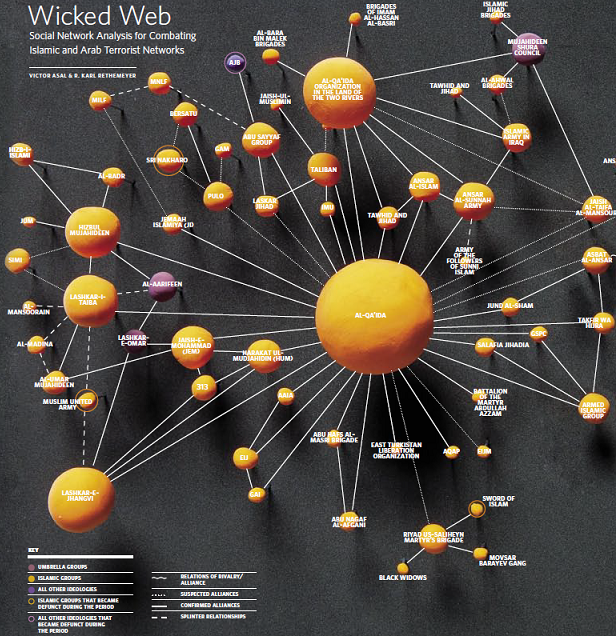
click image to download pdf & see pp 12-13 for closer, full-size look

Got it? That’s part of a double-page spread from the University of Maryland’s START Program report for 2011:

The National Consortium for the Study of Terrorism and Responses to Terrorism—better known as START – is a university-based research center committed to the scientific study of the causes and human consequences of terrorism in the United States and around the world.

Looking through the rest of the report, I’m tempted to say a snazzier, jazzier magazine I’ve seldom seen!

**

I maintain that’s far nicer to look at, but no more comprehensible than, this gorgeous and justly infamous power point slide:

click image for a closer, full size look

Got that one, too? That was a slide used to help GEN McChrystal understand that war he was fighting.

**

Watson and Crick introduced their 1953 paper in Nature, A Structure for Deoxyribose Nucleic Acid, with these words:

We wish to suggest a structure for the salt of deoxyribose nucleic acid (D.N.A.). This structure has novel features which are of considerable biological interest.

No less witty is the opening of George A. Miller‘s only somewhat less celebrated paper three years later in The Psychological Review, The Magical Number Seven, Plus or Minus Two: Some Limits on Our Capacity for Processing Information:

My problem is that I have been persecuted by an integer. For seven years this number has followed me around, has intruded in my most private data, and has assaulted me from the pages of our most public journals. This number assumes a variety of disguises, being sometimes a little larger and sometimes a little smaller than usual, but never changing so much as to be unrecognizable. The persistence with which this number plagues me is far more than a random accident. There is, to quote a famous senator, a design behind it, some pattern governing its appearances. Either there really is something unusual about the number or else I am suffering from delusions of persecution.

The gist of Miller’s piece (and by gist I explicitly mean the always misleading broad strokes version) is that we can usually manage to hold five to nine chunks of thought in mind at any given time, but that if we want to understand more than that, we need to “chunk” our thoughts in such a way that we think of “seven plus or minus two” items (Miller’s “magical number”) but can peer into any one of them and see it divided into lesser portions which we can also comprehend, in what I’ll call a tree > trunk > limb > branch > twig > leaf arrangement — always remembering that a tree may be part of a forest, and that sometimes ee just can’t see the forest for the trees…

Miller explains chunking succinctly thus:

It seems probable that even memorization can be studied in these terms. The process of memorizing may be simply the formation of chunks, or groups of items that go together, until there are few enough chunks so that we can recall all the items.

Neat, hunh? And he concludes, with another pleasant touch of wit:

And finally, what about the magical number seven? What about the seven wonders of the world, the seven seas, the seven deadly sins, the seven daughters of Atlas in the Pleiades, the seven ages of man, the seven levels of hell, the seven primary colors, the seven notes of the musical scale, and the seven days of the week? What about the seven-point rating scale, the seven categories for absolute judgment, the seven objects in the span of attention, and the seven digits in the span of immediate memory? For the present I propose to withhold judgment. Perhaps there is something deep and profound behind all these sevens, something just calling out for us to discover it. But I suspect that it is only a pernicious, Pythagorean coincidence.

**

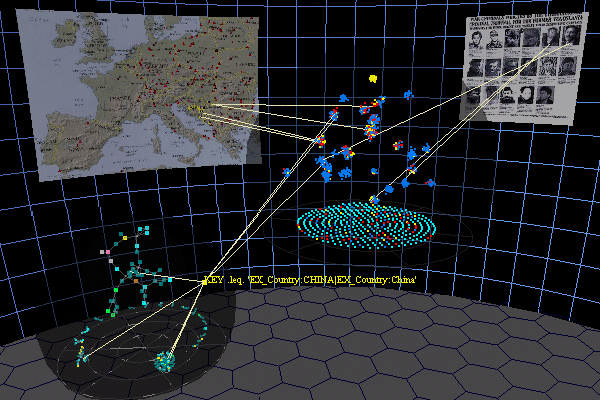
Of course there are high-node graphics programs like Starlight Analytics (from Future Point Systems via Battelle and the Pacific Northwest National Laboratory) which allow you to sample one of a cluster of very similar nodes, or to see where the outliers are and zero in on them…

or to focus in on only those nodes connected to one particular name or place on a map:

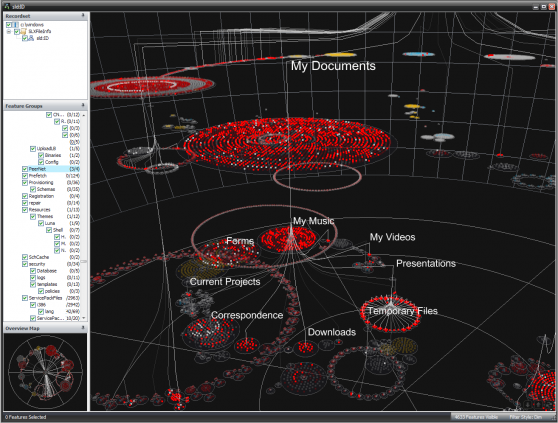
But can you find a file you’re looking for any faster by locating it somewhere in this graphic…

than by using your usual search methods?

So okay, high level analytics like Starlight may be useful for analysts who have the costly software and time to pinpoint and track and zoom and annotate and comprehend, become alarmed or calmed, and respond appropriately.

But people reading that glossy report from the START program? People trying to brief GEN McChrystal from a powerpoint slide?

Seven. Seven plus or minus is your number.

**

Once more, with feeling.

The moral of this tale is that graphical presentations of ideas to explain complexities should generally feature seven plus or minus two nodes, maximum, for eye and mind to consider at any one time, with perhaps an additional three or four that the eye can glide across to, forming a second chunk — thus delivering a maximum of 13 nodes without zooming in.

for the direct communication of major drivers in a complex situation — seven nodes plus or minus two is your optimal number.

**

Ah — but see, I forgot to show you the rest of that first image:

You can handle grasping the import of an image two parts, surely, can’t you?

Okay then — if you can, perhaps you can help me out…


Switch to our mobile site