zenpundit.com » 2012 » November

Archive for November, 2012

The Pillar of Cloud and the Pillar of Fire

Thursday, November 15th, 2012

[ by Charles Cameron — IDF terminology and the Gaza conflict, explanations of Exodus, an IDF video, Megillah 10b and the koan “with God on our side” / “with God on all sides” ]
.
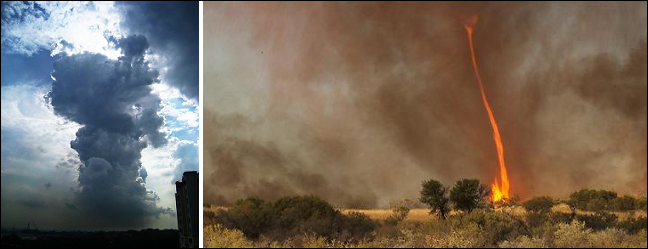
photo credits: Schristia, Cloud; Chris Tangey, Fire

.

I’m curious.

The IDF calls today’s Israeli operation in Gaza “Operation Pillar of Defense” in English, but as John Cook points out in Gawker, uses the term Hebrew term “Pillar of Cloud” in Hebrew.

There’s a great deal of interest here, apart from the difference between their use of non-Biblical terminology in English and Biblical terminology in Hebrew. One point that catches my ear, a poet being a poet, is that the phrase “Pillar of Cloud” is in fact only one half of a double reference…

Thus in Exodus 13.21-22 we read:

And the LORD went before them by day in a pillar of a cloud, to lead them the way; and by night in a pillar of fire, to give them light; to go by day and night: He took not away the pillar of the cloud by day, nor the pillar of fire by night, from before the people.

**

There are various ways of understanding the pillar of cloud and pillar of fire, but it’s pretty clear that there’s only one pillar —

And it came to pass, that in the morning watch the LORD looked unto the host of the Egyptians through the pillar of fire and of the cloud… [Exodus 14.24]

which is called a pillar of cloud by day and a pillar of fire by night, perhaps simply because we are speaking of theophany — the Divine Presence made visible — perhaps because smoke from a brazier is more visible in daylight and flames at night — perhaps because as Hans Goedicke, then chairman of the department of Near Eastern Studies at Johns Hopkins, suggested, the source of both fire and smoke was the eruption of Santorini around 1600 BCE.

The difference in worldviews behind those explanations alone is a matter of considerable interest.

**

Linguistically, however — and this is where the poet being a poet comes in — there are two pillars, and I have to wonder whether the name “Pillar of Fire” is being saved for a later and perhaps more impressive (“shock and awe”) operation, or — in line with the “by day and by night” distinction — refers to the covert side of the same op?

Not that anyone would be likely to give me that information, or that I’d have any use for it if they did.

But the Biblical phrasing is powerful, and “Pillar of Defense” doesn’t make a whole lot of sense — besides, cloud and fire go together in Hebrew in much the same way smoke and mirrors do in English.

Of the three choices, I’d have gone with “Pillar of Fire” myself.

**

An IDF spokesperson, in a response to Cook’s Gawker article, claimed:

I think that every example of Bible quotes you cited has defensive connotations, rather than “vengeful.”

One of those quotes is Exodus 14:24, which I quoted above but will now give in full, along with verse 25:

And it came to pass, that in the morning watch the LORD looked unto the host of the Egyptians through the pillar of fire and of the cloud, and troubled the host of the Egyptians, and took off their chariot wheels, that they drave them heavily: so that the Egyptians said, Let us flee from the face of Israel; for the LORD fighteth for them against the Egyptians.

I think calling that “defensive” is a bit one-sided, but on the other of the two hands in question, so is calling it “vengeful”.

The Israelites saw themselves in the larger context as escaping Egyptian oppression, the Egyptians obviously considered themselves under attack in the short term — just as surely as the people of Gaza must feel under attack by the oppressive Israelis today, while the Israelis clearly feel under attack by terroristic Hamas and its rockets. But hey, the IDF spokesman only offered his explanation that the Pillar of Cloud and Defense was “defensive” as “Just my two cents”…

FWIW, those two verses from Exodus sound just a little like Quran 33.26:

And He brought down those of the People of the Book who supported them from their fortresses and cast terror in their hearts; some you slew, some you made captive. And He bequeathed upon you their lands, their habitations, and their possessions, and a land you never trod. God is powerful over everything.

That’s an ayat that has always interested me, because of the use of the word “terror” found in a number of translations including this one, by AJ Arberry — others have “awe” or “panic”, but “terror” is interesting in the context of its contemporary usage.

**

Here’s the current strike counter strike in two tweets:

**

Okay, let’s get as close to visceral as modern technological warfare permits. After the recent truce was broken and numerous rockets fired into Israel, the IDF fired a missile that killed Hamas military leader Ahmed Jabari, and quickly put the video feed up on YouTube:

**

People are killing and getting killed. Should that be a matter for concern, or delight?

The narrative from which the IDF drew the name of their campaign in Gaza is taken from that of Israel’s escape from Egypt in Exodus, which also includes the parting of the waters and destruction of the Egyptian army:

And the angel of God, which went before the camp of Israel, removed and went behind them; and the pillar of the cloud went from before their face, and stood behind them: And it came between the camp of the Egyptians and the camp of Israel; and it was a cloud and darkness to them, but it gave light by night to these: so that the one came not near the other all the night. And Moses stretched out his hand over the sea; and the Lord caused the sea to go back by a strong east wind all that night, and made the sea dry land, and the waters were divided…. [Exodus 14.19-21]

And it came to pass, that in the morning watch the Lord looked unto the host of the Egyptians through the pillar of fire and of the cloud, and troubled the host of the Egyptians, And took off their chariot wheels, that they drave them heavily: so that the Egyptians said, Let us flee from the face of Israel; for the Lord fighteth for them against the Egyptians. And the Lord said unto Moses, Stretch out thine hand over the sea, that the waters may come again upon the Egyptians, upon their chariots, and upon their horsemen. And Moses stretched forth his hand over the sea, and the sea returned to his strength when the morning appeared; and the Egyptians fled against it; and the Lord overthrew the Egyptians in the midst of the sea. [Exodus 14.24-27]

Here again we see an instance of what I have called the two-fold logic of scriptures: In the Babylonian Talmud, Megillah 10b, R. Johanan tells us:

The ministering angels wanted to chant their hymns, but the Holy One, blessed be He, said, The work of my hands is being drowned in the sea, and shall you chant hymns?

to which R. Eleazar responds:

He himself does not rejoice, but he makes others rejoice.

**

To my mind, what we’re looking at here is a global koan: the immediate and eternal paradox of life and death.

But more on koans shortly.
Wei Wu Wei, or the inactionable option

Tuesday, November 13th, 2012

[ by Charles Cameron — the excellence of today’s piece by Joshua Foust and the importance of intelligence that is not actionable, with illustrations from Zenpundit, Dickens and Shakespeare ]
.

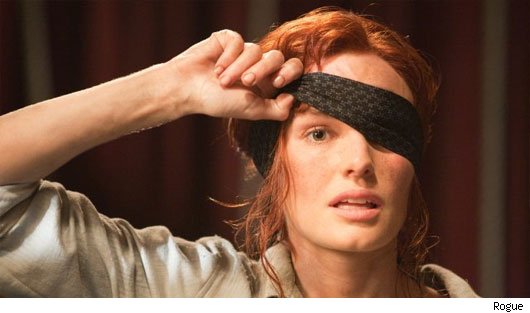
Kate Bosworth peers out from under a blindfold in the 2010 movie, Warrior's Way

**

Josh Foust just posted an important piece in his Atlantic column and on his American Security Project blog titled Myopia: How Counter-Terrorism Has Blinded Our Intelligence Community, with the subtitle:

The United States’ overriding interest in “actionable” information on terrorists has produced a dangerous form of tunnel vision.

Bingo.

This is important, and I’ll circle back to it. But first, please follow the full arc of the circle…

**

I post little headers at the top of all my Zenpundit posts these days, to let people know where on the irrelevance scale my latest offering should be placed — I guess the idea came from the 19th century practice of offering “synoptic chapter headings” to titillate the reader of novels, as when Mr Dickens titles one chapter of The Pickwick Papers:

Chapter XVIII. Briefly illustrative of two points; first, the power of hysterics, and, secondly, the force of circumstances

I digress.

Some while back, I posted a piece called The Haqqani come to high Dunsinane here on Zenpundit, and gave it the header:

why is non-actionable (useless) intelligence sometimes the most intelligent (useful)? – importance of multiple frames for complex vision

The piece was about the Haqqani network, but obliquely so — I was leaping from an image in a video where a cluster of Haqqani-guys in training were running around dressed as trees, to a similar image in Shakespeare‘s Macbeth:

Macbeth shall never vanquish’d be until
Great Birnam wood to high Dunsinane hill
Shall come against him.

Well, that was the prophecy, and Macbeth took it to mean he’d never be defeated in battle:

That will never be.
Who can impress the forest, bid the tree
Unfix his earthbound root? Sweet bodements! Good!

Prophecies and portents are notorious for their double meanings, however, and this one’s fulfillment comes when Malcolm gives the order to his men:

Let every soldier hew him down a bough
And bear’t before him. Thereby shall we shadow
The numbers of our host and make discovery
Err in report of us.

Heh — “discovery” here means what today we’d call “intelligence” — and notice the importance here of reading multiple meanings out of a single sign.

A while later, a messenger arrives, and declaims:

As I did stand my watch upon the hill,
I look’d toward Birnam, and anon, methought,
The wood began to move.

This turns out to be true enough, for in the next scene Malcolm, now before Dunsinane, gives the order:

Now near enough: your leafy screens throw down.
And show like those you are.

and:

Make all our trumpets speak; give them all breath,
Those clamorous harbingers of blood and death.

And so it goes.

**

Let me emphasize, this is not, definitively not, actionable intelligence that I am in any way attempting to offer as such to anyone engaging in close-quarters combat with the Haqqanis.

Our arc is almost complete at this point, so let’s take a closer look at Josh Foust’s piece:

Large areas of the IC have move away from their traditional role of analyzing a broad range of current events for policymakers and toward supporting the global counterterrorism mission. News stories about this shift suggest the counterterrorism mission has become the overarching concern of the national security staff.

This shift in focus can create blind spots that pose unique challenges for the president. If branch chiefs and the policymakers they support value “exploitable” information over deep understanding, they might be ignoring potentially vital information that doesn’t seem immediately of interest.

Imagine an analyst finding reports of a growing discontent in a Middle Eastern country’s politics; if that does not provide immediate benefit for a decision-making process for targeting suspected terrorists, it can easily be ignored in the avalanche of targeting information.

Blind spots, eh?

Those would be “the dots” in the “larger picture” that you can’t “connect” until it’s too late. And where are they found? In “information that doesn’t seem immediately of interest” — intelligence that’s not “actionable” in other words.

Or to put that another way, what Josh calls “tunnel vision” comes from staring at what’s “actionable” — whereas vision that’s “out of the tunnel” comes from noticing what’s in peripheral vision.

**

Wei wu wei? It’s a Taoist motto: literally, it means “action without action” though it can also be translated “effortless action”.

I know, I know, this is a useless post. But you know what Hui Tzu said to Chuang Tzu?

I have a big tree of the kind men call shu. Its trunk is too gnarled and bumpy to apply a measuring line to, its branches too bent and twisty to match up to a compass or square. You could stand it by the road and no carpenter would look at it twice. Your words, too, are big and useless, and so everyone alike spurns them!

And you know what Chuang Tzu said in response?

New Book: The Rise of Siri by Shlok Vaidya

Tuesday, November 13th, 2012

The Rise of Siri by Shlok Vaidya 

Shlok Vaidya has launched his first novel,  dystopian techno-thriller in e-Book format entitled The Rise of Siri.  Having been the recipient of a late draft/early review copy, I can say Shlok on his first time out as a writer of sci-fi has crafted a genuine page turner.

Companion site to the book can be found here –  The Rise of Siri.com

Blending military-security action, politics, emerging tech and high-stakes business enterprise, the plot in The Rise of Siri moves at a rapid pace. I read the novel in two sittings and would have read it straight through in one except I began the book at close to midnight.  Set in a near-future America facing global economic meltdown and societal disintegration,  Apple led by CEO Tim Cook  and ex-operator Aaron Ridgeway, now head of  Apple Security Division, engages in a multi-leveled darwinian struggle of survival in the business, political and even paramilitary realms, racing against geopolitical crisis and market collapse , seeking corporate salvation but becoming in the process, a beacon of hope.

Vaidya’s writing style is sharp and spare and in The Rise of Siri he is blending in the real, the potential with the fictional. Public figures and emerging trends populate the novel; readers of this corner of the blogosphere will recognize themes and ideas that have been and are being debated by futurists and security specialists playing out in the Rise of Siri as Shlok delivers in an action packed format.

Strongly recommended and….fun!

The 2012 Warlord Loop Reading List at SWJ

Tuesday, November 13th, 2012

Small Wars Journal has published the national security reading list  composed by members of  The Warlord Loop, a private listserv run by Colonel John Collins (ret.). You will find a wide-ranging list of titles in history, IR, strategic studies, military history, political philosophy and other fields recommended by experts and operators, soldiers and scholars and even a blogfriend or two. More than enough books to help fill out the empty shelves of your antilibrary.

The 2012 Warlord Loop Reading List

The U.S. national security community contains a slew of superlative political, military, economic, sociological, technological, and other specialists, but comparably qualified generalists prepared to cherry pick their products, then produce integrated policies, plans,  programs, and conduct operations that best suit this great Nation’s needs, are exceedingly scarce. The Warlord Loop’s 2012 reading list, which features interdisciplinary topics that cover the conflict spectrum from normal peacetime competition to what Herman Kahn’s classic On Thermonuclear War called a “wargasm,” is explicitly designed to help correct that imbalance.

Contributors include active and retired officials in executive and legislative branches of the U.S. Government, news media representatives, college professors, and   military personnel from every service who range in rank from noncommissioned officers to four-star generals and admirals. Males, females, liberals, conservatives, Republicans, Democrats, nonpartisans, assorted age groups, and a few foreigners span the complete range of public opinion. The Warlord recently challenged them to identify two books apiece that would help practitioners and concerned citizens better understand increasingly complex problems and optional solutions despite mutating situational changes that now circle this globe at bewildering speed. A cross-section of responses appears below. Publishers, dates, and synopses are available on the Internet.

Brigadier General Chris Arney, USA (Retired), a professor of mathematics at West Point, focuses on information networks, modeling, intelligence processing, and artificial intelligence.

          Mario Diani and Doug McAdam, Social Movements and Networks: Relational Approaches to Collective Action

          Howard Steven Friedman Howard, The Measure of a Nation: How to Regain America’s Competitive Edge and Boost Our Global Standing               

Lieutenant General David Barno, USA, (Retired), who saw combat in Grenada and Panama, commanded all U.S. and coalition forces in Afghanistan from 2003-2005. He now is a Senior Advisor and Senior Fellow at the Center for a New American Security.   

          Eliot Cohen, Supreme Command

          Colin Gray, Another Bloody Century

Captain Sean Barrett, USMC, is a Fellow for the Marine Corps Director of Intelligence, Office of Intelligence and Analysis, Department of Treasury. He served in Iraq and Afghanistan as an Intelligence Officer.

          Milton Friedman, Capitalism and Freedom

          George Orwell, Animal Farm

Lieutenant Colonel Robert Bateman, USA, formerly Office of Net Assessment, currently in International  Security Assistance Force Joint Command in Afghanistan.

          Azar Gat, A History of Military Thought

          John Lynn, ed., Feeding Mars, Logistics in Western Warfare, from the Middle Age to the Present   [….]

Read the rest here.

An interesting peek into the PKK

Monday, November 12th, 2012

[ by Charles Cameron — the PKK and religion, my own ignorance and curiosity ]
.

Flag of the Iraqi Kurds, not a PKK flag -- but see below...

**

The PKK is important in a “first cousin once removed” kind of way, if I’m understanding Karen Kaya‘s piece in SWJ this past May correctly:

As Turkish military and government officials often say, the PKK is to Turkey what Al-Qaida is to the U.S., or that “the PKK is Turkey’s Al-Qaida.”

**

So I was trawling the web today, and the mention of religion in this paragraph from McClatchy caught my eye:

Volunteers who join the Kurdish insurgency against Turkey must abandon Islamic religious practice and must forego “emotional ties” to anyone outside the group, as well as swear words and sex, or face trial and prison, according to a Syrian-born Kurd who defected from the group to Turkey over the summer.

People who “defect” not uncommonly offer prejudiced accounts of the organizations they’ve left, so I read on to see how trustworthy this source might be:

The 21-year-old defector, who surrendered in June, brought with him not only a tale of life inside the Kurdistan Workers’ Party, known by its Kurdish initials as the PKK, but also detailed information about a planned attack inside Turkey that helped Turkish authorities beat back the PKK offensive.

McClatchy obtained a copy of a 19-page Turkish-language account of his debriefing, which was dated July 4 and was not marked classified. The debriefing contained his name, but McClatchy is identifying him only by his initials, R.S., to protect family members who might still be in territory held by the PKK’s Syrian affiliate.

It seems his military intelligence was quite accurate — so far so good. Next, my own curiosity naturally led me to wonder what the PKK’s religious stance, apart from being opposed to Islam, might be. After all, it’s called the the Kurdistan Workers’ Party and was founded on Marxist principles…

Okay, I skipped a few paragraphs, and found this:

R.S. portrayed the PKK as anti-Islamic. Performing daily prayers, fasting and reading the Quran are among the offenses that could land a recruit in prison, he told Turkish authorities. Instead, fighters were told that the religion of Kurds is Zoroastrianism, one of the world’s most ancient religions, and they should worship fire. There are said to be fewer than 200,000 Zoroastrians today, mostly in Iran and India.

Now that’s a fascinating glimpse behind the curtain.

**

For an alternate viewpoint, here’s the University of Utrecht grad student in Conflict Studies and Human Rights, Wladimir van Wilgenburg, writing for Rudaw in English and sounding knowledgeable, though his own or Rudaw’s potential biases are unknown to me:

The idea that Kurds are actually Zoroastrians is not something new. Kurdish nationalists such as the Bedirkhan brothers tried to revive Zoroastrianism and Yezidism as the original religion of the Kurds in the 1920s and 1930s. By this the Bedirkhans aimed to separate the Kurds from their Muslim neighbors and give them a glorious pre-Islamic history that had once boasted many empires.

They did not emphasize much on the Kurdish Islamic warrior Salahadin al-Ayyubi that rallied the Muslims against the crusaders in the twelfth century. Similarly, Turkish nationalists tried to promote Shamanism as the original religion of the Turks. But despite these efforts, Islam remained an important element among Kurdish nationalist movements.

It is unlikely that Yezidis are originally Zoroastrians. The Zoroastrian religion is a dualist religion (with good and evil constantly fighting each other), while the Yezidi faith revolves more around a single deity as the Satan.

Therefore it is possible that the Zoroastrians would regard the Yezidis as devil-worshippers, just as some Muslims do.

There are still many Kurds (especially in Europe) who think Kurds are originally Zoroastrians and wear Zoroastrian symbols, even though they are non-religious and do not have much knowledge about Zoroastrianism and its rituals.

The PKK was particularly influenced by the ideas of early Kurdish nationalists. Its media promoted the idea that Kurds are originally Zoroastrians. Other Kurdish political groups also came under the same influence.

But in 1991 the PKK took a positive approach about Islam and thus managed to win some sympathy. Some say the PKK tried to merge Kurdish nationalism and Islam for its own cause.

In recent years the PKK has also used Imams, Friday prayers and Islamic language as a means to compete with the ruling Justice and Development Party (AKP). In return, the Turkish government is said to have plans to recruit 1000 Kurdish Imams in its battle to win the hearts and minds of the Kurdish people.

**

That (Iraqi) Kurdistan National Flag at the top of this post has a golden sun with 21 rays as it’s central feature — but it’s from Iraq. The PKK has used a variety of flags, some of them reflecting the group’s Marxist origins, but one in particular appears to borrow from the Iraqi flag:

As noted on this Flags of the World page:

This seems to be a variant of the original PKK flag, since it has the star and the red background of the PKK original flag but also the sun disc of the Kurdish Regional Government in Iraq.

That, in brief, is why the symbolism of the Iraqi Kurdish flag may be significant in understanding symbolism associated with the PKK.

The Kurdistanica page on the Iraqi Kurdish flag is a little coy on the topic of the sun, noting:

The primary Kurdish characteristic of the flag is the golden sun emblem at the center. The sun emblem has a religious and cultural history among the Kurds, stretching into antiquity. The sun disk of the emblem has 21 rays, equal in size and shape. The number 21 holds a primary importance in the native Yazdani religious tradition of the Kurds.

The sun might also be associated with Zoroastrianism, and the number 21 with the 21 nasks of the original Zoroastrian scriptures — but the issue of Kurdish religious nationalism is another area I’m unfamiliar with…

**

The nice thing about knowing that one doesn’t know is that it makes leaping to conclusions so much more difficult.


Switch to our mobile site