zenpundit.com » 2015 » September

Archive for September, 2015

Survival rates, a quick comparison

Saturday, September 12th, 2015

[ by Charles Cameron — shifting fashions in “some are more equal than others” ]
.

We hold these truths to be self-evident, that all men are created equal. Further, we believe the equality therein described applies also to women and children.

Accordingly, we note:

or bring forth this comparison:

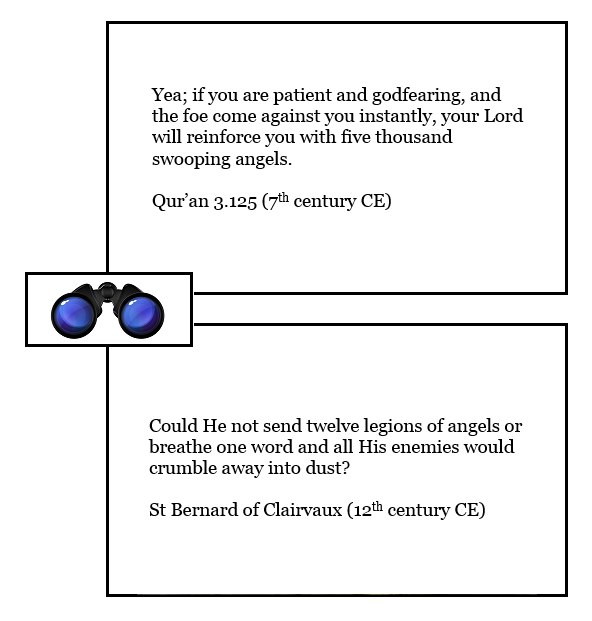
Angels considered as an Air Force

Saturday, September 12th, 2015

[ by Charles Cameron — when not dancing innumerably on the heads of pins ]
.

I responded to a question from David Ronfeldt today by saying I don’t know of a book that offers a “a sustained, point-for-point, systematic, thorough comparison” between earlier Christian and contemporary Islamist religious violence.

I do share his concern for point-for-point comparisons, however, and this one popped up as I was working on my response to David:

SPEC angels rank clairvaux

These two quotes are abstract, indeed metaphysical, I know, and don’t deal with human-on-human violence as such — but the DoubleQuote they form is nevertheless a point-for-point comparison, and the very exactness of its counterpoint gives it the sort of power the best haiku have, I believe, offering us wit in brevity, multum in parvo, small is beautiful.

Norway: what else?

Saturday, September 12th, 2015

[ by Charles Cameron — ointment and fly, and how one thing leads to another ]
.

Reading..

and..

in rapid succession on my twitterfeed the other day, I’ve been thinking of my Norwegian friend, the artist Jan Valentin Saether..

**

What else?

Ah yes, Anders Behring Breivik, the black dot in the white swoosh of the Tai-Chih symbol — and I’m beginning to get the impression the ripples are spreading:

  • The Guardian, Why are anti-immigration parties so strong in the Nordic states?
  • August: Vocativ, E.U.’s Right-Wing Parties Surging Thanks To Migrant Crisis
  • September: NY Times, Migrant Influx May Give Europe’s Far Right a Lift
  • Curious fact:

    Even in 2011, the year of the Utøya terror attacks, the Norwegian police only fired one shot.

    Fourteen years and two days on

    Friday, September 11th, 2015

    [anniversaried by Lynn C. Rees]

    The Internet told me Ahmed Shah Masood was dead.

    I was annoyed.

    I hated the Taliban: they were the enemy of all mankind. My hate didn’t single them out just for general Third World thuggishness, seventh century flavored oppression, or harboring a declared enemy of my country. No, my hate singled them out for blowing up some 1,500 year old statues.

    For 1,000 of those years, Islam lived with the Buddhas of Bamiyan. A millennium of entropy, nature and sporadic iconoclasm had savaged the Buddhas. But there they stood, as they’d stood for a millennium and a half.

    Then the iconoclastic ends of March 622 came calling, armed with the iconoclastic means of March 2001. Dynamite, artillery, and rocketry let the Taliban do in three weeks what history failed to do in fifteen centuries.

    History is fragile. What survives is idiosyncratic. We inherit only suggestive rubble from the past. From that debris, castles of the imagination without number are summoned. One particularly insistent ghost of conjured history drove Taliban iconoclasm: the vision of the umma, the ideal community created by Muhammad in Medina and Mecca before his death in 632. From an antiseptic remove, far from the compromised Islam of March 2001, this stern phantom looked down from the heights of 15 centuries and commanded the Taliban to remove the idolatrous Buddhas of Bamiyan from history. The phantom umma promised that, piece by piece of shattered idol, the sacralized community of the Prophet would draw nearer and nearer. And so the Buddhas of Bamiyan fell.

    History eats itself. Meddling in what survives and what doesn’t is unneeded: accident and negligence will devour more history than intention can aspire to. The Taliban insisted on speeding history along. Not only that, they figured they could not only speed it up but make it flip 180° and run backwards. And so the Taliban declared war on history.

    To me, this made the Taliban barbarians. To me, they deserved to be erased from history themselves. The only man who seemed to be actively helping the Taliban exit history was Massood. Massood created an island of sanity in a dark hole of crazy. Now Massood had gone, sped to Allah by the same set of barbarians.

    Downstairs I went. I ranted about the tragedy of Ahmed Shah Massood and his death to Mom and the passing brother. They had no idea who Ahmed Shah Massood was. They didn’t know where Afghanistan was. To them, it was a quarrel in a far-away country between people of whom they knew nothing. The Massood in Afghanistan might as well have been the Massood in the Moon, fighting to keep one small grubby corner of the lunar surface Taliban-free.

    Mom patiently listened as dinner was set. She’d grown used to my ranting on and on and on and on about this or that distant obscurity. She knew that, with time, I’d fulminate my way out of my momentary idée fixe and go back to quietly tending my garden of trivia. The world would go on. Normalcy would flow unvexed into the future.

    She was right. Rant mode ran out of steam. I ate dinner. I went back to my lair, where my books and my computers would protect me. I went to sleep. The clock set on September 9th, 2001.

    With murder in its heart, unseen in the gathering night, history, dead since 1989, was creeping up the East Coast to be reborn. Two Buddhas and the Lion of Panjshir were only the first to fall. A rock feels no pain. And an island never cries.

    Apocalypse soon from Lapido, McCants from Sources & Methods

    Thursday, September 10th, 2015

    [ by Charles Cameron — my latest for LapidoMedia gives Sunni, Shia background, & importantly the shift from Zarqawi to Baghdadi — followed by a chaser from Will McCants ]
    .

    My latest from Lapido, opening paras:

    TO SENIOR military officers, intelligence analysts and policy-makers, blood and guts are more real than fire and brimstone.

    To the followers of ISIS – which now calls itself the Islamic State – however, not only do the concepts of hell fire and the gardens of paradise seem real, the hope of heaven and fear of hell are powerful recruiting tools, morale boosters and motivating forces.

    While the battlefield is real to them, to lose one’s life on that battlefield is viewed as victory, and as martyrdom rewarded with a painless death, avoidance of Judgment Day and a direct passage to paradise.

    And that vivid expectation of paradise is accompanied by a sense that in any case, ‘the end is nigh’.

    That is why the ‘caliphate’ established by Abu Bakr al-Baghdadi has named its English-language magazine after the town of Dabiq.

    Indeed, Dabiq’s first issue opens with a quote from Abu Musa’b al-Zarqawi, the brutal founder of the group that became the Islamic State:

    ‘The spark has been lit here in Iraq, and its heat will continue to intensify – by Allah’s permission – until it burns the crusader armies in Dabiq.’

    The town of Dabiq is obscure enough that you won’t find it indexed in David Cook’s Contemporary Muslim Apocalyptic Literature, nor in French diplomat-scholar Jean-Pierre Filiu’s Apocalypse in Islam.

    Will McCants, in his book The ISIS Apocalypse: The History, Strategy, and Doomsday Vision of the Islamic State due out later this month, quotes a leader of the Syrian opposition as saying, ‘Dabiq is not important militarily.’

    And yet Abu Bakr al-Baghdadi, like Abu Musa’b al-Zarqawi before him, makes it a centrepiece of his strategy and propaganda.

    Read the whole thing on the LapidoMedia site

    **

    Will McCants gave a useful response in his Sources & Methods podcast interview yesterday, at the 35.00 mark — answering a question about apocalypticism in IS:

    I think it’s really important in terms of attracting foreign fighters from the west. If you think about what gets a foreigner motivated to leave their home and travel to an insanely violent conflict zone, there are few things that might motivate people more than the belief that the end times are right around the corner. So I see a lot of that apocalyptic propaganda from the Islamic State really directed towards foreign fighters. But also you know in the Middle East, after the Iraq war in 2003, apocalypticism began to get a lot more currency than it used to have. You know, before the war, apocalypticism among Sunnis was really kind of a fringe subject as compared to the Shia, for whom it’s been an important topic for centuries – for modern Sunnis, they kind of looked down on it, that’s something that the Shia speculate on, but that’s not really our bag. The US invasion of Iraq really changed the ways that Sunni’s thought about the end times. And then with the Arab Spring coming, and all the political turmoil that followed in its wake, it’s given an apocalyptic framework far more currency than it ever had as a way to explain political upheaval in the region.

    Listen to the whole thing at Sources and Methods.


    Switch to our mobile site
