zenpundit.com » 2016

Archive for 2016

The friend of my enemy is my what?

Wednesday, June 22nd, 2016

[ by Charles Cameron — or to quote the Stones, sympathy for the devil? ]
.

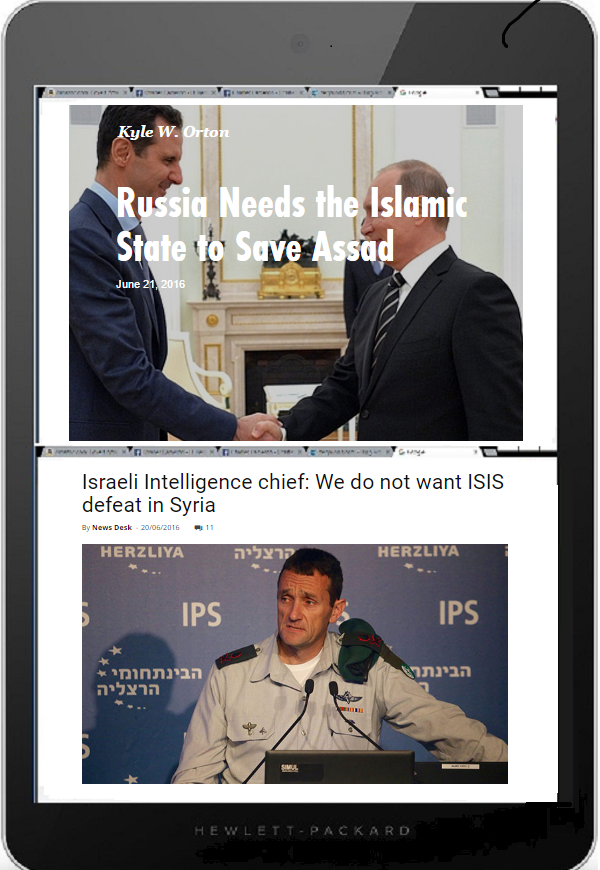
blank 600 Syria Israel Russia

Sources:

  • Kyle Orton, Russia Needs the Islamic State to Save Assad
  • Al-Masdar News, Israeli Intelligence chief: We do not want ISIS defeat in Syria
  • How Syria becomes Palestine

    Wednesday, June 22nd, 2016

    [ by Charles Cameron — on borrowing the atrocities of others for propaganda advantage ]
    .

    and:

    **

    It’s not as though this is the first time I’ve seen this done, nor is Syria > Palestine necessarily the trajectory — see for example this DoubleTweet from Phillip Smyth, Photographic enantiodromia at the Zaynab shrine?.

    Trump 1, Theology 0

    Tuesday, June 21st, 2016

    [ by Charles Cameron — politics wearing religion as a glove and vice versa, mostly re Trump but MB too ]
    .

    This is a sort of anti-post for me, because it reports on a situation where theology is considered unimportant by pastor and Governor Mike Huckabee.

    First, a DoubleTweet from Michelle Boorstein of WaPo:

    Trump is speaking today at Trump Towers, it appears, and Boorstein has been tweeting excerpts of what he’s been telling 900 top evangelical and social conservative leaders behind closed doors — she has, it would appear, an ear to a leaky keyhole.

    I’m not interested in the DoubleTweet-ishness here, Boorstein is simply dividing a comment that exceeds twitter’s 140 character rule into two parts to post it. But her message does indicate that the theological equivalent of “dress casual” is the tone of the meeting.

    **

    Which is surely what caused Michael Farris, Founder and now Chancellor of Patrick Henry College, to post a FaceBook comment today picked up as an op ed in Christian Post under the stunning title, Trump’s Meeting With Evangelical Leaders Marks the End of the Christian Right.

    Excerpts [I’ve collapsed the one-sentence-per-paragraph format here for ease of reading]:

    I attended the very first meeting of the Moral Majority held in Indianapolis in February of 1980. I was the Washington state director of the MM and have been a leader of the “Christian right” ever since.

    [ .. ]

    The premise of the meeting in 1980 was that only candidates that reflected a biblical worldview and good character would gain our support. Today, a candidate whose worldview is greed and whose god is his appetites (Philippians 3) is being tacitly endorsed by this throng. They are saying we are Republicans no matter what the candidate believes and no matter how vile and unrepentant his character. They are not a phalanx of God’s prophets confronting a wicked leader, this is a parade of elephants.

    In 1980 I believed that Christians could dramatically influence politics. Today, we see politics fully influencing a thousand Christian leaders.

    This is a day of mourning.

    **

    Farris was politely dis-invited from the meeting on account of his known anti-Trump sentiments, but for my purposes, what’s interesting here is what the incident shows us about the vexed business of disentangling religion and politics. In dealing with religiously-related terrorism, the question often arises as to whether a given text or act is political, wearing religion as “cover” — or essentially religious, albeit with political implications.

    In this case, it’s instructive (for me at least) to see that for Huckabee, politics is dominant, and wears religion as a glove or mask, whereas for Farris, it is religion that is dominant, albeit in the context of a presidential campaign which is by definition political.

    Whether as Farris asserts, today’s meeting at Trump Towers “marks the end of the Christian Right” presumably depends on which of those two words one chooses to emphasize.

    **

    FWIW, here’s the same “which is the hand, which is the glove” issue in Egypt:

    Egypt’s Muslim Brotherhood faces a dilemma: Religion or politics?

    Firefights, breath, & meditation

    Monday, June 20th, 2016

    [ by Charles Cameron — remembering my father, Capt Orford Gordon Cameron, DSC, RN ]
    .

    I came across two pieces with overlapping descriptions of what happens to the body, perceptions, and thought, in a firefight. As is my habit, I’ve picked some of the essential text and accompanying illustration in each case, and offer them to you in my DoubleQuote format:
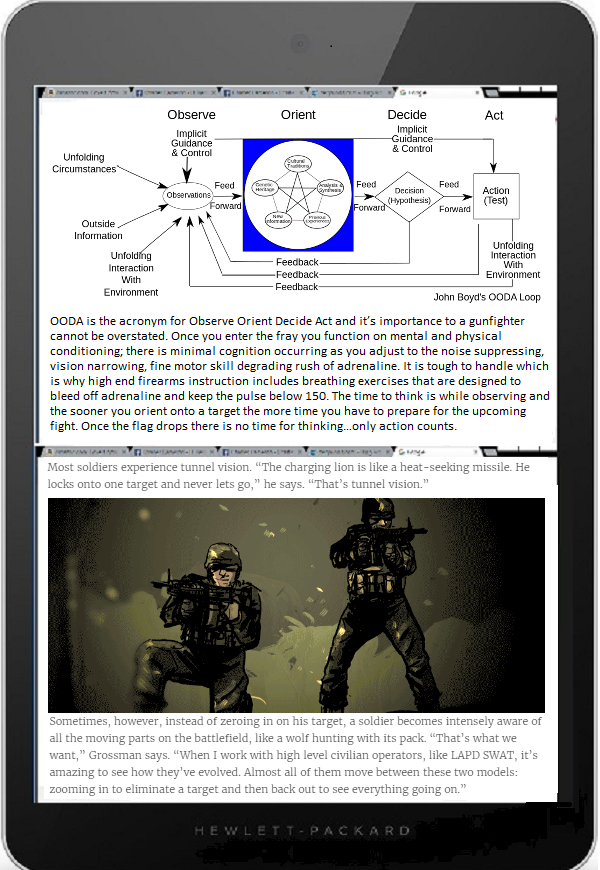
    DQ Breath and time dilation

    **

    The first quote, with the Boyd OODA Loop diagram heading it, comes from Tim Lynch‘s Fourth Generation War Comes To America: What Are You Going To Do About It?, which Michael Yon linked to.

    Lynch’s piece is his response to the Orlando shooting, its thrust being that the event went on way too long, and that we need more people to identify (and prepare) themselves as sheepdogs:

    Human Sheepdogs are, by nature, not a threat to their fellow citizens but are death dealing fighting machines when they, their loved ones or the sheep (other citizens) are in peril.

    In particular, Lynch delivers a mini-seminar on the essential contents of two books:

  • LTC Dave Grossman, On Killing
  • Gavin de Becker, The Gift of Fear
  • The second comes from Adam Linehan‘s This Is Your Brain On War at Task & Purpose. Again, the topic centers around Grossman’s work, but in this case the framing has to do with the tranfer of psychological insight from sports medicine to the military profession.

    There’s more in Linehan’s piece that’s relevant to my posting here than I’ve been able to quote in my “tablet” DQ format, so here’s some additional detail:

    The moment an engagement kicks off, the body initiates a dramatic response, beginning with the circulatory system, which immediately shunts blood away from the body surface. This, Grossman explains, is the body preparing to suck up damage.

    Preparing to absorb damage, the circulatory system moves blood away from the body’s surface to its core.

    “It’s called vasoconstriction. Just before the capillaries, there’s a mechanical shutdown of the blood flow, and now the arteries and the body core are holding up to twice as much blood. That’s why the face goes white.”

    There are two primary reasons for this. One, it helps prevent bruising, which is what happens when the capillaries and veins burst from blunt force trauma. If there’s no blood, they remain intact. But more importantly, the redirected blood flow helps keep the person alive long enough to finish the fight. [ .. ]

    Blood drains from the brain’s rational control center (the forebrain), leaving the midbrain in full control, at which point, you will do what you’ve been trained to do.

    That’s because, at its most extreme, vasoconstriction affects the brain, too. “As the blood drains from the face, blood drains from the forebrain, and there’s no rational thought,” Grossman explains. “I call that ‘condition black.’ And at condition black, the midbrain is in charge, and you’ll do what you’ve been trained to do — no more, no less. You will do what you’ve been programmed to do — no more, no less.”

    Thus, if a soldier reaches condition black and lacks adequate training, there’s a good chance he or she will freeze up. A well-trained soldier, on the other hand, will likely take action to neutralize the threat. “Given a clear and present danger, with today’s training almost everyone will shoot,” Grossman says.

    There are specific impacts on perception, too:

    Many soldiers report barely being able to hear the blast of their own rifles during combat.

    “The lion’s roar is a deafening, stunning event,” says Grossman. “But the lion doesn’t hear his roar, just like the dog doesn’t hear his bark. Their ears shut down, and so do ours. Gunpowder is our roar.”

    Under high stress, the nerve connecting the inner ear and the brain shuts down, resulting in temporary hearing loss, or “auditory exclusion.”

    This phenomenon is called “auditory exclusion,” and it’s a result of the nerve that connects the inner ear and the brain shutting down in the heat of battle. According to Grossman, 90% of combat soldiers report having experienced auditory exclusion. “You get caught by surprise in an ambush. Boom. Boom. Boom. The shots are loud and overwhelming. You return fire, boom. The shots get quiet, but you’re still getting hearing damage.”

    A soldier’s vision can also be affected by combat, and Grossman uses two different so-called predator models — the “charging lion” and the “wolf-pack dynamic” — to explain this.

    This is where the quote I selected about two types of vision — one in tight focus, one diffusely aware of everything going on around you — kicks in.

    And one more thing: there’s time-dilation.

    A number of soldiers and law enforcement officers whom Grossman has interviewed reported being able track incoming rounds with their eyes.

    There is another phenomenon involving vision that is widely disputed, but which Grossman insists is real, and that’s the experience of what he calls “slow-motion time.”

    “I have had hundreds of people tell me they can see the bullet in combat,” he says. “Many have been able to later point to where the bullet hit, and they could not have done that without tracking the bullet with their eyes. Not like the matrix. It’s like a paintball, where the bullet is slow enough you can track it with your eyes.”

    **

    I’m not much of a gun person — though this is Father’s Day, and I do recall going on exercises aboard my father‘s command (Royal Navy) when I was nine, and firing the Oerlikon and Bofors guns. Why, then, am I interested enough in these two articles to recap them together here?

    It’s because I’m a meditator, and concerned with breath and matters of cognition — so “high end firearms instruction includes breathing exercises that are designed to bleed off adrenaline and keep the pulse below 150” speaks to my daily practice — not because I’m in firefights, but because I want to enter a state of peace, and remain peaceable even when not meditating.

    And that, my friends, means there’s some common ground between warfare and peacefare right here, in the breath. Which is something I think should be of keen interest to all of us.

    Linehan’s article goes into more detail regarding cognition under fire, but two points particularly strike me. The first is that he mentions two states, often in rapid alternation, one involving tightly focused awareness, and the other a wide-angled awareness of 360 degrees around you, not to mention above and below..

    That interests me because there are two major strands of meditative practice, one using a tight focus (eg on the breath, a mantra, etc), and the other picking up on whatever crosses the threshold of consciousness, not only from all around your external environment, but also from the various streams of bodily sensations, emotions, and thoughts. Mantra meditation is of one kind, zen sitting an example of the other.

    Don’t take my word for it, though, I’m probably missing some important subtleties, and practice under the watchful eye of a teacher will give you a far better sense of the distinction and its niceties than I can.

    The last thing? Time dilation.

    It’s my experience — sometimes in meditation, but perhaps most noticeably when I was in a car rolling over and over in the Nevada desert — that time as perceived can both slow down and speed up. There can be all the time in the world to notice every last detail of what’s happening — and it can all be over in a flash, a split-second.

    Words really don’t do such experiences justice, so I’ll leave it at that. But the similarities and commonalities between military experience under fire and meditative experience in the cool of the day are striking enough to warrant in-depth study — or as the meditation community might out it, further contemplation.
    Don’t hide your money in a hortus conclusus

    Monday, June 20th, 2016

    [ by Charles Cameron — a criminal twist in Argentinian politics amid lofty considerations of convents, the Virgin Mary, and unicorns ]
    .

    The King James Version of the Bible, Song of Solomon 4:12, reads:

    A garden inclosed is my sister, my spouse; a spring shut up, a fountain sealed.

    In the Latin Vulgate, the phrase “a garden enclosed” is rendered “hortus conclusus” — and as the context makes clear, it refers both to a garden, literally, and metaphorically to a woman. In the Christian Middle Ages, the phrase was often used to indicate the Virgin Mary, often enclosed within a literal garden, as in this Hortus Conclusus from Cologne, ca 1430:

    600 Hortus Conclusus from Cologne, 1430

    Parhaps unsurprisingly, the hortus conclusus is also the place where the unicorn — only ever tamed by a pure virgin — ends up, as in this example from the Cloisters Unicorn Tapestries:

    600 Unicorn in Captivity

    So much art history, so much beauty, so much virginity — and all so that I can make a couple of points about Jose Lopez, an Argentinean MP who was arrested earlier in the week.

    **

    The unfortunate Lopez made the error of tossing some bags of money, or moneybags as they are sometimes called, over a hedge into a convent garden…

    A convent, as we’ll easily understand, is a terrific example of the hortus conclusus — and since nuns are typically sworn to poverty as well as chastity and obedience, it is altogether contrary to the intended purpose of a convent’s hortus conclusus to use it as a stash for ill-gotten gains, especially of a monetary kind — to the estimated tune of US$5-8 million.

    So that’s my point number one: that Lopez was acting in direct opposition to the contemplative and unworldly intent of the convent garden. Worse, indeed, he was also carrying some form of Sig Sauer rifle along with his “160 bundles of cash, 108 of dollars, and some of them still thermo-sealed with the stamps from China’s central bank.”

    Ouch.

    **

    But what I like best from the report is the sting in the end of this first paragraph:

    The ex-Kirchnerite official, considered the right/hand man of ex Federal Planning minister Julio De Vido was caught by the police after neighbors and a nun of the Fatima monastery warned authorities about the presence of a man throwing bags over a dividing line of bushes.

    It’s that bit about “throwing bags over a dividing line” that gets me.

    I’ve discussed the concept of liminality before, both lightheartedly, as in Liminality I: the kitsch part [note: NSFW], and more seriously, in Liminality II: the serious part — where I discussed the behavior of the USS Topeka at the Equator as the Second Millennium CE turned in to the Third, and the curious tale of the demonic king Hiranyakasipu and his death at the hands of Narasimha, an avatar of Vishnu.

    A limen or threshold is always a “special place” set apart, and thus sacred and powerful in its own right — and the limen around a convent’s perimeter even more so. We’ve seen the extraordinary effort ISIS made very early on in their campaign to erase the limen between Iraq and Syria established no less determinedly by Sykes-Picot. And we know, too, that the central rite-of-passage by which a woman becomes a nun is a liminal rite (van Gennep, Victor Turner).

    Beware, be very aware of the liminal! Enjoy the security a hortus conclusus provides the pure in heart — but don’t abuse it!

    **

    Sources:

  • Wikipedia, hortus conclusus
  • Wikipedia, Narasimha
  • MercoPress, An Argentine ex-Kirchnerite official caught red-handed trying to hide bags of cash in a monastery

  • Switch to our mobile site