zenpundit.com » 2017

Archive for 2017

There’s nothing I can see, so I can’t perceive it..

Monday, April 10th, 2017

[ Charles Cameron — on what may yet remain invisible ]
.

It is, surely, a matter of both culure and disposition:

**

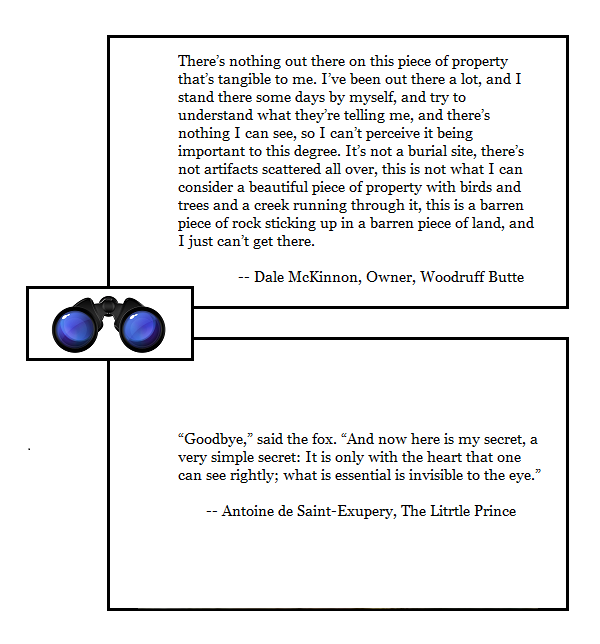
The Dale McKinnon quote is from In the Light of reverence, a documentary presenting native spirituality in conflict with western land uses in Lakota, Hopi and Wintu sacred areas (the Devil’s Tower, Colorado Plateau, and Mt Shasta, respectively):

Highly recommended.

**

Saint-Exupery‘s quote, from The Little Prince, offers a possible explanation and response.

Paul Klee on the role of the artist:

Art does not reproduce the visible; it makes visible

.

Cherry blossom season 02

Sunday, April 9th, 2017

[ by Charles Cameron — cherry blossoms and kamikaze, Palm Sunday and istishhad ]
.

It’s cherry blossom season, it’s Palm Sunday. Blossoms fall, while temporary followers of Christ — they’ll abandon him to crucifixion later in the week — celebrate Christ’s arrival in Jerusalem strewing palm leaves at this feet.
**

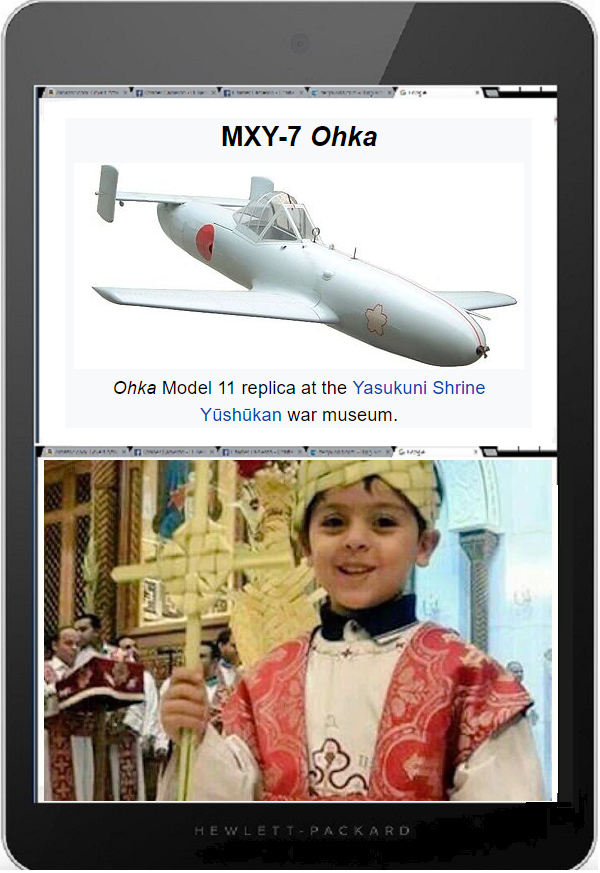
In the upper panel, Japanese self-sacrifice with intent to kill Americans:

The Yokosuka MXY-7 Ohka (“cherry blossom”) was a purpose-built, rocket powered human-guided anti-shipping kamikaze attack aircraft employed by Japan towards the end of World War II

Kamikaze pilots — the term translates to “divine wind” — drew strong associations between the transience of cherry blossoms and their own lives.

From WIkipedia:

The names of four sub-units within the Kamikaze Special Attack Force were Unit Shikishima, Unit Yamato, Unit Asahi, and Unit Yamazakura.[22] These names were taken from a patriotic death poem, Shikishima no Yamato-gokoro wo hito towaba, asahi ni niou yamazakura bana by the Japanese classical scholar, Motoori Norinaga. The poem reads:

If someone asks about the Yamato spirit [Spirit of Old/True Japan] of Shikishima [a poetic name for Japan] — it is the flowers of yamazakura [mountain cherry blossom] that are fragrant in the Asahi [rising sun].

From Emiko Ohnuki-Tierney, Kamikaze Diaries: Reflections of Japanese Student Soldiers:

As Hayashi entered the military and struggled to come to terms with death, he came to identify himself with cherry blossoms. In a letter to his mother, he laments his fate: the cherry blossoms at the Wo?n-san Base in Korea, where he was stationed, have already fallen, and yet the time for his sortie has not come. To his younger brother he writes from the Kanoya Base: “Cherry blossoms are blooming and I am going” (90). Hayashi consciously draws an analogy between himself and the fl owers; their falling signifi es the time for his death.

Other people also used the metaphor of cherry blossoms to refer to Hayashi. A poem written by his mother after the end of the war contains the idiomatic expression the “falling of my son,” applying the word conventionally used for the falling of cherry petals to the death of Ichizo¯. Hayashi’s friend Hidemura Senzo¯ laments that “Hayashi’s youth is fallen,” like cherry petals, but adds: “Peace arrived but not the peace you wished to bring through your sacrifi ce; it is only in the miserable aftermath of defeat.” Hidemura concludes, “Beauty appears in a sensitive vessel and life is short” (143–47).

See also: Ohnuki-Tierney, Emiko (2002). Kamikaze, Cherry Blossoms, and Nationalisms: The Militarization of Aesthetics in Japanese History.

**

In the lower panel, the face of a child killed in the ISIS-claimed suicide bombing of a church in Egypt this Palm Sunday, following an earlier ISIS announcment that they would be targeting Egyptian (Coptic) Christians.

ISIS Claims 2 Deadly Explosions at Egyptian Coptic Churches on Palm Sunday

TANTA, Egypt — Islamic State suicide bombers attacked two Coptic churches in Egypt on Palm Sunday, killing at least 40 worshipers and police officers stationed outside in the deadliest day of violence against Christians in the country in decades.

The militant group claimed responsibility for both attacks in a statement via its Aamaq news agency, having recently signaled its intention to escalate a campaign of violence against Egyptian Christians.

The first explosion occurred about 9:30 at St. George’s Church in the Nile Delta city of Tanta, 50 miles north of Cairo, during a Palm Sunday Mass. Security officials and a witness said that a suicide bomber had barged past security measures and detonated his explosives in the front pews, near the altar.

At least 27 people were killed and 71 others injured, officials said.

Hours later, a second explosion occurred at the gates of St. Mark’s Cathedral in the coastal city of Alexandria. That blast killed 13 people and wounded 21 more, the Health Ministry said.

The patriarch of the Egyptian Coptic Church, Pope Tawadros II, who is to meet with Pope Francis on his visit to Egypt on April 28 and 29, was in the church at the time but was not injured, the Interior Ministry said.

See also:

‘God gave orders to kill every infidel’ ISIS vows to massacre Christians in chilling video<

**

The joyous palm leaves of Sunday, greeting Christ‘s arrival in Jerusalem, will ritually and symbolically turn to ashes later in the week, as the adoring crowd turns vicious and demands his crucifixion.
Cherry blossom season 01

Sunday, April 9th, 2017

[ by Charles Cameron — scitech & artpo, two ways of seeing ]
.

It is cherry blossom season in Japan:

**

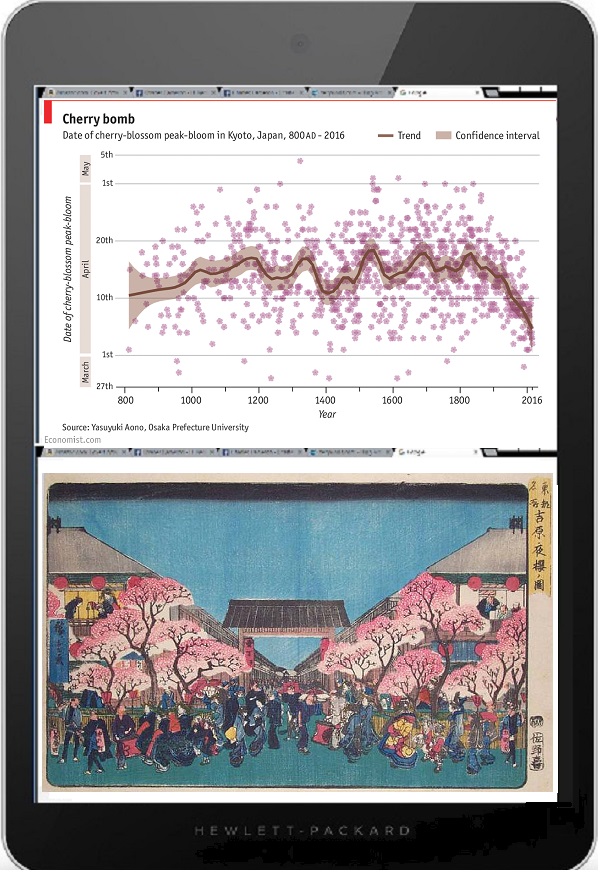
The upper panel image above is from an Economist blog, the lower from a Hiroshige print.

From the Economist piece, timeless:

HANAMI, the Japanese custom of contemplating the impermanence of life by gazing at the fleeting beauty of blossoming flowers, goes back a long way. “The Tale of Genji”, a tenth-century masterpiece that is perhaps the world’s first novel, devotes a chapter to the cherry-blossom festival staged in the emperor’s great hall. Diarists have keenly chronicled the comings and goings of cherry blossoms for centuries—records from Kyoto, the old capital, date back 1,200 years. This precious, ancient data set reveals a disturbing trend: in recent decades, the blossoms have emerged much sooner than they once did.

and (continuing) in our own time:

This precious, ancient data set reveals a disturbing trend: in recent decades, the blossoms have emerged much sooner than they once did.

**

Header:

Japan’s cherry blossoms are emerging increasingly early


Subhead:

Experts think climate change is to blame

Early: unh-uh. Fleeting: yes.

Palm Sunday surprise

Sunday, April 9th, 2017

[ by Charles Cameron — with Holy Week good wishes ]
.

What drives us is narrative. Narrative is (generally speaking) sequential in time. Sequence in time is marked on calendars. One purpose of calendars is to make each day sacred in its measure.

Today is Palm Sunday in the Christian calendar; I wish all ZP readers a profound and safe Holy Week to follow..

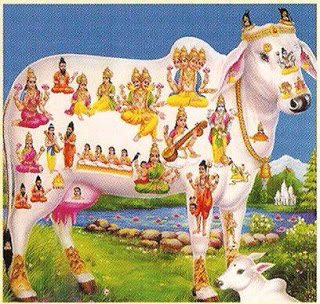
Holy cow: Mahatma Gandhi’s corrective to Hindutva violence

Saturday, April 8th, 2017

[ by Charles Cameron — a sad incident on the road, and its context & wider implications ]
.

**

I’m always on the lookout for what I term “serpent bites own tail” ouroboros reports; here’s another example:

A one-year-old calf was run over allegedly by the car of Hindu Yuva Vahini’s (HYV) Lucknow district convener in Nivada area in Janakipuram locality of the city on Wednesday. A social organisation founded by Chief Minister Yogi Adityanath, cow protection is one of HYV’s main objectives.

Source:

Indian Express,

  • Hindu Yuva Vahini leader’s car runs over calf, drags it 20 metres
  • **

    Two quotes by Gandhi:

    THE COW is a poem of pity. One reads pity in the gentle animal. She is the mother to millions of Indian mankind. Protection of the cow means protection of the whole dumb creation of God. The ancient seer, whoever he was, began with the cow. The appeal of the lower order of creation is all the more forcible because it is speechless.

    The cow is the purest type of sub-human life. She pleads before us on behalf of the whole of the sub-human species for justice to it at the hands of man, the first among all that lives. She seems to speak to us through her eyes: ‘you are not appointed over us to kill us and eat our flesh or otherwise ill-treat us, but to be our friend and guardian’

    Obviously Gandhi loved and revered cows… for what we might call Hindu, or better, Vedic reasons?

    **

    These days, under Hindutva (Hindu nationalist) influence, the love of cows has a political edge, leading to such events as this one:

    Muslim man dies in India after attack by Hindu ‘cow protectors’

    A Muslim man has died in western India after he was attacked by hundreds of Hindu cow protection vigilantes, the latest attack in a spate of mob killings in the name of the revered animal.

    Police said on Wednesday that Pehlu Khan, 55, had died in hospital two days after a group attacked his cattle truck on a road in Alwar in the desert state of Rajasthan.

    Gangs of “cow protectors” have been implicated in killing at least 10 people in the past two years as the welfare of the animal has become an increasingly charged issue in Indian politics.

    ***

    This section between triple asterisks added later, from Barkha Dutt today:

    We have already moved on from Mohammad Akhlaq who was killed in Uttar Pradesh over rumours that there was beef in his house and whose son, a corporal in the air force continued to believe his country would grant him justice. And I can confidently wager that not too many people would even know, leave alone remember, who Majloom Ansari and Inayatullah Imtiaz Khan are. In March 2016 they were found hanging from a tree in a Jharkhand village, their hands tied together by the nylon chords used to hold cattle. Imtiaz was only 12 years old. A school-going child, he was accompanying Ansari to a cattle fair in the hope of making a few extra bucks for his family. Later it emerged that Ansari had been threatened just a few days earlier by a gang of extortionists who asked him for a 20,000 rupee bribe money to ferry his oxen. The National Commission of Minorities team that investigated the killing reported a “brazen communal bias” in the police handling of the lynching and said that complaints by Muslim traders against the so called cow-protections groups had been ignored. A few months later the Jharkhand Chief Minister declared that “If India is your country; the cow is your mother.” But no mother would allow murder in her name.

    Once again: the cow is your mother.

    ***

    But then on the legal issue, Gandhi is quoted as saying:

    How can I force anyone not to slaughter cows unless he is himself so disposed? It is not as if there were only Hindus in the Indian Union. There are Muslims, Parsis, Christians and other religious groups here.

    Amen.


    Switch to our mobile site