zenpundit.com » 2017

Archive for 2017

Situation Room, echo chamber

Friday, April 7th, 2017

[ by Charles Cameron — does the Syria strike compare with the Abbottabad raid? ]
.

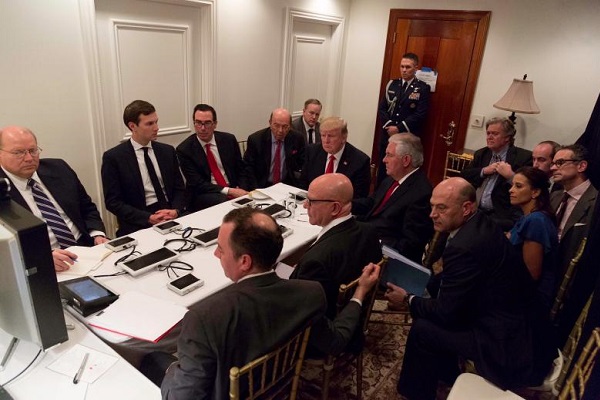
The Mar-a-Lago situation room, in a White House photo in which “President Donald Trump receives a briefing on the Syria military strike from the National Security team, including Vice President Mike Pence, Secretary of Defense James Mattis, and the Chairman of the Joint Chiefs of Staff via secure video teleconference .. White House Press Secretary Sean Spicer stated that this image has been digitally edited for security purposes”:

**

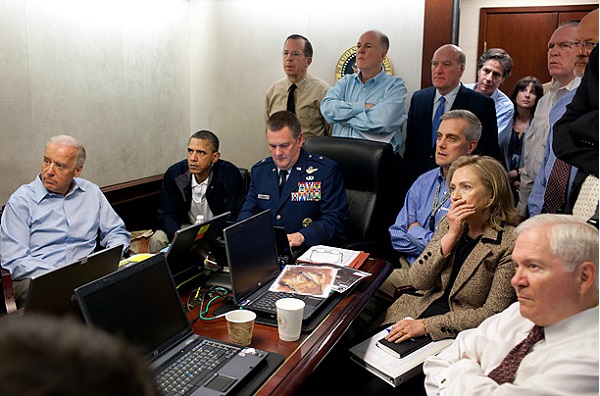
This closely echoes an earlier White House photo, from within the White House itself, in which “Vice President Joe Biden and President Barack Obama, along with members of the national-security team, receive an update on the mission against Osama bin Laden in the Situation Room of the White House on May 1, 2011. Please note: a classified document seen in this photograph has been obscured”:

A photographic DoubleQuote for sure!

Hey, even that bit about “Sean Spicer stated that this image has been digitally edited for security purposes” rhymes conceptually with “a classified document seen in this photograph has been obscured”..

**

— and a very deliberate echo, no doubt, on the photographer’s part.

Should we be comparing seating arrangements, person by person? You’ll note at least that Trump sits at the head of the table, Obama quietly off to the side..

Muslim Abu Walid al Shishani, also Trump’s hair

Friday, April 7th, 2017

[ by Charles Cameron — also critique of jihadist fatwas — with hat-tips to Pundita & JM ]
.

Pundita posted a photo today under the heading Al Qaeda celebrating Trump for bombing Syrian air base:

She got the image from the collection here:

**

The image Pundita posted is of Muslim Abu Walid al Shishani, and those aren’t actual wigs, they’re photo-enhancements — here’s the original photo, from a research site “documenting the involvement of Russian-speaking foreign fighters in the Syrian conflict”:

**

Reading that site’s material on Shishani, I came across these very interesting paragraphs, with their unadorned descritption of how young jihadists misuse jihadist scholars and their rulings. From Nohchicho’s Interview with Muslim Shishani:

Alhamdulillah, in Syria there are a lot of great scholars who have a sea of knowledge, and when you ask them a question of any difficulty, they explain it so beautifully and distinctly, giving ayats, hadith and the history of the Companions, that there is no doubt. But I also noticed that these scholars are very far removed from what is actually happening here. They don’t participate in the activities of the jamaats, even when they are part of them. They are not aware of the subtleties of the jamaats’ programs, they mainly deal with questions of nikah [marriage], divorce and such matters. The main issues of the jamaat get solved by the students of these scholars. [The scholars] get remembered only when a jamaat needs a fatwa to legitimize its questionable actions.

The situation gets presented like this: Sheikh, I’m in the desert, I didn’t eat a thing for many days. There are pigs not far from here, and if I don’t eat their meat, then I’m going to die. What should I do? And of course the Sheikh gives an affirmative answer. And then they ask that he announce it publicly so that others don’t reproach them, and then they start using this fatwa even when they just get hungry. And the whole problem is that the Sheikh isn’t up to speed with what is really going on.

Having gotten to know the scholars and the situation, I realized one thing: if you want to know the truth, then ask the scholars the scope of the Sharia in the particular case, where Allah’s pleasure is, and stick to it as far as possible within your situation. And a scholar’s fatwa basically depends on how you present your situation to him. It depends on your conscience.

When we ask Sharia questions to a fighter, military questions to politicians, and political questions to Sharia experts, we will always run into mistakes. But if we learn to ask questions to specialists in their relevant fields, and if these experts don’t get into issues outside their competence, then it’s going to be easier for us to reach the truth.

**

I’d welcome any info about Muslim Abu Walid al Shishani’s affiliation — Junud al-Sham, if that still exists? AQ? ISIS? This is the first time I’ve run across him.

Double & SingleQuoting Syria

Friday, April 7th, 2017

[ by Charles Cameron — who like Ryan Evans has more questions than answers ]
.

This, for the use of the DoubleQuotes format:

**

Okay, undeclared warfare has clearly been declared, if it hadn’t been already: maybe someone should tell Congress —

In the meantime, consider:

together with:

**

Reaction from the furthest right in two tweets:

together with:

**

And just for the sheer fun of it — no DoubleQuote here!

Among the believers

Wednesday, April 5th, 2017

[ by Charles Cameron — a blistering documentary account of Pakistan’s Lal Masjid, jihadist focal point ]
.

I’ve just been watching the 2015 documentary Among the Believers, now showing on Netflix. It concerns the Red Mosque, Lal Masjid — its teachings, its encouragement of jihad, and the government siege which shut it down in 2007. The speaker denouncing the masjid is Pakistani nuclear physicist Pervez Hoodbhoy.

Here are some screengrabs that caught my eye..

**

Maulana Abdul Aziz, who runs the place, speaks of his son, who was inside the Masjid during the bloody siege, and lost his life:

He was my only son. When I was in prison, during the final part of the siege, police guards loyal to us told me that since I had only one son, they would smuggle him out of there. But I said no. I told them I was willing to sacrifice him for Allah. You know, I regret the fact that I didn’t died for Allah. They said, “What’s more important than one’s child’s life?”

He concludes:

What is of interest here is the amplified echo of the story of Abraham‘s willingness to sacrifice his son (variously Isaac, Ishmael)

**

The book the student is reading is one I mentioned a while back, in 2011’s The Black Banners of Blackwater by Maulana Umar Asim.

**

A new category of martyr — the madrassah. Will it cross the bridge As-Sirat? What will be its reward?

**

What those who protest Lal Masjid’s encouragement of jihad wish to reclaim for a happier and more toalerant Pakistan..

The film is banned in Pakistan.

**

Here, to bring you some joy out of all this, is a song that I encountered on the soundtrack of this remarkable documentary, performed here as part of the splendid Coke Studios series:

Footnoted readings 04 – CVE, jihad & liminality

Sunday, April 2nd, 2017

[ by Charles Cameron — a term from cultural anthropology as a marker for jihadist intensity ]
.

**

Ahmed S. Younis, Deputy Special Envoy and Coordinator, Global Engagement Center, U.S. Department of State, during the George Washington University’s Center for Cyber and Homeland Security event, Toward a Global Partnership to Counter Online Radicalization and Extremism, the Understanding Online Counter-Messaging panel, March 28,2017, a little after the 2 hr 03’50” mark in the video above:

I would posit that terrorism and extremism by their definition are liminal states. They are defined by their inbetweenness. And often when we see someone who is radicalizing towards terrorism, they are shifting in a crevice between a series of pieces of life that bring them to a place where this type of activity appears as a solution or an option for their frustration with lived experience. And we lose, as people who want to fight this effort, when we try to pretend this is all about shariah and fiqh and issues of Islam. .. If radicalizing is sexy, then that sexiness is by definition interdisciplinary, and we have to meet people in the liminality of their moment. .. Reality is complex, and it is interdisciplinary.

**

My eyes prick up — I know, “pricking up” is really a phrase that’s apt for the ears, but I think it should apply to the eyes as well — my eyes do a double-take when I see the word “liminal”. It signals importance.

I’ve talked about liminality before, lightheartedly [Liminality I: the kitsch part] and more seriously [Liminality II: the serious part] — but by way of a reminder, I’ll just quote two stories from the latter, along with this definition:

liminality is between-ness — it’s what happens on thresholds

Here are the two stories:

Something pretty remarkable happened as 1999 turned into 2000 — something liminal. And it happened aboard the USS Topeka, SSN-754 (below):

USS Topeka, credit: United States Navy, released ID 090623-N-1126G-005

The Associated Press reported:

Its bow in one year, its stern in another, the USS Topeka marked the new millennium 400 feet beneath the International Dateline in the Pacific ocean. The Pearl Harbor-based navy submarine straddled the line, meaning that at midnight, one end was in 2000 while the other was still in 1999… The 360-foot-long sub, which was 2,100 miles from Honolulu, Hawaii, straddled the Equator at the same time, meaning it was in both the northern and southern hemispheres. Some of the 130 crewmembers were in Winter in the North, while others were in Summer in the South…

Sitting pretty on the threshold between two millennia, two centuries, two decades, years, seasons, months, days and hemispheres was an extraordinarily liminal idea — as the two-faced January is a liminal month — and I think illustrates effectively the terrific power of the liminal to sway human thinking

Navy commanders in charge of billion dollar ships seldom get up to such “fanciful” behaviors!

And if we might turn from the contemporary US Navy and its submarine to ancient Indian mythology and Hindu religion for a moment:

Narsingh avatar depicted in Nepali dance, credit: Navesh Chitrakar, Reuters / Landov

The story of Narsingh (above), the fourth avatar of Vishnu in Vaisnavism, also captures the idea of what’s meant by thresholds very nicely:

A tyrannous and oppressive king obtained a boon from the gods that he should die “neither by day nor night, neither within the palace nor outside it, neither at the hand of man nor beast” and thought his boon conveyed immortality — but when he persecuted his son, a devotee of God, a half-man half-lion figure — the Narsingh avatar of Vishnu — met him on his own doorstep at dusk and slew him, so that he died neither by day nor by night, neither within the palace nor outside it, and neither at the hand of beast nor of man.

Dusk, doorsteps and metamorphs are all liminal — with respect to day and night, home and abroad, man and beast respectively.

**

Two other references at the intersection of terrorism and liminality:

Arthur Saniotis writes in Re-Enchanting Terrorism: Jihadists as “Liminal Beings”:

Religious terrorists have been the subject of much scholarly scrutiny. While such analyses have endeavored to elucidate the ideological logic and implications of religious terrorism, the transnational character of jihadists necessitates new ways of understanding this phenomenon. My article attempts to explain how jihadists can be defined as liminal beings who seek to re-enchant the world via their symbolic and performative features. Jihadists’ strategically position themselves as ambiguous not only as a distinguishing device, but also to enhance their belief of a cosmic war on earth. Jihadists’ use of symbolic imagery on the internet works within the ambit of a magical kind of panoptic power which seeks to both impress and terrify viewers.

And Marisa Urgo Shaalan, in the course of a post on Liminality at her Making Sense of Jihad blog powerfully comments:

perhaps the most important factor drawing many young men into jihad is the sense that it is authentic and sacramental life. [And I mean sacramental. Jihad is a sacred act that they are told guarantees them paradise.]

Recommended.

**

I’d be very interested to learn more about Dr Younis’ insights into liminality in jihadist recruitment, and it’s implications for CVE.
Switch to our mobile site

