zenpundit.com » 2017

Archive for 2017

Footnoted readings 03 – Violence, theirs and ours

Sunday, April 2nd, 2017

[ by Charles Cameron — on analysis by symmetry, asymmetry, comparison, form ]
.


Vijay Prashad

**

Vijay Prashad writes in Jadaliyya under the title Violence: Theirs and Ours and sub-head Binaries:

I have spent decades thinking about the asymmetry of reactions to these sorts of incidents in places such as Iraq and Afghanistan. I have written about them, indignation as the mood of these essays. But this is spitting into the wind. It is futile on Facebook, for instance, to make the suggestion that the 2016 Karrada bombings in Baghdad (Iraq), which killed over 300 people, should have driven people to turn their profile pictures into Iraqi flags (as the world had done after the 2015 Paris attacks, when 137 people were killed). “Je Suis Charlie” is easy to write, but not #AmiAvijit. Eyes roll when these gestures are urged, whether through bewilderment at their meaning or exhaustion at their sanctimoniousness. After all, the eye-roll suggests, how could one compare a satirical French magazine with obscure Bangladeshi bloggers who have been hacked to death? It takes an immense act of will to push editors to run stories on tragedies that seem distant even from the places where they occur. All eyes focus on the latest attack in Molenbeek, but few turn with the same intensity to look at the tragedies in Beirut or in Cairo.

Okay, what interests me here is his mode of analysis by form: Prashad pays specific and repeated attention to binaries — symmetries and asymmetries. I think that’s a key move in analytic terms, and you can see it in play, again, in the way he phrases his concluding paragraph:

From Lord Baring’s Violent Shock to George W. Bush’s Shock and Awe: this cannot be terrorism. It is the business of rational states. Terrorism is what the others do. Always.

Violent Shock :: Shock and Awe.

**

Agree or disagree with Prashad’s analyses as you will, his method is one that I too have been focusing on here at ZP for a while now — that of emphasis on form as a clue to analytic significance.
Footnoted readings 02 – Acts of corporal mercy

Sunday, April 2nd, 2017

[ by Charles Cameron — a note at the intersection of material with spiritual ]
.

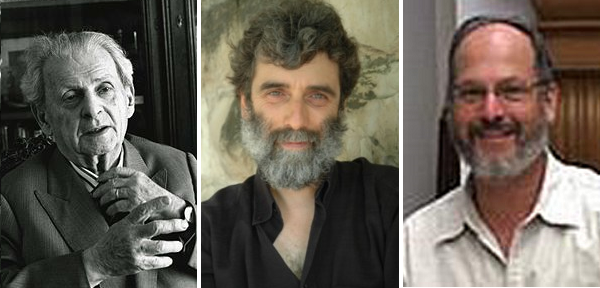
left to right: Emmanuel Levinas, Gershom Gorenberg, Elliott Horowitz

**

Gershom Gorenberg in March 28th’s Washington Post tells three stories from his own life of what I believe Catholicism would call “acts of corporal mercy” — feeding the hungry, giving drink to the thirsty, clothing the naked, visiting prisoners, visiting the sick, harboring strangers, and burying the dead (Matthew 25. 34-40). He concludes, honoring his mentor, Israeli historian Elliott Horowitz:

He said, without pride or embarrassment, that he acted out of religious conviction. In Israel, the political stereotype of Orthodox Jews is of people concerned exclusively with settling the occupied territories. In the world, commitment to the most traditional forms of faith — Jewish, Christian, Muslim or other — is often confused with building walls between people.

Elliott believed that faith demanded breaking down barriers between human beings created in God’s image. I believed that, too, but he pushed me to act.

**

It’s a story by and about a friend, and about human goodness. Apart from those two sterling but not uncommon facts, why should I care?

I care because the story illustrates the Jewish proverb of which Emmanuel Levinas reminds us:

the other’s material needs are my spiritual needs

It’s not easy to bridge the gap between subjective experience and objective, physical reality, which is why the hard problem in consciousness is called the hard problem in consciousness — but this quote bridges the gap effortlessly, and in a manner that instructs us.

Footnoted readings 01 – Whose beholding eye is this beauty in?

Sunday, April 2nd, 2017

[ by Charles Cameron — hoping to unload a series of quick posts sparked by my recent readings — 01, jihadi culture ]
.

**

I was reading Thorsten Botz-Bornstein, The “futurist” aesthetics of ISIS — who could resist such a title? — in the Journal of Aesthetics & Culture, desultorily, and my eye was naturally caught by the phrase “religious apoalyptic symbolism”, because symbolism is my terrain and apocalypse (IMO) the specific area where the human imagination runs wildest and freëst..

… and since analogy is my preferred mode of insight, I was then delighted to find the comment about “stronly reminiscent” but subdued jihadi purple:

In the case of ISIS the overcoming of symbolist rhetoric signifies a clear shift towards Futurism. In Symbolism, poetical speech attempts to present a refined and infinite mental world. Such symbolist ambitions do exist in ISIS propaganda but they remain restricted to religious apocalyptic symbolism. ISIS replaces sunsets and hazes with whirring engines and explosions; further, the aim of ISIS propaganda is not merely to evoke a metaphysical world for its own sake but rather to establish the forces of a new futurist ideology in everyday life as a utilitarian force. Also this overlaps perfectly with futurist strategies of overcoming symbolism.

While ISIS aesthetics makes a decisive step in this modernist direction, Al-Qaeda religious propaganda remains kitsch and is strongly reminiscent of visual material delivered by Jehovah’s Witnesses or New Age sects. With the latter it shares the preference of purple as the dominant color, though the jihadi purple is more subdued than the New Age one.

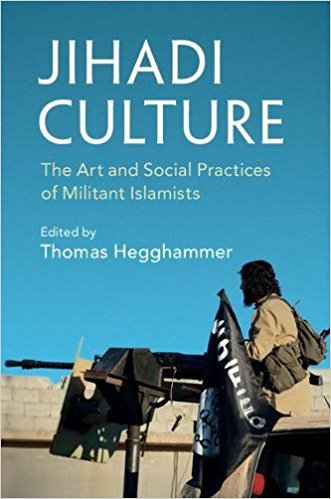
The whole idea of jihadi aesthetics, of course, will seem wildly inappropriate to those whose view is constrained to the physical personnel, materiel and processes of war — but to those hoping for insight into the jihadist mindset, it is not so easily dismissed — see Thoman Hegghammer‘s Paul Wilkinson Memorial Lecture, The Bored Jihadi blog and forthcoming book, Jihadi Culture: The Art and Social Practices of Militant Islamists.

Hegghammer’s book will be a
must read, I suspect. I hope to review it here on ZP>

A boon for conspiracists

Sunday, April 2nd, 2017

[ by Charles Cameron — FBI Pentagon photos from 9/11 h/t Nada Bakos, and an anarchist logo ]
.

The FBI just released a portfolio of previously unseen photos from 9/11 at the Pentagon, and Politico published them yesterday. My immediate reaction was to think what a boon they’d be to Truther conspiracists, since they could now measure and calculoate and generally insinuate a whole raft of new hypotheses regarding how the whole thing was staged, a false flag, a deliberate own goal.

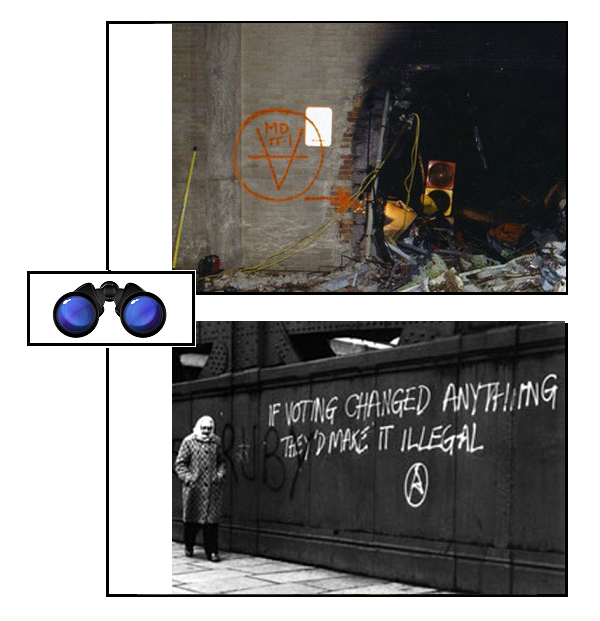
And then, see upper panel below, I noticed the circled inverted A in several of the slides:

That’s all the confirmation we need! It’s anarchist graffiti — see the same A in a circle in the lower panel for confirmation!

**

As I write this, it is still April First, and I am not seriously proposing that 9/11 was a put up job, nor that the inverted A in the Pentagon photo has anything to do with the anarchist A in the lower panel — but that’s how conspiracies unfold — a plausible match that supports an obsession or paranoid fantasy, and voila!

The anarchists did 9/11!

Trump, Flynn and immunity

Friday, March 31st, 2017

[ by Charles Cameron — tweets, and how they become, for me, a problem in number theory ]
.

The initial question is, should I pair this:

with this:

Or this:

— or the last two with each other?

Such are the hazards of imprisonment within the DoubleQuote system — two, when three or more are available and relevant, becomes a constraint rather than a facilitation. So would any other positive integer — and god save us from the irrationsals!


Switch to our mobile site