Limina, thresholds, more on spaces-between & their importance
[ by Charles Cameron — from one thing to another — and it’s the gaps — the in-betweens — the leaps — the links — the bonds between them that truly matter ]
.
Blog-friend Bryan Alexander concludes his blog post Casualties of the future: college closures and queen sacrifices with a clip from Babylon 5. What exactly does that have to do with Admiral McRaven?
**
A difference between bricks and bricks

That’s from near the top of Bryan‘s post.
**
Bryan, lately of Vermont and now at Georgetown, is our keenest observer of the higher educational future. He coined the term peak higher education in 2013 — like peak oil, but for education, right? — and has been tracking it since then. At some point, he added the notion of queen sacrifice — “A queen sacrifice is when a college or university cuts faculty, especially full-time professors, usually as part of shrinking or ending certain academic programs” — and has made at least sixty posts in which queens are sacrificed, and one on a knight or rook sacrifice? (sports). Bryan‘s latest post is Casualties of the future. In it, he writes:
That academic phase hasn’t been clearly replaced yet. The new phase’s nature isn’t fully evident. Perhaps its outlines will become apparent after several years of change. I’ve speculated on what that next higher education phase might look like here and elsewhere. But for now, let’s consider the present as a moment in between those two phases. That’s our time, right in the midst of a switching period, a liminal space, marked by uncertainty and instability. We’re in a boundary zone.
Okay: a gentleman scholar as wise as he is bearded — and that’s a considerable double-barreled compliment — sees fit to emphasize the liminal in his latest broadside on higher education and its current obsession with cutting arts and humanities programs and various faculty members — ahem, bringing new and far broader meaning, in fact, to the concept of cutting classes. And why?
Why provide a graphic of brick wall(s) unless, somehow, the idea of breaks, gaps, thresholds, borders, leaps, in short the liminal, is of intrinsic importance?
**
Picking up on What does it mean to be a Canadian citizen? where we left off in Walls. Christianity & poetry. And nations, identities & borders, with the questions:
Is citizenship a kind of subscription service, to be suspended and resumed as our needs change? Are countries competing service providers, their terms and conditions subject to the ebbs and flows of consumer preference? Edmund Burke long ago articulated an ambitious vision of society as a “partnership not only between those who are living, but between those who are living, those who are dead, and those who are to be born.” Does any of that still resonate? Or is it a bygone idea of a vanished age, dissolved in a globalized world?
We can consider the cases of women from the US, UK and elsewhere who volunteered for ISIS and now wish to return home.
**
Here’s a paragraph to transition us smoothly:
How easy should it be to give up your citizenship? In the era of Oswald, it could be difficult—like joining an especially selective monastic order that turns away aspirants until they kneel in the snow for a few days outside the monastery or consulate’s doors. Now a U.S. citizen can stop being American with a single visit to a consulate. (Most renounce not for ideological reasons but to avoid the complications of living as an American expatriate, subject to dual taxation and bureaucratic requirements far more onerous than for expatriates of almost any other country.)
That’s from Graeme Wood, Don’t Strip ISIS Fighters of Citizenship
See also:
Amarnath Amarasingam, Revoking Citizenship of ISIS Members is Not the Answer Dan Byman, The wrong decision on Hoda Muthana
That’s a liminal issue, questions of citizenship and borders are liminal. And Bryan is talking liminality when he talks education.
**
Here’s a quick liminal zing from Abigail Tracy, in the title and subtitle of here Atlantic piece:

I’d have been happy to include this in my chyrons and headers collection, but between the lines is too nicely liminal to miss.
**
A limen is a <threshold: it ‘s neither one thing nor the other, it’s in-between. And in-between is a time or state of transition, often tricky — think of the interregnum between the election of a President and his or her Inauguration — and often deeply human — we’re stuck with human nature, every one of us, which as Solzhenitsyn noted has a fault line in it more significant perhaps than even the fissure that separates our left and right cerebral hemispheres. Stunning us, he wrote:
If only it were all so simple! If only there were evil people somewhere insidiously committing evil deeds, and it were necessary only to separate them from the rest of us and destroy them. But the line dividing good and evil cuts through the heart of every human being. And who is willing to destroy a piece of his own heart?
There’s liminality for you.
**
Here’s how Bryan ends his post:
Babylon-5:
Listen:
There is a greater darkness than the one we fight. It is the darkness of the soul that has lost its way. The war we fight is not against powers and principalities, it is against chaos and despair. Greater than the death of flesh is the death of hope, the death of dreams. Against this peril we can never surrender. The future is all around us, waiting in moments of transition, to be born in moments of revelation. No one knows the shape of that future, or where it will take us. We know only that it is always born in pain.
The war we fight is not against powers and principalities — see my earlier post today on spiritual warfare. And The future is all around us, waiting in moments of transition, to be born in moments of revelation — the horror, the blessing of liminality.
And Admiral McRaven:
He too deals with the fight against chaos:
SEAL training is the great equalizer: If you want to change the world, measure a person by the size of their heart — and that deep sense of being equalized by sand. tide, and fatigue, brings with it fine-grained humility and profound bonding with ones’ fellows.
**
Victor Turner was the anthropologist who made liminality the corner-stone of his great work, The Ritual Process — see how closely his ideas correspond with McRaven‘s SEAL training. Back in my early post on the topic here on ZP, I wrote:
Basing his own work on van Gennep‘s account of rites of passage, Turner sees such rites as involving three phases: before, liminal, and after.
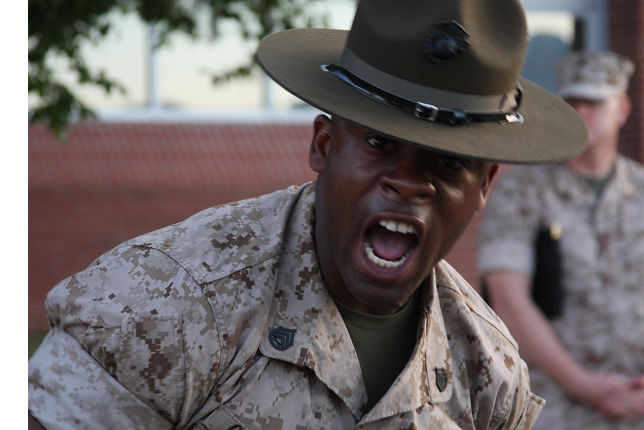

There are two things to note here. One is that liminality is a *humility* device, the other is that is creates a strong sense of bonding which Turner calls *communitas*: in one case, the Marine’s esprit de corps, in the other quite literally a monastic community. Part of what is so fascinating here is the (otherwise not necessarily obvious) insight that humility and community are closely related.
**
earlier Zenpundit posts on liminality and borders, among them:
Liminality II: the serious part Of border crossings, and the pilgrimage to Arbaeen in Karbala Violence at three borders, naturally it’s a pattern Borders, limina and unity Borders as metaphors and membranes McCabe and Melber, bright lines and fuzzy borders Walls. Christianity & poetry. And nations, identities & borders
But go back to that first post, Liminality II: the serious part, and read the whole thing. The story of the USS Topeka, SSN-754 alone is worth the effort..


