zenpundit.com

The Middle East in two War Games — and a tribute to Ibrahim Mothana

September 6th, 2013

[ by Charles Cameron — with regard to Mothana: the voice of sanity is not easily heard in the asylum ]
.

Here’s most everything you need to know about the complexities of the Middle East, spelled out in two simple war games:
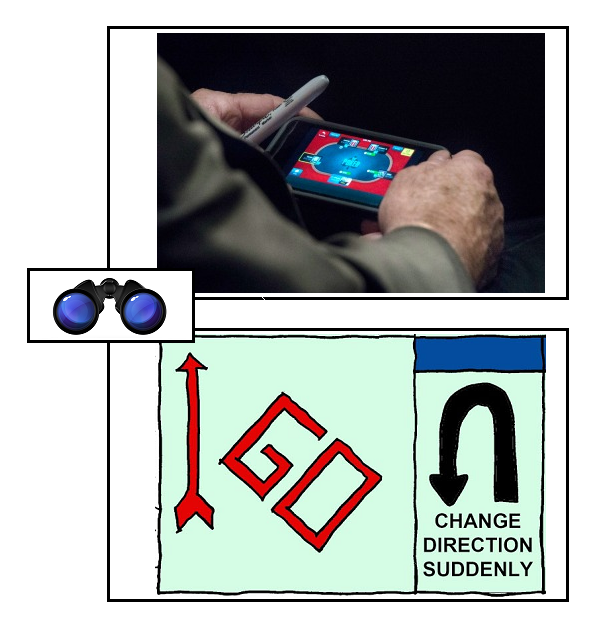
Sources:

  • McCain plays poker during Syria war hearing
  • Detail from Yemeni Politics — The Board Game
  • **

    The Yemen politics game was the work of 24 year old Ibrahim Mothana, who died this week. His moving NYT op-ed about his beloved Yemen in June last year told us:

    Drone strikes are causing more and more Yemenis to hate America and join radical militants; they are not driven by ideology but rather by a sense of revenge and despair. Robert Grenier, the former head of the C.I.A.’s counterterrorism center, has warned that the American drone program in Yemen risks turning the country into a safe haven for Al Qaeda like the tribal areas of Pakistan — “the Arabian equivalent of Waziristan.”

    Anti-Americanism is far less prevalent in Yemen than in Pakistan. But rather than winning the hearts and minds of Yemeni civilians, America is alienating them by killing their relatives and friends. Indeed, the drone program is leading to the Talibanization of vast tribal areas and the radicalization of people who could otherwise be America’s allies in the fight against terrorism in Yemen.

    His written testimony for the Senate Judiciary Committee’s Subcommittee on the Constitution, Civil Rights and Human Rights can be found in this Guardian post from Glenn Greenwald in May of this year.

    Mothana had many admirers across the spectrum, as this tweet from Gregory Johnsen attests:

    We mourn his loss, and ask for peace.

    For joy and sorrow: DoubleQuotes in the Wild

    September 6th, 2013

    [ by Charles Cameron — without access to joy, how shall we carry the burdens of despair? ]
    .


    via Bill Murray likes

    **

    DoubleQuotes are juxtapositions that have a powerful impact. Our minds and hearts are drawn naturally to seeing parallels and contradictions, making comparisons between ideas and creative leaps from one idea to another, and since this is a very basic human cognitive ability, I’ve developed my own DoubleQuotes format for presenting striking juxtapositions, and use it frequently in my posts here at Zenpundit. But I also collect strong examples of such juxtapositions when others make them, and call them DoubleQuotes in the Wild.

    Today, I’d like to double up on my wild DoubleQuotes, and having offered you Jimi Hendrix (graffito juxtaposed with tree, above) to bring you joy, now offer you the poignant example from a Serbian Orthodox monk (Aleppo, Syria, then and now, below) to bring you sorrow:

    **

    Music, munitions — we may think them unequal combatants, yet as von Clausewitz puts it:

    One might say that the physical seem little more than the wooden hilt, while the moral factors are the precious metal, the real weapon, the finely-honed blade.

    — or in somewhat more recent terms, as Michael Herr noted in his book Dispatches:

    Whenever one of us came back from an R&R we’d bring records, sounds were as precious as water: Hendrix, the Airplane, Frank Zappa and the Mothers, all the things that hadn’t even started when we’d left the States.

    sounds … as precious as water

    L’shanah tovah

    September 4th, 2013

    [ by Charles Cameron — life is full of habitual regularities without which there could be no sudden surprises ]
    .

    With one eye on the Bible, one eye on the news

    September 4th, 2013

    [ by Charles Cameron — in whose borrowed opinion, if therefore thine eye be single, thy whole body shall be full of light ]
    .

    Here’s another DoubleQuote that doesn’t fit my usual format, but sets up an interesting dynamic anyway. This just in, from Joel Rosenberg:

    I find it charming that we can read the opening paragraphs of a Mother Jones piece about Joel Rosenberg on on Rosenberg’s own site. Here are the first paras — or grafs, as my friend Danielle would say:

    In early 2012, bestselling novelist Joel Rosenberg came to Capitol Hill for a meeting with an unidentified member of Congress to discuss the end of the world. “I thought the topic was going to be the possible coming war between Israel and Iran,” Rosenberg explained on his website. “Instead, the official asked, ‘What are your thoughts on Isaiah 17?’”

    For the better part of an hour, Rosenberg says, the writer and the congressman went back forth on something called the “burden of Damascus,” an Old Testament prophecy that posits that a war in the Middle East will leave Syria’s capital city in ruins—and bring the world one step closer to Armageddon. As Rosenberg put it, “The innocent blood shed by the Assad regime is reprehensible, and heart-breaking and is setting the stage for a terrible judgment.”

    But Rosenberg and his anonymous congressman aren’t alone in viewing Syrian president Bashar al-Assad’s actions through a Biblical lens.

    That’s my first shoe. And here’s Richard Bartholomew, the blogger at Bath’s Notes, dropping the second:

    **

    Okay, here are some observations of my own, which I wrote a while back…

    Which comes first: history or Revelation?

    Just as nature and scripture can be “read against” one another, each perhaps illuminating the other at times, so in the case of one particular scripture — the Revelation — the book is “read against” history: there’s a long history of interpreters attempting to “translate” the book into contemporary political terms.

    Luther is one who tried his hand at this:

    Since it is meant as a revelation of what is to come, and especially of coming tribulations and disasters for the Church, we can consider that the first and surest step toward finding its interpretation is to take from history the events and disasters that have happened to the Church before now and to hold them up alongside these pictures and so compare them with the words. If, then, the two fit and agree with each other, we can build on that as a sure, or at least an unobjectionable, interpretation.

    But Bernard McGinn makes a shrewd comment on Luther’s process, in his article on Revelation in Robert Alter and Frank Kermode‘s Literary Guide to the Bible:

    Earlier interpreters, such as Joachim (but not Augustine), had also claimed to find a consonance between Revelation’s prophecies and the events of Church history, but they had begun with Scripture and used it as a key to unlock history. Paradoxically, Luther, the great champion of the biblical word, claimed that history enabled him to make sense of Revelation…

    So: which direction should theologians “read” the analogy between Revelation and history in?

    Should they, like Luther, start with history and try to “shoe-horn” the Book of Revelation to fit it, or vice versa? There are two very different processes here, and the results may be correspondingly different — but when people today read accounts of Revelation which propose that the “end times” are nigh, they seldom even ask the question: which came first in the interpreter’s mind?

    Hezbollah facing towards Mecca?

    September 4th, 2013

    [ by Charles Cameron — it is, when all is said and done, the qibla of their prayers ]
    .

    Whether this is an individual or group obligation, I don’t know. Since I have no access to SITE, I’ll just leave you with their tweet.

    **

    Aside:

    CS Lewis, in his Allegory of Love, writes:

    It must always be remembered…that the various senses we take out of an ancient word by analysis existed in it as a unity.

    Something very similar applies to concepts cross-culturally. We in the secular west tend to differentiate religion from politics in a sort of conceptual separation of church and state — but such a separation may not always be appropriate in evaluating such things as the Hezbollah statement above.

    We have that saying about war as the continuation of politics — perhaps in this case (and many like it) war is the continuation of politics is the continuation of religion? Always remembering that these things are not as easily separated as the layers of a coaxial cable…

    I first ran across “doctrine” as a theological term, but the DOD defines it thus:

    Fundamental principles by which the military forces or elements thereof guide their actions in support of national objectives.

    The echoes and eddies in language get dizzying when religious, political and military considerations are all in play.

    **

    I suppose I’m looking for a word that means distinct though inseparable, or even better, distinct though complexly and untidily interwoven.


    Switch to our mobile site