


[by Mark Safranski a.k.a. “zen“]
Some “new” used books I picked up from Half-Price Books this holiday weekend….
War and Anti-War by Alvin and Heidi Toffler
The Tofflers were among the most influential and prescient of the pop futurists of the 1970’s and in War and Anti-War they took a stab at how revolutions in information and science fields were going to change warfare and peace making. Or as Alvin Toffler said:
The thesis is very simple. The way you make war is the way you make wealth. If you change the way you make wealth, you inevitably change the way you make war. And if you change the way you make war, you ought to be thinking about changing the way you make peace.
War was initiated by the agrarian revolution, or in our terminology “the first wave of change.” With the coming of the industrial revolution, particularly the French Revolution and Napoleon, you begin to get mass production, you begin to get mass conscription. You begin to get machine guns for the machine society. With mass production, you get mass destruction – industrialized warfare. And if we are now in the process of transforming the way we create wealth, from the industrial to the informational, or call it whatever you wish, there is a parallel change taking place with warfare, of which the Gulf War gives only the palest, palest little hint. The transition actually started back in the late-1970s, early-1980s, to a new form of warfare based on information superiority. It mirrors the way the economy has become information-dependent.
An important part of this will be what we call “knowledge strategies” – social knowledge strategies, national knowledge strategies, and so on. In military terms there will be attempts to coordinate all the knowledge- intensive activities of the military from education and training to high- precision weaponry to espionage to everything that involves the mind – propaganda – into coherent strategies.
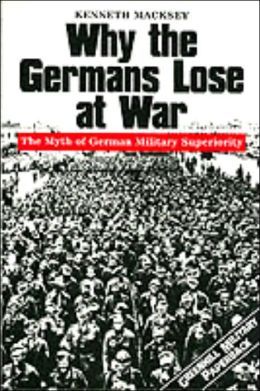
Why the Germans Lose at War: The Myth of German Military Superiority by Kenneth Macksey
The book is short and focused primarily upon the 20th century German grab for European hegemony and world power and, I expect, somewhat polemical as a counterweight to Germanomania common among military history buffs. Most of the Amazon reviewers panned it.
Hitlerland: American Eyewitnesses to the Nazi Rise to Power by Andrew Nagorski
An account of American perceptions – reporters, diplomats, scholars and businessmen living in the Reich – of the Nazi movement and it’s coming to power and totalitarian rule over Germany. Useful in showing intelligent and well-informed people operating without benefit of hindsight as they attempted to assess the early stages of National Socialist Germany at a time when Fascism and Communism were popularly believed among Western intellectuals to represent the wave of the future.
Mike Royko: A Life in Print by Richard Ciccone
I grew up reading Mike Royko and the earlier part of my childhood was spent in the kind of gritty Chicago neighborhood of aspiring middle-class bungalows, dingy corner taverns and 16 inch softball leagues in Ed Kelly-run parks of the people who frequently populated Royko’s columns. I have read Boss several times and it is a classic tale of the world of big city Democratic Machine rough and tumble politics as much as The Last Hurrah.
The Chicago Tribune, is a mere shadow of the great and independent newspaper that hired Mike Royko as a columnist after his career at the long defunct Chicago Daily News and The Chicago Sun-Times, which Royko quit the day it was purchased by Rupert Murdoch. Had Royko lived to see the Trib purchased by the exceedingly nasty Sam Zell, he’d have quit there as well.




