Just received a courtesy review copy of Spinning the Law from Ruby at FSB Associates. This is not the genre of books that I typically review and I was initially hesitant that it would just be a pop culture title, but in skimming, I am pleased to report that the author, former US. Attorney Kendall Coffey, is engaged in an analysis of how public opinion, shaped by the media, impacts the justice system.
Coffey explains the strategies and tactics that prosecutors, defense lawyers and their clients employ as well as the hazards and mistakes made in playing to the media. Coffee’s reach includes the trials of Joan of Arc, Socrates and Aaron Burr as well as more recently infamous characters as the American Taliban, John Walker Lind, Jose Padilla and Governor Rod Blagojevic. Spinning the Law would seem to have a great deal of applicability to those readers interested in IO and public diplomacy, as well as those with conventional interest in the legal system and American politics.
I look forward to reading this and eventually posting a full review.
I mentioned TEMPO a few months back and I wanted to comgratulate Dr. Rao and the launch of his book and notify readers that Venkat will be doing a cross-country drive/book tour to promote TEMPO. Sort of a strategic cognition version of On The Road.
A review of TEMPO will appear here later this week.
Blog-friend Cameron Schaefer has a piece up at Small Wars Journal today in which he quotes Boyd (writing that his approach “incorporated science, but more closely approximated the often chaotic, creative impulses of art”) and Mahan (“art, out of materials which it finds about, creates new forms in endless variety”), and concludes:
Approaching strategy in an indirect fashion, as more of an art than science may make some uneasy, specifically those who find safe haven in the concreteness of checklists and formulas. Yet, the nature of strategy reflects the nature of the world. It is infinitely complex, it is always changing and it is filled with humans that often do irrational things. Literature (see Charles Hill) and psychology have as much of a place at the strategy table as military history… as do mathematics, physics, political science and technology. So, when asking, “what must one study to be a great strategist?” the answer seems to be, “everything else.”
Okay, so that (and Hill‘s work, which Zen reviewed recently) gives us the significance of the arts in strategic thinking which, one hopes, is practiced before going in to battle, and may indeed give one second thoughts about it…
*
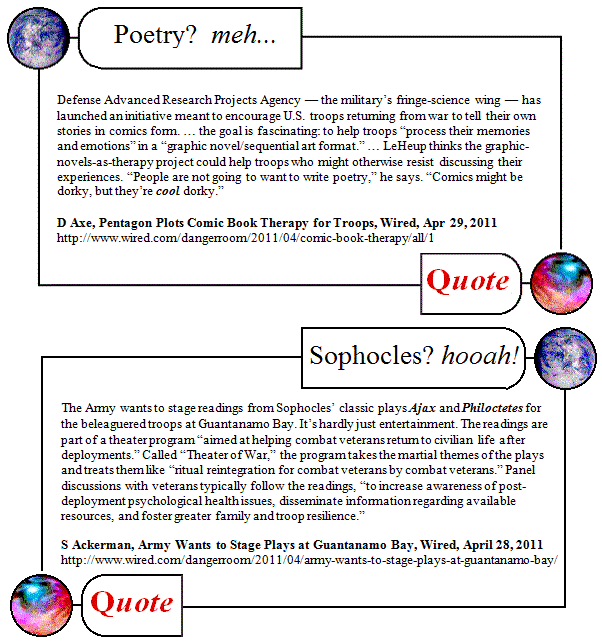
Literature and the arts are also important after battle, though – and the US Military and DARPA have clearly been thinking about that side of things:
Poetry? meh… Sophocles? Chlanna nan con thigibh a so’s gheibh sibh feoil!
*
Lionel Tiger and Robin Fox in The Imperial Animal characterize modern health care as the “bureaucratization of mercy” and propose that for comparison, we set it beside:
the Greek ideal of the hospital as the place with the best food, the finest furnishings and paintings, and the most skilled musicians and comedians.
The greatest healing center in ancient Greece was the Asclepion at Epidavros / Epidaurus, which housed an amphitheater that could seat more than ten thousand people for dramatic and musical performances without amplification.
At Epidavros, patients would be healed by watching those same dramas of Sophocles to which the US Army is now turning for therapeutic relief in Guantanamo — for as Tiger and Fox (what a pair of names) go on to argue:
It is not the healthy, but the sick who most vitally needed such agreeable and re-creative stimuli; and the resources the community had were most beneficially and sanely used in helping them ease their personal disarray and feel encouraged by this display of their community’s careful concern.
*
It’s also interesting to note that the graphic novel Silver Shields mentioned in Axe‘s piece as a precursor to DARPA’s “Online Graphic Novel/Sequential Art Authoring Tools for Therapeutic Storytelling” project is “set during the ancient Greek invasion of Afghanistan more than two millenniums ago” as a metaphor for America’s current situation…
At the time of this writing the United States may or may not still consider itself engaged in a limited-means campaign in Libya, whose declared objective is to protect Libyan civilians and whose implicit objective is regime change. This military endeavor is, or has been, conducted in contravention of hard-learned American strategic doctrines; and it is an odd pick when contrasted with other more pressing and significant challenges to US vital interests in the Middle East.
As is the case with many lessons learned, the US has paid a high price for the insights embodied mostly in the Weinberger Doctrine and also in the Powell Doctrine. Yet, as is also often the case, it has offhandedly brushed aside that hard-earned strategic prudence.
….Yet the planners of the Libyan operation have preferred force economy and risk aversion over winning. First and foremost has been the demarcation of acceptable risks and consequently acceptable modes of military operation, while the gap between those tolerable ways and means on the one hand and the ends on the other hand remain knowingly unaddressed. The operation’s architects have only been willing to commit and risk limited assets applying standoff fire and possibly special operations, and whatever those can achieve – will be achieved. It is not the objectives and theater characteristics but economy and risk aversion that have driven the campaign’s design.
From SWJ Blog where they are about to launch their subscription newsletter, where I debut as the Recommended Reading columnist with Crispin Burke of Wings Over Iraq:
Once a month, beginning on 1 May, we will be sending out an e-mail overview of the latest news, issues, events and more from SWJ and the broader Small Wars / Irregular Warfare community of interest and practice.
Keep abreast of what’s happening in the far flung reaches of the SWJ Empire – sign up below for our newsletter today.
***Sign up now – One lucky SWJ E-News subscriber will win a copy of the 1987 reprint of the Small Wars Manual.*** ***This copy is in new condition – never been opened and has been priced as high as $101.00 on Amazon.com***The contents of SWJ E-News No. 1 will include:
* SWJ News – Journal articles and blog entries, Council debates and discussions, This Week at War and a sneak preview of our SWJ challenge coin,
* Doctrine Man @ SWJ – DM’s exclusive for Small Wars Journal cartoon commentary,
* Professional Reading – Snapshots and links to articles of interest from a wide array of professional journals,
* SWJ Interviews – A recap with links covering our SWJ interview series,
* Starbuck and Zenpundit – Recommended reading,
* Book Review – Bing West’s The Wrong War,
* Upcoming Events – Small Wars-related workshops, conferences, seminars and webcasts,
* More…
Finally, Wikistrat has released the latest Core-Gap Bulletin:
Terra Incognita – What to Do With Despots Who Fight to the Bitter End?
Bahrain Repression Indicates Just How Scared of Iran the Saudis Truly Are
IMF and Standard & Poors Both Issue Warnings on Unprecedented US Debt
As Libyan Stalemate Looms, NATO Increases Involvement
South Africa Formally Joins BRIC Group, Signaling China’s Dominance
And much more…
The entire bulletin is available for subscribers. Over the upcoming week we will release analysis from the bulletin to our free Geopolitical Analysis section of the Wikistrat website, first being “Terra Incognita – What to Do With Despots Who Fight to the Bitter End?”
Zenpundit is a blog dedicated to exploring the intersections of foreign policy, history, military theory, national security,strategic thinking, futurism, cognition and a number of other esoteric pursuits.


 ***This copy is in new condition – never been opened and has been priced as high as