zenpundit.com » Uncategorized

Archive for the ‘Uncategorized’ Category

Turkey — keeping an eye out for Gülen

Saturday, July 16th, 2016

[ by Charles Cameron — a substantial side-current in the coup attempt draws attention to Gülen, who presently lives in the Poconos and is heavily involved in US charter schools ]
.

I don’t have anything fresh to say about the situation in Turkey beyond what others can say, but my interest in religious movements has long focused my attention on Fethullah Gülen.

Like his rough contemporary Harun Yahya aka Adnan Oktar — celebrated for his Islamic creationism — Gülen was a student of the late Said Nursi. He is reported to have been influenced by the works of Rumi, Ibn Arabi, and other sufis. Gülen has strengthened one sphere of his considerable influence by encouraging academics to write about him, and I’m not sure as to how much of what has been written as a result is the flattery of courtiers, and how much reliable scholarship — but for what it’s worth, Heon Kim‘s Gülen’s Dialogic Sufism: A Constructional and Constructive Factor of Dialogue, published in the then-Gülenist newspaper, Zaman, discusses both Gülen’ssufism and his interest in interfaith dialogue.

He’s certainly an interesting fellow to watch.

**

From Twitter:

**

**

**

**

**

**

**

**

**

Aha!

**

Go figure.

Strange votes, odd bedfellows, weird juxtapositions

Thursday, July 14th, 2016

[ by Charles Cameron — ’tis the season of the unexpected ]
.

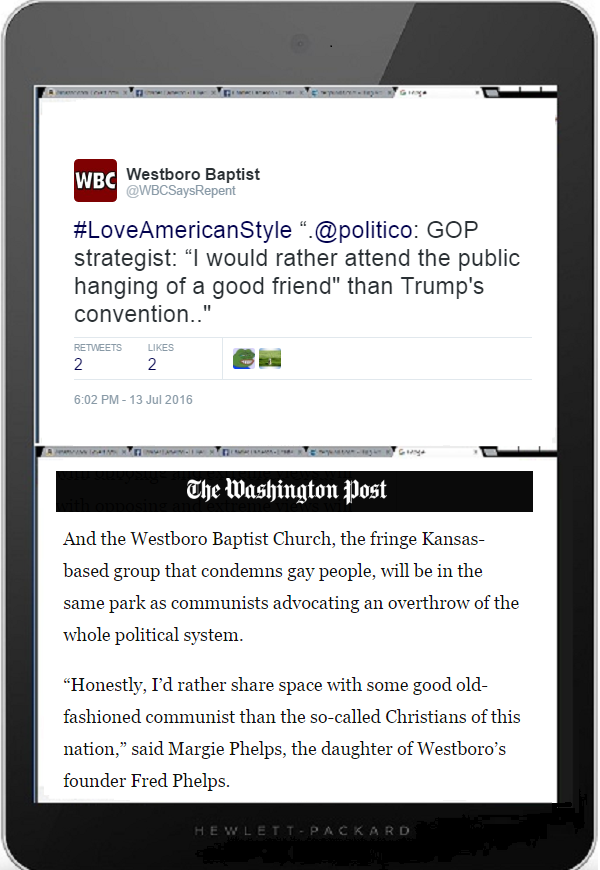
Strange votes:

DQ Tablet strange votes

Westboro Baptist:

Tablet DQ WBC

and Pokemon Go:

WBC Pokemon

Should trees, parks, rivers, whales, corporations have standing?

Thursday, July 14th, 2016

[ by Charles Cameron — and what about straw men & sovereign citizens? ]
.

Tablet DQ Trees standing

**

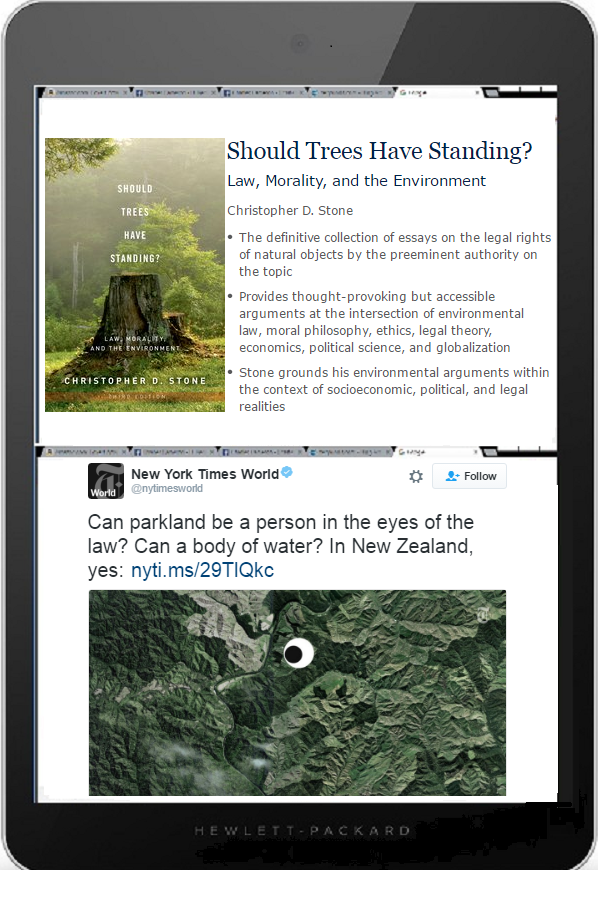
I have long appreciated Mr Justice Douglas‘ dissent in Sierra Club v. Morton, 405 U.S. 727 (1972), and Christopher Stone‘s comment on the same, Should Trees Have Standing? — presented along with other essays in Stone’s book of the same name [upper panel, above].

That takes care of the trees in my title. Parks and rivers are covered by the New York Times piece today, In New Zealand, Lands and Rivers Can Be People (Legally Speaking).

Whales and apes get added to our list, as you can see, in Brighter Green‘s Nature’s Rights: Rivers, Trees, Whales, and Apes — which mentions that under Ecuador’s constitution enshrining the legal rights of nature as a whole::

Ecuador stepped to the forefront of the nature’s rights movement when it became the first country to include the rights of Mother Earth (Pachamama) in its constitution, which was ratified in 2008. The document states, “Nature or Pachamama, where life is reproduced and exists, has the right to exist, persist, maintain, and regenerate its vital cycles, structure, functions, and its processes in evolution.” Nature is a “rights-bearing entity that should be treated with parity under the law.” Citizens are given the power to sue on behalf of nature, now a legal entity

**

And corporations?

The irony here, of course, is that those who would like to see Nature get a word in edgewise in the courts as a legal Person, tend to be unhappy with corporations having the same rights as chimpanzees. Eric Posner in Slate, Stop Fussing Over Personhood, catches the irony nicely:

From a legal standpoint, there is nothing remarkable about a chimpanzee claiming to be a person. Indeed, there are a number of cases that have been brought by animals—including a palila, a marbled murrelet, and a spotted owl. All of these animals sought to enforce their rights under the Endangered Species Act, under a provision that gives “persons” the right to bring suit.

In none of these cases was a judge fooled into thinking that an animal possesses all the rights of human beings. The lawyers bringing them were simply ensuring that a judicial remedy was available to address the harm that Congress sought to fix. If the spotted owl had also asked for the right to vote, the request would have been denied. A judge wouldn’t give a hoot that an earlier court had deemed the owl a “person” under the Endangered Species Act. A person for one legal purpose is not necessarily a person for another.

The law also treats various nonhuman, nonsentient entities as “persons” for certain legal purposes. Corporations, estates, trusts, partnerships, and government entities are often defined this way. Walmart, Illinois, and the California Pension Fund can sue, for example, without anyone asking if they have a right to abortion.

The classic case here is the famous and infamous Citizens United v. Federal Election Commission, No. 08-205, 558 U.S. 310 (2010).

**

I’d be remiss if I didn’t mention here also the curious notions of personhood invoked by members of the Sovereign Citizens movement. From JM Berger‘s recent report, Without Prejudice: What Sovereign Citizens Believe:

Fictitious Person

Because the UCC provides an interstate standard for things such as driver’s licenses, property ownership, and bank accounts, many sovereigns believe that these documents (and associated laws and financial obligations) do not apply to them, but instead to a fictitious person created by the illegitimate law, sometimes referred to as a “straw man.” Some believe a fictitious person is denoted in legal documents by listing his or her name in all capital letters. The fictitious person is a legal entity akin to a company with the same name as the citizen, sovereigns believe.

Some sovereigns create their own driver’s licenses and license plates because they believe the state-issued documents are inauthentic, as they refer to the fictitious person, and that using or signing these documents exposes them to vulnerabilities under the illegitimate and tyrannical commercial laws, including debt collection, arrest, and prosecution.

The correct use of certain phrases or legal citations can reduce or eliminate these vulnerabilities, however. For instance, some believe that documents used by the illegitimate system, such as contracts or court documents, can be signed safely if the citizen appends the phrase “Without Prejudice UCC 1-308” to the signature, which they believe preserves the sovereign citizen’s common law rights and privileges.

**

Let’s return to sanity.

The final word in Sierra Club vs Morton is given to Mr Justice Douglas: in a footnote, he cites John Donne, poet — and thus according to Shelley, one of the “unacknowledged legislators of the world”:

“No man is an Iland, intire of itselfe; every man is a peece of the Continent, a part of the maine; if a Clod bee washed away by the Sea, Europe is the lesse, as well as if a Promontorie were, as well as if a Mannor of thy friends or of thine owne were; any man’s death diminishes me, because I am involved in Mankinde; And therefore never send to know for whom the bell tolls; it tolls for thee.”

Devotions XVII.

And by way of comparison, here’s a Maori expression of the same sense of extended personhood, in context from the NYT article I cited above:

A former national park has been granted personhood, and a river system is expected to receive the same soon.

The unusual designations, something like the legal status that corporations possess, came out of agreements between New Zealand’s government and Maori groups. The two sides have argued for years over guardianship of the country’s natural features.

Chris Finlayson, New Zealand’s attorney general, said the issue was resolved by taking the Maori mind-set into account. “In their worldview, ‘I am the river and the river is me,’” he said. “Their geographic region is part and parcel of who they are.”

New Book: High Towers and Strong Places by Tim Furnish

Thursday, July 14th, 2016

[Mark Safranski / “zen“]

High Towers and Strong Places: A Political History of Middle-Earth by Timothy R. Furnish

The hundredth anniversary of the terrifying and tragic Battle of the Somme seems a fitting time to review a new book about Middle-Earth, as it was born at the Somme  from the imagination of a young British officer who survived it, J.R.R. Tolkien. From the death and destruction of the Western Front, Tolkien wrought a deep and elegant mythology that has entertained and fascinated hundreds of millions of readers for decades, spawned a sword and sorcery genre of popular fiction, major motion pictures, video games and even an academic field, “Tolkien Studies“. It is to the latter that High Towers and Strong Places by Dr. Timothy Furnish belongs and it represents a major analytic contribution; Furnish takes that which is well-known and widely read and breaks new ground.

Departing from the tradition of analyzing Tolkien’s works as literature, poetry, linguistics, mythology, culture and even roots in Christian theology, Furnish applies the disciplinary lens of political science and opens up into view the geopolitics of Middle-Earth; Sauron as tyrannical theocrat, Gondor as hegemon and Gandalf as the grand strategist of the West. Furnish, a former Arabic linguist and Army chaplain with a PhD in Islamic history, emphasizes that J.R.R. Tolkien, as a scholar and “subcreator” was deeply concerned with history and historical realism as a substantive basis for his fictional world that he took to “amazing lengths” of detail. This makes Middle-Earth a prime candidate, Furnish argues, to be analyzed in “real-world fashion”:

….The Silmarillion and LotR are both shot through with politics – whether about the intrigues of noldorin princes of the First Age, the even more byzantine plots of the Second Age Numenorean kings, or the dynastic struggles of the rulers of Arnor and Gondor in the Third Age. But the latter two are in even larger measure books about wars, while even The Hobbit contains a major, and important, battle before its end.

Furnish looks at Middle-Earth from the wars of Beleriand to the War of the Ring in the Third Age in terms of “Races and Realms” all demonstrating three basic “Types of Rule” from which flows politics, policies and to some instances, strategy, manifesting in “The Physical, Cultural-Political and Economic Aspects of Middle-Earth Warfare”. To some degree, the early part of the text is a review of the major components of Tolkien’s legendarium, enjoyably familiar to the rabid Tolkien fan but absolutely useful to the more casual reader, who has read The Hobbit and Lord of the Rings but not The Silmarillion, Unfinished Tales, the more recent The Children of Hurin,  or the twelve volume The History of Middle-Earth by Christopher Tolkien. Having laid the groundwork, Furnish then begins to examine Middle-Earth with the disciplinary lens of political science and IR.

Heavily footnoted and charmingly illustrated by Anke Eissmann, where High Towers and Strong Places really shines is in Furnish’s detailed analysis of the realms of men and the critical role of the Edain and their descendants – the fierce Numenoreans and the Dunedain of Gondor and Arnor – play in Tolkien’s universe. It is conventional to interpret the history of Middle-Earth through an Elvish perspective given the events of The Silmarillion and the individual power of the greatest of the Eldar – Feanor, Luthien, Fingolfin, Finrod Felagund, Thingol, Galadriel, Celebrimbor, Elrond – which overshadow all but a heroic few men in Tolkien’s legendarium. Timothy Furnish is the first scholar to put the true scope and scale of the rise of Numenor and it’s armed might into perspective; Numenor was a true global empire and the mightiest military power of not only the Second Age, but perhaps of any age. The Numenoreans eclipsed the power of the Noldorin Elf-kingdoms of Beleriand, ruled the Seas and vast swaths of Middle-Earth and easily humbled Sauron at the pinnacle of his strength. It is an open question if Numenor at its height would have rivaled the power of Angband, but under Ar-Pharazon the Numenoreans invaded Valinor, a feat even Morgoth never dared to do. As Furnish writes:

Numenor was clearly modeled on the Atlantis myth, the importance and the centrality of which to Tolkien’s own view of his legendarium’s history having already been noted. For some 3300 years, these “Kings of men” dominated the political and military dimensions of Middle-Earth, because of their being “more like to the Firstborn [Elves] than any other of the kindred of men”. Elven aspects of these men included not only extremely long lifespans….but also great bodily stature, usually reaching 6 1/2 to 7 feet. In addition, the Numenoreans….became the most technologically advanced people in Middle-Earth – particularly in ship-building and as mariners and, eventually, in terms of military technology and weaponry

While there are many points of interest in High Towers and Strong Places, such as the nature of Orcs or the relationship between Hobbits and Men or the political characteristics of Elven lordships vs. kingdoms, another strength is Furnish’s examination of  “the realms of evil”, Angband and Mordor and their satellites and clients. While differentiating between the strategic ambitions of the dark lord Morgoth and his chief disciple and successor Sauron, Furnish characterizes them both as “theocratic tyrants”, albeit Sauron was the more rational and calculating of the two.  As incarnated evil, immortal in nature and possessed of immense personal powers, the dark lords were aspiring “god-kings” seeking not merely political rule imposed by military dominance, but “worship” and total domination of the wills of others and – in Morgoth’s case – over the very substance of Arda itself.

This supernatural despotism has no genuine analog in the real world, of course, but their mad striving for “unipolarity” and reaping the consequences of counter-balancing and downfall is a familiar pattern. Furnish does a thorough job with the waxing and waning of power between the “states” of the West (of Elves, Dwarves and Men but especially Numenor and Gondor) and Sauron’s eastern hegemony headquartered in Mordor. The flow and rhythm is one recognizable to anyone who has studied the Cold War or the empires of the ancient world. Furnish intends to build upon this political history with a second volume, a military history of Middle-Earth that will delve deeply into how Tolkien conceived of war and warfare in his legendarium.

High Towers and Strong Places is a must-have tome on the shelf for every dedicated fan of J.R.R. Tolkien.

Will you, won’t you, won’t you join the dance?

Sunday, July 10th, 2016

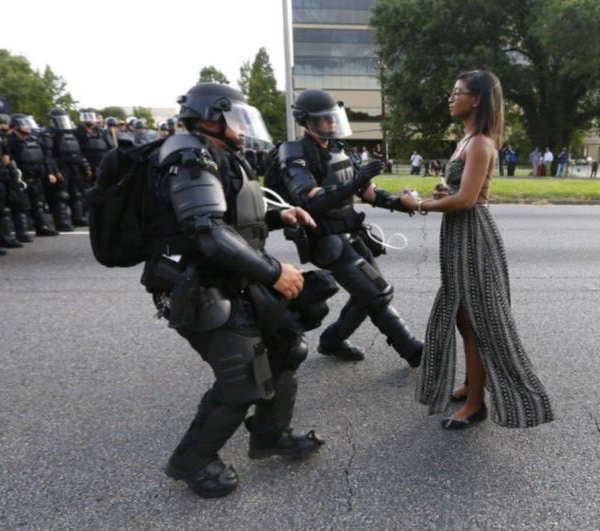
[ by Charles Cameron — protest and arrest in Baton Rouge ]
.

will you won
Reuters – Jonathan Bachman

It is the stunning balletic quality of this image that catches my attention here, and gives this post a title drawn from Lewis Carroll‘s Lobster Quadrille in Alice’s Adventures in Wonderland.


Switch to our mobile site