zenpundit.com » diplomacy

Archive for the ‘diplomacy’ Category

Russia Policy: Trying to Make A Virtue Out of Having Ceded the Initiative

Thursday, August 14th, 2008

I had actually intended to post briefly on the implications of the Russo-Georgian War for State vs. State warfare and 4GW but today’s reactions by the Bush administration and Senators McCain and Obama are a more important concern. The United States has no strategic policy in regard to Russia – and if the statements of the candidates for president are to be believed – we won’t have one in the next four years either.

President Bush, speaking today:

….As I have made clear, Russia’s ongoing action raise serious questions about its intentions in Georgia and the region. In recent years, Russia has sought to integrate into the diplomatic, political, economic, and security structures of the 21st century. The United States has supported those efforts. Now Russia is putting its aspirations at risk by taking actions in Georgia that are inconsistent with the principles of those institutions. To begin to repair the damage to its relations with the United States, Europe, and other nations, and to begin restoring its place in the world, Russia must keep its word and act to end this crisis.

The President is alluding to Russia’s G-8 membership, the WTO, the OECD and similarly prestigious diplomatic entities. The strong emphasis Bush placed upon the need for Russian adherence to the cease-fire agreement and extending humanitarian aid was very well placed from the perspective of a moral level of conflict. The cancellation of  American participation in a scheduled Russian-NATO meeting was also appropriate ( no allies signed on to that very minor reprimand). Though we need to be honest here, the dispatch of U.S. military personnel to deliver humanitarian aid is meant as a “tripwire” against a resumption of a full-bore Russian onslaught into Georgia, not just to hand out MRE’s and bottled water to displaced villagers. It’s a very serious move ( and unaccompanied as far as I am aware by German, French or other NATO troops – if I am wrong, please correct me).

Let’s be perfectly clear: the Russian Army’s invasion of Georgia was carried out in trademark Russian fashion, brutally with obvious disregard for civilian casualties and reports of casual murders and looting by Russian soldiers. The only noteworthy exception to their usual, thuggish, performance here has been the swift accomplishment of all military objectives and total rout of the enemy army. Not since special KGB commandos seized the Tajbeg Palace in Kabul and assassinated a Prime Minister in 1979 has a Russian military operation been carried out so flawlessly. 

As a result, many people in European capitals, the State Department, the IC and the Pentagon have egg on their faces right now.  A lot of serious VIPs have been embarrassed by a client ( Saakashvili and company) who performed so poorly in this debacle – at every level that matters – that much of their previous professional advice and opinions regarding said client in retrospect look like hopelessly incompetent bullshit. These VIP’s are faced with two choices: circle the wagons around their naked emperor and try to find some kind of bow to put on this disaster or candidly admit that they horribly misjudged the entire situation to their superiors and reassess the policy in regards to Georgia from scratch.

Guess which route we are going today ?

Now to be fair, many of the actions taken by the President are sound and wise ones. Russia needs to feel significant pushback here and Bush is doing that very firmly and responsibly – and without much help from our allies other than President Sarkozy. The problem is that these are ad hoc reactions – flailing about frantically because in truth the United States has had no strategic policy toward Russia or any objective that gets much further than pleasing insider interests who are squealing loudest to the administration or the Congress. Not decommissioning Russian nukes fast enough ? Look no further than American uranium company lobbies. In regards to Kosovo or Georgia, that would be the EU. What? Isn’t Saakashvili America’s “special project” ( to quote Russia’s Foreign Minister – some Putin toady, name unimportant, he warms a chair). Well, not really. My friend Dave Schuler has an outstanding post on Europe’s stake in Georgia. It’s a lot larger than is ours:

….Germany’s ties with Georgia are, if anything, closer. Georgia is Germany’s fifth largest trading partner. I presume that much of this trade is a consequence of Georgia’s two pipelines. Energy independence is as much a political hot topic in Germany as it is here but the term means mostly not being so terribly dependent on Russia. The path to greater energy independence for Germany lies through Georgia.

….In 2007 FDI in Georgia exceeded the $1 billion mark. A substantial proportion of that was EU countries.

[ Ed. Note: The above quote is in error – Georgia is not Germany’s fifth largest trading partner – thank you to b and Annie for the correction] 

Would any reader care to hazard a guess as to the number of German troops expected to be standing next to American soldiers in Georgia delivering humanitarian aid ? This is not to knock the Germans per se as to point out that the United States carrying all of the water for Europe and absorbing all of the friction in return for nothing doesn’t make a whole lot of strategic sense.  Europe is safe,  wealthy and grown-up and not shy about pressing their collective economic interests but slow to accept all of the responsibilities they ask of the United States and our own State Department is a reflexive enabler of the extended European adolescence. Leadership in an alliance does not always mean being the other guy’s doormat.

Deciding what our long-term interests are in the region and what our relationship with Russia should be is something seventeen years overdue and presidential candidates who have no clue, left to their own devices, of what to do or, who take foreign policy advice from a paid agent of a foreign government, worry the hell out of me.

UPDATE:

Fabius Maximus had some recommended posts on Russia-Georgia worth sharing that I’d like to add here along with a few others I caught this morning:

Stratfor   War Nerd   Helena Cobban  Joshua Foust   Glittering Eye   Coming Anarchy   Robert Kaplan (Hat tip CA)

Whirledview   SWJ Blog    Global Guerillas   Selil Blog   Andrew Sullivan

“I will Make Georgia Howl”

Tuesday, August 12th, 2008

Perusing the latest news on the Russo-Georgian War via the always excellent SWJ Blog, I fear some of my analysis from the other day will come to pass, simply because the only restraint on Putin’s disposition to use force against Georgia thus far is Putin’s self-restraint. Of which I’m not seeing much.  If something constructive in terms of statesmanship is to be done to end the crisis, we ought to move toward doing it while the Georgian Army is still intact.

 Western bluster is not going to help Saakashvili as much as would quietly putting the squeeze on the far-flung economic interests of the siloviki clique in Putin’s inner circle, or of the Russian state itself. That would be a practical and proportionately useful response to signal displeasure with Moscow’s actions. Far moreso than invoking comparisons with Hitler or Saddam Hussein or other rhetorical nonsense by folks who know better.  But doing that would require that the Europeans – the nations that wanted the BTC pipeline, after all – rapidly act as a diplomatic united front with Washington and accept some risk of retaliation – say, a 100 % increase of gas prices by Gazprom.

Kudos to President Sarkozy ‘s efforts but I’m not holding my breath on that one.

Adam Elkus suggested that we may be seeing an example of military theorist Frank Hoffman’s hybrid war in action. Possibly. Or we may see a combined arms version of an EBO attack by Moscow against the Georgian state. The critical variable will be if the Russians try for an occupation of Georgia proper, which will likely result in an open-source insurgency, or if they are engaged in what used to be called a “punitive expedition” and intend a prompt departure while they are still ahead.

Addendum:

In addition to linking to me ( gracias!) Galrahn is chasing down some very interesting rumors regarding Israelis and also of threatened executions of POWs. 

Addendum II.

Discussion at Small Wars Council rises to the occasion.

Addendum III.

Registan has a series of informative posts and lively commenters (some anti-Barnett mania as well). Dr. Dan Nexon has a good post up at Duck of Minerva with a priceless quote:

“We don’t look very good,” said a former Pentagon official long involved in Georgia. “We’ve been working on [Georgia] for four years and we’ve failed. Everyone’s guilty. But Putin is playing his cards brilliantly. He knows exactly what he’s doing and the consequences are all negative.”

That kind of truth telling is good. The fact is that if you look at Georgia and the U.S. backed Ethiopian intervention, there seems to be a systemic failure to anticipate and plan a response for the likely eventualities when carrying out proxy operations. It’s almost as if there’s a rule somewhere forbidding the raising of “What if ”  questions during the interagency process.

A Brief Word on Petraeus: Pundita

Friday, April 25th, 2008

I did not have much time for blogging the other day when the good news of General Petraeus’ nomination to CENTCOM broke. However, blogfriend Pundita, who specializes in the political and economic nuances of the  inside-the-beltway shaping of American foreign policy, was kind enough to inquire of my opinion yesterday via email. Even kinder on Pundita’s part to use it in a post:

“Mark, What do you think of the nomination? Good move, or is it kicking Petraeus upstairs?
Pundita”
“Miss P:
This is excellent news and yet more confirmation of the competence and vision of SecDef Robert Gates – as well as his political clout. General Petraeus was due for consideration for a significant posting after his tour of duty in Iraq and CENTCOM chief is among the best options.

Had Petraeus been sent to NATO or the Pentagon, that might have indicated an institutional retreat from the current, evolving COIN [counterinsurgency] strategy on the part of the Army’s old guard, just as they did in the wind-down of Vietnam.Moreover, the appointment of a traditional, conventional warfare advocate at CENTCOM instead of Petraeus could easily have been taken as a signal that the Bush administration was gearing up in it’s waning days to “broaden the war” by initiating a major conflict with Iran.

I expect that Petraeus is also the most ‘confirmable’ candidate, given the rhetoric of Democratic candidates on Afghanistan. And given that NATO is struggling in executing COIN consistently against the Taliban, Petraeus’ skill and experience will be needed to get things back on track without antagonizing our European allies.

On a related matter I’m very, very happy with Robert Gates. I think he just gave a ‘shape up or ship out’ warning to the senior brass.[1] What he said the other day to the cadets regarding John Boyd was akin to a Soviet General-Secretary giving a speech to the Supreme Soviet on the virtues of Milton Friedman. Or Pope Benedict praising Martin Luther.

….Dear Mark:
Thank you for your observations. I was not happy when I first heard Gates was on track for SecDef. Your analyses suggest I should stop sticking pins in his effigy — er, wait a minute, maybe it’s been working.
Also, I note that you’re recommending John McCain signal that if he wins the White House he’s going to keep Gates as SecDef.Interesting points. And Gates in that position might dissuade President McCain from his views on Russia, which deeply trouble me”

Me too. I hope that Senator McCain broadens and deepens his foreign policy and defense teams in the coming months.  Russia and China are not our allies by any means but it makes little sense to try and provoke each of them into an active, anti-American, partnership. Let’s deal with these powers pragmatically when and where they are willing to get down to business and quietly but firmly pushback where they are negatively impacting our interests.

If some segments of the American Left can’t stop being apologists for the long expired Soviets then there are some on the Right who need to accept that America won the Cold War and that it’s time to move on.

PETRAEUS UPDATE:

Tom is already irritated.

SWJ BLog has the uber-round-up.

On Synchronicity and Other Variables

Saturday, March 15th, 2008

Blogfriend Matt Armstrong was recently featured at the USC Center for Public Diplomacy where he had a very thorough and well-considered op-ed on Information Operations and New Media. Pretty much everything Matt had to say were things the USG should be doing in attempting to craft some kind of coherent narrative of it’s national objectives, policies and values:

SYNCHRONIZING INFORMATION: THE IMPORTANCE OF NEW MEDIA IN CONFLICT

Insurgents and terrorists increasingly leverage New Media to shape perceptions around the globe to be attractive to some and intimidating to others. New Media collapses traditional concepts of time and space as information moves around the world in an instant. Unlike traditional media, search engines and the web in general, enable information, factual or not, to be quickly and easily accessed long after it was created.The result is a shift in the purpose of physical engagement to increasingly incorporate the information effect of words and deeds. Thus, the purpose of improvised explosive devices, for example, is not to kill or maim Americans but to replay images of David sticking it to Goliath.
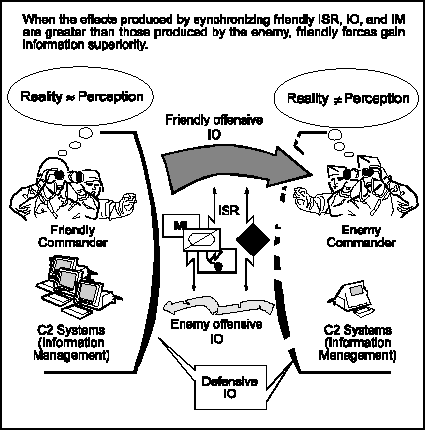
The U.S. military is actively and aggressively revising its role in shaping its own narrative in cyberspace, but this is falling short. While the U.S. is finally coming to grips with the centrality of information and perceptions, it remains confused as to how to use information effectively. American responses seem to stem from the belief that the message and the messenger we are countering are the same without regard for the target audience, intent, or how the message fits into a larger narrative, which perhaps mirrors our own perception of information as propaganda. ….A famous dead Prussian once said that war is a continuation of politics by other means, but the reality today is that war is not part of political intercourse with foes but an orchestrated, if loosely, effort to gain strategic influence over friends, foes, and neutrals. YouTube, blogs, SMS and traditional media, make every GI Joe and Jihadi a communicator, public diplomat, and persuader. Our adversaries understand and exploit this reality. Writing to Abu Musab al-Zarqawi in 2005, Ayman al-Zawahiri stated that “we are in a battle, and that more than half of this battle is taking place in the battlefield of the media [sic].”The U.S. military as reluctant heir to the information throne in an online world has several inherent challenges. First, operating in the environment of New Media requires awareness and agility inconsistent with the current organizational culture of the military. For example, in Iraq the military broke through the bureaucratic red-tape and started posting videos on YouTube. However, this small “victory” was incomplete: the group that uploaded to YouTube was still not permitted to view YouTube. In effect, they were posting information they were not authorized to see.”
Those quotes were snippets. Matt’s post is rich in detail and really requires being read in full.

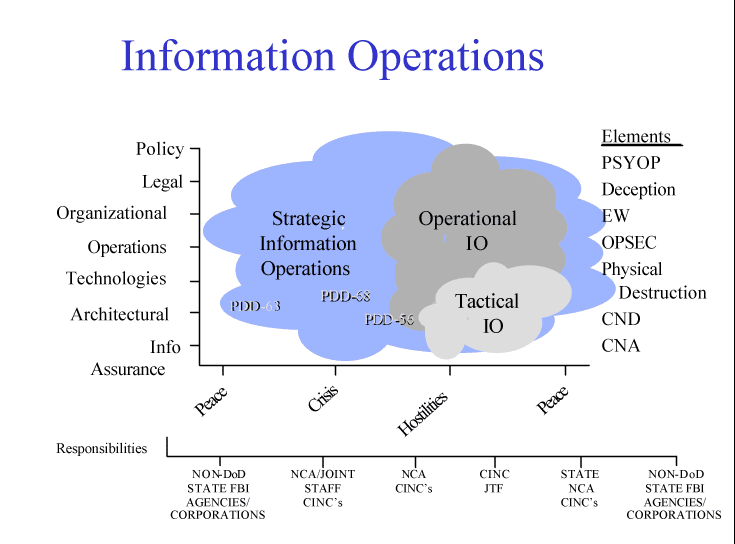
I have tilted at the IO windmill a few times in the past. It’s a subject that is both easy as wel as difficult to analyze. Easy, because the USG has yet to initiate and/or master the fundamentals of good IO as Matt’s post makes clear ( there are genuine IO experts in the USG, perhaps even a large number of them, but the bureaucracies are not institutionally optimized to conduct IO with consistency or coordination) but difficult because the level of genuine sophistication and effective nuance in strategic communication remains so far off. Even if that level of “play” was achieved by our civil service and soldiers, any  IO campaign could be undone in an instant by some clumsy action or statement from a political appointee or elected official concerned primarily with fellating some domestic special interest group. 

Matt’s focus on “synchronicity” is apt. It will be a herculean task needing laser beam focus to get all of the USG players on the same message most of the time; even then some dissension and debate being showcased is itself a vital advertisement of the attractive nature of a liberal, open society and a sharp contrast with the dismally intolerant and brutally ignorant alternative our Islamist enemies have to offer. In pursuing that, I’d like to offer a few suggestions:

Credibility is the COIN of the Realm:

Matt touched on this but I want to give this principle added weight. For all our official, overt, communication by any spokesman representing the United States, the best long term strategy is a reputation of credibility. It may hurt to concede errors or enemy successes in the short run but having the global audience grdugingly concede that “the Americans speak the truth” adds momentum of every word, every idea and every action we undertake. It will not bring us love because oftentimes, our pursuing national interests will come at the expense of others but truth-telling will yield something more valuable, respect. No one cares to be treated as if they were a fool and most of the transparently self-serving gibberish official spokesmen offer up pays dividends only in contempt being added to the anger foreigners already feel at some of our policies.  Credibility is to the war of ideas what COIN is to guerilla warfare and it is a valuable and exceedingly rare quality because once your credibility is lost, it is lost.
Without Attention Being Paid All Our efforts Are Useless:

Credibility is not enough. Key messages or memes also have to be interesting. If people are not psychologically engaged in the presentation then they are not hearing it, much less reaching the points of comprehension, sympathy or agreement. American popular culture and commercial advertising is nothing short of an unrelenting global juggernaut that is eroding traditional mores of every society with which it comes into contact, yet our official proclamations remain starkly uninteresting even to most Americans so why should a Yemeni teen-ager or Afghan farmer tune in to what we are selling ? As long as our attempts at capturing attention remain at the level of dull mediocrity we can expect to fail.

Influence is a Long Term Investment:

The 1980’s saw a march toward capitalism and democracy in part because we were reaping the harvest of decades of student visas, cultural and scientific exchanges and consistent public diplomacy outreach. From Mongolia to Czechoslovakia Chile there were reformers taking power who were ” Chicago Boys” who had imbibed free markets at the feet of Nobel laureates. The National Endowment for Democracy, the USIA, VOA, Radio Free Europe and NGO’s like the AFL-CIO whose efforts and programs abroad were robust and self-confident. American society was permitted by the USG to sell itself. These things cost pennies on the dollar compared to having to  use hard power options and they lower our transaction costs when sanctions or military intervention is the order of the day.

Deception is Best Left to the Clandestine Operators :

HUMINT based strategic influence efforts, black propaganda and disinformation and various arts of deception will be better left to covert programs, plausibly deniable third parties and used sparingly and with subtlety. The increasingly “radically transparent” world ensures that too many sophisticated eyes with all sorts of agendas will be analyzing our official spokesmen 24/7. The best will can hope to accomplish is effectively framing our public message to be truthful and compelling. Any meme that is verifiably false, if we believe we must put it out into the global media environment, cannot have a return address.


IO is a secondary area of operations for the United States.  Good IO programs cannot remediate incompetent statecraft or poor military leadership or put a “happy face” on obvious disasters but poor or absent IO capabilities can fritter away the capital that successful diplomacy or military action can accrue when our enemies accusations go unanswered. 

Crossposted at Chicago Boyz

MountainRunner at Democracy Project

Friday, March 7th, 2008

Usually, when I link to Democracy Project it is to highlight some important problem that my friend Bruce Kesler attacking head on. Today, Bruce has invited another friend, Matt Armstrong of MountainRunner, to share the spotlight in a special guest post in an area of expertise – the crisis of American public diplomacy:

U.S. Tongue-Ties Self In Talking To World

To begin with, we must accept that the romantic days of the United States Information Agency are gone. So many confuse the USIA and the other information services, such as Radio Free Europe and Radio Liberty, of recent decades with the USIA that was engaged in the active psychological struggle that largely ended with détente and the finalizing of the European partition.

Unlike half a century ago, the U.S. military has a clear voice and is arguably our dominant public diplomat. Therefore, simply resurrecting “USIA” without reorganizing our national information capabilities across civilian and military lines would turn it into just another voice struggling to be heard over America’s military commanders, spokespersons, and warfighters.

The candidates must look deeper than re-creating an agency and or re-establishing old outreach programs. They must show strong leadership and have a bold vision to rally the government and country to adapt to a world that requires understanding the information effect of action, agile response capabilities, and above all, credibility and trust.

Read the rest here.


Switch to our mobile site