zenpundit.com » diplomacy

Archive for the ‘diplomacy’ Category

Luttwak on the Australian Strategic Pivot

Sunday, September 30th, 2012

Iconoclastic strategist Edward Luttwak has characteristically caustic words on an Australian -American strategic entente to contain an “autistic” rising China:

Australia counters Chinese threat 

AUSTRALIA has been quietly building a regional defence coalition to restrain China’s increasingly ”aggressive” and ”autistic” international behaviour, an influential adviser to the Pentagon says.

Edward Luttwak bluntly contradicts Australian and US denials that they see China as a threat or want to contain its rise. ”Australians view themselves as facing a strategic threat,” he writes in his coming book, The Rise of China v The Logic of Strategy.

The emerging latticework of regional defence arrangements augments ”the overall capacity of the US-Australian alliance to contain China”.

The book praises Australia’s strategic initiative in forging ties with countries such as Malaysia, Indonesia and India that lie beyond America’s natural security orbit, as well as broadening the defence networks of close US allies such as Japan.

”Each of these Australian initiatives derives from a prior and broader decision to take the initiative in building a structure of collective security piece by piece, and not just leave it all to the Americans,” it says.

….The Australian National University’s Hugh White has argued that the US needs to ”share power” with what is going to be ”the most formidable power the US has ever faced”. But for Mr Luttwak, the ”logic of strategy” dictates that neighbours will naturally coalesce against the new rising threat, thus preventing China from realising anything like the relative military power that has been projected.

”The rapid accession to prosperity has been a very common way for countries to lose their sanity,” Mr Luttwak told the Herald. He said China suffered from ancient and new foreign policy weaknesses.

”The Chinese are autistic in dealing with foreigners, they have no sense of the ‘other’,” he said. ”They think they are incredibly brilliant strategists as if they had been conquering other nations, when in fact it’s been the other way around for 1500 years.”

Ouch.

China’s political system is in the midst of a particularly edgy and uncertain generational transition of power, following the succession machinery designed by China’s last “paramount leader”, Deng Xiaoping, to retain harmony among the ruling Communist Party elite.  Deng’s successors are following his script, but their hearts no longer appear to be in it – 15 years after Deng’s death, cracks have appeared in the facade of unity. Not a fatal flaw, but lacking a leader of Deng’s stature who, even in retirement, remained the supreme arbiter of China’s political system, factions of China’s elite have more room to push conflicting agendas.

In foreign policy we see the effects in China’s erratically belligerent, then conciliatory behavior towards it’s East Asian neighbors and the United States. Strategically, it makes little sense for China to repeatedly generate friction over territorial claims to the entire South China Sea with Vietnam, Philippines, Taiwan, Brunei, Malaysia, Indonesia and the United States and push a separate dispute with Japan simultaneously, yet because of intra-elite, domestic politics, Beijing is unable or unwilling to restrain enthusiast Chinese officials from doing so.

Of films, riots and hatred II: when islands are the issue

Monday, September 17th, 2012

[ by Charles Cameron — comparative riotology, with sidelong glances at goats and a single mole ]
.


.

It’s not always disrespect for the Prophet that causes people to burn flags and attempt to break into embassies

This week, the disputed sovereignty of some uninhabited islands has done the trick quite nicely in Beijing, where rioters have attempted to breach the Japanese embassy and burned the Japanese flag (upper image, above) in a manner that’s somehow reminiscent of the breaching of the US embassy and corresponding burning of the US flag (lower image) in Cairo .

I imagine that if one was Japanese or Chinese, one might consider the Beijing protests over the ownership of the Senkaku / Diaoyu / Tiaoyutai Islands to be the primary troubling news-story about embassies, rioting and gross breaches of diplomatic protocol this week.

There’s a strange kind of parallax involved here, I think. Or perhaps: what’s in the foreground depends on where you stand.

But that’s not to say there’s an exact equivalence between the situations, just that bearing one in mind may shed some light on the other.

**

I hope to get into the layers and layers of motivation that feed a riot in a subsequent post, but for now I’d just like to point to one similarity between the two situations. In each case, there’s an undertow of strong feeling that surfaces at a certain point — and astonishes us by its force.

In the case of the disputed islands, it may be Chinese feelings about Japanese behavior towards them in World War II that are triggered by Japanese claims on the islands. As China Daily USA says:

Japan has to recognize China’s sovereignty over the Diaoyu Islands and atone for its past aggressions and atrocities, and take measures to punish those Japanese who deny the country’s violent past, in the way that Germany has been doing for decades. Only if Japan does that will China and other Asian countries see it as a normal country. Otherwise, China should prepare for a long-term struggle.

Or as the Israeli Arutz7 puts it:

As

The dispute with Japan is now part of the legacy of World War II and China claims that under the Potsdam Declaration of 1945, Japan was obligated to return all the territories seized illegally.

The above means that the dispute over the islands is now connected to one of the most highly charged issues in Sino-Japanese history, making it a matter of national honor for the Chinese that is not subject to negotiation.

Note here that the question is expressly one of honor.

It is significant, too, that the Chinese can be described as lenient towards their protesters attaching the sovereign embassy of a sovereign nation, just as the Egyptian government has been described as lenient towards their protesters attacking the sovereign embassy of the United States:

In the interim, China has allowed anti-Japanese demonstrators a relative freehand (“Their feelings are perfectly understandable” explained the Chinese Foreign Ministry) and the Japanese Embassy in Beijing has issued warnings to Japanese citizens and businessmen to take precautionary measures.

**

I strongly believe that undertows, as I am calling them here, are among the most important topics for monitoring and analysis — and that the fact that they so often take us by surprtise is a good reason to pay them closer analytic attention.

They surface in dreams, in graffiti, in conspiracy theories, in all the liminal spaces. And they can have game-changing impact: Great Game Changing impact.

That, btw, is why Cass Sunstein‘s paper on conspiracy theories is one we should consider in detail here on ZP one of these days.

**

Of course, as this recent map from the Economist shows

— there are also oil and gas fields nearby.

What drives a crowd to riot and what interests the powers that be may be two very different sides to the same affair.

**

Curious Goat Fact accompaning the above map:

In the 1970s Japanese ultra-rightists took two goats on a 2,000km (1,250-mile) trip southwest from Tokyo to a group of uninhabited rocks near Taiwan called the Senkaku Islands. In the absence of humans willing to live in such a remote outpost, the hardy creatures would be the vanguard of a new push to solidify Japan’s hold over the islets, which are also claimed by China and Taiwan.

Supplementary Mole Fact:

The Senkaku mole is an endangered species.

**

Does comparing Beijing 2012 with Cairo 2012 change the emphasis with which you view recent events in Cairo and elsewhere?

Do you find the analogy between Cairo 2012 (upper panel above) and Tehran 1979 (lower panel) more convincing?

Look, I think the making of analogies is one of the chief ways — if not the chief way — in which we make “instinctive” judgments, which we then back up with appropriately selected data and reasoning. If you like, it’s subject to our own mental version of undertow in terms of what analogies we chose and how strongly we then weigh them — unless we take responsibility for the process, and begin to explore how it actually works in our own minds, and in the public mind…

Analogy is an extremely powerful instrument of thought — and it’s about time we understood it as well as we understand linear logic.

Obama’s Foreign Policy Gamble on the Moderate Islamists

Wednesday, September 12th, 2012

As you probably already know, the US Embassy in Cairo Egypt was stormed today by Islamists supposedly angry about a video on Youtube supposedly made or endorsed by anti-Muslim Quran-burner and bigot Rev. Terry Jones. The embassy, deliberately left without sufficient protection by the Egyptian government of Islamist President  Mohamed Morsi, was overrun, Islamists tore down the US flag and hoisted the black flag of al Qaida while a senior Muslim Brotherhood official has called on the US to “apologize”. All on the anniversary of 9/11.

The US Consulate in Benghazi, Libya was attacked by an Islamist militia with RPGs and small arms, sacked and burned, killing at least one American.

The Obama administration has gambled heavily upon a Mideast policy of engagement verging into appeasement and sponsorship of Sunni Islamist groups’ political and even revolutionary aspirations in the hopes of  co-opting “moderate” or “pragmatic” Islamists into a durable partnership with the United States. The new regime of American-educated Mohammed Morsi, represents the cornerstone of this policy, alongside the Libyan Revolution that toppled Gaddafi. This initiative has been delicately balanced, Nixon-style, with a very tough campaign of unapologetic targeted drone strikes on hard-core al Qaida terrorists in Afghanistan, Pakistan, Yemen and Somalia.

If you have a sense of deja vu, you are harkening back to 1979, when another Democratic administration and an arrogantly uninformed group of senior State Department officials severely misread another, that time Shia, Islamist revolution. We lost several embassies then as well and endured a national humiliation of the Iranian hostage crisis.

But give the Carter administration, it’s due: when the embassy in Teheran was seized or the one in Islamabad burned by military-sponsored Islamist mobs, no State Department official at the time responded with quite this level of truckling moral cowardice and incompetence:

@Mbaha2

@USEmbassyCairo you say all humans are equal but the truth is you hate Muslims and describe us as terrorists when u are the real terrorists

@USEmbassyCairo

@mbaha2 No, that’s not true. We consistently stand up for Muslims around the world and talk abt how Islam is a wonderful religion

Perhaps the time for anxiously politically correct FSOs describing Islam as “a wonderful religion” to an online Salafist hater could wait a few days, at least until Egypt restored the American embassy to it’s sovereign status with an apology and the body of the slain American diplomat is returned to their family from Libya for a decent burial?

The administration’s policy teeters on a knife’s edge. Their so far craven and confused response today to two of our diplomatic missions being attacked by the forces they themselves have engaged could potentially cause a snowball effect across the region. Their would-be “allies” are  currently calculating the costs of biting the hand that fed them vice the dangers of their own swarming fanatics in the streets. The administration’s officials as of today seem to have little awareness of the effects of their bizarrely conciliatory words and a stubborn determination to double-down rather than correct their course  have begun to reevaluate at least their rhetoric. The policy is another question.
.
Perhaps for our next hostage crisis, we will see an American ambassador beheaded live on al Jazeera……
.
UPDATE:
.
Events in Libya were worse than news reports yesterday indicated. Ambassador Stevens and three other diplomatic personnel were killed and the security situation in Libya remains dicey.
.
When this terrible incident is examined by Congressional committees, one focus will be on the security provided to the embassy and Ambassador Stevens by the State Department and the government of Libya, whose security minister reported that the government safe house sheltering American diplomatic personnel had been discovered by the attackers. “Where were the Marine guards?” is a question already being asked privately by national security and defense professionals which will soon be put forward in public.
.
UPDATE II:
.
Now policy may be changing sharply in the direction of realism. Good

At a distance of three caliphs

Friday, August 31st, 2012

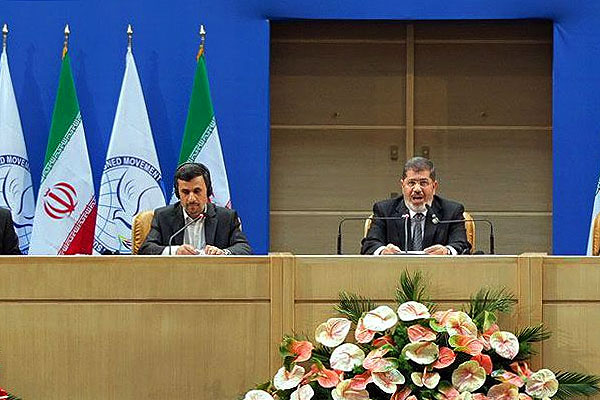
[ by Charles Cameron — caliphal succession as a marker in Egyptian-Iranian diplomacy at NAM ]
.


.

Describing Egyptian President Morsi‘s speech in Iran at the Non-Aligned Movement conference, Rodger Shanahan of Australia’s Lowy Institute wrote, tellingly:

Invoking the names of the first four caliphs (which never goes down well in uber-Shi’a Iran), his condemnation of the Syrian regime (an Iranian ally) caused the walkout of the Damascene delegation and stole much of the positive messaging that Iran would have been hoping for from this meeting.

Sunni Islam recognizes four “rightly guided” Caliphs as the successors to the Prophet: first among them was Muhammad‘s friend Abu Bakr, who was succeeded by Umar — who when he conquered Jerusalem, is said to have entered it on foot, and guaranteed the protection of the Christians and their churches – third, Uthman, remembered for establishing the definitive text of the Quran, and finally the Prophet’s cousin and son-in-law, Ali ibn Abi Talib.

Of these, Ali alone is recognized by the Shia, who consider him the Prophet’s rightful heir and their own first Imam.

As the photo above suggests, Morsi, a Sunni, and Ahmadinejad, a Shia, are precisely three caliphs apart.

Rhetoric, intent — logistics — and who went first?

Monday, August 27th, 2012

[ by Charles Cameron — when religious leaders talk of wiping nations off the map ]
.

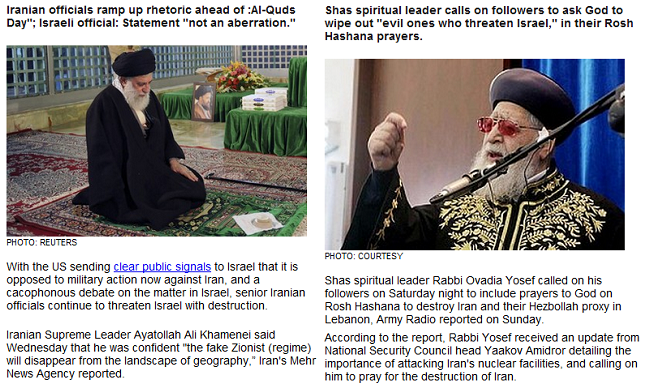
-Two bearded religious figures face of with what seems like parallel but opposite rhetoric:

______________________________________________________________________________________________

______________________________________________________________________________________________

The Ayatollah Khamenei, left, is the Supreme Jurisprudent of Iran — not merely a senior cleric but Iran’s final authority. Rabbi Ovaida Yosef, right, is the leader of the Shas movement in Israel and a cleric who swings enough power that Prime Ninister Netanyahu consults him and Foreign Minister Avigdor Lieberman, briefs him — an influence, then, something akin to an eminence grise perhaps, but by no means the final authority.

You may, loathe one of them you may loathe both of them: I doubt there are many people who admire both. But I’m not here to stir your animosities, I’m here to see what we can learn from comparing and contrasting them by catching them in similar circumstances. Perhaps it will make their differences stand out in high relief — perhaps it will reinforce their similarities.

The two men are both religious clerics, both political players, both getting on in years, both grey-bearded — and both seem to be comfortable using the same rhetoric at this point.

My aim here is to learn from this juxtaposition.

*

So I have two sorts of questions that I’d like to explore here, calmly and with appropriate documentation if you please…

One sort of question probes the differences in position and pouvoir of the two men:

Who has the higher position? Whose side has the most potent weapons? Whose side started this — or is that a moot question?

The second sort is subtler, since it has to do with motives hidden in the hearts and minds of men — and with the differences that sometimes exist between between rhetoric and intent.

Is is an entire people, or simply a regime that they would like to see an end to?

Is either one of them bluffing?

And of course my own favorite: is either one of them, the rabbi or the ayatollah, saying what he’s saying because of an “end times” (Messianic or Mahdist) expectation?

**

Hitler‘s rhetoric in Mein Kampf was pretty clear, and the actions of his Dritte Reich did not belie his rhetoric. Considerable planning was involved, there was documentation.

What, beyond rhetoric, do we know about Israeli planning to take down the Iranian nuclear program? What, beyond rhetoric, do we know about Iranian planing to respond to an Israeli strike — or to defeat and destroy Israel more generally?

Do the logistics back the rhetoric up?

What happens when the word “fire” is itself a match? What happens in an echo chamber, in a hall of mirrors?


Switch to our mobile site