zenpundit.com » ISIS

Archive for the ‘ISIS’ Category

Islamic State, Etat Chrétien

Tuesday, November 24th, 2015

[ by Charles Cameron — breaking news, and I hope it stays broken ]
.

Here’s the breaking news in French, followed by my comments, then back to the document in question:

**

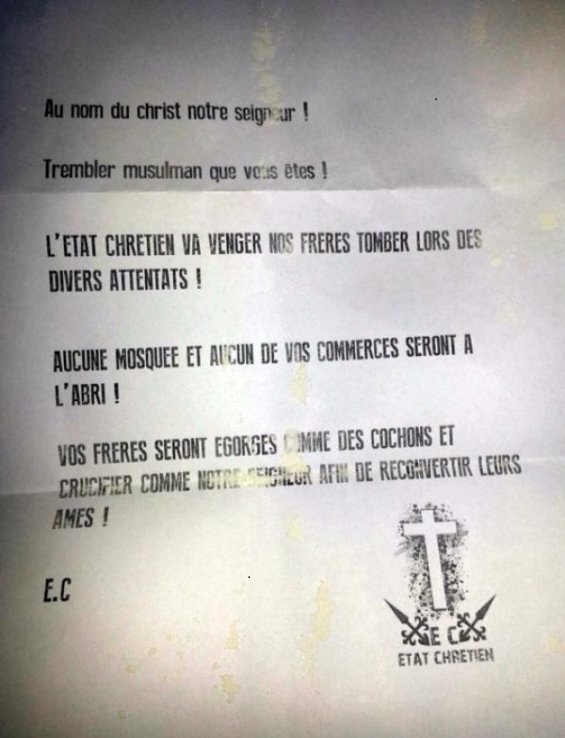
There’s a symmetry to the names, Etat Chrétien and Islamic State — and a considerable asymmetry as to the size of the two groups — but here we have my (poor) translation of the Etat Chrétien’s message to a mosque in Molenbeek, Belgium — a Brussels municipality much in the news recently:

In the name of Christ our Lord!
Tremble, Muslim that you are!
The Christian State will avenge our brothers fallen in various attacks!
No mosque and no business of yours will be sheltered!
Your brothers will be slaughtered like pigs and crucified as our Lord was in order to convert their souls!

I’m not clear on whether the import of that last line is that the EC will slaughter and crucify Muslims to convert their souls, or that Christ was crucified to convert their souls. Either way, for those who claim to be Christians to crucify anyone under any circumstances seems a seriously aberrational act in light of what was done to Christ himself.

Crucifying others is not the Imitatio Christi.

It’s as if these people want to prove that the propaganda narrative of IS, AQ and the rest is right, and Christianity truly is at war with Islam — which in itself is a gift to IS propaganda and recruitment.

The asymmetry I mentioned, BTW, is pretty much evened out by the old saw phrased by the RAND corporation thus: Terrorists Have to Be Lucky Once; Targets, Every Time. In the present case, both sides are terrorists, and each only has to be lucky once.

**

I’m ashamed of my rusty French skills — in case yours are better, here’s the missive:

lettre_de_meance_belgique

Target: innocence

Sunday, November 22nd, 2015

[ by Charles Cameron — the DoubleQuote as déjà vu, and as moral contrast and comparison ]
.

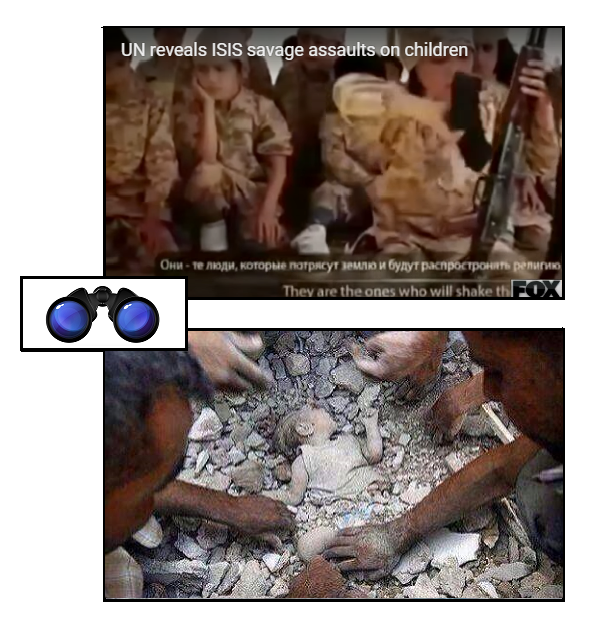
The targeting of innocence seems particularly reprehensible —

SPEC DQ format

but in this instance, the Islamic State is only following in the footsteps of the Soviets in Afghanistan.

**

Perhaps someone can help me understand whether training young boys to kill

SPEC DQ killer or killed

or killing children — is the more heinous crime.

Or sin?

**

Sources:

  • Armament Research Services, Islamic State employs improvised explosive devices
  • Christian Science Monitor, The Afghan child and the bright red plastic truck
  • Daily Mail, ISIS release shocking new video of child soldiers from Kazakhstan
  • We Write What We Like, Defying the media lies about Syria – finding truth
  • Red mercury as scam and symbol

    Friday, November 20th, 2015

    [ by Charles Cameron — CJ Chivers, nuclear nonsense, faux chemistry, and the alchemical imagination, with hat-tip to Cheryl Rofer ]
    .

    CJ Chivers, conflict journalist extraordinaire and author of a book about the Kalashnikov assault rifle, The Gun, today posted a remarkable account of what he terms The Doomsday Scam, with the subtitle “For decades, aspiring bomb makers — including ISIS — have desperately tried to get their hands on a lethal substance called red mercury. There’s a reason that they never have.”

    A taste:

    The Islamic State, he said, was shopping for red mercury.

    Abu Omar knew what this meant. Red mercury — precious and rare, exceptionally dangerous and exorbitantly expensive, its properties unmatched by any compound known to science — was the stuff of doomsday daydreams. According to well-traveled tales of its potency, when detonated in combination with conventional high explosives, red mercury could create the city-flattening blast of a nuclear bomb. In another application, a famous nuclear scientist once suggested it could be used as a component in a neutron bomb small enough to fit in a sandwich-size paper bag.

    and:

    To approach the subject of red mercury is to journey into a comic-book universe, a zone where the stubborn facts of science give way to unverifiable claims, fantasy and outright magic, and where villains pursuing the dark promise of a mysterious weapon could be rushing headlong to the end of the world. This is all the more remarkable given the broad agreement among nonproliferation specialists that red mercury, at least as a chemical compound with explosive pop, does not exist.

    Indeed, there’s a sidebar in Chivers’ post which sums the topic up nicely:

    The shadowy weaponeer’s little helper, red mercury was the unobtainium of the post-Soviet world.

    There’s much more, of course — with red mercury rumored to be found in old Singer sewing machines, which briefly raised the price of such machines in Saudi Arabia a thousandfold to $50,000 — and the whole extraordinary piece is more than worthy of your attention. It is also about a concrete, if counter-factual, reading of the term “red mercury.”

    Cinnabar, aka mercury sulphide, anyone?

    **

    A centuries-old debate concerning alchemy has concerned the literal and metaphorical interpretations of alchemical texts.

    Scholars up to and including Isaac Newton theorized about and practiced alchemy in their aptly named lab-oratories, at a time when literal and metaphorical “readings” were much less easily considered separately than is the case today. Alchemy was then for a while widely ridiculed as proto- and indeed pseudo-science — a tendency still prevalent in many circles today. And more recently, alchemy has been explored by Carl Jung and followers (and his predecessor, Silberer) as a field of imaginative, metaphorical inquiry illuminating spirituality, psychology and literature.

  • BJT Dobbs, The Foundations of Newton’s Alchemy
  • BJT Dobbs, The Janus Faces of Genius
  • Herbert Silberer, Problems of Mysticism and its Symbolism
  • CG Jung, Psychology and Alchemy
  • CG Jung, Alchemical Studies
  • CG Jung, Mysterium Coniunctionis
  • Marie-Louise von Franz, Aurora Consurgens
  • Titus Burckhardt, Alchemy
  • Jung’s reading of alchemical texts is a symbolic reading — in accordance with the principle “the stone which the builders rejected Has become the chief corner stone” (Psalm 118.22, cf Acts 411), he has taken precisely those materials in the alchemical tradition which modern chemistry rejected as ridiculous, and reclaimed them as symbolic, richly metaphorical expressions of psychological truth.

    **

    It is in that spirit that I turned from Chivers’ fascinating treatment of “red mercury” as an allegedly physical, albeit spurious, substance, with its intriguing narratives of scams from the Cold War to the present day and IS, to take a look at what I might find via a brief search in the Jungian literature. I say “quick” because I have neither the appropriate library nor the time for a more intensive search, but here’s what little I found:

    There’s a “red mercury” reference in Stanton Marlan, The Black Sun: The Alchemy and Art of Darkness, on p. 22:

    The idea is that the raw solar energy must darken and undergo a mortificatio process that reduces it to its prime matter. Only then can the creative energies produce a purified product. In this image the sperm of gold refers not to the ordinary seminal fluid of man but rather to “a semi-material principle,” or aura seminales, the fertile potentiality that prepares the Sun for the sacred marriage with his counterpart, darkness, which is thought to produce a philosophical child or stone and is nourished by the mercurial blood that flows from the wounding encounter of the Lion and the Sun. The blood — called red mercury — is considered a great solvent.

    Marlan then gives us what is effectively a translation of the paragraph above into contemporary therapeutic language:

    Psychologically, there is nourishment in wounding. When psychological blood flows, it can dissolve hardened defenses. This then can be the beginning of true productivity. In dreams the imagery of blood often connotes moments when real feeling and change are possible. The theme of the wound can also suggest a hidden innocence, which is also a subject of mortification. The green color of the lion, which is referred to as “green gold,” suggests something that is immature, unripe, or innocent, as well as growth and fertility. The alchemist imagined this innocence, sometimes called virgin’s milk, as a primary condition, something without Earth and not yet blackened. Typical virgin-milk fantasies are often maintained emotionally in otherwise intellectually sophisticated and developed people.

    **

    And then there’s what Jung would term synchronicity..

  • CG Jung & Wolfgang Pauli, The Interpretation of Nature and the Psyche
  • In my twitter stream within 3 minutes of my posting my first tweet re Chivers’ piece, & before I’d tweeted my follow up, I ran across this tweet containing the phrase “Drawing Blood will eat the sun”:

    Drawing Blood will eat the sun — just how synchronistically alchemical can Molly Crabapple and Twitter get?
    Let’s get metaphysical — a quick sequence of tweets

    Thursday, November 19th, 2015

    [ by Charles Cameron — From Elkus to Furnish, Tolkien to Feynman, — too tired to write, not tired enough to sleep — ripe for the twitter feed ]
    .

    The occasion of mirth:

    **

    Adam Elkus identifies the zone:

    The mirth:

    and:

    and:

    **

    Meanwhile, Tim Furnish was there ahead of time, defending Tolkien & attacking IS:

    And now let’s get back to those laws of physics:

    The “refugee” koan

    Wednesday, November 18th, 2015

    [ by Charles Cameron — considering both sides, while tilting one way or the other ]
    .

    I call it a koan because you can flip it — there are two sides to it, and very possibly a serrated edge that it can balance on, foiling your best efforts to come up with a yes-no answer:

    On the one side, Tsarnaev:

    Not a Christian, BTW..

    **

    Okay, before the second shoe drops…

    Consider this, from Benjamin Wittes, In Defense of Refugees today on Lawfare:

    It is worth reflecting at least briefly on the security risks of turning our backs on hundreds of thousands of helpless people fleeing some combination of ISIS and Assad. Imagine teeming refugee camps in which everyone knows that America has abandoned them. Imagine the conspiracy theories that will be rife in those camps. Imagine the terrorist groups that will recruit from them and the righteous case they will make about how, for all its talk, the United States left Syria to burn and Syrians to live in squalor in wretched camps in neighboring countries. I don’t know if this situation is more dangerous, less dangerous, or about as dangerous as the situation in which we admit a goodly number of refugees, help resettle others, and run some risk—which we endeavor to mitigate — that we might admit some bad guys. But this is not a situation in which all of the risk is stacked on the side of doing good, while turning away is the safe option. There is risk whatever we do or don’t do.

    Most profoundly, there is risk associated with saying loudly and unapologetically that we don’t care what happens to hundreds of thousands of innocent people — or that we care if they’re Christian but not if they’re Muslim, or that we care but we’ll keep them out anyway if there’s even a fraction of a percent chance they are not what they claim to be. They hear us when we say these things. And they will see what we do. And those things too have security consequences.

    And, from a very different area of the political spectrum, this:

    There’s a reason that hospitality is actually a religious virtue and not just a thing that nice people do: it is sacrificial. Real hospitality involves risk, an opening of the door to the unknown other. There is a reason it is so important in the Biblical narratives, which were an ancient people’s attempt to work out what they thought God required of them in order to be the people of God. Hospitality isn’t just vacuuming and putting out appetizers and a smile — it’s about saying, “Oh holy Lord, I hope these people don’t kill me or rape my daughters, but our human society relies on these acts of feeding and sheltering each other, so I must be brave and unlock the door.” Scary stuff. Big stuff. Ancient and timeless stuff. “You shall welcome the stranger.”

    Now: is that wisdom, or foolishness?

    **

    Aha, the second shoe..

    Besides Tsarnaev, who else do we know who came here as a refugee?

    albert einstein non christian refugee

    Einstein, no less.

    And Einstein was not a Christian either, FWIW.


    Switch to our mobile site