zenpundit.com » ISIS

Archive for the ‘ISIS’ Category

Whose black banner is it, anyway? — and the Khawarij

Monday, December 29th, 2014

[ by Charles Cameron — a flag flapping in the wind, in the mind ]
.

You see this flag?

Who flies it?

**

The media often call it “the Islamic State flag” these days, and indeed in the photo above, it’s a convoy of IS / Daesh vehicles that’s flying it.

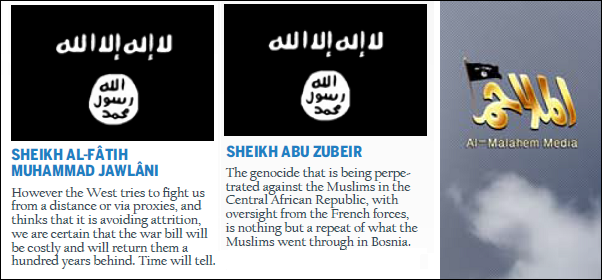
But in the recent 13th issue of Al Qaida in the Arabian Peninsula‘s magazine, Inspire, that same flag is used as an icon for both Mohammad Jawlani, the emir of AQ’s Iraqi branch, Jabhat al-Nusra, and Mukhtar Abu Zubair, late emir of al-Shabaab — and indeed, it also features in AQAP’s Malahem Media logo:

whose black banner

It is one of the ironies of the age that the image of a black banner featuring the white circular “seal of the Prophet” is flown by both sides in the contentious rivalry between the Islamic State and Al Qaida for leadership in the global jihad .

**

And who are the Khawarij today?

Joas Wagemakers, in ‘Seceders’ and ‘Postponers’? — an analysis of the ‘Khawarij’ and ‘Murji’a’ labels in polemical debates between quietist and jihadi-salafis, identifies the central distinctive opinion of the Khawarij thus:

The first of these is the Khawarij’s belief that revolt against Muslim rulers was allowed if they were deemed insufficiently pious. When ‘Ali accepted arbitration with Mu‘awiya, the people later known as Khawarij reportedly shouted ‘judgement is God’s alone’ (la hukm illa li-llah). In the context of that event, this referred to their belief that only God had the authority to arbitrate, not human beings, and that ‘Ali should not have accepted Mu‘awiya’s offer. The slogan later came to represent their broader view that all judgements and rulings should be left to God, thus applying Qur’anic rulings so strictly that they expelled Muslims guilty of major sins from their community and fought them. Because they believed sinful Muslims to be unbelievers (kuffar, singular: kafir), they directly applied passages from the Qur’an pertaining to jihad against non-Muslims to those of their co-religionists who were less than perfectly pious.

Does any of that sound familiar?

**

Well and truly trolled, JM!

UN Human Rights Commissioner Prince Zeid bin Ra’ad al-Hussein

Monday, December 22nd, 2014

[ by Charles Cameron — WINEP hosts Countering Violent Extremism and Ideology discussion ]
.

Addressing the Washington Institute for Near East Policy earlier this month, Prince Zeid bin Ra’ad al-Hussein, United Nations High Commissioner for Human Rights and former Jordanian Ambassador to the United States said of the IS / Daesh “caliphate”:

I think it requires a much deeper sort of analysis than what we often see coming through to us via the media outlets.

He went on to explain what he meant — emphasizing not military force but an Islamic theological response to the Daesh doctrinal claims:

We listened very carefully in Geneva to the remarks made by Walid Muallem, the foreign minister of the Syrian government, and he was dismissive of the efficacy of the airstrikes. Now this is something that I think has to be studied because we have learned from other sources that this may well be the case – or at least, if they were not supplemented by a concerted discussion within the Islamic world to confront, line by line, the thinking of the takfiri groups, that the results may not be what we hope they will be, and fall short of where we want them to be.

The letter that I have alluded to [..] was issued by a hundred and twenty-six Muslim scholars back in September as a response to the July Jumaa sermon issued by Abu Bakr al-Baghdadi. And what I found really quite unfortunate is that this letter which was remarkable, in the sense that it was scholarly, it was backed by Muslim scholars from all over the world, it dealt by each of the points raised in the sermon, rebuttal followed by another rebuttal to each of Abu Bakr al-Baghdadi’s points, that this received far less in the way of media attention than the decisions to launch airstrikes and take very active military operations. Because I felt at the time and still do that this letter needs to be supported and alluded to and spoken about and referred to by politicians in the Islamic world and beyond — not least because if it isn’t shown that the Islamic world is responding, at least from a scholarly angle, then we will continue to see the phenomena we see in Europe and we saw in germany yesterday, of demonstrations basically targeting Islam as a religion, as opposed to the takfiri ideology where the denunciations should be properly be directed.

**

Here, then, so that we can better grasp these issues as they can be understood within Islam, is the Letter al-Hussein spoke of:

**

The Letter can also be downloaded as a .pdf. Among the highlights of the Executive Summary:

9. It is forbidden in Islam to declare people non-Muslim unless he (or she) openly declares disbelief.
10. It is forbidden in Islam to harm or mistreat—in any way—Christians or any ‘People of the Scripture’.
11. It is obligatory to consider Yazidis as People of the Scripture.
12. The re-introduction of slavery is forbidden in Islam. It was abolished by universal consensus.
13. It is forbidden in Islam to force people to convert.
14. It is forbidden in Islam to deny women their rights.

**

For those of you who watch the video of the WINEP discussion, I should warn you that the close captioning is inexcusably poor. I’m betting, eg, that Zeid bin Ra’ad al-Hussein did not say “jihadi nostra” (cute though that might be) when the context clearly suggests “Jabhat al-Nusra”.

Black Banners in Sydney 2: on flags and their meanings

Monday, December 22nd, 2014

[ by Charles Cameron — the history and dwindling significance of a sign ]
.
two flags

**

In my previous post in this series, Black Banners in Sydney 1: a DoubleQuote in the Wild from Ardeet, I wrote:

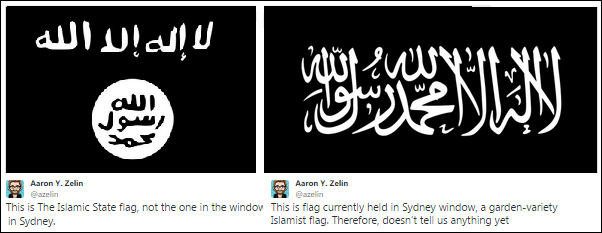
The flag in the image from the Lindt cafe is not in fact the Daesh / Islamic State flag, and indeed the hostage-taker appears to have asked for a genuine Daesh / IS flag as one of his demands. The flag shown is a black flag containing the Shahada or Islamic profession of faith in white, and black flags in Islam have a history as war flags dating back to the time of the Prophet himself.

The banners are black, and there are implications.

**

First, the black banner was the Prophet’s flag, the raya.

The Islamic Imagery Project at West Point’s Combating Terrorism Center lists “Black Flag” under the heading “Warfare Motifs“, saying:

The Black Flag (al-raya) traces its roots to the very beginning of Islam. It was the battle (jihad) flag of the Prophet Muhammad, carried into battle by many of his companions, including his nephew ‘Ali ibn Abi Talib. The flag regained prominence in the 8th century with its use by the leader of the Abbasid revolution, Abu Muslim, who led a revolt against the Umayyad clan and its Caliphate. The Umayyads, the ruling establishment of the Islamic world at the time, were seen as greedy, gluttonous, and religiously wayward leaders. The Abbasid revolution, then, was aimed at installing a new, more properly Islamic ruling house that would keep orthodox Islam at the center of its regime. Since then, the image of the black flag has been used as a symbol of religious revolt and battle (i.e. jihad). In Shiite belief, the black flag also evokes expectations about the afterlife. In the contemporary Islamist movement, the black flag is used to symbolize both offensive jihad and the proponents of reestablishing the Islamic Caliphate.

The Abbasids flew black banners, and were therefore known as the musawwids, or “wearers of the black”.

**

There are ahadith, considered by the scholar David Cook and others to be Abbasid forgeries, which claim that black banners from the east are a sign of the Mahdi’s coming. One such hadith reads:

If you see the black flags coming from Khurasan, join that army, even if you have to crawl over ice, for this is the army of the Caliph, the Mahdi and no one can stop that army until it reaches Jerusalem.

In Understanding Jihad, Cook writes:

Since Afghanistan, as Khurasan, has powerful resonance with many Muslims because of the messianic expectations focused on that region, this gave the globalist radical Muslims associated with al-Qa’ida under the leadership of Bin Ladin additional moral authority to proclaim jihad and call for the purification of the present Muslim governments and elites.

And as I have said before, Cook notes in his Contemporary Muslim Apocalyptic Literature that bin Laden’s mentor, Abdullah Azzam, made fresh use of this line of messianic tradition and “popularized the position of Afghanistan as the messianic precursor to the future liberation of Palestine” in his book, From Kabul to Jerusalem, while bin Laden refers to finding “a safe base in Khurasan, high in the peaks of the Hindu Kush” in his 1996 Declaration of Jihad.

**

There are many variants on the black flag, some of them carrying the Shahada or proclamation of faith, some decorated with the Prophet’s seal, some identifying particular jihadist factions. And while AQ in particular has capitalized on the hadith for recruitment as Ali Soufan detailed in his book The Black Banners, the breakaway “caliphate” use of black banners has been so prominently reported in the media that what used to be termed “the Al-Qaida flag” is now often called “the ISIS” (or “Islamic State”) flag.

It is against that somewhat confused background that we must understand Man Haron Monis’ demand, once he realized that the black flag with Shahada he was forcing hostages to hold in the window of the Lindt café was not the “right” black flag, that he be brought an “Islamic State” black flag – presumably the one with the Prophet’s seal, which had in fact been known as the “Al-Qaeda flag” before Daesh / IS took it up.

I once asked the American jihadist Omar Hammami, late of Al-Shabaab – who used that same black flag with Shahada and Prophetic seal in Somalia – whether their choice of flag referred only to Muhammad’s banner, or to the “black banners of Khorasan” ahadith also? – to which he replied:

the raayah is something general in religion regardless of color, but obviously those hadiths influenced black choice

**

I have been harping on the “end times” and specifically Mahdist significance of black banners in the contemporary context for seven years now, and lamenting that so little mention is made of the black banners’ apocalyptic connotations.

For the Islamic State / Daesh, there is no need to question its apocalyptic significance – all five issues to date of their magazine Dabiq have focused on the great “end times” battle to be fought at Dabiq in Syria – a name to compare with Har Megiddo, where the battle of Armageddon will be fought in the equivalent Christian “end times” narrative.

But for some demented guy taking hostages in a café in Sydney?

**

It now appears to me that the “meme” of black flags simply meaning “jihadist” is now so wide-spread, that the apocalyptic resonances may no longer be intended when someone picks up such a flag – or photographs it in some new context —

— no more so than the sign of a Che Guevara poster in a college dorm betokens a serious adherent to Marxist revolution.
Black Banners in Sydney 1: a DoubleQuote in the Wild from Ardeet

Monday, December 22nd, 2014

[ by Charles Cameron — feeling kinship with the cartoonist who calls himself Ardeet ]
.

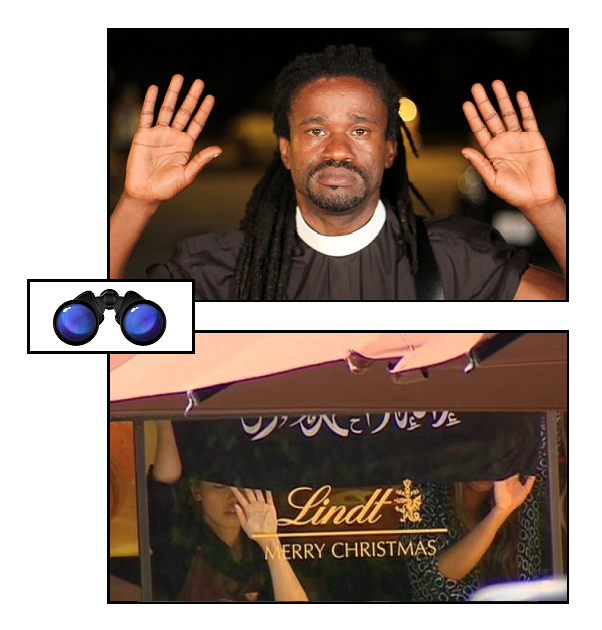
two images

**

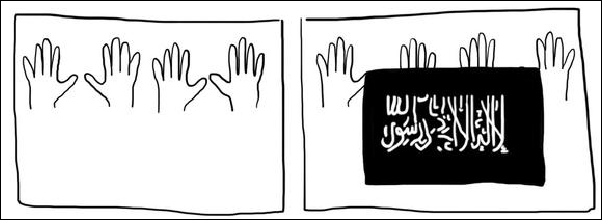
As my regular readers know by now, I have a “form” I use for juxtaposing ideas — verbal, visual, and even mathematical on occasion — that I term DoubleQuotes, and I believe that juxtaposition, whether it be used to make a point of raise a question, is a standard feature of human thinking and a very powerful rhetorical device, yet little explored, critiqued, explained and appreciated.

In my view, when humans consistently use a certain way of doing things on many otherwise unrelated occasions, it’s a good bet that “sharpening” that way of doing things into a tool — making a point of it, if you like — will result in both practical and educational benefit.

Thus when I spot others using juxtapositions in a similar way, I call them DoubleQuotes in the Wild. They are an inspiration to me, confirming my hunch of the general utility and ongoing prevalence of the DQ principle.

**

Here, then, is a “DQ in the Wild” from cartoonist Ardeet:

Local situation

That’s powerful, the suggestion being that the world press takes an event where there’s a suggestion of possible jihadist involvement (“terrorism”) a lot more seriously than one where that is not the case (“spree killing”). While the hostage situation was playing out in Sydney, for instance, a US vet killed “his ex-wife and five of her relatives” in Pennsylvania, drawing far less media interest.

**

I could see how Ardeet’s cartoon could be read in that sense, but I wasn’t sure how he intended it, having been exposed recently to dozens of images of hands raised as a sign of the Ferguson protests.

A somwhat different pairing therefore suggested itself to me, one with a different emphasis:

SPEC DQ hands & banner

Here the point is not that an event moves from local to global interest when the jihadist’s black banner appears, but that the hostage-taking in Sydney offers a curious and ironic (albeit unintended) take on one of the chief symbols of the protests in and about Ferguson, while the Ferguson protest gesture adds resonance to the image of hostages forced to hold up the black banner in Sydney.

**

I have been talking about the “black banners from Khorasan” hadith an its Mahdist implications online since 2007 if not earlier, and on Zenpundit since September 2009, and I think a clarification is in order at this point.

The flag in the image from the Lindt cafe is not in fact the Daesh / Islamic State flag, and indeed the hostage-taker appears to have asked for a genuine Daesh / IS flag as one of his demands. The flag shown is a black flag containing the Shahada or Islamic profession of faith in white, and black flags in Islam have a history as war flags dating back to the time of the Prophet himself.

Two tweets from Aaron Zelin will clarify the matter visually:

**

More on this in Black Banners in Sydney 2: on flags and their meanings.

A most curious YouTube quotation

Tuesday, December 16th, 2014

[ by Charles Cameron — total clash or bizarre agreement? Sydney hostage-taker Man Haron Monis quoted Christian apologist David Wood video on his Twitter feed ]
.

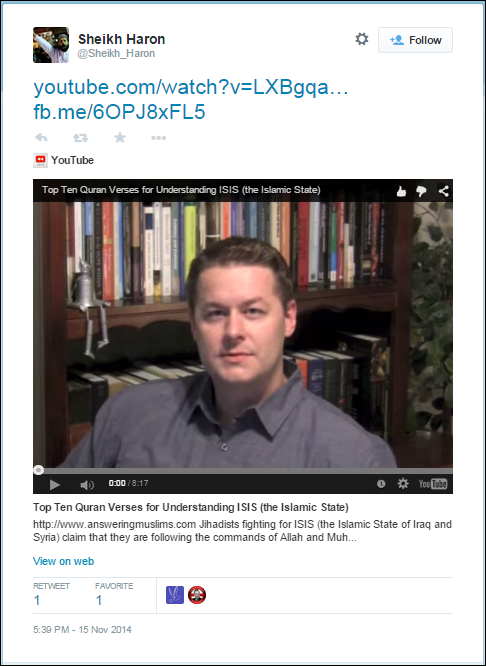
I am really not sure quite what to make of this. Sheikh Haron, aka Man Haron Monis, the disturbed ex-Shia convert to “Islam” who was the Sydney “hostage-taker” had a Twitter-feed, still up as I was researching this piece, which included this tweet:

**

Somewhat to my amazement, Haron is posting a video by the Christian apologist David Wood of Acts 17 Apologetics — a gentleman I’ve run across before, strongly opposed to Islam. Here’s the video in question, as featured on the Acts 17 Apologetics YouTube channel

Is Haron quoting Wood like this because he agrees (??!!) with Wood’s analysis of IS in terms of Quranic injunctions — or to show how disdainfully opposed to Islam, western views or Christian apologetics “really are”? — perhaps even both simultaneously?

No matter how you read Haron’s use of Wood’s video, or the various versions of the two Abrahamic faiths under discussion, the appearance of a Christian apologeticist on Haron’s website should give us pause for thought.

For an insight into Wood himself, the redemptive bio on the Moral Apologetics website under the title On Psychopathy and Moral Apologetics is worth your attention.

**

In case Haron’s feed gets taken down — I’m amazed it hasn’t been taken down already — here is a screen cap of that tweet:

Sheikh Haron's tweet

For more on Haron’s online presence, see Zack Beauchamp quoting Daveed Gartenstein-Ross in Sydney hostage taker Man Haron Monis pledged allegiance to ISIS on his website


Switch to our mobile site