zenpundit.com » framing

Archive for the ‘framing’ Category

The Glenn Beck, Mahdism & Antichrist series

Wednesday, April 27th, 2011

[ by Charles Cameron ]

.

Glenn Beck has a new documentary coming out tonight on Mahdism and the Antichrist.

He calls it “the documentary that you will not see on mainstream television” and to get to see it, you have to be a subscriber to Beck’s Insider Extreme channel on the web. But then that fits with Beck’s emphasis right now — he doesn’t mind crying shame on the media for not carrying the documentary, but he doesn’t want unbelievers to see it either — he told his radio audience today:

Make sure you see it tonight at nine o’clock. And if I may recommend that you watch it with some friends. Invite some friends over, some like-minded people, don’t try to get any converts in. Pull up the nets, man, pull up the nets.

So okay — it won’t be on “mainstream television” but it will be seen in a million “like-minded” homes, and it will influence them, it will influence their perspective on Islam, and on the Middle East.

Here’s a description of what they can expect, drawn from Joel Rosenberg‘s blog today. Joel is the author of the apocalyptic thriller The Twelfth Imam, has seen the rough cut and will be appearing on the video, along with those he lists here:

Tonight on his website, Glenn Beck will premiere his new documentary film, “Rumors of War — Part Two.” As with Part One, I was interviewed for the film…

The documentary examines current events and trends in the Middle East and the Islamic world from various vantage points — Biblical End Times theology, Jewish End Times theology, and Islamic End Times theology. It discusses the latest threats from the Radical Islamic world to Israel, the West and our allies. It features a wide range of Jewish, Muslim and evangelical Christian authors and commentators in a balanced yet provocative and fascinating way. Among them:

  • Dore Gold, former Israeli ambassador to the U.N.
  • Reza Kahlili, former CIA agent inside Iran and author of A Time To Betray
  • Tim LaHaye, author of the Left Behind novel series
  • Brigitte Gabriel, author of They Must Be Stopped: Why We Must Defeat Radical Islam and How We Can Do It
  • Joel Richardson, author of The Islamic Antichrist
  • Dr. Zudi Jasser, president of American Islamic Forum for Democracy

*

The thing is, Beck doesn’t know a whole lot about these things, and his advisers get things wrong — sometimes flat out wrong, sometimes just out of proportion — too.

I aim to review Beck’s documentary along with its predecessor, and the books of Joel Richardson and Joel Rosenberg, and also take a look at some other books and articles that cover the same materials with greater scholarship and less religious special interest — notably the works of David Cook, J-P Filiu and Timothy Furnish — clear up some of this issues in which definitive corrections are in order, suggest areas where the preponderance of evidence and informed commentary leans away from Beck’s position, and raise again those urgent questions which remain.

Because from where I sit, Glenn Beck has hit on one of our blind spots — and is giving us a dangerously distorted mirror in which to view it.

*

Here’s Beck talking about the upcoming documentary this morning on his radio show:

Tonight, you don’t want to miss, on Insider Extreme, something that we have been trying to tell the story for quite some time, and I have told it to you many times before, the story of the Twelfth Imam, well this is not the full story of the Twelfth Imam, this is what people Middle East believe about the Twelfth Imam, or the Mahdi as the… Sunnis? Sunnis are in Egypt, Shias are in, ah, is it Shias in Iran or is it the other way around? I think it’s S.. Shias are in Iran. One believes in the Twelfth Imam, the others believe in the Mahdi, same guy, it is the… the… you would know it as the Antichrist. It is the, it has every earmarking of the Antichrist, every single one, I mean, he makes a peace for seven years with Egypt, he viol… — I mean with Israel, he violates it, he marks people with a number, he beheads people if they don’t submit, I mean it’s all there. It’s all there. And Ahmadinejad says that he is alive and well and orchestrating the things in the Middle East.

Did you get that? He’s not sure: “is it Shias in Iran or is it the other way around?”

If Beck has been working on this documentary for a year now, let’s hope he does in fact know the difference between Sunni and Shi’a, and that he’s using the popular gag technique of pretending not to know, so his audience — who haven’t all been working on a documentary and may well not know — can feel all the more strongly “he’s one of us”. And besides, Sunni, Shia, it’s all the same, Mahdi, Twelfth Imam, no difference at all, right?

So that’s the level of required accuracy that’s tolerated here. Which side was it wanted to keep slavery? I forget now, I think it may have been the South. Belfast — now is that Catholic, or Protestant?

*

And one last quick note from the same post on Joel Rosenberg’s blog:

As far as I can tell, Glenn Beck is leaving the Fox News Channel in part because Fox is opposed to him devoting so much time on his program to End Times issues, Bible prophecy, Iran’s eschatology, and the linkage of these things to left wing efforts to sow seeds of revolution and chaos. It’s too bad, really.

That’s an interesting data point.

*

There will be plenty to talk about, anyway:

the new documentary, Joel Rosenberg’s thriller, which I enjoyed, Joel Richardson, with whom I correspond and whom I like, the new Mahdist video in Iran which is causing quite a stir, and may or may not be an “official” Iranian production, the vexed question — vexed in all three Abrahamic faiths — of whether you can hasten the coming of the Awaited One and if so, how, and the implications of all this both in the United States and in the Middle East, the Iranian nuclear program…

The Glenn Beck, Mahdism & Antichrist blog series, coming up.

A HipBone approach to analysis VII: world wide spiders & the web

Tuesday, April 19th, 2011

[ by Charles Cameron ]

*

I thought I’d back-track a little, and drag in two blog posts that I made elsewhere back in March of 2008, which may help to explain my basic outlook on the sorts of issues that analysts face.

.

I. The version of the idea as poetry:

I am Charles

.

My concern is the human mind in service
to an open heart, and my problem
is that the heart picks issues rich in ambiguity
and multiplicity of voices, tensions
and torsions tugging not one way but
in many directions, even dimensions, as does
a spider’s web weighed down with dew –
to clarify which a mind’s abacus is required
.
equal in subtlety to subtlety itself, while
in all our thinking and talking, one
effect follows one cause from question
to conclusion down one sentence or white
paper — whereas in counterpoint,
Bach’s fugal voices contain their dissonance.

.

II. The same idea presented in prose — as I say, a few years back — with graphical illustration:

Spiders and dewdrops

Spiders and dewdrops do a pretty convincing job of portraying a certain level of complexity in this node-and-edge diagram of the global situation.

spider_web.jpg

When, say, Castro hands over power to his brother, or Musharraf has to give up control of the Pakistani army, it’s like snipping a couple of threads in that spiders web — and the droplets fall this way and that, carom into one another, the fine threads they’re on swing down and around until a new equilibrium is reached…

But try thinking that through in terms of Cuba and Pakistan before breakfast one morning if you’re Secretary of State, with a linear Cold War mind, Russia going through its own changes, and al-Qaida and associates training and recruiting in the background…

Well, those two instances have been and gone, and the new configurations are now the tired old same old configurations we believe we’ve figured out — until another dewdrop slips, and a thread breaks, and all things are once again new…

.

Funnily enough, I think this spider’s web of mine ties in with the Hokusai quote I posted in response to Zen‘s quote from Steven Pressfield yesterday, and with a piece I read today about intelligence analysts — Martin Petersen, What I Learned in 40 Years of Doing Intelligence.

It’s the web of tensions that constitutes the “complexity” that must somehow be grasped by the analyst, the writer, the historian…

And Hokusai, watching across the years how grasses bend in the winds, reach for sunlight, bow under the weight of dew — and spring back when released — may finally have a mind that’s attuned to that kind of complexity — to a degree that linear thinking will never reach…

A two part meditation, part i: scenario planning the end times

Wednesday, April 13th, 2011

[ by Charles Cameron ]
.

Some people like banking, I prefer religion.

I’m perennially fascinated by the way myths and rituals, meditations and sacraments can not just motivate and move people but change them. That’s just the way I am. I spent ten minutes this morning listening to a zen nun explaining on YouTube how to strike a bell (she preferred to think of it as “inviting” the bell), how to listen to it, how to wake up.

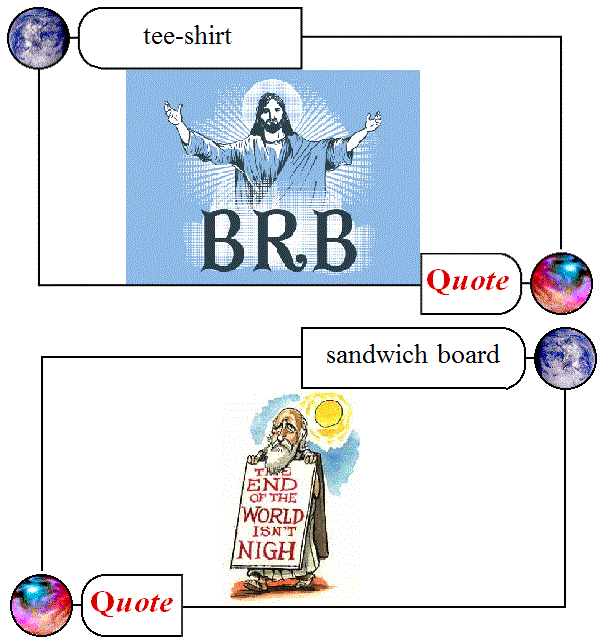
So when it comes time for scenario planning, I find the logistical and economic side of things less interesting than the tada! End of the World! excitement that seems to pop up all over the place from time to time. On billboards here in California (with a date certain: May 21st, 2011), for instance. In videos from Iran (coming soon to a theater of war near Jerusalem). And on Glenn Beck (ditto).

It seems to be a meme that cartoonists and satirists enjoy, too…

.

quo-end-times.gif

*

The thing is, there are two worldviews here, which we could conveniently label sacred and secular – though there’s no reason why one can’t hold a “sacred” view of the world (as I do) and not expect it to end any time soon (I don’t), or a “secular” view, and expect a new ice age or terminal global warming around the next bend in the road…

Two worldviews. And here’s where we get a “clash of cultures”.

Either there exists a definitive blueprint for the future of geopolitics – in Daniel, Ezekiel, and Revelation — or the future of geopolitics is something we’ll have to wrangle ourselves, using our best intelligence, wisdom and material resources.

On Sunday, you can go learn about the blueprint in an evangelical church – or you can kick back with the Sunday supplements and “Meet the Press”. And nobody much minds if you do one thing, and your neighbors do the other.

Things get interesting, however, when geopolitical decision times come around, and a great nation must decide what to do about the Palestinians, say, or Iran.

*

Okay.

Joel Rosenberg is a writer of popular, well-crafted thrillers – a Tom Clancy for the end times set.

Since his books are engaging, and since Glenn Beck frequently features Rosenberg on his show, his most recent novel, The Twelfth Imam, has been enjoying pretty decent sales, making it to #8 on the NYT best-seller list, #8 on Publisher’s Weekly and #10 on the WSJ hard-cover fiction lists in one week, not so long ago. And since I’m a student of comparative eschatology, I read his work with considerable interest, and follow his blog.

Today, he wrote:

As international support builds for the Palestinians to unilaterally declare their own state at the U.N. General Assembly opening session in September, I am growing increasingly concerned the President Obama is preparing to endorse such a move and even push for it. This would be a terrible mistake.Bible prophecy makes it clear that in the last days the nations of the world will divide up the land of Israel. But the Scriptures are also crystal clear that the nations will face the judgment of Almighty God for doing so. “For behold, in those days and at that time, when I restore the fortunes of Judah and Jerusalem, I will gather all the nations and bring them to the Valley of Jehoshaphat [“the Lord judges”]. Then I will enter into judgment with them there on behalf of My people and My inheritance, Israel, whom they have scattered among the nations; and they have divided up My land.” (Book of Joel 3:1-2).

Let the nations be warned by the God of Israel: they are on a dangerous and disastrous road. Let us pray they turn around before it is too late.

*

That’s actually a pitch for geopolitics by Biblical fiat — as Rosenberg explicitly points out:

One could wish the clear warning of the Bible would be enough to dissuade the President from dividing the land of Israel. I am not sure it will. Perhaps sheer politics will help.

If you believe in the sacred “Biblical blueprint” theory, and believe that the end times are very rapidly approaching, this should encourage you. If you believe in the secular “let’s hope our politicians don’t fubar this one” it might worry you – because you don’t trust some writers a couple of millennia ago to have an accurate appraisal of today’s Middle East, when even our intelligence services don’t claim to be able to predict the outcomes of various interventions in a complex situation, with unknown unknowns to boot.

And of course you might also be Israeli (and hold a sacred or secular viewpoint), Iranian (secular or sacred), or just not interested in geopolitics.

In Iran, the holders of a sacred, end times tradition are in power. In the US, the holders of a sacred, end times tradition exert some political influence. If you’re in Israel, you may hope and / or pray the Iranian end timers don’t visit their scenario on your head. If you’re a Palestinian, you may hope and / or pray the American end timers don’t visit theirs on yours.

I think it’s good to be aware of these things, but not get too excited.

*

More to follow in A two part meditation, part ii: of monks and maniacs.

The Year of Living Memory

Wednesday, April 6th, 2011

[ by Charles Cameron ]

*

Some people’s — and more to the point, some peoples’ — living memory appears to be longer than others. China, for instance, has what you might call long term living memory.

*

But first, the Crusades. When Bush 43 first used the word “crusade” in reference to the US response to 9/11, I went to Google and checked, and the first listing for “crusade against” that came up was to The Crusade Against Dental Amalgam. I’m the suspicious type, and as I suspected, the word “crusade” simply doesn’t have the same valence for most twenty-first century Americans that it has for many in the twenty-first century Arab world. In the US, a crusade is a concerted effort to change just about anything, the use of mercury in dental fillings being just one example.

Across the Arab world, however, the word has very different connotations: thus Amin Maalouf writes in The Crusades through Arab Eyes:

The Turk Mehmet Ali Agca, who tried to shoot the pope on 13 May 1981, had expressed himself in a letter in these terms: I have decided to kill John Paul II, supreme commander of the Crusades. Beyond this individual act, it seems clear that the Arab East still sees the West as a natural enemy. Against that enemy, any hostile action — be it political, military, or based on oil — is considered no more than legitimate vengeance. And there can be no doubt that the schism between the two worlds dates from the Crusades, deeply felt by the Arabs, even today, as an act of rape.

That’s long term living memory for you.

*

I’m writing this because I just read a fascinating article by Robert Barnett on the New York Review of Books blog titled The Dalai Lama’s ‘Deception’: Why a Seventeenth-Century Decree Matters to Beijing — need I say more?

The title will suffice for those who don’t have much time today — I understand, we’re all under the fire-hose one way or another — while those with the ability to sneak in ten or fifteen minutes laterally while the clock’s not watching can and should definitely read the whole thing…

*

I have just one side-observation though — the article tells us, among many other things directly relating to Tibet and the history of the Dalai Lamas:

And again, when Jiang Zemin made a brutal decision to annihilate the basically harmless Falungong cult in 1999, it is believed that he saw it as analogous to the religious movement that had started the Taiping Rebellion and nearly toppled the Qing in the mid-19th century.

I think that’s right — but what Barnett doesn’t mention, since Taiping is only an aside for him, is that the rebellion was only eventually quelled at the cost of between twenty and thirty million lives…

I mentioned my own hunch that memories of Taiping were behind the Chinese government’s fierce response to Falun Gong in question time after Ali A Allawi‘s talk on Mahdist movements in Iraq at the Jamestown Foundation a few years back, and he responded that similarly, the reason the Iraqi government took such fierce action against a small Mahdist uprising near Najaf — even calling in US air support as I recall, for an incident perhaps best compared in US terms with Waco — was that they remembered the Babi movement in their own neck of the woods, and the tens of thousands who died back in the 1850s, around the same time as the Taiping in China.

*

Living memory — which could almost be a definition of history, or at least of what historical research aims to create — can itself be long term or short, perishable or perennial.

And then there’s Psalm 90, which declares “For a thousand years in thy sight are but as yesterday when it is past, and as a watch in the night.”

Now (and I’m being playful here, albeit with a touch of serious intent) does that suggest a Memory that reaches back in perfect detail through the eons to the Big Bang and perhaps before it? Or … “twentieth century? nineteenth? the Crusades?.. it’s all a bit of a blur, I’m afraid — it all rushes by so fast…”

*

There seems to be a choice set before us as individuals — and more to the point, as peoples:

Shall we choose Lethe, and the restfulness of oblivion, or Mnemosyne — the mother of all Muses? There are, you know, immediate educational implications, and serious geopolitical implications down the road, for the choice we make…

Of Quantity and Quality I: weighing man against book

Tuesday, April 5th, 2011

[ by Charles Cameron ]

*

It may be that the hardest thing for a human to wrestle with is the correlation of quality with quantity.

.
One:

I’m writing this post by way of a response to the comments of J Scott Shipman and Fred Zimmerman on my earlier post, Burning scriptures and human lives — but as I said in a comment of my own there, not in a point by point fashion, more in the manner of a meditation. Our conversation grew out of a discussion of the killing of humans and the burning of Qur’ans, and perhaps I should say at the outset that in my view, the burning of sacred books is in general a pretty offensive business, the taking of human lives in general even more so.

.
Two:

If, however, we wish to know our enemies, as Sun Tzu advises, let alone to love them, as Christ suggests, we might reflect that what is happening these days in Afghanistan in many ways resembles what was happening in Europe a few short centuries back:

A little later, after the definition of the dogma of transubstantiation by the Fourth Lateran Council in 1215, a new libel surfaced, known as host desecration. According to this calumny, the Jews obtained a consecrated host from the mass, with the assistance of a Christian who retained it from the administration of communion, took it to their synagogue or homes and subjected it to every indignity, including trampling on it and sticking pins into it. … The accusation was made for the first time at Belitz, near Berlin; all the Jews of the town were burned. One hundred instances of the charge have been recorded, in many cases leading to massacres.

William Nichols, Christian Antisemitism: A History of Hate, pp 239-40

William Gibson is frequently quoted as saying, “The future is already here — it’s just not very evenly distributed” – and by the same token, the past is still with us, and no more evenly distributed.

For myself, I don’t see how I can condone or judge those whose values are as radically different from my own as those Christians, these Afghans – or the “religious but unstable” woman in Spartanburg County, Tennessee, who chained up and burned her nephew’s dog because it had chewed her Bible and was clearly a “devil dog”. Thankfully, it is neither mine to condemn nor to forgive.

.
Three:

I value human life way more than I value any physical book – and I revere those insights, not infrequently found in scriptures, which encourage love, wonder, compassion, insight, wisdom, peace, generosity, gratitude and praise…

I revere them enough that I can understand Sir Thomas More preferring to surrender his own life rather than to go against that which his own traditions, scriptures, and sacraments had taught him to venerate. Likewise, I can find no fault in the Zen of the monk who famously burned a wooden statue of the Buddha when the firewood ran out… a tale that is worth repeating:

In a famous zen story, a travelling monk was resting in a monastery during a cold night. He took down a wooden Buddha statue and used it as fire wood.When the resident monks saw what he did, they became very angry and demanded to know why he did that.

He replied “I am looking for sarrira (holy relics).

The monks then laugh and exclaimed: “How can one find sarrira in a wooden statue?”

In reply, the travelling monk then said “Well then, can you pass me that other wooden statues also?

.
Four:

I once climbed the many stairs and stood on the small platform atop the head of the great 6th century Buddha of Bamiyan, which just ten years ago was demolished by the Taliban, and I remember that day with great affection.

Historically speaking it is a tragedy for the world and the Afghan people that the Buddhas were destroyed.

What Buddha taught, remains, however. What the Beatitudes taught, remains., despite what dogs may chew. What the Qur’an teaches remains, beyond the pastor’s fire. What the host at the Eucharist embodies, remains…

It is in the sense of what I have written above that I wrote, “The value of one human life is the value of the world. The Qur’an is indestructible. It is deeply inadvisable to threaten, attempt or facilitate the destruction of man, world, or book…”

.
Five:

Mind you, I am not suggesting that others should share my view – my own life experiences just don’t encourage me to use scriptures or credal statements against others until I have first “removed the beam from my own eye”. In the meanwhile, I take my inspiration where I can find it.

.
Six:

And find it I do in this comment on my previous post, from Jimpa:

Books are paper and ink and can be republished. A human life is a miracle of creation (regardless of whose theory is used to explain it.) There is only one of each of us there are no copies of anyone, even cloning can not create a replacement.

To me, this gets to the spirit and clarity of the matter.

.
Seven:

But there’s also its soul, its blues if you like, its duende – and I find that quality – another voice in the music of inspiration, perhaps, in this impassioned post by Abu Muqawama, aka Andrew Exum:

The crime was horrific, and the mob outside the jail was angry. They had gathered before and demanded the death of the man inside, but a conservative cleric, who ran a religious school for boys, had appeared and told them all to go home and repent before God. Because the men in the mob were all religious and obeyed this particular cleric, they went home as he had ordered. When the crowd returned a few days later, though, while that cleric was away preaching elsewhere, they fought their way past the guards and found the man for whom they were looking. The man was from a minority group in the area, and though he was actually innocent of the crime of which he had been accused, that did not stop the violent mob from beating him horribly, tying a rope around his neck and throwing him off a bridge while hundreds cheered.

The year was 1906, and the place was my hometown of Chattanooga, Tennessee. The name of the man killed was Ed Johnsen, a black man who had been accused of the brutal rape of a white woman, Nevada Taylor. (The conservative cleric? Well, that madrasa he founded has produced several U.S. senators, governors, businessmen and one dyspeptic defense policy blogger.) …

The reason I mention the story, though, is because it popped into my head when I read my friends Dion and Maria’s account of what had happened in Mazar-e Sharif a few days ago when several innocent United Nations workers were brutally murdered because some fundamentalist crank in Florida thought it would be a hot idea to videotape himself burning a Quran. It was not that long ago, we should remind ourselves going into a discussion of what happened in northern Afghanistan and why, when the ugly kinds of mob scenes we saw in Mazar might have also happened in the United States. (The last lynching of an innocent black man of which I am aware took place in the American South in 1981.)

I see those two posts as working together like head and heart — the “soul” and richness of feeling in Abu Muqawama’s post adds depth to the “spirit” and clarity of thought in Jimpa’s. To have a high standard of measurement is fine — to forget one’s own human frailty, not wise at all.

[ to be continued in Of Quantity and Quality II: weighing man against world ]


Switch to our mobile site