zenpundit.com » richard landes

Archive for the ‘richard landes’ Category

When win-win games get gamed

Monday, August 3rd, 2015

[ by Charles Cameron — a paradox I’m currently chewing on, courtesy of Richard Landes]
.

I want to take something that Richard Landes has been saying, abstract it from those conflicts to which Richard applies it, simplify it by removing one technical term that’s part of his detailed breakdown, and present it in as bare-bones a manner as I can manasge. You can see two of Richard’s own versions of the issue below.

**

The basic question, as I understand it, is this:

How does a non-zero-sum move look to a zero-sum player, and vice versa?

Let’s suppose your entire background and upbringing revolves around the idea of zero-sum, you-win-I-lose games. If you see any sign of your adversary gaining an advantage in a negotiation, that’s proof positive that you’ve been bamboozled: somehow, you must have lost. Your job is to make no concessions — to be the winner in a winner-takes-all contest.

Now suppose your background and upbringing have revolved around the idea of non-zero-sum, win-win games, in which both sides of a negotiation make some concessions so that both can emerge as winners. You offer concessions in good faith, and in return you expect similar concessions.

What happens when a zero-sum game player and a non-zero-sum game player meet in play?

It’s Landes’ suggestion that any generosity on the part of a win-win player offering his winner-take-all opponent a concession will be taken as evidence of weakness,. and the opponent, far from making a corresponding compromise, will press on and demand more — making further nmoves which will offer so little that the win-win player will be at a loss to explain why such a promising start to bnegotiations fell apart so badly.

A further supposition: so-called honor-shame societies are geared for zero-sum, winner-takes-all gameplay, while societies which rely on an innocence-guilt reading of human behavior will be no less inclined toeards playing non-zero-sum, win-win games.

That’s the idea expressed in game-theoretic terms, as simply as I can put it. To my mind, these game considerations are worth thinking through in their own right, absent the specifics to which Richard Landes brings them.

**

Here is Landes making the same point, in the context of Israeli relations with the Palestinians, the Arab and Muslim worlds, and European liberalism –all of the above broadly speaking:

And a text version, Cognitive Egocentrism, for those who find words fly home faster in print…

**

Help me think this through.
The Boston IS and Apocalyptic Conference

Thursday, July 16th, 2015

[ by Charles Cameron — I was (unexpectedly) almost totally deaf at the time, so the videos of the conference allowed me a second go-around, for which I’m profoundly grateful ]
.

CMS Landes 602
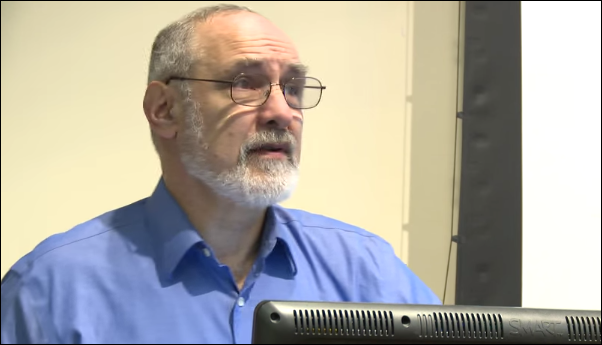
Richard Landes, opening the Boston conference

**

With what I hope will turn out to be the wisdom of a fool, I am going to propose the importance of (a) Richard Landes‘ now defunct Center for Millennial Studies at Boston University, and (b) its recent resurgence as a single and singular conference on Apocalyptic Hopes, Millennial Dreams and Global Jihad.

Bear with me, I’m an enthusiast.

**

Gregory Bateson died thirty-five years ago July 4th, the day I started writing this post — a fact I only know because I’m inclined to associate the Boston Conference as one of the great cross-disciplinary and initially underestimated conferences alongside the early Macy conferences on Cybernetics, in which Gregory Bateson was so significant a partner — or the seminal Eranos Conferences attended by the friends of CG Jung.

The Macy conferences ushered in the computer age, the Eranos conferences celebrated the highest level of cross-cultural and cross-disciplinary exchanges between psychologists, philosophers, religious scholars and physicists — while the Millennial Studies conferences focused on a studiously ignored area of knowledge that has swung into heightened significance via the arrival on scene of Al-Qaida and the Islamic State.

**

Participants, Macy and Eranos:

The Macy Cybernetics Conferences included such participants as William Ross Ashby, William Grey Walter, Kurt Lewin, J. C. R. Licklider, Warren S. McCulloch, Margaret Mead, Oskar Morgenstern, F. S. C. Northrop, Walter Pitts, I. A. Richards, Claude Shannon, Heinz von Foerster, John von Neumann, and Norbert Wiener.

The Eranos Conferences included presentations by Carl Gustav Jung, Rudolf Otto, Mircea Eliade, Wolfgang Pauli, Karl Kerényi, Erich Neumann, Henry Corbin, G van der Leeuw, Louis Massignon, Gilles Quispel, Hellmut Wilhelm, Hugo Rahner, Erwin Schrödinger, Gershom Scholem, Heinrich Zimmer and Martin Buber.

In each case, the ideation was intensely and deliberately cross-disciplinary, and the importance of the series of conferences only widely apparent at a later date.

**

Participants, Center for Millennial Studies:

In the case of the Boston conference on Apocalyptic Hopes, Millennial Dreams and Global Jihad, the series in whicb it partakes is that of the new defunct Center for Millennial Studies, an extraordinary organization which studied millennial movements from the Dead Sea Scrolls via the Taiping Rebellion (20-30 million dead), and the Siege of Mecca (1979 CE), to Aum Shinrikyo, Waco and Y2K — with implications for future events at least as far as the 2000th anniversary of the crucifixion in the 2030s and the start of the next Islamic century in the 2070s.

Among the attendees at this year’s conference were Richard Landes, William McCants, Graeme Wood, Timothy Furnish, Cole Bunzel, Jeffrey M. Bale, myself, David Cook, JM Berger, Itamar Marcus, David Redles, Paul Berman, Charles Strozier, Brenda Brasher, Mia Bloom and Charles Jacobs. Husain Haqqani was expected to attend and intended to speak about the Ghazwa e-Hind but couldn’t make it, and Ayaan Hirsi Ali cancelled her appearance for security reasons as a result of the Garland, TX, shooting the day before.

Speakers at previous CMS conferences included, in additiopn to some of the above, Steven O’Leary, Michael Barkun, Albert Baumgarten, Chip Berlet, Bruce Lincoln, Moshe Idel, Michael Tolkin, Gershom Gorenberg, Damian Thompson and Robert Jay Lifton.

**

You can see the entire series of CMS 2015 Conference videos

  • here
  • In particular and given my own special interests, I recommend the talks by

  • Will McCants (on IS eschatology)
  • Cole Bunzel (on the 1979 Mahdist assault on Mecca), and
  • David Cook (on Islamic apocalyptic and Boko Haram)
  • You can follow those up with such friends and worthies as Tim Furnish, JM Berger, and (on Palestinian messaging) Itamar Marcus — Itamar’s brilliant presentation shifted my thinking on the Israeli-Palestinian question by about ten degrees.

    My own contribution is

  • here
  • **

    My recent discombobulations (see previous post) and an over-busy writing schedule have prevented me from posting separately on each of the talks at the conference, which I had hoped to do — but McCant’s forthcoming book will soon be with us, and this brief introduction (and my three reading lists) will hopefully provide background while we await it.

    The book I brought with me, for (heh!) light reading, was A. Azfar Moin‘s The Millennial Sovereign: Sacred Kingship and Sainthood in Islam. Path-breaking, scholarly, intelligent, unfailingly curious, written with grace — a true delight!

    A dozen or more books on NRMs, apocalyptic, and violence

    Wednesday, April 29th, 2015

    [ by Charles Cameron — biblio post #2 in preparation for the Boston conference – background on new religious movements and violence ]
    .

    Assuming I’m right that Islamic eschatology is now swinging into focus, and since my interest in the topic was sparked by David Cook at a 1997 Millennial Studies conference, I first recommended monitoring scenarios with global impact involving Bin Laden in an October ’98 job application, and have been more or less doing that myself ever since, most recently via Zenpundit posts, I think it might be helpful to follow up my list of books on Islamic eschatology with one on eschatological movements across the continents and centuries.

    Eschatologically driven movements are by no means all violent — think of the Quakers and Shakers, and more recently the Chen Tao group, eg — but when violent or faced with violence, they can be peculiarly explosive, hence Tim Furnish‘s often quoted and and perhaps only somewhat over-emphatic remark:

    Muslim messianic movements are to fundamentalist uprisings what nuclear weapons are to conventional ones: triggered by the same detonating agents, but far more powerful in scope and effect.

    **

    General introductions:

  • Robert Jay Lifton, Superpower Syndrome: America’s Apocalyptic Confrontation with the World
  • Richard Landes, Heaven on Earth: The Varieties of the Millennial Experience
  • Robert Jay Lifton’s book is short and powerful, published in 2003, and opens with the following claim:

    The apocalyptic imagination has spawned a new kind of violence at the beginning of the twenty-first century. We can, in fact, speak of a worldwide epidemic of violence aimed at massive destruction in the service of various visions of purification and renewal. In particular, we are experiencing what could be called an apocalyptic face-off between Islamist forces, overtly visionary in their willingness to kill and die for their religion, and American forces claiming to be restrained and reasonable but no less visionary in their projection of a cleansing warmaking and military power. Both sides are energized by versions of intense idealism; both see themselves as embarked on a mission of combating evil in order to redeem and renew the world; and both are ready to release untold levels of violence to achieve that purpose.

    Richard Landes’ book, longer, richer in detail, and more recent than Lifton’s, explores numerous millennarian movements with an extraordinary breadth of scholarship. The unrivalled best introduction to the topic, but a weighty tome in at least two senses, you have been warned.

    **

    The Oxford Handbook of Millennialism

    Editor Cathy Wessinger writes:

    The Oxford Handbook of Millennialism (2011) has chapters on the wide range of millennial phenomena in numerous locations in the world. These include discussions of millennial groups and movements that become involved in violence in different ways.

    Jean Rosenfeld is author of the chapter on “Nativist Millennialism”; Melissa Wilcox wrote “Gender Roles, Sexuality, and Children in Millennial Movements”; John Walliss wrote the chapter on “Fragile Millennial Communities and Violence”; David Cook wrote the chapter on “Early Islamic and Classical Sunni and Shi’ite Apocalyptic Movements”; Rebecca Moore is author of the chapter on “European Millennialism”; Scott Lowe wrote the chapter of “Chinese Millennial Movement”; Rosalind Hacket is author of “Millennial and Apocalyptic Movements in Africa”; Garry Trompf wrote “Pacific Millennial Movements”; Michelene Pesantubbee is author of “Native American and Geopolitical, Georestorative Movements”; Jon R. Stone wrote “Nineteenth- and Twentieth-century American Millennialisms”; David Redles wrote “National Socialist Millennialism”; Robin Globus and Bron Taylor wrote “Environmental Millennialism”; Michael Barkun wrote “Millennialism on the Radical Right in America”; Yaakov Ariel is author of “Radical Millennial Movements in Contemporary Judaism in Israel”; and Jeffrey Kenney wrote “Millennialism and Radical Islamist Movements,” and there are many other chapters ..

    The Table of Contents is available at The Oxford Handbook of Millennialism – Catherine Wessinger – Oxford University Press

    Much appreciated, Cathy!

    **

    Specific treatment of violence:

  • Jeffrey Kaplan, ed, Millennial Violence: Past, Present and Future
  • Cathy Wessinger, ed, Millennialism, Persecution and Violence: Historical Cases

  • Michael Barkun, ed, Millennialism and Violence
  • Robbins & Palmer, ed, Millennium, Messiahs and Mayhem: Contemporary Apocalyptic Movements
  • Kaplan’s book is notable for its presentation of the FBI, Canadian CSIS and Israeli official documentation on the violent possibilities associated with the turnover from 1999 to 1000 CE.

    **

    Various:

  • Charles Strozier, Apocalypse: On the Psychology of Fundamentalism in America
  • Damian Thompson, Waiting for Antichrist: Charisma and Apocalypse in a Pentecostal Church
  • Hall, Schulyer & Trinh, Apocalypse Observed: Religious Movements and Violence in North America, Europe and Japan
  • John Gray, Black Mass: Apocalyptic Religion and the Death of Utopia
  • Particularly important to my understanding of end times thinking is Damian Thompson’s book on a London church, which describes in detail the ways in which parishioners’ world views may incorpoorate disparate elements not present in the church’s official teaching — but available in the church bookstore — and the dg=egree to which congregants ca n affirm the “soon coming” with their lips, while behaving in day to day life as though their grandchildren’s grandchildren will still have the same supermarkets available from which to obtain their milk and groceries.

    **

    Classics:

  • Norman Cohn, The Pursuit of the Millennium: Revolutionary Millenarians and Mystical Anarchists of the Middle Ages
  • Stephen O’Leary, Arguing the Apocalypse: A Theory of Millennial Rhetori
  • Cohn’s is the brilliant book that introduced the theme of millenarian thinking to western scholarship, showing plausible links between the medieval eschatology of Abbot Joachim of Fiore and both Marxist and Nazi ideologies. O’Leary’s is the foundational work on apocalyptic rhetoric.

    **

    Case studies:

  • Tabor & Gallagher, Why Waco?
  • Jayne Seminaire Docherty, Learning Lessons from Waco
  • Stuart Wright, ed, Armageddon in Waco: Critical Perspectives on the Branch Davidian Conflict
  • Tabor and Gallagher show that events Waco could have turned out very differently had the FBI been willing to listen to eschatologically informed scholars who were in dialog with David Koresh. Docherty is excellent on the dialog necessary between law enforcement and religious scholarship for a peaceable resolution of future clashes with “true believers” in an end times ideology.

  • Robert Jay Lifton, Destroying the World to Save It: Aum Shinrikyo, Apocalyptic Violence, and the New Global Terrorism
  • Ian Reader, Religious Violence in Contemporary Japan: The Case of Aum Shinrikyo
  • Lifton’s is among the best narratives of the Aum Shinriku attempt to poison the Tokyo subway system. Reader’s is a scholarly tour-de-force on the religious roots of Aum’s violence.

  • Jonathan Spence, God’s Chinese Son: The Taiping Heavenly Kingdom of Hong Xiuquan
  • Vincent Shih, The Taiping Ideology: Its Sources, Interpretations, and Influences
  • Again, Spence offers the narrative, Shih investigates the details of Taiping ideology.

  • Michael Barkun, A Culture of Conspiracy: Apocalyptic Visions in Contemporary America
  • James Aho, This Thing of Darkness: A Sociology of the Enemy
  • Kerry Noble, Tabernacle of Hate: Seduction into Right-Wing Extremism
  • Contemporary American extremism. Two of various possible books from Barkun and Aho. Kerry Noble’s book is a classic inside view / case study of a violent movement, the Covenant, Sword & Arm of the Lord, and its complex prophet.

    **

    I requested the help of a group of scholars of new religious movements as I was formulating this list, and will include some of their helpful comments and urther reading suggestions in a follow up post. I haven’t counted, but I may have exceeded two dozen recommendations in h]this post alone/. The topic is not only well-researched in NRM circles, but also IMO signally important at this time.

    A dozen or so books on Islamic apocalyptic

    Wednesday, April 29th, 2015

    [ by Charles Cameron — since this topic is at last swinging into focus ]
    .

    It is my impression that Islamic apocalyptic has finally surfaced as a significant contributor to those interested in questions of contemporary national security — first, through CJC Martin Dempsey‘s 2014 comment that IS has “an apocalyptic, end-of-days strategic vision”, second, through Graeme Wood‘s article What ISIS Really Wants in the Atlantic, third, through the publication of Stern & Berger‘s ISIS: the State of Terror, and fourth (as yet upcoming), Will McCants’ The ISIS Apocalypse: The History, Strategy, and Doomsday Vision of the Islamic State.

    While we’re reading Stern & Berger and waiting for McCants book, though, I thought it might be useful to compile a couple of lists of relevant books, first (here) on Islamic apocalyptic, and second (soon) on the complex relationship between apocalypticism (of whatever stripe) and violence (soon).

    Here’s my list, with comments, of books on Islamic apocalyptic:

    **

    First choice:

  • Jean-Pierre Filiu, Apocalypse in Islam
  • My Jihadology review gets into some detail, but the book is superb. From the concluding pages:

    For the moment, only the Iraqi militia known as the Supporters of the Imam Mahdi has actively sought to translate the rise of eschatological anxiety into political action. Yet one day a larger and more resourceful group, eager (like Abu Musab al-Suri) to tap the energy of the “masses” as a way of achieving superiority over rival formations, may be strongly tempted to resort to the messianic gambit. An appeal to the imminence of apocalypse would provide it with an instrument of recruitment, a framework for interpreting future developments, and a way of refashioning and consolidating its own identity. In combination, these things could have far-reaching and deadly consequences.

    **

    Overviews:

  • Richard Landes, Heaven on Earth
  • Heather Selma Gregg, The Path to Salvation
  • Landes’ book gives an impressive, nay encyclopedic, tour of apocalyptic movements across time and space, excluding Judaic and Christian versions to make space for his expansive survey across time and space (featuring, eg, the Xhosa cattle-slaying of the 1850s), and concludimng with a chapter on contemporary Islamist apocalyptic. Gregg’s slimmer olume is an information-packed tour of “religious violence from the Crusades to Jihad” and from Jerusalem to Ayodhya.

    **

    Varieties of Islamic apocalyptic:

  • David Cook, Studies in Islamic Apocalyptic
  • David Cook, Contemporary Muslim Apocalyptic Literature
  • David Cook’s high-level scholarship explores ancient and contemporary Islamic apocalyptic texts in detail. It was David who introduced me to the topic in the late ’90s at a Center for Millennial Studies conference, not unlike the one David, JM Berger, Will Mcants, Tim Furnish, myself and others will speak at on IS and apocalyptic in early April.

    **

    For specific angles on the issue:

  • Timothy Furnish, Holiest Wars: Islamic Mahdis, Their Jihads, and Osama bin Laden
  • Anne-Marie Oliver & Paul Steinberg, The Road to Martyr’s Square
  • Thomas Hegghammer & Stephane Lacroix, The Meccan Rebellion
  • Gershom Gorenberg, The End of Days
  • A Azfar Moin, The Millennial Sovereign
  • Joel Richardson, The Mideast Beast
  • Furnish discusses the history of Mahdist movements; Oliver and Steinberg write a passionately engaging narrative of life in Gaza, with special focus on suicide bombers and Hamas street propaganda; Hegghammer and Lacroix cover the Mahdist revolt that kicked off the new Islamic century in Mecca, getting into theological details that resonate to this day; and Gorenberg covers the three competing apocalypticisms of Judaism, Christianity and Islam with respect to the Temple Mount / Noble Sanctuary in Jerusalem, which he terms “the most hotly contested piece of real estate on earth”. Azfar Moin’s book gives an account of the quasi-Mahdism of Safavid Iranian and Mughal Indian kingship, in which sufi notions of sanctity and courtly notions of royalty mix and mingle — simply mind-boggling. And Joel Richardson views Islamic apocalyptic through Christian apocalyptic eyes.

    **

    For Shi’ite eschatology:

  • Abdulaziz Sachedina, Islamic Messianism
  • cf Sachedina’s translation of Ayatullah Ibrahim Amini‘s Al-Imam al-Mahdi, The Just Leader of Humanity
  • Abbas Amanat, Apocalyptic Islam and Iranian Shi’ism
  • **

    Reading Islamic scriptures in and out of context:

  • Jonathan Brown, Misquoting Muhammad: The Challenge and Choices of Interpreting the Prophet’s Legacy
  • It is all too easy to cherry pick quotes to show that Islam is peaceful, warlike or whatr have you: Dr Brown shows us how variously the texts can be interpreted, tus opening the door to a more cautious, context-driven and historically aware of what we read in opposing contemporary polemics. Brilliant.

    **

    In a following post, I shall list books predominantly from the religious studies area, as various authors examines violence in new religious movements, many of which are millenarian / apocalyptic in orientation.

    So: how does it feel at World’s End?

    Saturday, March 21st, 2015

    [ by Charles Cameron — on conveying the experience of the eschatological — on the way to better understanding the allure of IS ]
    .

    Beatus de Facunda. And the fifth Angel sounded the trumpet: and I saw a star fall from heaven upon the earth, and to him was given the key of the bottomless pit" -- Revelation 9.1-11

    And the fifth Angel sounded the trumpet: and I saw a star fall from heaven upon the earth, and to him was given the key of the bottomless pit

    **

    WE ARE ENTERING PHASE TWO:

    I think we’re entering Phase Two of our conversations about Islamist eschatology.

    In Phase One, the task was to point out that apocalyptic scriptures and scriptural interpretations were a feature of Al-Qaida discourse, and specifically used in recruitment, and this phase was necessary because apocalyptic movements, in general, are all too easily dismissed by the secular mind until “too late” — think Aum Shinrikyo in Tokyo, the Branch Davidians in Waco, Heaven’s Gate in Rancho Santa Fe.

    With GEN Dempsey declaring that IS holds an “apocalyptic, end-of-days strategic vision”, with Graeme Wood describing that vision in a breakthrough article in The Atlantic, with Jessica Stern and JM Berger making the same point forcefully in their ISIS: The State of Terror, and with Will McCants promising us a book specifically about the eschatological dimension of IS, that need may now have passed.

    In my view, the salient points to be made in Phase Two are:

  • that the apocalyptic ideology of IS has strategic implications
  • that there’s a largely and unwisely ignored area of religious studies dealing specifically with eschatological violence, and
  • that the sense of living in eschatological time is viscerally different — I’ve termed it a “force multiplier”
  • In particular, IS strategy is likely to draw in part on the specifically eschatological last hundred pages in Abu Musab al-Suri‘s 1600-page Call to Global Islamic Resistance. As I noted in my review of Jean-Pierre Filiu’s Apocalypse in Islam, Filiu himself states there is “nothing in the least rhetorical about this exercise in apocalyptic exegesis. It is meant instead as a guide for action”. While Filiu devotes several pages to it, Jim Lacey ignores it completely in his A Terrorist’s Call to Global Jihad: Deciphering Abu Musab al-Suri’s Islamic Jihad Manifesto, commenting only, “Where appropriate, we have also removed most of the repetitive theological justifications undergirding these beliefs” — see my review of Lacey for the Air force Research Institute.

    I’ll deal with the religious studies literature on violent apocalyptic movements in a future post.

    This post is my first attempt at addressing the feeling engendered by being swept up in an “end times’ movement. I foresee this as my major upcoming area of interest and future contributions.

    **

    SUGGESTED CONTEXTS:

    There’s an extraordinary paragraph in Seduction of the Spirit by Harvey Cox, the prominent Harvard theologian, in which he tells us what the world’s next great encyclopedic work on religion might be like — using the analogy of Thomas AquinasSumma Theologica in a decidedly post-psychedelic age:

    Thus the next Summa might consist not of a thousand chapters but of a thousand alternative states of being, held together not by a glued binding but by the fact that all thousand are equally real.

    Imagine what kind of world it would be if instead of merely tolerating or studying them, one could actually be, temporarily at least, a Sioux brave seeing an ordeal vision, a neolithic hunter prostrate before the sacred fire, a Krishna lovingly ravishing a woodsful of goat girls, a sixteenth-century Carmelite nun caught up in ecstatic prayer, a prophet touched by flame to go release a captive people…

    Religious experience is as wide, and in fact as wild as that, and the lives and world views of a Black Elk, a Teresa of Avila, an incarnation of Vishnu and an Isaiah are as different as cultures can be, united only in the degree of their focus. Cox can list them, he can invite us to consider their experiences in turn, but he cannot entirely bring us into each of their lives. Between them and his readers is a distance not only of cultural imagination, but of conviction, of tremendous passion.

    **

    In Fiction as the Essence of War, George Vlachonikolis wrote on War on the Rocks recently:

    Coker reveals the struggle of many a veteran by asking: “how can someone who was there tell others what it was like? Especially if they can’t find a moral?” This is a thought that will resonate with anybody with a wartime experience. As for me, my 6 years in the Army has now all but been reduced to a handful of dinnerpartyfriendly anecdotes as a consequence of this plight.

    Stern & Berger, on page 2 of their book, ISIS: The State of Terrorism, write:

    It is difficult to properly convey the magnitude of the sadistic violence shown in these videos. Some featured multiple beheadings, men and women toether, with the later victims force to watch the irst die. In one video, the insurgents drove out into the streets of Iraq cities, pile out of the vehicle, and beheaded a prisoner in full view of pedestrians, capturing the whole thing on video and then driving ogg scot-free.

    Some things are just hard to explain in a way that viscerally grips the reader, engendering rich and deep understanding.

    The power of religion is one of them, and that’s true a fortiori of the power of its extreme form, that of those who are “semiotically aroused” — in Richard Landes‘ very useful term — by the power of an “end times” vision.

    **

    I have quoted the first paragraph of Tim Furnish‘s book, Holiest Wars, often enough already, and I’ll quote it again for shock value — I don’t think it’s the sort of analogy that can be “proven” or “refuted”, but it gives a visceral sense of the importance of identifying an Islamist jihadist apocalyptic movement as such, and understanding what that implies:

    Muslim messianic movements are to fundamentalist uprisings what nuclear weapons are to conventional ones: triggered by the same detonating agents, but far more powerful in scope and effect.

    And Richard Landes in Fatal Attraction: The Shared Antichrist of the Global Progressive Left and Jihad gives us a sense of how an apocalyptic undercurrent works:

    It is a great mistake to suppose that the only writers who matter are those whom the educated in their saner moments can take seriously. There exists a subterranean world where pathological fantasies disguised as ideas are churned out by crooks and halfeducated fanatics for the benefit of the ignorant and superstitious. There are times when this underworld emerges from the depths and suddenly fascinates, captures, and dominates multitudes of usually sane and responsible people, who thereupon take leave of sanity and responsibility. And it occasionally happens that this underworld becomes a political power and changes the course of history.

    **

    A FIRST APPROXIMATION:

    Let me take a first stab at indicating — by analogy — the level of passion involved:

    Cox writes of prophecy, Sylvia Plath of electroshock treatment. In her poem, The Hanging Man:

    By the roots of my hair some god got hold of me.
    I sizzled in his blue volts like a desert prophet.

    And her description of the same experience in her novel The Bell Jar is no less, perhaps even more powerful — note also the “end times” reference:

    I shut my eyes.

    There was a brief silence, like an indrawn breath.

    Then something bent down and took hold of me and shook me like the end of the world. Whee-ee-ee-ee-ee, it shrilled, through an air crackling with blue light, and with each flash a great jolt drubbed me till I thought my bones would break and the sap fly out of me like a split plant.

    Let me suggest to you:

    Many IS members feel they have been shaken “like the end of the world” and live and breathe in “an air crackling with blue light”.

    __________________________________________________________________________________________________________

    The illustration at the head of this post is one of many from The Beatus of Facundus, itself one of many brilliantly illustrated versions of Beatus of Liebana‘s commentary on Revelation. I was first exposed to Beatus by an article Umberto Eco wrote for FMR magazine. Eco also mentions the Beatus in Name of the Rose, and indeed wrote a most desirable book on the topic.


    Switch to our mobile site

