zenpundit.com » analogy

Archive for the ‘analogy’ Category

Glass Beads and Complexity

Monday, May 27th, 2013

[ by Charles Cameron — achieving something like closure on a post I started for Adam Elkus here, with a side dish along the way here ]
.

.

It’s astonishing to me how closely complexity science is related to Hermann Hesse‘s Glass Bead Game.

Adam Elkus recently pointed those who follow him to Cosma Rohilla Shalizi, Methods and Techniques of Complex Systems Science: an Overview, and just a quick dip there gave me the graphic I’ve put at the head of this post, together with this quote about “patterns” as Shalizi understands that term:

I mean more or less what people in software engineering do: a pattern is a recurring theme in the analysis of many different systems, a cross-systemic regularity. For instance: bacterial chemotaxis can be thought of as a way of resolving the tension between the exploitation of known resources, and costly exploration for new, potentially more valuable, resources (Figure 1.2). This same tension is present in a vast range of adaptive systems. Whether the exploration-exploitation trade-off arises among artifcial agents, human decision-makers or colonial organisms, many of the issues are the same as in chemotaxis, and solutions and methods of investigation that apply in one case can profitably be tried in another. The pattern “trade-off between exploitation and exploration” thus serves to orient us to broad features of novel situations. There are many other such patterns in complex systems science: “stability through hierarchically structured interactions”, “positive feedback leading to highly skewed outcomes”, “local inhibition and long-rate activation create spatial patterns”, and so forth.

**

Let’s start with patterns. The “people in software engineering” Shalizi mentions gleaned their use of the term “pattern” from the architect Christopher Alexander, author of the extraordinary, seminal book A Pattern Language, which in turn has hugely influenced computer science. Alexander distilled the essence of his thinking in his “Bead Game Conjecture”:

That it is possible to invent a unifying concept of structure within which all the various concepts of structure now current in different fields of art and science, can be seen from a single point of view. This conjecture is not new. In one form or another people have been wondering about it, as long as they have been wondering about structure itself; but in our world, confused and fragmented by specialisation, the conjecture takes on special significance. If our grasp of the world is to remain coherent, we need a bead game; and it is therefore vital for us to ask ourselves whether or not a bead game can be invented.

Manfred Eigen, Nobel laureate in Chemistry, called his book with Ruth Winkler-Oswatitsch Laws of the Game — and it deals with molecular biology, cellular automata, game theory, and games. But not just that — it is specifically written with Hesse’s concept in mind:

We hope to translate Hermann Hesse’s symbol of the glass bead game back into reality.

While we’re on about cellular automata, what about Stephen Wolfram? I don’t know that he talks about the Glass Bead Game himself, but at least three people talk about Wolfram’s book, A New Kind of Science, and/or his search engine, Wolfram Alpha as being strongly analogous to Hesse’s game — Jason Dyer, Graeme Philipson, and most recently, Mohammed AlQuraishi. Here’s a key para from Quraishi’s piece:

I think the Game is an intriguing concept, and I think it may one day be realized. In fact I think we are already on our way toward realizing it. In the simplest and most general sense, mathematics and programming languages allow us to formalize all knowledge. Contenders for the language of the Game already exist, at least in principle. But we are further along than that. Search engines like Wolfram Alpha have already begun the process of formalizing diverse pieces of knowledge, unifying them in a single medium, and providing the means to connect and reason about them. A repeated example in the book, the mapping of musical compositions to mathematical formulas or even historical events, is eminently doable within Wolfram Alpha. Much remains to be done of course, and there is no “game” yet that can be played across the vast sea of all human knowledge, but some enterprising individuals have already gotten started on creating it.

And then there’s John Holland, the “father of genetic algorithms”. Holland told an interviewer:

I’ve been working toward it all my life, this Das Glasperlenspiel. It was a very scholarly game, starting with an abacus, where people set up musical themes, then do variations on it, like a fugue. Then they’d expand it to where it could include other artistic forms, and eventually cultural symbols. It became a very sophisticated game for setting up themes, almost as a poet would, and building variations as a composer. It was a way of symbolizing music and of building broad insights into the world.

If I could get at all close to producing something like the glass bead game I can’t think of anything that would delight me more.

**

I’ve been working on a playable variant on the Glass Bead Game too, for twenty years quite consciously, and more if you count subterranean stirrings. And I don’t think glass beads, or stones, or chess or go pieces, or beads on an abacus, or strings of ones and zeros, or cells in an agent-based model for that matter, are the way to go. Which is not to say those approaches shouldn’t be tried, or don’t have remarkable things to teach us. I just don’t believe they give us quite what Hesse envisioned:

a direct route into the interior of the cosmic mystery, where in the alternation between inhaling and exhaling, between heaven and earth, between Yin and Yang, holiness is forever being created.

I think what’s important in Hesse’s game is that concepts that humans can grasp should reveal their stunning interrelations to heart and mind. And for that reason, the “moves” in my games [Hipbone, and more recently Sembl] consist of concepts — musical, verbal, visual, mathematical — and the links, the analogies, the “semblances” between them.

**

And thus the game is a search for analogies.

The human mind must inevitably perform what Shalizi calls the “trade-off between exploitation and exploration”. Some thoughts are proximate to others, they can be developed without any special insight by regular “linear” thinking. We do this every day, every minute — but it is not particularly revelatory. It doesn’t solve thorny problems, much less create beauty. There is another mode of thinking, however, that leaps between thoughts that are not so “close” but are nevertheless deeply related. To leap the apparent distance between such deeply related thoughts, we deploy analogy and creative thinking, and that is where the aha! of revelation occurs.

So I would suggest there is a close analogy here with the point Shalizi is making with the diagram atop this post. The human mind, to slightly paraphrase Shalizi’s caption, will “exploit the currently-available patch of food” for thought by linear, inside-the-patch thinking, but at full stretch it will also “explore, in hopes of ?nding richer patches elsewhere” — the “elsewhere” being attained precisely by “creative leaps” — by seeing semblances, patterns, analogies.

And to return to my earlier post, Thinking outside the cocoon, of which this post is a continuation, and perhaps the completion….

Shalizi’s “random walk” is thus also the archangel’s “zig-zag wantonness” in that great poem, Tom O’Roughley — when William Butler Yeats asks, “how but in zig-zag wantonness / could trumpeter Michael be so brave?” and writes, “wisdom is a butterfly / and not a gloomy bird of prey”…
GMTA: Temple Grandin

Friday, May 24th, 2013

[ by Charles Cameron — here’s today’s windfall apple from the tree of creative delight ]
.

On March 31st, 2012 (or very likely the evening of the day before, because the clock this blog runs on is always way ahead of me) I posted a graphic here:

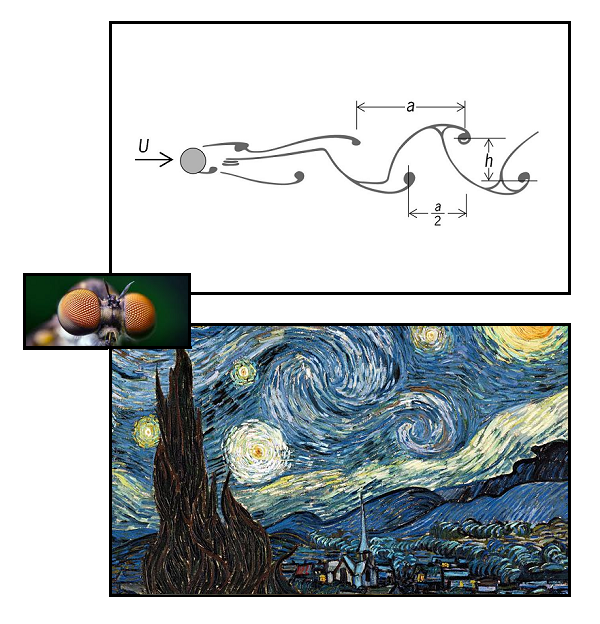
The upper image illustrates Theodore von Kármán‘s mathematics of turbulent flow, the lower image Vincent van Gogh‘s view of the night sky, and I juxtaposed them using my “DoubleQuotes” format to illustrate the underlying unity of the arts and sciences, and the breathtaking beauty and insight we can derive when we recognize a “semblance” — a rich commonality that transcends our usual division of concepts into separate and un-mutually-communicative “disciplines” and “silos”.

Apparently, this kind of cognition — the basis of every DoubleQuote, and of every move in one of the Hipbone / Sembl games — has now been termed “pattern thinking”.

**

According to Amazon, Temple Grandin and Richard Panek‘s book The Autistic Brain: Thinking Across the Spectrum was released April 30, 2013 although books are often available a couple of weeks ahead of release date, and galleys and proofs earlier still).

I read about it for the first time today, in Grandin & Panek’s piece, How an Entirely New, Autistic Way of Thinking Powers Silicon Valley in Wired. That article begins with a pull-quote from Grandin’s book:

I’ve given a great deal of thought to the topic of different ways of thinking. In fact, my pursuit of this topic has led me to propose a new category of thinker in addition to the traditional visual and verbal: pattern thinkers.

Obviously, that’s something i’d want to find out more about, so I read on into the article, expecting good things. Imagine my surprise when I read this paragraph, though:

Vincent van Gogh’s later paintings had all sorts of swirling, churning patterns in the sky — clouds and stars that he painted as if they were whirlpools of air and light. And, it turns out, that’s what they were! In 2006, physicists compared van Gogh’s patterns of turbulence with the mathematical formula for turbulence in liquids. The paintings date to the 1880s. The mathematical formula dates to the 1930s. Yet van Gogh’s turbulence in the sky provided an almost identical match for turbulence in liquid.

Boom!

**

Okay, I just received my review copy of Hofstadter and Sander, Surfaces and Essences: Analogy as the Fuel and Fire of Thinking — I guess I’ll have to review Grandin and Panke here, too.

The Abel Prize for a great Sembl move

Wednesday, May 22nd, 2013

[ by Charles Cameron — cross-posted from Sembl ]
.

You don’t have to be playing a Sembl or Hipbone game to make a great Sembl move — you just have to see a rich semblance between two concepts in (previously) widely separated fields of thought. Thus Pierre Deligne of Princeton’s Institute for Advanced Study, who won the Abel Prize in mathematics this year, did so by working on a rich Sembl-style insight from André Weil. As Scientific American reports today:

Deligne’s most spectacular results are on the interface of two areas of mathematics: number theory and geometry. At first glance, the two subjects appear to be light-years apart. As the name suggests, number theory is the study of numbers, such as the familiar natural numbers (1, 2, 3, and so on) and fractions, or more exotic ones, such as the square root of two. Geometry, on the other hand, studies shapes, such as the sphere or the surface of a donut. But French mathematician André Weil had a penetrating insight that the two subjects are in fact closely related. In 1940, while Weil was imprisoned for refusing to serve in the army during World War II, he sent a letter to his sister Simone Weil, a noted philosopher, in which he articulated his vision of a mathematical Rosetta stone. Weil suggested that sentences written in the language of number theory could be translated into the language of geometry, and vice versa. “Nothing is more fertile than these illicit liaisons,” he wrote to his sister about the unexpected links he uncovered between the two subjects; “nothing gives more pleasure to the connoisseur.”

**

While I was still a schoolboy, my favorite place to visit on vacation was the great Abbaye St. Pierre de Solesmes, celebrated for its central part in the renewal of Catholic liturgy and of the Gregorian Chant in particular. Two of my fondest memories are of the terrific bowls of coffee served in the monastic refectory at breakfast, and of my opportunity to take a class in chant under the chironomic hand of Dom Joseph Gajard, then Choirmaster at Solesmes. The liturgy and the chant were sublime.

I was an Anglican (“Episcopalian”) at the time, and just a wee bit concerned that the monks might want to convert me to the One Holy [Roman] Catholic and Apostolic version of the faith — but when I expressed my concern to one of the monks, I was reassured: they had had an earlier guest at the abbey, one Simone Weil, and she too had been unready to convert, though deeply moved by the liturgy…

So I’ve felt a quiet kinship with Simone Weil ever since, and try to keep a copy of her Letter to a Priest nearby me at all times. She begins:

When I read the catechism of the Council of Trent, it seems as though I had nothing in common with the religion there set forth. When I read the New Testament, the mystics, the liturgy, when I watch the celebration of the mass, I feel with a sort of conviction that this faith is mine or, to be more precise, would be mine without the distance placed between it and me by my imperfection.

I love her for that — and I love, too, that her brother should make such a splendid Sembl move.

**

I suppose I’d better post my reading of Wiles’ Proof of Fermat’s Last Theorem viewed as a Glass Bead Game as a follow up.

Two pebbles in the pond of thought

Saturday, January 12th, 2013

[ by Charles Cameron — regarding the idea that Islam might be monolithic as well as monotheistic, and more generally, the patterns created when concentric ripples intersect ]
.


.

Drop these two pebbles into the pond of thought, and watch the ripples as they intersect, overlap, enhance one another, cancel each other out and continue…

**

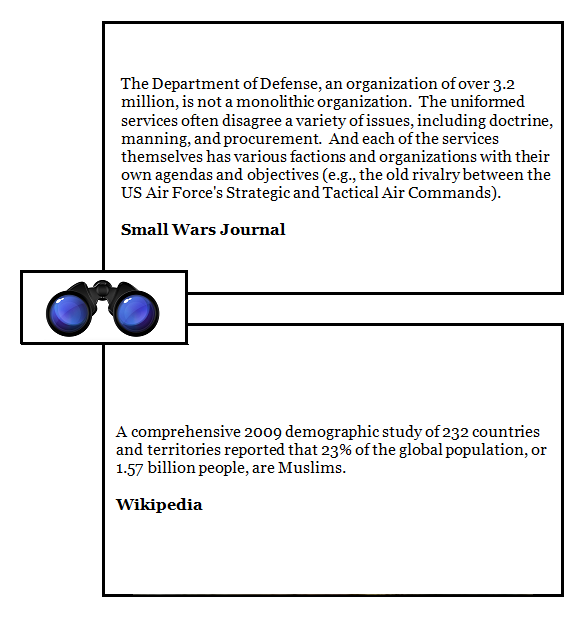
It may seem obvious that Islam is not, and could not possibly be, a monolithic entity — but I want to suggest something more than that fairly basic fact.

I want to suggest that just as we have all enjoyed watching the way concentric ripples fan out from the place where a pebble — or a raindrop — hits a pond, and the fascinating ways win which two or more such ripples intersect —

— in much the same way, it can be fascinating — and often illuminating — to watch the way in which ripples of thought in the thought pond intersect.

In fact, that’s the basic “move” behind all creativity.

**

My sources for the two quotes above:

Small Wars Journal, Disruptive thinking
Wikipedia, Islam

My sources for the two images above:

Doodles and jots, ripple effects
David Armano on “ripples of influence”

Which is to what as this is to that?

Saturday, December 15th, 2012

[ by Charles Cameron — second of two quick posts, this one concerning hasty comparisons between two school tragedies, the one here and the one in China ]
.

You’ve no doubt noted the same double school tragedy that I have today — twenty school kids wounded in China, twenty school kids gunned down in America.

**

I can’t do much more than try to be respectful of the victims and their families in both cases: my prayers are with them. But being a pattern seeker, I’m also wondering what questions this raises.

For some, it will seem clear that guns are to knives as deaths are to wounds.

Or should that be: America is to China as guns are to knives? America is to China as death is to injury? Once you start comparing what are, after all, two close similarities — brought forcibly to our attention by their commonality location in schools, their common date, their closely similar numbers of victims — it becomes clear that there are also very many differences to take into account, and that no one-size-fits-all ratio will accommodate their complexity.

Something for me to ponder, as I jump — as all humans, athletes of the mind, appear to jump — to hasty conclusions.


Switch to our mobile site

