zenpundit.com » theory

Archive for the ‘theory’ Category

Strategy, Power and Diffusion

Monday, November 19th, 2012
“….and therefore, two kinds of reactions are possible on the defending side, depending whether the attacker is to perish by the sword or by his own exertions.

                                                               – Carl von Clausewitz,  On War

 “Again, if the campaign is protracted, the resources of the State will not be equal to the strain.”

                                                                 – Sun Tzu,  The Art of War 

A recent estimate for the cost of the war in Afghanistan by the Congressional Research Office is $443 billion dollars to occupy and fight a Pakistani-supported insurgency in a primitive country whose annual GDP is a mere $ 27 billion. A  figure that itself inflated by $ 3-4 billion is remittances, $ 4 billion in NGO aid and $14 billion in direct US aid (2010 figure); when you then subtract opium smuggling ($ 4 billion), Afghanistan’s legitimate economic activity may only be a miniscule GDP of  $ 2 – 3 billion.

This does not, of course, include the cost of ten years of lavish bribes for Pakistan, a portion of which was used by the ISI to support the Taliban  killing American and ISAF  soldiers  and Afghan civilians.

This is not a cost-effective or strategic way to run a war. In fact, even for a nation as wealthy as the United States there is nothing in Afghanistan worth such an expenditure of blood and treasure, especially when the bulk of our enemies appear to be based in Pakistan, not Afghanistan. You can approach a strategic problem directly or indirectly but to do so indirectly in the most expensive way logistically possible makes little sense. For example:

….Since the ‘war to end all wars’, however, war has not exactly stood still.  Although the US Defense Logistics Agency rather quaintly describes its mission in terms of a supply chain extending ‘from factory to foxhole’, it is, above all, the mobility of military violence that is central to the conduct of late modern war.  But Creveld is adamant that since 1945 the operational freedom of modern ground forces has not markedly increased, not least because their prized mobility is absolutely dependent on supplies of petrol and gasoline.  Since the end of the Second World War the use of petroleum-based fuels by the US military has soared, and as its stripped-down forces have been expected to do more with less (through technological change and outsourcing) so the fuel expended per soldier has increased by 175 per cent to an average of 22 gallons (83 litres) per day. [viii]  As Obama had US forces ‘surge’ into Afghanistan in 2009 so ISAF’s daily fuel consumption rocketed from two million to over four million litres a day. Given these volumes, it is scarcely surprising that the death-dealing capacities of the US military and its allies should have been tied in knots by ‘umbilical cords’ far more convoluted than Creveld could ever have imagined.

There are three main supply networks to be disentangled in turn.  All of them are ground lines of communication.  Air transportation is extremely, usually prohibitively expensive, and only four airports in Afghanistan are accessible to non-military aircraft, so that until 2011 only 20 per cent of cargo was flown in.  Similarly, onward delivery to combat outposts and forward operating bases has usually only involved airdrops if other options are too dangerous. Still, by the start of 2010 around 30-40 per cent of bases were being supplied by air because the Taliban controlled much of Highway 1, the ring road that loops between Afghanistan’s major cities, and its IED attacks on NATO and Afghan forces were increasingly effective.  The high cost of airdropping pallets of fuel, ammunition, water and supplies has imposed all sorts of fuel economies on the military as it attempts to reduce its carbon footprint – ‘troops have learned to sip, not guzzle’ – but it is still the case that, as one US pilot put it, ‘we’re going to burn a lot of gas to drop a lot of gas’.  According to some estimates it can cost up to $400 a gallon to deliver fuel by air. [ix] 

Neither war nor strategy are a hard science like physics. That said, there are fields of study and investigation that while not being a science are, like physics, inherently about systems or systemic relationships. Economics  and engineering are two such examples, strategy is another.  Because of this similarity, it is often profitable to employ metaphors or analogies from physics to illustrate strategic problems, as Clausewitz famously did in On War with “friction” and “center of gravity“.

Diffusion” might be another analogy for statesmen and soldiers to keep in mind.

Military force, or more broadly, national power marshaled and employed toward a vital objective represents a potent concentration of energy like a red hot iron bar. Thrust deeply into a trough of ice water, the surface of the water yields to the mass and heat of the iron bar in a furious burst of steam and boiling turbulence. Keep the bar submerged and every erg of heat will be sapped out of it by the water and the iron will emerge cold, tempered by the experience and inert. Keep the bar submerged long enough and the water will begin to rust the iron away until nothing is left.

Vast spaces, hostile populaces and deeply impoverished environments are like ice water to the molten heat of an invading power, as we have discovered in Afghanistan.

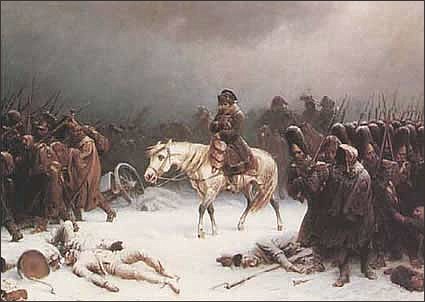
There are already old military maxims that express a warning about the risks of diffusion, notably “Don’t get into a land war in Asia” or “Don’t invade Russia in winter”.  Napoleon Bonaparte marched his vast and fabled Grand Armee of 600,000 men into the endless steppes of Tsar Alexander’s Russia. Everything gave way before Napoleon’s legions, but the Russians were not the Austrians or Prussians, they retreated, savagely burning and destroying as they went:

….Alexander’s proclamation to his people, issued at the time of the French invasion, appealed to these deep seated feelings: Napoleon had come to destroy Russia; the entire nation must rise against ‘this Moloch’ and his ‘legions of slaves’. ‘Let us drive this plague of locusts out! Let us carry the Cross in our hearts and steel in our hands!’ The proclamation was read in all the churches, and the priests supplemented it with embellishments of their own. The Comte de Segur, at this time an aide-de-camp to Napoleon, wrote: ‘They convinced these peasants we were a legion of devils commanded by the Antichrist, infernal spirits, horrible to look upon, and whose very touch defiled”

In Moscow, the city in flames, even Napoleon the Conqueror, the master of Europe, did not have enough men, or material or speed of movement to either digest and rule the immense spaces of Russia or compel Alexander to come to terms:

….Throughout the fall of 1812, Napoleon waited in vain for Alexander’s peace proposals to arrive in the Kremlin. When none came, he made overtures of his own, but Alexander sent no reply. As the days stretched into weeks, Napoleon came to see that he, not Alexander, faced a truly desperate situation, for Russia’s armies grew stronger by the day while his own dwindled from desertions and the ravages of disease. He faced the hopeless prospect of wintering in Russia without adequate food, shelter, or supplies, surrounded by a people so hostile that they burned their grain rather than sell it for French gold. As winter approached, and as the Russian partisans stepped up their attacks on his rear, Napoleon saw that his line of communications, which relied upon a perilously vulnerable corps of couriers who raced from Paris to Moscow in fourteen days, must soon collapse.

Of the Grand Armee, only five thousand returned home from the snowy wastes of Russia alive.

The Wehrmacht did little better. Hitler’s imagined drive to the Urals without a surrender and territorial concession by Stalin was a fantastical ambition. The far-flung distance, roadless mud and icy snow alone were too much for panzer armies and Luftwaffe air wings that proceeded to break down with statistical certainty. Supply lines were too long; gasoline and replacement parts were too few, as were replacements for the men for whom the Eastern Front was a grave. To the dogged resistance of the Red Army, the Germans needlessly added the people’s rage of the Russian partisans by demonstrating to the peasantry that the NKVD held no monopoly on atrocity.  Imperial Japan’s coterminous war in China tells exactly the same unhappy tale.

William Lind and the 4GW school used to like to make the point, regarding your moral and political legitimacy, that ” If you fight the weak, you become weak”. The corollary to that is economic: “If you fight the poor, you become poor”.

Grinding poverty itself  is a tax upon the invading force. There are no resources for your army to comandeer or buy, no skilled manpower to requisition or hire, no infrastructure for them to use. All of that must be imported and built at great expense by the invader whose troops are accustomed to far less spartan environs. The local population is usually malnourished, illiterate, ignorant, suspicious of outsiders and  rife with disease; their living habits and water sources unsanitary and endanger the troops. Caring for the locals, even minimal administration of humanitarian aid, becomes a bureaucratic and logistical burden consuming time and diverting resources away from urgent military needs.

The United States under George Bush the Elder, entered into Somalia, a land beset by violent anarchy and it’s people in the grip of a terrible famine and was driven out shortly thereafter under Bill Clinton. The last scenes there being the emaciated Somali followers of  a two-bit warlord,Mohammed Farah Aidid, gleefully swarming over and looting our military’s former…. garbage dump.

When the enemy has a land so poor that he treasures and makes use of the crap you throw away, the economic spillover of your logistical supply lines will fund his war against you. Used to surviving on bare subsistence, the invader’s presence becomes an economic bonanza for resistance and collaborator alike. Sort of a highly kinetic form of military Keynesianism. The war itself and the occupation become an irreplaceable cornerstone of their economy. They hate you being there, but can’t afford to defeat you and drive you out either – making a “quagmire” irregular conflict their ideal economic equilibrium to maintain.

What lessons can we draw here?

  • Keep your national power concentrated – don’t diffuse it with unmanageable, ill-defined, tasks of unlimited scope
  • Military power is to be used for a clear and articulated policy end with a defined political settlement in mind
  • If a political settlement is impossible because the problem is intractable, avoid involvement.
  • If you cannot avoid getting involved (i.e. -you were attacked) your best option is to engage in a punitive expedition to destroy the war-making capacity of the enemy and impose  ruinous costs and then immediately leave.
  • Keep campaigns short. In operation, military power is a terrible, swift sword and you should sheathe it just as quickly. 
  • Ruling over enemy population is a wasteful, thankless, burden not to be undertaken except in extremis (Reconstruction and occupation of Germany and Japan were in extremis cases).
  • Maximum gains accrue from the most effective use of the smallest possible force in the shortest period of time.
  • Make an army large enough and the enemy will become a secondary or tertiary concern of its leaders.
 

Does Culture Trump Strategy?

Thursday, November 1st, 2012

The always interesting John Hagel tweeted a link recently to an old post at  Mill’s-Scofield Innovanomics, a blog run by a business strategist and consultant with a science background, Deb Mills-Scofield.

Summer’s Trump Cards 

….Culture Trumps Strategy: The best made plans are worthless if they’re not aligned with the culture. Sometimes the strategy can help transform the culture (for good or bad), but if the culture doesn’t support it, it won’t happen.  Perhaps that’s why I think CEOs need to be CCS’s – Chief Culture Stewards.

Challenge:  Start to check the health of your culture – really, be brutally honest -before the end of August.

This was interesting to me.

Obviously, Mills-Scofield was concerned here with “business strategy” and organizational theory and not strategy in the classical sense of war and statecraft. As Dr. Chet Richards has pointed out, unlike a military leader in war, businessmen are not trying to destroy their customers, their employees or even their competition, but while not the same kind of “strategy”, the underlying cognitive action, the “strategic thinking”,  is similar. Perhaps the same.

So, shifting the question back to the original context of war and statecraft, does culture trump strategy?

On twitter, I had a brief twitter discussion on this with Marc Danziger who was sympathetic to the proposition of cultural supremacy. I am not so sure, though I think the relationship between culture and strategy is an iterative one, the degree to which culture matters in strategy is highly contextual and is determined by how broadly you define cultural values as being directly operative in driving the scenario. Some disjointed comments:

  • Your own cultural-societal worldview shapes politics, policy and politik. So indirectly, culture will be a determining factor in conceiving “Ends” worth spilling blood and dying for – particularly in wars of choice. When war, especially existential conflict is forced upon a state by an enemy attack, some of the initiative and room for constructing artful or limited “Ends” has been lost and becomes secondary to survival. Even Stalin’s normally overweening and murderous ideological preferences mattered somewhat less in Soviet policy and strategy the day after Operation Barbarossa began than the day before.
  • If the Ends in view imply forcing a political settlement upon the enemy – “compelling him to do our will” – than the enemy’s culture matters a great deal. All the moreso, if the war entails COIN, military governance of an enemy population and reconstructing an enemy state to our liking. The enemy culture is part of the operational environment because our use of military force (destruction) is going hand in glove with substantial political activity (construction) – mere physical control of the population is not enough, though it is a precondition for success. MacArthur’s role as SCAP in post-war Japan demonstrated an exceptionally shrewd blend of coercion and concession to traditional Japanese cultural touchstones.
  • If our Ends are much more limited – degrading enemy operational capacity and/or simple, spasmodic, punitive expeditions to impose costs on an enemy state or entity in retaliation for aggression; or, if we intend to stand off-shore and strike with air and naval superiority – than the enemy culture matters far less. Force is being used to “bargain” at a very primitive level that does not require much cultural nuance to understand and the message of “we will hit back” . Likewise, if the war is an unlimited one of extermination and Carthaginian peace, enemy culture matters far less than your military capacity to execute your strategy.
  • Your cultural worldview shapes your grand strategy or statecraft because great and lesser powers are not coldly playing chess for material interests alone when they engage in geopolitical conflict and warfare but are establishing, evolving and protecting a national identity on the world stage. What Thucydides called “Honor”, the British “Paramountcy”, Richard Nixon “Credibility” and Joseph Nye “Soft Power” may all have been intangible expressions, difficult to quantify, but are very much part of the strategic calculus of war and peace.
  • Finally, it is important to note that strategic employment of brute force has a large role in setting the parameters of where and when cultural nuance and interpretation matter and exercise political leverage during war. Extreme violence disrupts and warps the cultural norms of belligerents, usually for the worse. It was the wars of the French Revolution and Napoleon that awoke the romantic pan-German nationalism of the 19th century that eventually united Germany and transformed it into the terror of the world in the 20th. The First World War ushered in a century of ideological monstrosities and revolutionary state terrorism on an epochal scale of murder unequaled even by the butchery of the Romans or Mongols. War is often the Abyss that looks into you.

Thoughts?

A Handy intro to Networks

Monday, October 22nd, 2012

Blogfriend Rob Paterson has two concise posts up on understanding networks and network theory. If this is a subject you want to know more about, they are must-reads.

My Network Revealed – Now what can you learn about yours?


….Here is my social network as created by the Mapping tool on Linkedin. It’s not the 100% true picture but it looks like 90% to me. You can use their mapping tool by going here.

If I am right and we are moving to an economy that depends on our networks, then it is essential that we learn what each of our networks means and what we can do to make them healthier. So, with that in mind, let’s look at mine and I will share some lessons with you.

Next week, I will post a podcast that I recorded yesterday with the Master of Networks, Valdis Krebs. Anything I know is because of him. He will go much deeper than I – so this is an introduction.

Diversity – In nature diversity is a good thing – so it is with our social networks. You can see that I am connected to a series of worlds. PEI , Public Media, Network Thinkers, Family and I have 2 outside nets of New Military Thinkers and my legacy Corporate connections.

I think that this does not look too bad – I have good links into many fields. How does your world look? 

Our networks are like gardens, we can always make them better. We can always add and remove. We can always pay attention. ….

Read the rest here.

Human Networks – A masterclass by the Master Valdis Krebs – Podcast #networks

This is Valdis Krebs – The Galileo of human Social Networks – ie the person who shows us what they look like, when before they were invisible, and who shows us the simple rules that drive them. 

The few nations that were early into navigation and exploration in the 16th century, did very well. As we ourselves move into a world where all the advantages will accrue to those that understand Networks, I think it is vital that we understand how to navigate in the Network world. 

The problem that many of us have is that when we hear the work “Network” we think of TV networks or Telephone networks that are driven by the old rules of engineering. What Valdis talks about mainly are Natural Networks, of which human social networks are a part. These are driven by the rules of Emergence and Nature and NOT by the rules of the CEO.

The good news is that the Rules of Nature in this regard are simple to understand and to operate. 

Network copy
This is the “Map” that we are now going to explore.

Read the rest here.

Valdis Krebs is indeed the master of network-mapping and leveraging social networks


Strategy and Creativity: Part I.

Tuesday, October 9th, 2012

“War is more than a true chameleon that slightly adapts its characteristics to the given case. As a total phenomenon its dominant tendencies always make war a remarkable trinity–composed of primordial violence, hatred, and enmity, which are to be regarded as a blind natural force; of the play of chance and probability within which the creative spirit is free to roam; and of its element of subordination, as an instrument of policy, which makes it subject to reason alone.”
                                                                                                -Carl von Clausewitz, On War

“Thus the highest form of generalship is to balk the enemy’s plans; the next best is to prevent the junction of the enemy’s forces; the next in order is to attack the enemy’s army in the field; and the worst policy of all is to besiege walled cities….Therefore the skillful leader subdues the enemy’s troops without any fighting; he captures their cities without laying siege to them; he overthrows their kingdom without lengthy operations in the field. With his forces intact he will dispute the mastery of the Empire, and thus, without losing a man, his triumph will be complete. This is the method of attacking by stratagem.”
                                                                                             – Sun Tzu, The Art of War 

This blog is read by many people with a deep interest in strategy coming from different philosophical and professional perspectives. While I have my own speculations  based on years of study, I would like to begin by first posing a few questions to the readership:

  • What is the relationship between strategy and creativity?
  • Or between strategic thinking and creative thinking?
  • Is “doing strategy” primarily an act of planning, calculation and rational problem-solving or is it also a profoundly creative and intuitive enterprise?
  • If we get better at thinking creatively, do we become better, more effective strategists? The reverse?
  • Is creativity more useful in “grand strategy” (or “statecraft”, if you prefer) and policy than in straightforward “military strategy”?

The floor is yours, strong argument is welcomed.

Bassford’s Dynamic Trinitarianism, Part II.

Monday, September 24th, 2012

In Part I.  we looked at a working paper by Professor Christopher Bassford that he he has posted at Clausewitz.com entitled  Tiptoe Through the Trinity, or, The Strange Persistence of Trinitarian Warfare.  As I said previously:

At 31 pages of analytic prose, diagrams and footnotes regarding the nature of  Carl von Clausewitz’s“fascinating” trinity; how Bassford thinks Michael Howard and Peter Paret got some important points in their translation of On War wrong ; the real meaning of Politik and on the perfidy of non-trinitarians – Bassford’s paper is not a quick read but a worthwhile one. I learned some important things about On War from reading this paper and had some uncertain speculations strengthened by Bassford’s expertise on Clausewitz and Clausewitzians.  I am not going to attempt a summary of so long and abstruse an argument, but I would instead like to highlight some of Bassford’s more valuable insights. There were also a couple of points where, in stretching to make analogies with other fields, I think Bassford may be going astray, as well as some commentary I might make regarding “non-state war”.

This paper will be more digestible if we blog the topics one at a time, in succession. 

Having previously tackled Bassford’s interpretation of the “fascinating” trinity and his argument for it’s dynamic nature, the time has come to observe how he explains a concept almost as important for understanding On War, what Clausewitz meant by “Politik“. We have all heard the often quoted maxim that Clausewitz said that “War was the continuation of politics by other means”, but what that sentence actually meant has been subject to both misunderstanding and debate. Here is Bassford:

….That leaves us with the problem of Politik. This is a huge subject, for it encompasses the entire issue of the relationship between it and war; perhaps 90% of debates about Clausewitz turn on it. Let us pause for a (long) moment and consider the meaning of those problematic words, Politik, politics, and policy.

Clausewitz seldom overtly defines Politik in any detail, and when he does so the definition is shaped to fit the immediate context. In translating Politik and related words, English-speakers feel compelled to choose between “politics” and “policy.” Some even prefer the much more specialized term “diplomacy,” which limits the discussion to relations among organized states—that is how Jomini’s Politique was usually rendered into English. Our choices can seriously distort Clausewitz’s argument. Clausewitz himself would probably have been very comfortable with the word “statecraft,” the broad zone of concerns and activities within which “statesmen” operate. But that term avails us no greater clarity and might even lock him exclusively into the state, where so many modern writers want to (uselessly) maroon him. We are interested in what Clausewitz meant by Politik, of course, but our focus here is even more on the question of what we mean by policy and politics. The latter two terms are related but far from equivalent. Each captures a part of the meaning of Politik, but even used together they do not cover quite the same ground.

…..1. Politics and policy are both concerned with power. Power comes in many forms. It may be material in nature: the economic power of money or other resources, for example, or possession of the physical means for coercion (weapons and troops or police). Power is just as often psychological in nature: legal, religious, or scientific authority; intellectual or social prestige; a charismatic personality’s ability to excite or persuade; a reputation, accurate or illusory, for diplomatic or military strength. Power provides the means to attack, but it also provides the means to resist attack. Power in itself is therefore neither good nor evil. By its nature, however, power must be distributed unevenly, to an extent that varies greatly from one society to another and within the same society over time.*25

2. “Politics” is the highly variable process by which power is distributed in any society:the family, the office, a religious order, a tribe, the state, an empire, a region, an alliance, the international community. The process of distributing power may be fairly orderly—through consensus, inheritance, election, some time-honored tradition. Or it may be chaotic—through intrigue, assassination, revolution, and warfare. Whatever process may be in place at any given time, politics is inherently dynamic and the process is always under pressures for change. Knowing that war is an expression of politics is of no use in grasping any particular situation unless we understand the political structures, processes, issues, and dynamics of that specific context…..

….The key characteristics of politics, however, are that it is multilateral and interactive—always involving give and take, interaction, competition, struggle. Political events and their outcomes are the product of conflicting, contradictory, sometimes cooperating or compromising, but often antagonistic forces, always modulated by chance…..

….War—like politics—is inherently multilateral, of course, though Clausewitz often uses the term sloppily in the sense of a unilateral resort to organized violence…..

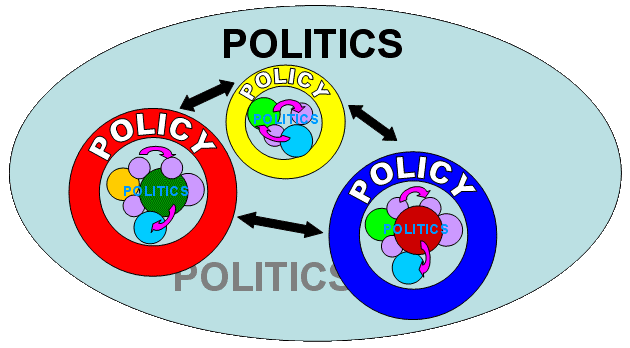
….3. “Policy,” in contrast to politics, is unilateral and rational. Please do not confuse rationality with wisdom, however. As you may already suspect, there is no shortage of unwise policy out there. Policy (like strategy) represents a conscious effort by one entity in the political arena to bend its own power to the accomplishment of some purpose—some positive objective, perhaps, or merely the continuation of its own power or existence. Policy, is the rational and one-sided subcomponent of politics, the reasoned purposes and actions of each of the various individual actors in the political struggle.

….The key distinction between politics and policy lies in interactivity. That is, politics is a multilateral phenomenon, whereas policy is the unilateral subcomponent thereof.

….This makes policy and politics very different things—even though each side’s policy is produced via internal political processes (reflecting the nested, fractal *27 nature of human political organization).*28 This is not of merely semantic importance. The distinction is crucial, and there is a high price for confusion.

….In general, H/P’s word-choice reflects this logic, despite its strong bias towards “policy.” Whenever the context can be construed as unilateral, as in the Trinity discussion, we see “policy.” In Clausewitz’s final and most forcefully articulated version of the concept, however, the context is unarguably multilateral, with so strong an emphasis on intercourse and interactivity that, ultimately, even H/P is forced to use “politics” and “political”:

We maintain, on the contrary, that war is simply a continuation of political intercourse, with the addition of other means. We deliberately use the phrase “with the addition of other means” because we also want to make it clear that war in itself does not suspend political intercourse or change it into something entirely different. In essentials that intercourse continues, irrespective of the means it employs. The main lines along which military events progress, and to which they are restricted, are political lines that continue throughout the war into the subsequent peace. How could it be otherwise? Do political relations between peoples and between their governments stop when diplomatic notes are no longer exchanged?*30

….The clash of two or more rational, opposing, unilateral policies brings us into the realm of multilateral politics. Thus there really is no reason to avoid translating the Trinity’s politischen Werkzeuges literally, i.e., as “political instrument.”

That brings us to the problem of instrumentality. Force or violence is, of course, an instrument, in the sense of a hand-tool or weapon, of unilateral policy. War, however, must be bi- or multilateral in order to exist. Thus, while military force is indeed an instrument of unilateral policy, we should see war as an instrument of politics only in a very different, multilateral sense, as the market is an instrument of trade or the courtroom an instrument of litigation (“which,” as Clausewitz says, “so closely resembles war”)

….Clausewitz seems simply to assume that his readers will distinguish, on the fly, whether he is speaking in the unilateral or the multilateral sense. After all, he has stressed time and again the interactive nature of war, and, of course, his own language’s term Politik encompasses both our multilateral politics and our unilateral policy. But this casual stance results in constant confusion for the translator and the reader.

….We sometimes forget, of course, that Clausewitz’s magnum opus is not about policy or politics, nor about human nature or the nature of reality. It is merely a mark of the book’s profundity that these matters arise immediately in any serious discussion of it. In fact, Clausewitz himself dismisses the political complexities of policy in order to focus on his true subject, the conduct of military operations in war

….On the other hand, he’s offering some good advice here, not necessarily a prediction. It seems rather superfluous to suggest that perhaps Clausewitz actually grasped the facts that there is such a thing as bad policy, that bad policy has military consequences, and that this in turn may have consequences for both the political leadership and the community whose interests it is supposed to represent.

Clausewitz’s analogy to markets and litigation are interesting, partly because they are strained.  Still useful, but strained.

In the case of the former, the relationship is actually the reverse: trading is an instrumentality of economic relationships and economic laws which continue to operate even if their “natural” manifestations are suppressed by political power wielded by the state (i.e. the Soviet Union or North Korea could fix prices or set quotas but then had shortages, surplus goods and black markets instead). However, in CvC’s defense, he was still correct that there was a degree of parallel between economic competition and war and economics was then still in it’s infancy. Some of the classical economists had yet to become regarded as such by wrestling with their own conception of iterative, friction-generating, relationships. Furthermore, in Clausewitz’s day, the heavy hand of the state in economic life was traditional in continental Europe while “liberalism” (allowing freer markets) seemed like a radical innovation rather than an underlying mechanism behind an existing system of distortions.

The same might be said that litigation is the instrument of the courtroom or justice, but I am less sure here. Continental legal traditions and assumptions are sometimes very different from the Anglo-American legal systems based more upon common law and the evolution of judicial independence from the executive. And unfortunately, early 19th century Prussian royal courts are a subject beyond my competence. In any event, the adversarial and zero sum nature of litigation carries through in Clausewitz’s analogy.

In regard to Politik, I think Bassford has done an excellent job teasing out the ambiguities of a German word that does not translate or transliterate precisely into an English equivalent. He offers the reader a method for sensibly discerning when to use “politics” or “policy” in interpreting Clausewitz’s text and reasonably assumes that Clausewitz expected the reader to infer the correct meaning from the surrounding context. That’s how most of us write when dealing with multi-layered, abstract topics – we sacrifice exact clarity for useful brevity and expect (or hope) the audience will intuitively grasp the right nuance in our line of reasoning.

I am also intrigued by Bassford’s diagram. The representation of internal political dynamics is very useful but I am curious how he would weave a visual representation of strategy flowing from policy or (more accurately, policies) and strategy’s relationship with politics, beyond being subsumed. Many a potential strategy is stillborn in the tumult of bureaucratic-military politics, never mind the larger societal kind.

As complex as the text of On War sometimes seems, it really was a brilliant simplification by Clausewitz of the dynamics mediating conflict and war.


Switch to our mobile site