zenpundit.com » theory

Archive for the ‘theory’ Category

Spree Terrorism

Saturday, November 29th, 2008

I lack sufficient depth and familiarity with the Indian political context to comment intelligently on the origins and ultimate aims of the shadowy Islamist group that carried out the Mumbai Massacre. I’d love to hear Olivier Roy speculate on the ideological aspect but in terms of organization, I’d bet heavily on a “modular” structure of transnational and indigenous personnel – a strategic alliance between groups or a hybrid operation.

What I can comment sensibly on is the use of “Spree killings” as a tactic by terrorist groups. Spree killings are an attractive tactic because they are easy to initiate, impossible to anticipate and can be massively effective in driving media attention.

Spree killers like Andrew Cunanan or John Muhammed  “the DC Sniper” riveted the attention of an entire nation or acheived international news coverge. Cunanan, while on the run from a national manhunt for earlier murders managed to assassinate celebrity designer, Gianni Versace before committing suicide; Muhammed and his junior partner managed to murder ten people in a metropolitan area blanketed with local, state and Federal law enforcement despite having gandiose plans that were the product of a confused and agitated mental state. “School shootings“, another form of spree killings, have almost become a macabre rite of Spring in the United States and the late 1990’s bank robbery gone awry in Los Angeles, that featured a heavily armed, body armored, pair of criminals holding off dozens of police in a savage shoot-out that may have been inspired by a scene in the Robert DeNiro movie Heat.

Spree killings, though rare, have previously been used to forment terror both by non-state actors as well as by states. A few examples:

 In 1997,  Gamaa Islamiya massacred 58 foreign tourists at Luxor, Egypt an action that led the Egyptian regime of Hosni Mubarak to crush Egyptian Islamist groups as harshly as Nasser had once cracked down on the Muslim Brotherhood. In 1990, the Tamil Tigers killed 147 Muslim men and boys at four mosques in  Katthankudi, Sri Lanka ( the Tigers are a highly effective and innovative terrorist-insurgency, having pioneered both suicide bombing and naval-terror operations).

In 1941, the radically fascist and fanatically anti-semitic Iron Guard in Romania attempted a coup d’etat against the nationalist dictator and Nazi ally, Ion Antonescu, which featured wild street violence by Legionaires and a ghoulish pogram against Romanian Jewry so horrific that even German SS commanders on the scene in Bucharest were appalled. Despite having made use of such tactics himself in the Kristallnacht and the Night of the Long Knives and having his own genocidal program for the Jews, Hitler ordered the Wehrmacht and SS to assist Antonescu in crushing the Iron Guard revolt.

Spree killings have almost never produced long term positive effects for the groups using them and we can expect that the Mumbai massacre will have negative consequences for both Pakistan as well as Indian Islamist groups. Despite this, we can expect that the likelihood of spree terrorism will increase when groups become sufficiently radicalized because any semi-open society presents almost ubiquitous oportunities for random mass-murder on a modest budget and the terrorists’ own extremism blinds them to how their actions will be interpreted or perceived.

From an email with security expert Steve Schippert of Threatswatch.org, ( see Schippert’s Mumbai commentary here and here ) I learned that the terrorists in Mumbai were unable to or never targeted any systems in India’s center of capitalism – water, power, internet, road arteries etc. – were left untouched. That in my view is a future danger, terrorists using the all-consuming attention generated by spree terrorism as a trojan horse or distraction to conceal a strategic systems-level attack.
More on 2025

Wednesday, November 26th, 2008

A follow up with some good commentary on Global Trends 2025.

Dave Schuler writing at Outside the Beltway:

…This idea goes gack to Thomas Carlyle. It’s the “Great Man” theory of history and I think it’s a load of bull. While individual historical figures, e. g. Julius Caesar, Napoleon, Mao, may bring color and texture to the fabric of history that fabric is formed by economics, demographics, and social structures. Gaius Julius Caesar might have elected never to cross the Rubicon into the precincts of Rome, fomenting the collapse of the Republic and the rise of the Empire. Rome would still have been expansionist and there would still have been an empire. Rome’s location, population, and way of life demanded it. We’d just have used some other word for monarch than Kaiser or tsar.

France was loaded for bear after the French Revolution. Even without Napoleon’s military genius it still would have spread the Revolution all over Europe. It might not have invaded Russia but it most certainly would have invaded Italy.

And so on. The ghastly thing about that pronouncement in this document is that it has nothing whatever to do with the meat of the document at all. Nowhere do the authors demonstrate how the choices of individual leaders will influence the world of 2025. If they’re saying that the world of 2025 is completely unpredictable because it will be so completely formed by the decisions of unpredictable leaders in that world they could have stopped this 120 page report at page 25.

There is a repeated confusion of absolute growth with relative growth. While emphasizing the significance of the latter they don’t seem to appreciate that it’s absolute power, strength, and wealth that’s important not relative power, strength, and wealth. China is powerful because of its enormous size not just because of its relative growth, however dramatic that might be. The U. S.’s continued absolute power, strength, and wealth despite the relative change in power, strength, and wealth insures U. S. pre-eminence for the foreseeable future, even with our present economic downturn. Were it otherwise Luxembourg would be the most important country in the world.

Read the rest here

There’s a synergy between great men and their times. Without Adolf Hitler, WWII is a localized, limited, war over the degree to which France and Britain  were going to accept Germany politically dominating the smaller states of Eastern Europe (Germany’s economic domination was inevitable). Without Germany’s defeat in WWI, Versailles and the Depression there would have been no Hitler as Fuhrer of a Nazi regime.

Dave is right that the document is very weak and in need of systems thinkers from the hard and soft sciences and experts on cultural touchstones. Except for a distinct minority, most professional historians shy away from that kind of extrapolation and speculation due to their methodology regarding evidence, or at least they limit the scope of such activities. Historians and futurists are not the same thing, though the two should engage with one another.

Historians as a group tend to excel at going deep on particular subjects with only secondary concern how that subject relates to everything else.  I’ve never been content to accept that, seeing historical knowledge as a platform or scaffold upon which to build new ideas. When I began my first master’s degree, I proposed doing a comparison of the development of the American Populist movement with the Russian Narodniki and People’s Will of the same period. The professor smiled wryly and said that topic was interesting but of a suitable size to be better left for a magnum opus to close out my career.

Analysis is enriched by consilience.

Metz on Iraq and the Evolution of American Strategy

Tuesday, November 25th, 2008

Nothing like a change in administrations to generate a string of excellent books on strategy and national security.

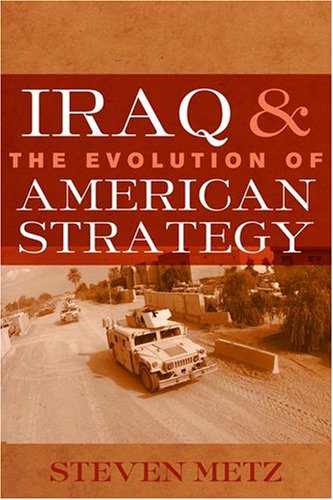
I’ve just ordered Iraq and the Evolution of American Strategy by  Dr. Steven Metz  of the Strategic Studies Institute ( and also of the Small Wars Council ). As I do not yet have a copy of Iraq and the Evolution of American Strategy, which also contains a foreword by Dr. Colin Gray, I will yield the floor to the comment  of Lt. General Paul K. Van Riper:

“Two institutions failed the American people in the run-up to the ongoing war in Iraq. Neither the Congress nor the media provided oversight of the Executive Branch, which is constitutionally required of the first institution and expected of the latter. As a consequence a fundamentally flawed strategy was implemented by an equally flawed military plan. The results have been tragic and costly. Dr. Steven Metz does our nation a great service by exploring the causes of this U.S. strategic debacle, one that may well exceed that of the Vietnam War. Recognizing a problem and its cause are the first steps in setting things right. In this book Dr. Metz identifies the problem, explains what caused it, and most importantly, shows us a better path for the future.”

One for the top of your bookpile.

The Social Science of War

Tuesday, November 11th, 2008

Briefly, here is a juxtaposition of posts worth looking at that portray war through the lens of the social scientist:

Rethinking SecurityThe Study of War as A Social Science

…Rather, it would be better to re-concieve the study of strategic affairs as a multi-disciplinary social science major combining sociology, international relations, philosophy, political science, cognitive science, economics, history, and “pure” military theory. This would be intellectually rigorous enough to banish forever the stereotype of the armchair general and the wargamer.

I see learning about strategy in itself as the key aim of such a curriculum–the goal would be to produce a student able to either apply his or her learnings in a think-tank or government, join the armed forces, come up with reasonable anti-war critiques as an activist, resolve conflict as a humanitarian, or apply strategy in the corporate world.

War as a social science akin to sociology or economics would bring empirical and quantitative rigor into the study of military history and affairs on the undergraduate level as well as a focus on the mechanics of war (tactics, operational art, strategy, and grand strategy) rarely seen outside of a Professional Military Education (PME).

SWJ Blog –  The Genetic Roots of the War on Terrorism

….In the article, titled “A Natural History of Peace,” Stanford Professor Robert M. Sapolsky compares and contrasts human aggressive tendencies with well-documented propensities for violence among several species of primates, and develops a case suggesting that human aggression of the kind that produces warfare mainly stems from the genetic impulses rooted in humans as primates (not a new suggestion of itself). But more significantly, he offers proof extracted from a now robust body of field work that even strong genetic tendencies for violence in certain species of primates can be mitigated by exposure to the equivalent of “cultural” forces. He singles out from the body of such observations the case history of one group of baboons (a particularly aggressive and violent species of primate) that he calls the Forest Troop, the intensely aggressive behavior of which was ameliorated after exposure to the more peaceful and tolerant “mores” of another baboon troop of an identical species with which the Forest Troop had come in contact. He concludes by asserting that “some primate species can make peace despite violent traits that seem built into their natures.” He goes on to muse, “The challenge now is to figure out under what conditions that can happen, and whether humans can manage the trick themselves.”

Sapolsky’s argument frames the issues associated with the current global conflict in which the United States is now engaged in a potentially very useful light: as a biological problem best understood and dealt with using means specifically tailored to deal with human genetic tendencies in order to promote cooperation and tolerance instead of competitive violence. This stands in contrast to the current approach which appears to assume that the conflict mainly results from a combination of cultural and economic factors that can be dealt with by a strategy that combines selected violence, targeted monetary investments mixed, and cross cultural messages through so called strategic communications.

The Social Sciences are a powerful but fractionating, reifying lens. Individually, they unearth certain aspects of large and highly complex phenomena albeit at the cost, at times, of distorting the proportional importance to the whole of the aspect that the social scientist chooses to study. The sociobiological perspective is a radical and controversial one but it is a position that is far more open to empirical investgation in a scientific sense than are many traditional components of strategic theorizing.  At Rethinking Security, Adam wisely tries to balance the heavy load of quantitative methods in his proposed program with at least a few qualitative disciplines; input from military practitioners and security experts would also be helpful to the prospective student in this regard as well.

Perception Pyramid vs. OODA Loop

Friday, November 7th, 2008

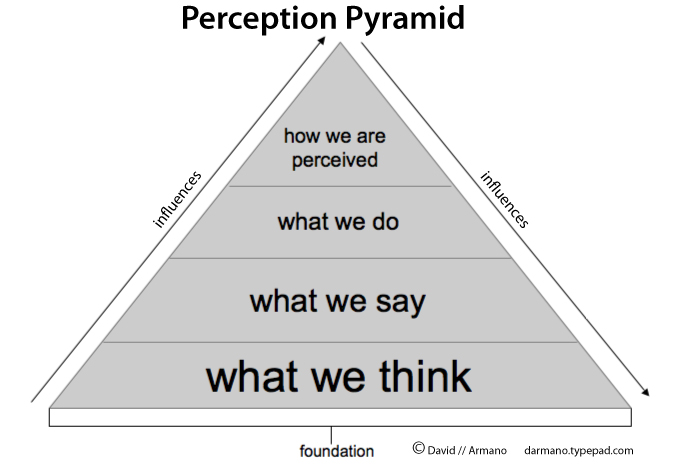
Design guru David Armano had a graphic up that was intriguing from a psychological point of view:

armano.jpg

My instant impression on seeing Armano’s visual was a reminder from Western philosophy and Eastern religion:

“We are what we frequently do” – Aristotle

“What we think, we become” – Buddha

The second impression from the graphic was it’s simultaneous representation as both a feedback loop and a hierarchy. As a hierarchy, I’m not certain I would put “what we say” as a more fundamental tier than “what we do” as Armano did.  Actions would appear to be less subjective as events occuring in time and space than words but words moreso than the perceptions of others which we can neither control nor reliably audit, yet they very much influence us, as Armano suggests.

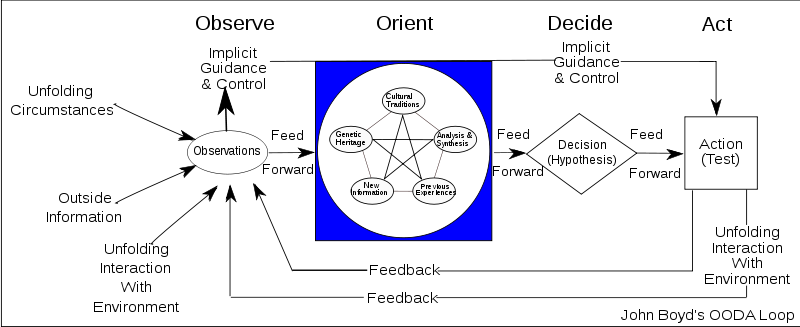
Compare the flow of information/action in Armano’s pyramidical graphic with John Boyd’s OODA Loop:

ooda.png

Boyd’s conception is not hierarchical or sequential, though many people view OODA as a deliberative step by step process, running through it in such a manner instead would slow the cycle considerably. Armano’s consideration of the perceptions of others would be important to Boyd as “outside information” and “unfolding interaction with environment”. It would address the mental and moral levels of conflict and competition

  • Mental (against individuals and groups): surprise, deception, shock, and ambiguity
  • Moral (against groups): menace, uncertainty and mistrust, resulting in disintegration of cohesion and the moral fragmentation of the opponent into many non-cooperative centers of gravity, which pumps up friction.

It would also measure our ability to attract support from or positively influence third parties or allies.

Interested in any thoughts the readership might have on the comparison or from any of my numerous co-authors….


Switch to our mobile site