zenpundit.com » media

Archive for the ‘media’ Category

Dateline, June 5th 2012

Monday, June 10th, 2013

[ by Charles Cameron — screengrabs from a very recently posted video, mostly Taliban with just a smidgeon of NSA ]

[edited to add: please see warning in comment below]
.

Scary, hunh? Yeah?

**

No, this is not from a NSA / Prism video — I’ll have just a little more on that topic later.

Nor is it from your local mafiosi

In fact, it’s from the Islamic Emirate of Afghanistan

i.e the Afghan Taliban.

And it’s addressed to Saakashvili and the people of Georgia (FSU), telling them:

and:

**

What interests me here is this: I tend to think of the Islamic Emirate as mainly Afghanistan-centric, so viewing this video I wondered whether they’ve announced similar intent to raid or attack other nations. Alex Strick van Linschoten responded to my query as to whether he’d seen this sort of message before:

He also pointed me to his book, An Enemy We Created: The Myth of the Taliban-Al Qaeda Merger in Afghanistan, where (p. 277 in my uncorrected proof) we read:

It was around this time that Dadullah started to make increasingly strident statements of support for a global jihad, one in which attacks in Europe and the United States were not to be ruled out.101 Dadullah was, in contrast to most other Talibs of his generation, a ‘true believer’ in this rhetoric. Some commentators have suggested this is pathological, but a possible explanation can be found in the time he spent with foreign jihadis both on the northern fronts during the 1990s as well as post-2001, when he was in South Waziristan. He was frequently used as a go-between for the Taliban in Pakistan and retained ties to the foreign al-Qaeda affiliates as well.

So this kind of thing is not entirely unknown, and indeed “revenge” strikes outside Afghan territory would fit the model Dadullah himself proposed for strikes within Afghanistan (pp. 273-73):

Our tactics now are hit and run; we attack certain locations, kill the enemies of Allah there, and retreat to safe bases in the mountains to preserve our mujahidin. This tactic disrupts and weakens the enemies of Allah and in the same time allows us to be on the offensive. We decide the time and place of our attacks; in this way the enemy is always guessing.

Mullah Dadullah died in 2007, but it seems his thinking still exerts some influence…

** ** **

And NSA — or Nonesuch as I was taught to call it, back in the day?

I stand by the idea I tweeted to JM Berger yesterday:

I’d only add that three days doesn’t seem long enough in this case, and that when the dust settles we may still find ourselves holding just a few loose ends of a multiply-tangled web…
Manhunt: religion and the director’s eye

Saturday, June 8th, 2013

[ by Charles Cameron — with an assist from Wm Benzon, under-appreciated and brilliant film and literary critic, musician, author of Beethoven’s Anvil ]
.

Screen-time is valuable: movie directors don’t just throw it away.

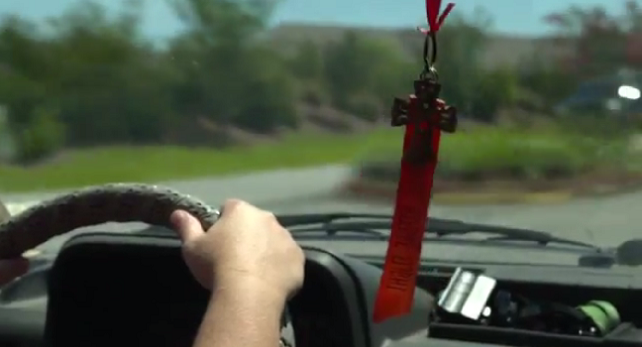
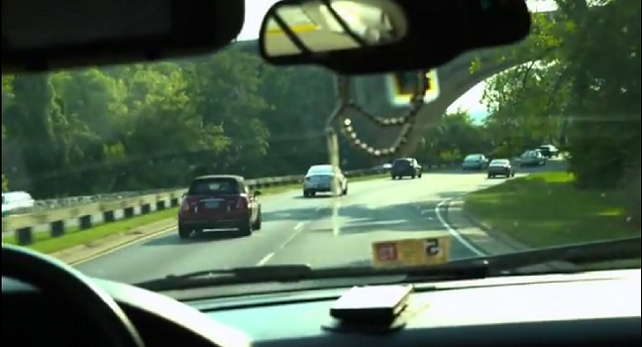
Here are screen-grabs of two moments in Greg Barker‘s HBO bin Laden documentary, Manhunt, offered for your consideration:

and:

**

As you know from my review of Battle of Algiers (Pontecorvo) and Black Friday (Kashyap), I’m a film buff.

Screen time is the life-time of story: every second counts. And thus it is that if a director uses the same shot with variations at two or more points in a movie, they don’t just follow along, the way the elements in the narrative through-line follow along, one after another — they stack up. They “mean” cumulatively, synchronically…

Putting that in musical terms, they take on the function of rhythm rather than melody — and it is rhythm that can make the body dance, just as it is melody that can make the heart soar.

So, this repetition, this striking parallelism — why?

**

Here’s my friend Bill Benzon, writing about the use of parallelism in Apocalypse Now:

The Assassin and the Surfer

Now for the less obvious parallel: Willard and Lance, the only member of the boat crew to survive. One can’t miss the parallel killings nor Willard’s statement of kinship with Kurtz. This parallelism, on the other hand, is easy to miss. That is to say, it may well elude conscious notice. Unconscious notice, on the other hand … Well, what is that?

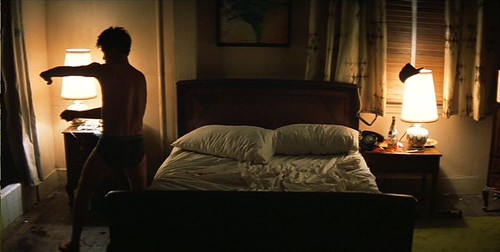
Here’s three frame-grabs that point up the parallel. The first is from the opening montage of Willard in Saigon just before he gets his orders:


Montage AN 19 martial arts

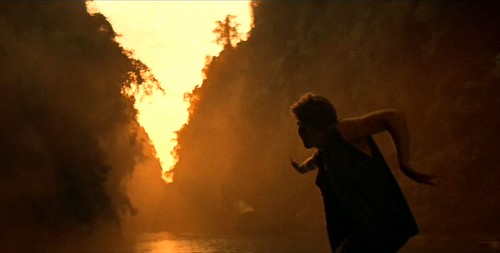
The second shot comes much later in the film. Clean has been killed (bullet), then the Chief (spear). Lance is the one who floated the Chief’s body down the river. Now they’re heading upriver toward Kurtz again, with Lance in the bow of the boat:


AN Lance dance1

He’s doing a martial arts dance. Not the same one as Willard did in the opening montage, but a martial arts dance. No one else in the film does such a thing. Clean does some dance moves while listening to the Rolling Stones, but they’re in an entirely different style; faster, jerkier, more angular.

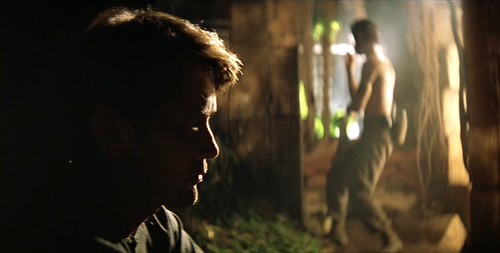
Finally, we have this scene in Kurtz’s compound. Willard’s in the foreground, and Lance is in the background:


AN Lance dance2

One might suggest that this parallel is a mere accident, one might. And perhaps it is. In cases like this, however, my default assumption is that it is not an accident. It may not be there by conscious intent and deliberate plan; but it is not there by accident. The people who made this movie are too skilled to do such things inadvertently.

That final remark of Benzon’s makes exactly the point I was hoping to make here, before commenting on those two screen-grabs from Manhunt:

The people who made this movie are too skilled to do such things inadvertently.

**

There’s actually a third shot in Manhunt with a view of a dangling rear-view-mirror ornament — let’s take a look:

This one’s from the van Peter Bergen and his cameraman, Peter Jouvenal, took in the docu’s re-enactment / flashback to their CNN interview with bin Laden, back in 1997. I don’t think this one is a rosary-like thing though it might be — I think it’s just the sort of tassel decoration you’ll find on saddle-bags, or decorating a camel or a car in Afghanistan.

The other two, however, seem clearly religious, both of them are shots of the cars in which American counter-terrorist folks would have gone to work during their efforts to track down bin Laden — and I find it significant that one features a (Christian) cross while the other very likely shows (Muslim) prayer-beads.

I say “very likely” because the beads could be (secular, Greek) worry-beads — but they look more like a tasbih to me. And why would that be interesting — why would a film-maker be interested in such a parallelism?

Besides the fact that these shots allow voice over and show us the various folk involved going to work, they specifically point up the fact that those working to defeat bin Laden were not all kuffar but included Ali Soufan of the FBI and “Roger” — the fellow described by Greg Miller in this March 2012 piece in WaPo, At CIA, a convert to Islam leads the terrorism hunt.

Am In right? I don’t know. But the subliminal message, if I am, is that the manhunt for bin Laden was indeed not a “Crusaders against Islam” affair.

**

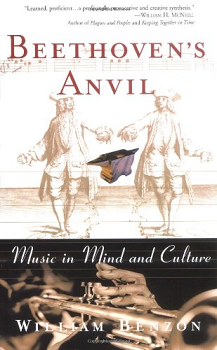
May I recommend Wm. Benzon’s Beethoven’s Anvil to all who read here who have an interest in cognition and / or music?

For more on parallelism in cinema, see David Bordwell, Julie, Julia, & the house that talked, to which Benson also pointed me.

Disrespect of the Prophet’s Mosque in Medina in Azan #2?

Wednesday, June 5th, 2013

[ by Charles Cameron — the second holiest site in Islam disrespected by the editors of Azan? ]
.

I’ve taken out the surrounding matter, but here’s the section on “decorated mosques” as a sign of the time of the Dajjal or Islamic antichrist, from Maulana Asim Umar‘s Third World War and Dajjal in the second issue of Azan:
.


.

**

There’s no doubt that the photo that has been dropped in there is of the interior of the Mosque of the Prophet in Medina — compare, for instance here and specifically the larger image here — and the accompanying hadith are less than flattering of “decorated” mosques — suggesting they signal the time of the Dajjal:

Anas ibn Malik narrates that the Prophet of Allah said that the Hour would not arrive until the people show off to each other in (the construction and going to) of mosques. [Saheeh Ibn Khuzaima Vol. 2 Pg. 282, Saheeh Ibn Hibban Vol. 4 Pg. 493]

Abu Darda said that when you start decorating your mosques and beautifying your Mushaf (i.e. The Quran – adorning it with jewellery etc.), then upon you will be destruction. [Kashf-ul-Khifa’ Vol. 1 Pg. 95]

Abdullah ibn Abbas narrated that the Prophet said that when the sins of a nation increase, then their mosques become greatly decorated. And decorated mosques will only be constructed at the time of the emergence of the Dajjal. [Al Sunnan Al-Waridah Fil Fitn: Vol. 4 Pg. 819]

**

What exactly do the Pakistani brothers intend to signal to their readers with this juxtaposition? As Mr Orange has reminded me, they are Deobandis, and consider devotions at the tombs of saints to be a form of shirk — but would they bring bulldozers to the Prophet’s mosque on that account, as their Wahhabi brothers in jihad did to a small shrine commemorating Abraham in Ayn al-Arous, Syria, recently?

I’d like to get a better sense of whether the juxtaposition is as unexpected in Pakistani context as it was to me, thousands of miles away, and would appreciate further clarification…

Apocalyptic Fire in Azan #2

Wednesday, June 5th, 2013

[ by Charles Cameron — on end-times rhetoric and having no need of sun or moon ]
.

Detail from a Commentary on the Apocalypse by Beatus of Liebana

**

On the whole, the “signs of the end times” described in the installment of Maulana Asim Umar‘s Third World War and Dajjal, pp. 23-31, and now posted in the second issue of Azan on pp 83-89 are standard fare of the “wars and rumors of wars” type that could fit pretty much any time n history, including our own — “When the most despicable person of a nation would be its leader” would fit an astounding number of rulers across recorded history, depending on your point of view, including Nero and Diocletian, George III and Abe Lincoln, and a slew of Saddams, Mubaraks and Assads

There was one section, however, that struck me as a powerful piece of visionary apocalyptic, and I wanted to bring it to the attention of those interested in such things.

The Maulana writes [I’ve omitted the Arabic honorifics since I lack Arabic, and corrected one typo in Enlish]:

“Hazrat Abu Hurayrah narrates that the Prophet of Allah said that the Day of Judgment would not occur before a fire erupts from Hijaz and lights up the necks of the camels of Basra.” [Bukhari, Muslim]

The incident mentioned in this Hadith has already occurred according to Hafiz Ibn Kathir (RA) and other historians. This fire appeared in 650 H on the Day of Jumu’ah in some valleys of Madinah Munawwarah and remained for about a month. The narrators have said that the fire suddenly erupted from the direction of Hijaz. The scene looked like a whole city of fire – containing a whole castle, tower or battlement etc. Its height was 4 “farsakh” (around 12 miles) and its width was 4 miles. The fire would melt any mountain it reached as if the mountain was made out of wax or glass. Its flames had the sound of thunder and the energy of river waves. Blue and red-colored rivers looked to be coming out of the fire. In such a (horrible) state, the fire reached Madinah Munawwarah. But the curious thing was that the wind that was emanating from the direction of the flames felt cool in Madinah. The scholars have written that the fire had encompassed all the jungles of Madinah such that in the Haram-e-Nabwi and in Madinah, all the houses were lit up as if from the sun. The people would do all their work in the night from the light (of the fire); in fact, the light of the sun and the moon would became faded because of the light of the fire.

Some people of Makkah (at the time of the fire) bore witness that they saw the fire while they were in Yamama and Basra.

A strange quality of the fire was that it used to burn the stones to coal but it would not have any effect on the trees. It is said that there was a large stone in a jungle – half of it was in the limits of Haram-e-Madina and half of it was outside the limits. The fire burnt to coal the half of the stone that was outside the limits of the Haram-e-Madina. However, it cooled when it reached to the other half and hence, this half remained safe.

The people of Basrah bore witness that they saw the necks of camels light up from the light of the fire…

[The Beginning and the End: Ibn Kathir (RA)]

**

You know my interest in semblances and parallelisms. Compare:

in fact, the light of the sun and the moon would became faded because of the light of the fire

in that narrative with:

the city had no need of the sun, neither of the moon to shine in it, for the glory of God did lighten it

in Revelation 21:23.

I am not arguing that there is an echo between the two accounts, nor that they describe the same phenomenon — simply that the rhetoric of each has a similar poetic intensity. This just happens to be one of those occasions when there are more things in heaven than are dreamed of in your natural sciences.

Boston special issue promoted in Azan #2

Wednesday, June 5th, 2013

[ by Charles Cameron — for the record, there’s a Boston “special edition” of Azan, though I’ve only seen the ad! ]
.

The second issue of Azan magazine is out, and not all that exciting — but just as I did last time, I’ve scanned it for bits that interest me, and come up with a couple — but first I’d like to note is the teaser on p. 49 (below) for a “special issue” on the Boston bombings, dated 15/5 on the cover and claiming to have been published “soon after the attacks”:

I haven’t seen it, but there’s corroboration. SITE appears to have found a copy and announced it in this tweet on May 25th:

So somewhere between Azan #1 and Azan #2, there would seem to have been an out of series issue. Since it concentrates on Boston, however, and not Khorasan, there’s probably not much in it along my line of interest, so knowing it’s out there only piques my curiosity just a tad.


Switch to our mobile site