zenpundit.com » media

Archive for the ‘media’ Category

Dabiq issue 15, specific notes part 1, Crucifixion

Wednesday, August 3rd, 2016

[ by Charles Cameron — first of two parts of an essay on Dabiq‘s attack on Christian doctrines ]
.
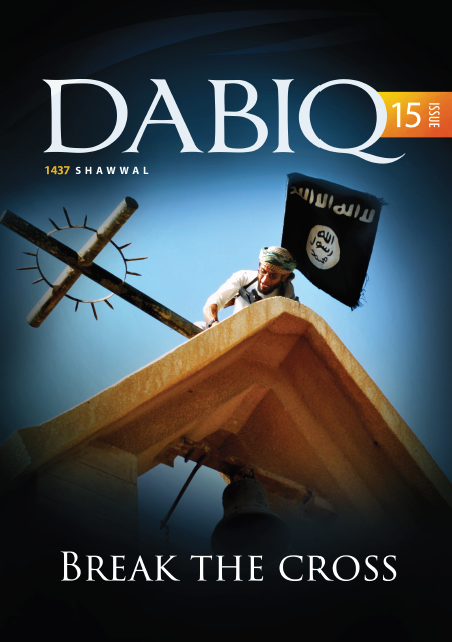
dabiq 15 cover

**

I have written a two part essay examining the latest issue of ISIS’ Dabiq magazine, which is essentially an attack on Christianity and invitation ot Islam.

The first part, dealing mostly with the Crucifixion, is now out at LapidoMedia under the title ‘Breaking the cross’: Pathetic ISIS ‘theologians’ get wires crossed. Here’s the opening:

Misapprehension of Christian doctrine once again provides the excuse for Islamic State war-mongering.

The latest issue of its propaganda magazine Dabiq focuses on the crucifixion of Jesus and the Trinity, although Judaism, secularism, atheism, and feminism also get a drubbing.

The issue invites Christians in particular, and other non-Muslims in general, to abandon their beliefs and adopt Islam – an invitation accompanied by violent threats against those who refuse.

The introduction exults in recent attacks in Orlando, Nice, Germany and Normandy, adding: ‘[W]e take this occasion of multiple massacres inflicted upon their citizens and interests to call them once again to the religion of pure monotheism, truth, mercy, justice, and the sword. ‘

As in previous issues of Dabiq, the magazine opens with the declaration of the group’s founder, Abu Mus’ab az-Zarqawi, that the jihad will not end ‘until it burns the Crusader armies in Dabiq’ – a reference to the site of the great end-times battle in an otherwise obscure apocalyptic hadith [alleged saying of Muhammad].

The back cover of the magazine closes with another hadith. ‘By the One in whose Hand is my soul, very soon shall the Son of Maryam descend in your midst, being an equitable judge. He shall break the cross, kill the swine, and put aside the jizyah.’

Please click through to read the rest on the LapidoMedia site.

The second part of my essay will be posted at Lapido shortly — likely on Friday — and mainly deals with the ISIS magazine’s attack on the Christian doctrine of the Trinity viewed as a denial of God’s unity (Tawhid).

I’ll post an announcement here when it comes out.

**

Also of note, from Tim Furnish:

Tim Furnish is quoted discussing Dabiq 15 in a WND piece, ISIS: Christians are pagan ‘cross worshippers’. If he writes anything on MahdiWatch or elsewhere on the topic, Ill let you know.

Meanwhile, Tim’s tweet gives the short version:

Sunday surprise: peering digitally around corners 2: Blade Runner

Sunday, July 31st, 2016

[ by Charles Cameron — moving from a consideration of Holbein’s Ambassadors to a celebrated scene in Ridley Scott’s Blade Runner — and thence, wide-angle, to Kumbh Mela ]
.

Here’s the Bladerunner scene:

What Ridley Scott depicts is a camera with the ability to see around corners — a fantastic piece of science fictional cinematography, demonstrating a sufficiently advanced technology with a skill amounting to wizardry.

**

How close, though, can state-of-the-art cameras come to seeing around corners? Here’s what Nature has to say:

Andreas Velten, Thomas Willwacher, Otkrist Gupta, Ashok Veeraraghavan, Moungi G. Bawendi & Ramesh Raskar, Recovering three-dimensional shape around a corner using ultrafast time-of-flight imaging:

Abstract:

The recovery of objects obscured by scattering is an important goal in imaging and has been approached by exploiting, for example, coherence properties, ballistic photons or penetrating wavelengths. Common methods use scattered light transmitted through an occluding material, although these fail if the occluder is opaque. Light is scattered not only by transmission through objects, but also by multiple reflection from diffuse surfaces in a scene. This reflected light contains information about the scene that becomes mixed by the diffuse reflections before reaching the image sensor. This mixing is difficult to decode using traditional cameras. Here we report the combination of a time-of-flight technique and computational reconstruction algorithms to untangle image information mixed by diffuse reflection. We demonstrate a three-dimensional range camera able to look around a corner using diffusely reflected light that achieves sub-millimetre depth precision and centimetre lateral precision over 40 cm×40 cm×40 cm of hidden space.

Here’s another illustrative video:

**

Okay, seeing is simple, but we’re Zenpundit, so there’s gotta be a military angle we can see around, no?

Here are two possibilities — the first is called CornerShot:

while the second is called ShotView:

**

We’re still pretty far from Ridley’s Blade Runner, but the idea of seeing / shooting around corners has clearly caught the imagination of others.

Okay, those last two videos are for those interested in matters martial.

Kumbh Mela

For my own sake, and for the possible interest of blog-friend Pundita, let’s take a look at a video of Ramesh Raskar, head of MIT Media Lab’s Camera Culture research group and one of the authors of the Nature paper quoted above.

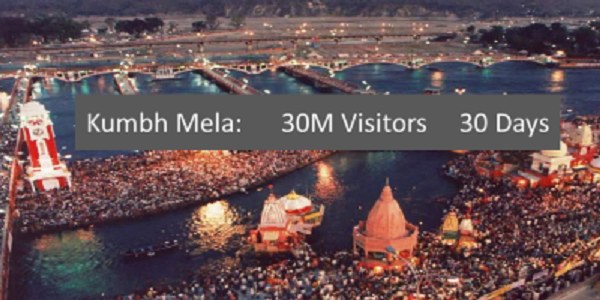
Here Dr Raskar is talking about that most fascinating of Hindu festivals — and largest of human gatherings? — the Kumbh Mela

Talk about wicked problems — and crowd-sourcing solutions — and genius — and the manifold intersections of the secular and the sacred!

Whole lot of DoubleQuoting going on..

Friday, July 29th, 2016

[ by Charles Cameroncompare & contrast is a very basic mental practice, and one I’d like to sharpen into the cognitive tool or mental app I term DoubleQuotes ]
.

This may well be the most significant DoubleTweet of the day — the very fact of its doubleness placing the issue into the category of Who Knows?

— both tweets, as you see, come to us courtesy of Mike Walker, former acting SecArmy & deputy FEMA director — and since this is Friday, let me say #FF him at @New_Narrative.

**

A French-language DQ worthy of note and our support:

**

A Trump trumps Trump DQ:

— hat-tip to @pourmecoffee.

**

Another Trump on Trump, this one caught by Adam Serwer:

FWIW, I’m sure there are Clinton on Clinton DoubleTweets too..

**

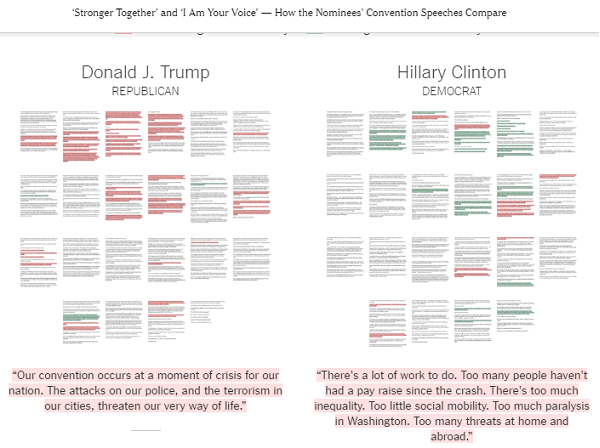
An entire, detailed NYT comparison between the two election campaigns demonstrates the power of extended compare and contrast thinking, aided and abetted by the graphical ease of digital capture and analysis —

NYT e;lection DQ article

— but you’ll need to click through and read it to get the full effect.

**

And while we’re on the subject of patterns, here’s a great quote which I got via Jessie Daniels:

A fine use of the ouroboric form to hammer home the significance of an observation — and also a powerful contemporary creation myth!

Will you, won’t you, won’t you join the dance?

Sunday, July 10th, 2016

[ by Charles Cameron — protest and arrest in Baton Rouge ]
.

will you won
Reuters – Jonathan Bachman

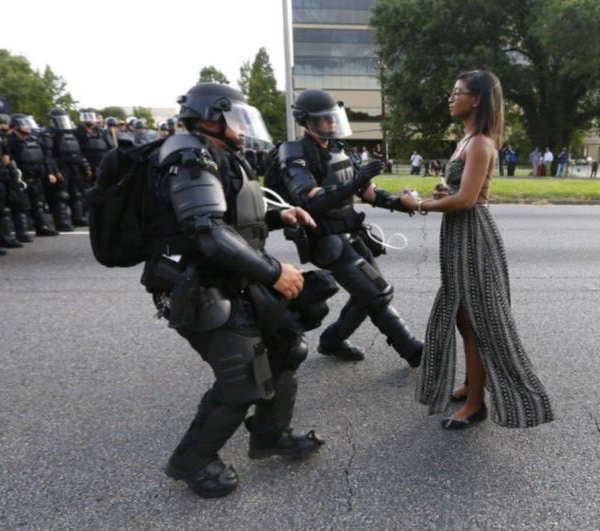
It is the stunning balletic quality of this image that catches my attention here, and gives this post a title drawn from Lewis Carroll‘s Lobster Quadrille in Alice’s Adventures in Wonderland.

A brief Trump policy statement & book-length question in response

Sunday, July 10th, 2016

[ by Charles Cameron — also a tweet asking for a DoubleQuote & getting one ]
.

As so often, Part I of this post is a somewhat playful teaser for Part II, which is where my real interest is to be found.

Part I, then, is about someone inquiring about two tweets Donald Trump made, asking in effect whether anyone had DoubleQuoted them:.

I like this question because it shows that DoubleQuoting — and indeed it’s subset, DoubleTweeting — is not some lonely idea of mine, but a more general form of inquiry that I’m aiming to fashion into a specigic and teachable tool for thinking.

**

As it happens, one Chris Taylor responded to Martyn’s question the next day, putting the two tweets in question together. Sadly for my purposes, he did this by screengrabbing the pair of them, thus making it impossible to click through to Trump’s two originals. I’ve therefore gone to Trump’s timeline, and present them here as they originally appeared there:

I see this juxtaposition as having some mild merit as political argument, but mainly as a sort of nit-picky point-scoring — so I’ll leave it at that.

For anyone who’s interested, here’s a storified compilation of Donald Trump’s tweets on Islam, Muslims and the Middle East — I haven’t verified its contents or up-to-date-ness, but ran across it in my rooting around, and thought it might be of use to some here.

**

Part II is where things get interesting.

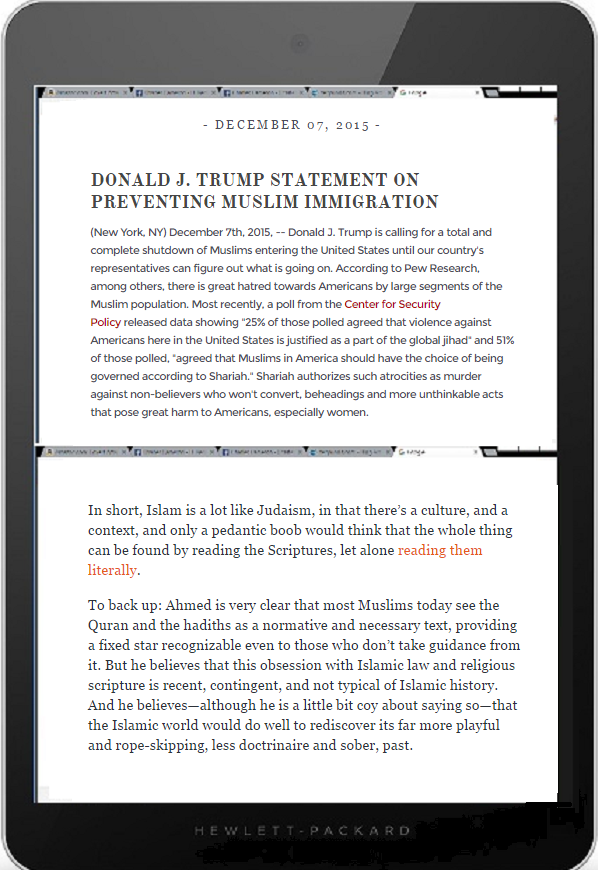
In the DoubleQuote below, I have posted excerpts from two documents — in the upper panel, Donald Trump’s news release on the prevention of Muslim immigration, and in the lower panel, a couple of paragraphs from the Tablet magazine review of the late Shahab Ahmad‘s extraordinary book, What is Islam, published this year by Princeton UP, and described in a blurb by Harvard Law’s Noah Feldman as “Not merely field changing, but the boldest and best thing I have read in any field in years.”

DQ tablet Trump Ahmed

Boiled down to it’s haiku-like essence, this twofer goes like this:

  • Trump: single page, single strand statement about banning Muslims
  • Ahmad: 550 page, multiple strand question as to how to define Muslims
  • **

    It’s inevitable that much of our popular — meaning “of the people, by the people, for the people” — discussion of Islam, brought on principally by the as yet but poorly understood connection between Al-Qaida and Islam, and exacerbated more recently by the equivalent link with the (so-called) Islamic (so-called) State — is framed in headlines and soundbites.

    Such single-stranded short-form messaging cannot hope to convey much at all of reality, and to get a deeper dive into what the words Islam and Muslim point to, one could hardly do better than The Study Quran for Islam’s central scripture, Jonathan Brown‘s Misquoting Muhammad for the history and interpretation of the corpus of hadith — and Ahmad’s What is Islam for the amazing richness of the Islamic traditions across continents and centuries.

    9780691164182

    Somewhere between the single words Muslim and Islam on the one hand, and the 550 pages of Ahmed’s erudition, aided and abetted by 44 pages of notes in small type and a substantial index on the other, there’s an awareness of rich complexity, perhaps sufficient for a 25-page essay or 125-page Oxford Very Short Introduction, that we could all benefit from applying to our political considerations of Islam in these fraught times.


    Switch to our mobile site