zenpundit.com » china

Archive for the ‘china’ Category

The Chinese Strategic Tradition: A Research Program (I)

Tuesday, June 2nd, 2015

[By T. Greer]
.

We’re honored and delighted to announce that blog-friend and commenter T Greer has accepted Zen’s invitation to join us as a member of the Zenpundit team, and trust the following post in two parts will stir fruitful conversation not only here at ZP but across several related blogs.. — Charles Cameron, ZP managing editor

____________________________________________________________________________________
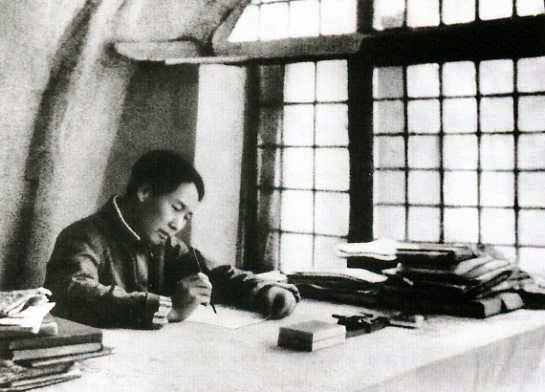
Mao Zedong writing On Protracted Warfare (Yan’an, 1938)
Source: Wikimedia.

This essay was originally published at The Scholar’s Stage on 26 May, 2015. Because of its length it has been divided into two posts, both lengthy in their own right. This–the first of these two posts–is republished here at Zenpundit with little alteration. The second half of the essay shall be posted here later this week.

INTRODUCTION


Last fall I wrote a popular series of posts outlining the history of the eight decade war waged between the Chinese Han Dynasty and the Xiongnu (old style: Hsiung-nu) nomadic empire. My posts were a response to a prominent American strategic theorist who misunderstood the history of the Han-Xiongnu relations in his search for enduring patterns in China’s military and diplomatic history relevant to China’s foreign relations today. Unfortunately, this experience was not a singular event. It seems that every month some new book or article is published pushing a misleading version of Chinese history or a strained interpretation of classical Chinese political thought to shore up a new theory of what makes China tick. I could devote this blog solely to refuting these poorly sourced theories and never run out of things to write about.

Despite these errors, I have a great deal of sympathy for those who pen them. They face a nearly insurmountable problem: many of the thinkers, strategists, and conflicts most important to the Chinese strategic tradition have next to nothing in English written about them. Critical works have yet to be translated, translated works have yet to be analyzed, histories of important wars and figures have yet to be written, and what has been written is often scattered in obscure books and journals accessible only to experienced Sinologists. English speakers simply do not have access to the information they need to study the Chinese strategic tradition.

This needs to change. It needs to change both for the sake of strategic theory as a discipline, which has essentially ignored the insights and observations gleaned from 3,000 years of study and experience, and for understanding the intentions of our rivals and allies in East Asia, who draw upon this tradition to decide their own political and strategic priorities. But in order to make these necessary changes we need a clear picture of where we are now. This essay attempts to provide this picture. It is not a bibliographic essay per say, for I will freely admit that I have not read all of the books and research articles I will mention below. Some titles I have only read in part; others I have not read at all. However, the goal of this post is not to review the results and conclusions of all these works, but to outline where research has been done and where more research is needed. For this purpose awareness suffices when more intimate knowledge is lacking.

Mastering 3,000 years of intellectual and military history is a gargantuan task. But in order to find the answers to some of the questions inherent in the study the Chinese strategic tradition, it must be done. I make no such claim of mastery. My expertise is uneven; I am most familiar with both the strategic thought and the actual events of the China’s classical period (Warring States through the Three Kingdoms era, c. 475 BC-280 AD), and am probably weakest when discussing the first two decades of the 20th century, a time critical to the development of the tradition but difficult to master because of the number of political actors involved, the complexity of their relations, and the great intellectual variety of the era. Despite these weaknesses I know enough to chart out the broad outlines of current scholarship, a charge most specialists in strategic theory cannot attempt and most Sinologists would not desire. These biases and proclivities have kept the two disciplines far apart; there is an urgent need for these two scholarly bodies to draw together. If this essay–which is addressed primarily to the first group but should be accessible to second–helps in some small way to bring this to pass I shall consider it a grand success.

This essay shall have three parts divided over two posts. The final section is a list of recommendations on how to establish and develop the study of the Chinese strategic tradition as an academic sub-field, as well as some thoughts on where individual Anglophone scholars might focus their research. The two earlier sections will review what has been published in English about the Chinese strategic tradition already. The term “the Chinese strategic tradition” is usually used in reference to the thinkers and the theorists of Chinese history, not the commanders and ministers who actually implemented policy. In the West this is almost always how the topic is discussed. Texts like Sun-tzu’s Art of War (hereafter, the Sunzi) are dissected with little reference to the way its thought was consciously implemented by those who studied it most carefully. This is a mistake. Most of the pressing questions in this field can only be answered by looking at how Chinese soldiers and statesmen actually behaved, and most of the errors common to Western punditry can be sourced to this tendency to ignore actual events in favor of theory. [1] In the case of ancient histories–whose account of events were highly stylized and moralizing–this distinction blurs. However, for the sake of organization I shall maintain the distinction between strategic thought (a subset of intellectual history) and strategic practice (a subset of diplomatic, political, and military history), covering each in turn.

(more…)
The Tao Te Ching in contemporary western contexts

Friday, May 29th, 2015

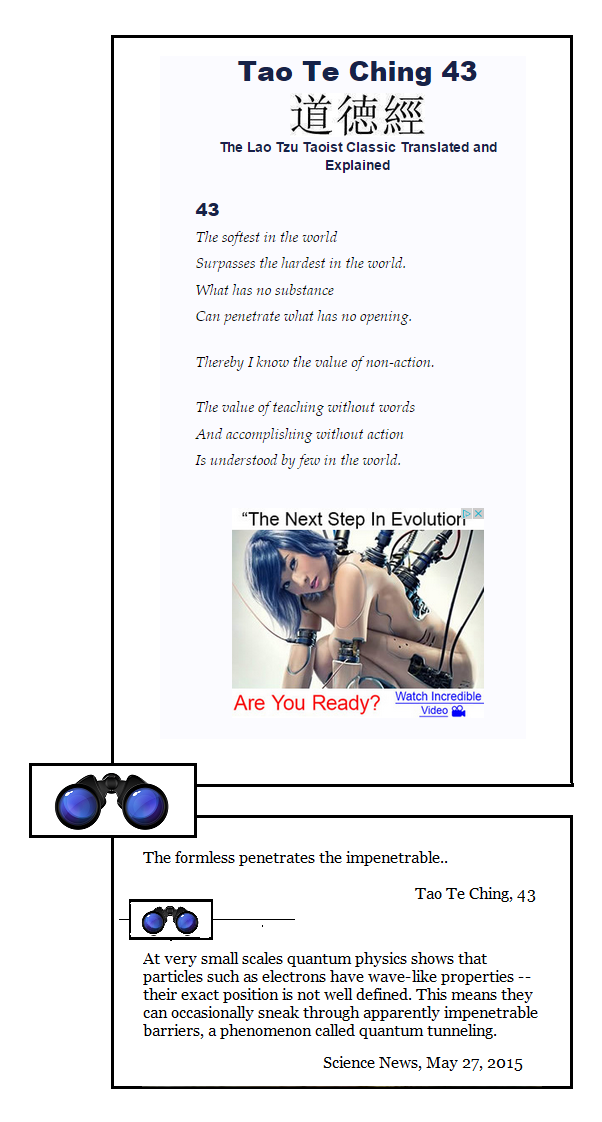
[ by Charles Cameron — two reasonably diferent ways of contextualizing the Tao Te Ching for the west ]
.

DQ Tao Te Ching 43 in Modern Contexts

Strange, eh?

I somewhat like Witter Bynner‘s non-literal take on the line in question: “to yield with life solves the insoluble”.

My own carefully ambiguous version: “Chinese meanings can slip through / into obstinate English translators”.

**

Sources:

  • Taoistic Taoism Explained
  • Tao Te Ching (Dao De Jing) by Lao Tzu (Laozi), Chapter 43
  • Physicists solve quantum tunneling mystery
  • New Books, On China and Neighbors

    Tuesday, April 7th, 2015

    [by J. Scott Shipman]

    china books


    Imperial China, by F.W. Mote

    Mountains of Fame, John W. Wills (not pictured)

    Liao Architecture, by Nancy Steinhardt

    The Seven Military Classics of Ancient China, by Ralph D. Sawyer

    Inner Asian Frontiers of China, by Owen Lattimore

    Empires of the Silk Road, Christopher I. Beckwith

    The Perilous Frontier, by Thomas Barfield

    The Horse, The Wheel, and Language, by David W. Anthony

    3,000 Years of Chinese Statecraft, by Dennis Bloodworth

    The Imjin War, by Samuel Hawley

    The Tyranny of History, by W.J.F Jenner

    The Wars for Asia 1911-1949, by S.C.M. Paine

    Hard Road Home, by Ye Fu (not pictured, and a specialty publisher with great customer service Ragged Banner Press)

    After the first of the year I commenced yet another “modern” assessment of China as a potential adversary, and had not gotten too far before the author attempted to channel ancient Chinese history to explain current Chinese policies. The author’s confidence and specious use of history made me aware of just how illiterate I am in that portion of the world. I don’t know about you, but when I’m faced with a known gap and seam in some area of knowledge, I do a (fill in the blank) study. (I’ve done studies on central Africa, cognition, neuroeconomics, strategy (which seems on-going), and naval tactics to name a few.) My normal process is to find a syllabus from someone I trust or admire, or ask my network to offer five or six must read books on the topic. T. Greer at Scholar’s Stage, is a well known to the readers here at Zenpundit as a commenter and very knowledgeable on Chinese history. He recommended most of the books in the list above.

    Sawyer’s Seven Military Classics was already in my library, and often read as a reference. Also I’d read large chunks of Empires and Horse, Wheel, Language (these books were already in my library, too, and are very complementary in their approach). And while the Imjin War book is focused on Japan, someone on Facebook suggested the addition. The only books purchased new was the Imperial China volume by Mote and Imjin. The remainder were purchased used and cost less than $75 total on the secondary market (I use both Amazon and ABE.com).

    I’m a little more than a third through Imperial China, and while it is textbook, Mote’s writing style is engaging and exhaustive. Halfway through Mountains of Fame; it has been my go-to travel book—hence I forgot to include in the picture as the volume remains in an unpacked bag from a recent trip. I have read the introductions to all of these titles and by far the Paine book seems the most intriguing—I love the writing style. The only two likely to be relegated to the anti-library are the architecture book and the volume by Lattimore.

    So, along with Zen, what new books are you reading?

    T. Greer on Sun Tzu the Radical

    Sunday, January 4th, 2015

    [by Mark Safranski, a.k.a. “zen“]

    T. Greer at Scholar’s Stage had an outstanding post on Sun Tzu and his classic The Art of War the other day in which I learned a number of things that were new to me, which is the best kind of blog post!

    The Radical Sunzi

    When translated into English, the Sunzi Bingfa, usually titled Sunzi’s Art of War, is a fairly small work. When we take away the commentary and annotation added by its translators we are left with a sparse text indeed: Roger Ames’ translation is 71 pages long, the Denma Group’s translation is 66 pages, Victor Mair’s translation is only 56, and Ralph Sawyer’s translation clocks in at a mere 30 pages total. [1] The brevity of the Sunzi explains its staying power. The Sunzi only has space for a foundational discussion of abstract strategic principles, leaving no room for detailed discussions of either the tactics or the political realities of its time. This is what gives the Sunzi its transcendent feel. Great power competition between the kingdoms of Chu, Qi, and Qin faded into the realm of memory centuries ago; the proper way to deploy squadrons of crossbowmen and charioteers is now a question that interests only the historian. In contrast, the strategic principles outlined in the Sunzi endure. Their very terseness frees them from the historical context from which they came and allows them to be applied by men living thousands of years after they were first etched into bamboo.

    Timeless as it may seem, however, the Sunzi was the product of problems experienced at a specific time and a specific place. It is my belief that we cannot really understand the Sunzi if we do not first understand the world from which it came–the world of the Warring States.[2] A few historians and scholars of Chinese thought have written this sort of analysis; the best of these attempts to place the Sunzi within its historical context are usually focused on the broad, macro-historical trends that divided the Spring and Autumn period that preceded the Sunzifrom the Warring States period that gave birth to it. From this perspective the Sunzi and the other military manuals that followed it were the natural product of a world torn asunder by wars waged on an ever increasing scale between large infantry armies fighting in the name of territorial, bureaucratized states.[3] There is, however, more to the Sunzi‘s historical setting than the institutional history of ancient China. Just as important is the intellectual milieu of early Warring States times. The compilers of the Sunzi were not the first Chinese to write about war. When read as a response to these earlier voices, the Sunzi’s vision of war and politics is nothing less than radical. [….]

    Here comes the important part, one that demonstrates a curious symmetry with the cultural shift  between the post-Dark Age heroic-aristocratic Archaic Greece to the Classical Greece of the Golden Age that laid the foundations of Western civilization:

    ….The Sunzi that Meyer describes is radical–at the time of its compilation it was possibly the most radical attack on ancient China’s old aristocratic order etched in bamboo. The Sunzi‘s assault on the old regime begins with its opening line:

    The military [bing] is the great affair of the state, the terrain of life and death, the way of survival and extinction, it cannot but be investigated. [4]

    To modern ears this sentence may sound controversial, but it is hardly subversive. Its revolutionary nature only becomes clear when we see what it was written in response to. The place to turn is the Zuo Zhuan, China’s oldest narrative historical account and one of the few preserves of the old Spring and Autumn ethos. One of its better known dictums reads:

    The great affairs of state are sacrifice and warfare.[5]

    Meyer comments on the contrast between the two statements:

    [In the Sunzi] all mention of sacrifice is eliminated, telegraphing the text’s contention that martial matters must be viewed in purely material terms. Rather than “warfare,” the “military” is held up as the great affair of state, implying (as the text goes on to elaborate) that there are uses for military power beyond the ‘honorable’ contest of arms. Moreover, the word that the Sunzi uses by reference to the “military,” bing???, does not evoke the aristocratic charioteer but the common foot solider, who had become the backbone of the Warring States army.[6]

    The Sunzi‘s insistence that military methods were more important to the state’s survival than sacrifice was not merely radical–it was nonsensical. In the early Chinese world view, sacrifice and warfare could not be separated from each other. As with the Aztecs, Maya, and many other premodern peoples, for the Chinese of Zhou times, warfare was a sacrificial ritual. The Lost Book of Zhou, an early warring states record that chronicled the conquests of the semi-mythical King Wu, provides a clear picture of these views. It contains an interesting narrative account of the King’s return to his clan’s ancestral temple to report his victorious conquest:

    Read the rest here

    I just finished reading a book by the Israeli scholar Moshe Halbertal, On Sacrifice; here’s an enormous difference between a culture that “sacrifices to” and one that is worth or requires “sacrificing for“. It is not only a cultural difference, it is cognitive. Strategy is possible in a “sacrificing to” society only to the extent that it does not conflict with (often maximalist) religious dictates, which will often mean a rational strategy to achieve victory is impossible. The Jews at Masada or the Greeks of the Trojan War would have understood the precepts of warfare of the ancient Chinese of the Zhou era very well.

    In war, the bronze age peoples sacrificed to. We sacrifice for – and to spend our lives to best effect we need strategy.

    Jottings 11: self-immolators and suicide bombers?

    Tuesday, February 18th, 2014

    [ by Charles Cameron — on some aspects of religiously motivated suicide, and I’m not clear why I called this one a jotting, since it’s quite long and detailed ]
    .


    .

    I have been taking a couple of online courses on terrorism in recent months, and in one of them I ran across a Foreign Policy article titled Ultimate Sacrifice: What’s the difference between self-immolators and suicide bombers?

    … there is another form of deadly protest that has made a resurgence in recent years. Not only did Tunisian street vendor Mohamed Bouazizi’s fiery suicide ignite the region and inspire subsequent self-immolations in Algeria, Egypt, and Morocco, but a growing number of Tibetans have also set themselves alight to protest Chinese rule in Tibetan region

    It’s an intriguing question, phrased by one of my fellow students as the question, “Can Tibetan Self-immolators be considered “terrorists”?

    **

    I did my “due diligence” research, and came up with some articles worth reading:

  • Tenzin Tharchen, 125 Self-Immonlations: why suicide by fire protests continue in Tibet
  • Tsering Shakya, Self-Immolation, the Changing Language of Protest in Tibet
  • Martin Kovan, Buddhist Self-immolation and Mahayanist Absolute Altruism
  • while my interlocutor offered this one:

  • Jose Cabezon, On The Ethics Of The Tibetan Self-Immolations
  • But you know, the mind has indirect back-channels as well as direct information freeways, and the question seems to have been percolating while I’ve been asleep.

    **

    Sonam Wangyal, Lama Sobha, was the first Tibetan lama to self-immolate, and left a cassette tape in which he explained his motives:

    I am giving away my body as an offering of light to chase away the darkness, to free all beings from suffering, and to lead them — each of whom has been our mother in the past and yet has been led by ignorance to commit immoral acts — to the Amitabha, the Buddha of infinite light. My offering of light is for all living beings, even as insignificant as lice and nits, to dispel their pain and to guide them to the state of enlightenment. I offer this sacrifice as a token of long-life offering to our root guru His Holiness the Dalai Lama and all other spiritual teachers and lamas.

    The full text of Lama Sobha’s message can be found at the bottom of an International Campaign for Tibet page titled Harrowing images and last message from Tibet of first lama to self-immolate — the “harrowing images” themselves are linked to, but not shown.

    **

    The Chinese come close to targeting Tibetan self-immolators as terrorists, using the terms “Splittist”– so often also used of the Dalai Lama — and calling their actions “intentional homicide”. This from the “>Scottish Parliament’s Cross-Party Group on Tibet:

    Nonetheless, the response by the Chinese authorities to self-immolations by Tibetans has been extremely draconian, largely because of an assumption that all protest by Tibetans must be intrinsically “splittist” (that is, secessionist). In particular, it has involved the formulation of new laws that seem to target Tibetans specifically, and the imposition of collective punishments, and the application of the crime of “intentional homicide” to all those aiding, abetting, encouraging or even photographing self-immolations.

    **

    It occurs to me that sacrificing oneself for the benefit of other beings is symbolically enacted in the Tibetan Chöd ritual, in which one symbolically feeds the parts of one’s body to the pretas or hungry demons to satiate them and put them to sleep — and also in some of the Jataka Tales of the previous rebirths of the Shakyamuni Buddha.

    I’m thinking particularly of The Bodhisattva and the Hungry Tigress, and will quote here from Edward Conze‘s telling in Buddhist Scriptures, pp 24-26. On being told that self-sacrifice is difficult, Mahasattva (the future Buddha) replies:

    It is difficult for people like us, who are so fond of our lives and bodies, and who have so little intelligence. It is not difficult at all, however, for others, who are true men, intent on benefitting their fellow-creatures, and who long to sacrifice themselves. Holy men are born of pity and compassion. Whatever the bodies they may get, in heaven or on earth, a hundred times will they undo them, joyful in their hearts, so that the lives of others may be saved.

    His prayer before offering his own body and blood to feed an ailing tigress and her cubs is:

    For the weal of the world I wish to win enlightenment, incomparably wonderful. From deep compassion I now give away my body, so hard to quit, unshaken in my mind. That enlightenment I shall now gain, in which nothing hurts and nothing harms.

    Assuming the Jataka tales made it to Tibet, this one might be a potent influence on potential self-immolators.

    **

    A possible Tamil “comparable” — presumably Hindu rather than Buddhist, culturally if not religiously:

    When young Murugathasan Varnakulasingham (aged 26) committed self-immolation in front of the UN headquarters in Geneva on 19 February 2009 he was protesting against international failures of intervention in the unfolding humanitarian tragedy in northern Sri Lanka, where he believed that large bodies of Tamil people faced extinction by the Sri Lankan government. “The flames over my body will be a torch to guide you through the liberation path,” he wrote in his parting letter.

    There have been a few other protest suicides by Tamils in Tamilnadu and Malaysia, but Varnakulasingham’s altruistic act probably garnered the most attention.

    **

    Further thoughts:

    There’s always Samson, pulling down the pillars that upheld the roof of their temple on the Philistines, once he’d regrown his hair and strength…

    Then the lords of the Philistines gathered them together for to offer a great sacrifice unto Dagon their god, and to rejoice: for they said, Our god hath delivered Samson our enemy into our hand. And when the people saw him, they praised their god: for they said, Our god hath delivered into our hands our enemy, and the destroyer of our country, which slew many of us. And it came to pass, when their hearts were merry, that they said, Call for Samson, that he may make us sport. And they called for Samson out of the prison house; and he made them sport: and they set him between the pillars. And Samson said unto the lad that held him by the hand, Suffer me that I may feel the pillars whereupon the house standeth, that I may lean upon them. Now the house was full of men and women; and all the lords of the Philistines were there; and there were upon the roof about three thousand men and women, that beheld while Samson made sport. And Samson called unto the Lord, and said, O Lord God, remember me, I pray thee, and strengthen me, I pray thee, only this once, O God, that I may be at once avenged of the Philistines for my two eyes. And Samson took hold of the two middle pillars upon which the house stood, and on which it was borne up, of the one with his right hand, and of the other with his left. And Samson said, Let me die with the Philistines. And he bowed himself with all his might; and the house fell upon the lords, and upon all the people that were therein. So the dead which he slew at his death were more than they which he slew in his life.

    — Judges 16.23-30 — not quite self-immolation, not quite suicide bombing, but certainly suicidal warfare with a religious motive.

    Okay, When Christians quote John 15.13:

    Greater love hath no man than this, that a man lay down his life for his friends.

    surely they include in their understanding of that verse, those who throw their bodies on top of grenades to protect their comrades — which would seem in its own way to parallel the teaching of the Jataka Tale.

    **

    Likewise, when Muslims quote the hadith from Sahih Bukhari, Volume 4, Book 52, Number 53, in which the Prophet says:

    Narrated Anas bin Malik:

    The Prophet said, “Nobody who dies and finds good from Allah (in the Hereafter) would wish to come back to this world even if he were given the whole world and whatever is in it, except the martyr who, on seeing the superiority of martyrdom, would like to come back to the world and get killed again (in Allah’s Cause).”

    and from Sahih Muslim, Chapter 28, Book 020, Number 4626:

    It has been narrated on the authority of Abu Huraira that the Messenger of Allah (may peace upon him) said:

    [ … ] By the Being in Whose Hand is Muhammad’s life, if it were not to be too hard upon the Muslims. I would not lag behind any expedition which is going to fight in the cause of Allah. But I do not have abundant means to provide them (the Mujahids) with riding beasts, nor have they (i.e. all of them) abundant means (to provide themselves with all the means of Jihad) so that they could he left behind. By the Being in Whose Hand is Muhammad’s life, I love to fight in the way of Allah and be killed, to fight and again be killed and to fight again and be killed.

    — how close are we to Nathan Hale:

    I only regret that I have but one life to lose for my country

    — and behind that, to Joseph Addison:

    What a pity it is
    That we can die but once to serve our country.

    — that’s from Addison’s now obscure play, Cato, a Tragedy, Act IV, Scene 4

    **

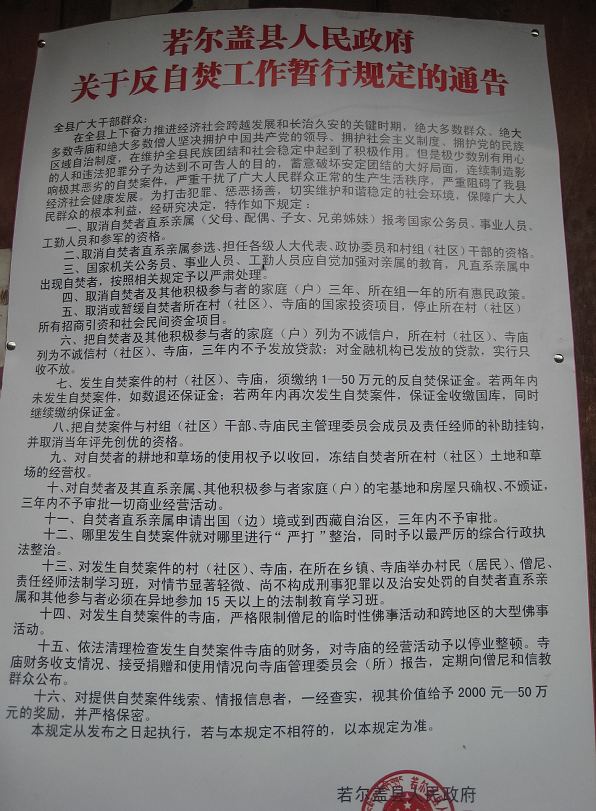
    Of course, the way to stop self-immolations in Tibet is simple — put up a notice:

    See also New document sheds light on China’s campaign against self-immolations in Tibet


    Switch to our mobile site