zenpundit.com » war

Archive for the ‘war’ Category

In Search of Strategy(s), a Voice, a Narrative because, ‘Gentlemen, We Have Run Out Of Money; Now We Have to Think’

Friday, December 13th, 2013

[by J. Scott Shipman] [Warning: Maritime in flavor]

No matter how far humanity may go in seeking to foster the arts of civilization and the ideals of civic peace, there will come times when acts of war are required in order to defend world order and sustain the peace of civilized peoples. Charles Hill’s, Grand Strategies, Literature, Statecraft, and World Order, page 48

The lift quote in the title is attributed to Winston Churchill, and in this period of uncertainty with sequestration and deep cuts in defense commanding the attention of military leadership, one thing is becoming crystal clear: we have no cogent or explainable military strategy. Sure, we have “concepts” like Air-Sea/Air-Land Battle, A2/AD, and Off-Shore Control, but our most recent unclassified Navy strategy document A Cooperative Strategy for 21st Century Seapower was written in 2007 may be a bit dated.

This week I attended the U.S. Naval Institute’s annual Defense Forum, Shaping the Maritime Strategy and Navigating the Budget Gap Reality and given the title, there was a lot of talk about funding and in that light/context, strategy was that thing “we’re in the process of doing.” Several people I spoke with expressed concern about “telling the navy’s story,” “why we have a navy,” and one member of Congress encouraged us to build an engaged constituency to put pressure on Congress to knock-off the schizophrenic approach to appropriations, so that a bit of certainty will allow the development of a strategy. Since DoD hasn’t been successfully audited in a long, long time (if ever), I wouldn’t hold out hope for a grass-roots rescue. As Mr. Churchill wisely advises, “now we have to think.”

Strategy Defined

Since strategy is a hot topic, offered here are several definitions ranging from the classic to practitioners and academics, with the goal of framing the elegant simplicity of strategy as a theory, and challenge of defining in reality. As Colin Gray points out in his National Security Dilemmas: “The United States has shown a persisting strategy deficit.” (page 170) Dilemmas, written in 2009 before the budget axe fell in earnest he offers: “One would think that the following definition and explanation must defy even determined efforts of misunderstanding:” (he then quotes Clausewitz)

Strategy is the use of engagement for the purpose of war. The strategist must therefore define an aim for the entire operational side of the war that will be in accordance with its purpose. In other words, he will draft the plan of the war, and the aim will determine the series of actions intended to achieve it: he will, in fact, shape the individual campaigns and, within these, decide the individual engagements.” (On War, page 177)

The definition of strategy from the Department of Defense Dictionary of Military and Associated Terms, Joint Publication 1-02:

strategy — A prudent idea or set of ideas for employing the instruments of national power in a synchronized and integrated fashion to achieve theater, national, and/or multinational objectives. (JP 3-0)

Other definitions:

J.C. Wylie, RADM, USN, Ret., Military Strategy, page 14

“A plan of action designed in order to achieve some end; a purpose together with a system of measures for its accomplishment” 

Henry E. Eccles, RADM, USN, Ret., Military Concepts and Philosophy page 48:

Strategy is the art of comprehensive direction of power to control situations and areas in order to attain objectives. (emphasis in original)

Bernard Brodie, Sea Power in the Machine Age, page 78

“Tactics may be distinguished from strategy by the criterion proposed by Mahan—the fact of contact. “Tactics” refers to localized hostilities that occur where the adversaries are in contact; “strategy” refers to those basic dispositions in strength which comprise the entire conduct of a war.” 

General André Beaufre, Introduction á la stratégie, 1963, page 16. (note: I don’t read/speak French, I found the quote in Edward Luttwak’s Strategy, The Logic of War and Peace)

“…the art of the dialectics of wills that use force to resolve their conflict.” 

Paul Van Riper, LtGen, USMC, Ret, Infinity Journal, Volume 2, Issue 3, Summer 2012

“…strategy is specifically about linking military actions to a nation’s policy goals, and ensuring the selected military ways and means achieve the policy ends in the manner that leaders intend.”

From John Boyd’s Strategic Game of ?And?

What is strategy?

A mental tapestry of changing intentions for harmonizing and focusing our efforts as a basis for realizing some aim or purpose in an unfolding and often unforeseen world of many bewildering events and many contending interests.

What is the aim or purpose of strategy?

To improve our ability to shape and adapt to unfolding circumstances, so that we (as individuals or as groups or as a culture or as a nation?state) can survive on our own terms. (emphasis added)

Our own Lynn Rees

Politics is the division of strength. Strategy, its tool, squares drive, reach, and grip while striving for a certain division of strength.

Drive falls between too weak and too strong. Reach falls between too short and too far. Grip falls between too loose and too tight.

How strategy squares the three is open ended and ongoing. Outside friction, deliberate or not, always conspires with inside friction, intentional or not, to keep things interesting for strategy.

Drive is the certainty you want. Reach is the certainty you try. Grip is the certainty you get. Grip can be a little sway over certain minds. It can be big hurt carved in flesh and thing. Amid uncertainty, strategy strives for certain grip. The varying gulf between certain want, uncertain try, and not certain getting is the father of strategy.

Observations

Paradoxically, complexity is easy to design.  Colin S. Gray, The Strategy Bridge, page 25

All of these definitions have merit, and most coalesce around: power, conflicting wills, violence, and control. Lynn recently had a post on “Grip” where he offers a guide to physically grasp strategy (I do admire his imagery). Admiral Eccles also has a similar and complementary list:

A strategic concept is best expressed in explicit statements of

What to control,

What is the purpose of this control,

What is the nature of the control,

What degree of control is necessary,

When the control is to be initiated,

How long the control is to be maintained,

What general method or scheme of control is to be used. (page 48)

Both of these lists are unambiguous. (One of the biggest complaints about Air-Sea Battle and A2/AD is the ambiguity. Sam Tangredi wrote a book on the latter which I’ll review soon.) Bernard Brodie in A Layman’s Guide to Naval Strategy, page 14-15 (emphasis added), reminds us:

There is no need for a complicated terminology. However, to say that the basic principles of war are easy to understand is not to say that it is easy to comprehend the finer points, or what is more important, to determine upon a wise plan of strategy and then carry it out. The great commander must of course have a profound insight into all the ramifications of strategic principle, but that is only the first requirement of military leadership. He must thoroughly understand tactics, which with modern arms is bound to be exceedingly complex and require long training and experience. He must know how to solve problems of supply or “logistics,” he must know human nature, and he must have certain qualities of character and personality which transcend mere knowledge. He must be able to stick to his course despite a thousand distractions and yet be sufficiently elastic to recognize when a change in circumstances demands a change in plan. He must above all be able to make adjustments to the inevitable shocks and surprises of war.

Unfortunately, the very preoccupation of commanders with specific and inevitably complex problems sometimes tends to make them impatient with the age old verities. Long-tested doctrines which are utterly simple are rejected in part because of their very simplicity, and in part too because of the dogma of innovation so prevalent in our age. The French High Command in the summer of 1940 found out too late that the side which carries the ball makes the touchdowns, and that all the maxims of great military leaders of the past relative to the merits of initiative had not been outmoded by modern arms. We live in an age when basic theories of naval warfare are being rejected out of hand by responsible officials on the wholly unwarranted assumption that they do not fit modern conditions. One can say about theory what Mahan said about materiel: “It is possible to be too quick in discarding as well as too slow in adopting.”

There’s a lot to digest in those two paragraphs, but one take away is that whatever the Navy presents as a strategy should be easy to understand and explain. The strategy should also explain how it plans to maintain control or “command the seas.” And finally, as Wylie reminds the planner:

Wylie’s assumptions in a General Theory of War:

Despite whatever effort to prevent it, there will be war

The aim of war is some measure of control over the enemy

We cannot predict with certainty the pattern of the war for which we prepare ourselves

The ultimate determinate in war is the man on the scene with a gun

As we build our strategies and plans, these decidedly old-fashioned and many cases very simple guides can help us get it right.

Manea interviews Kilcullen at SWJ

Tuesday, November 26th, 2013

[by Mark Safranski, a.k.a. “zen“]

Octavian Manea, the interviewer par excellence of Small Wars Journal, steps up with an interview with COIN guru and former USG senior adviser Dr. David Kilcullen:

Future of Warfare in a Post-COIN Conflict Climate

[….]

SWJ: Should we expect that when we see all these clustered elements conflict is more likely, the societal environment more conflict prone?

David Kilcullen: There are two different ways to look at this set of relations. If we look at this from the standpoint of the military or law-enforcement, then it is pretty clear that we really need to get comfortable with operating in a very littoral, very urban and very highly networked environment because that is where the bulk of the people on the planet are going to live in the next generation. If you are not comfortable operating in such an environment you are not going to be effective. But this doesn’t mean that the solution to this problem is a military one. Seen from the perspective of the city in itself, it is pretty clear that the solution is not to bring the hawk cops in, and apply hard power tools to stabilize the environment. This is often a recipe for disaster. The paradox is that, on the one hand, there are no military solutions, but at the same time there are no solutions at all without security. Someone will provide that security and it is better for it to be the locals, but if the locals cannot do it, then history suggests that we will be drawn into this kind of conflict with about the same frequency as in the past.    

SWJ: You emphasized in your book, and also at the New America Foundation launching event that in the future we will face operational continuity and environmental discontinuity. What if the environmental discontinuity can in itself be a variable able to change the operational continuity?

David Kilcullen: That’s possible, to the extent that we have data — information based on historical patterns. On one hand, it seems that there is a lot of unwillingness on behalf of the American politicians to contemplate future engagements like Afghanistan and Iraq. Congress has no appetite as we’ve seen in the case of Syria for further military activity overseas. The military leadership is very reluctant to recommend that kind of operation. But going back to the 19th century we see a cyclical pattern in American military history where we repeatedly have leaders coming out with this kind of statement and yet we end up doing these kinds of operations anyway, on about the same frequency. There are deep structures about the way the US is connected to the international community that lead to this kind of behavior. It is possible that we won’t do this in the future, but it is not the way to bet. If you are going to bet on what is likely to happen, the pattern suggests that we are going to see a specific “conflict climate” (shaped by population growth, urbanization, littoralization and connectedness) within which wars will arise.

Read the rest here.

Oh, those papal mullahs

Sunday, November 24th, 2013

[ by Charles Cameron — Iranian diplo communiqué on Twitter uses Vatican imagery, huh? ]
.

Here’s Seyed Abbas Araghchi‘s tweet announcing the conclusion of the first series of negotiations with Iran:

Here’s the tail end of the Guardian article, Iran seals nuclear deal with west in return for sanctions relief, in which that tweet is translated:

The first announcement that a deal had been reached, by Ashton’s spokesman Michael Mann, and the confirmation by Zarif, were both made on Twitter – a first for a major global accord.

“Day five, 3am, it’s white smoke,” tweeted the deputy Iranian foreign minister, Seyyed Abbas Araghchi, referring to the terminology used in Vatican for the announcement of a new pope.

Julian West, dear friend and one-time Telegraph war correspondent covering Iran, Afghanistan, Pakistan, India and Sri Lanka, quoted those two paras with approval, and commented:

Not just a first on Twitter, I’d say the first time an Islamic state has used a papal metaphor, thereby confirming my first impressions while reporting there early 2000s. These aren’t a bunch of woolly mullahs.

Woolly mullahs, Julian? I don’t know — but I too like the reference to white smoke and papal elections.

**

For those who don’t like the deal — me, I don’t feel well-enough informed to want to comment — here’s Omer Bar-Lev‘s view, as presented in a Times of Israel piece titled Labor MK: Compared to strike, deal is ‘far superior’:

Considering the achievements such as the dismantling of [Iran’s] stockpile of uranium enriched to 20 percent, reducing the number of centrifuges, halting construction of the heavy water facility [in Arak], all the while the sanctions of Iranian oil and banking industries continue — compared to the alternative of a military strike at this point — it is clear that the agreement reached is far superior…

John Schindler‘s tweeted comment:

Bar-Lev is no softie, he’s the former CO of Sayeret MATKAL, the IDF’s top SOF unit.

and ah, yes, his next tweet:

I think it’s too soon to tell; I have no faith in Tehran.

I’ll buy “too early to tell” — curious, hopeful, wary, that’s me.

Two from the Comments Section on Wylie

Thursday, November 21st, 2013


Grip, the post by Lynn Rees generated comments linking to two further posts on the topic of Rear Admiral Joseph Caldwell  (J.C.) Wylie, Jr. and his  Military Strategy: A General Theory of Power Control which I suspect are of interest to many readers here:

Seydlitz89 – Towards a General Theory of Strategy: A Review of Admiral JC Wylie’s “Military Strategy” 

….I will introduce and discuss six specific areas of Wylie’s book. The first regards the nature of strategy itself including his view of what strategy should be able to accomplish and the nature of strategic theory. Second is his actual definition of strategy and some of the assumptions behind it. Third is the methods of studying strategy including his comments on cumulative and sequential strategies. The fourth is one aspect of his commentary in regards to Mao, and the fifth pertains to his second assumption in regards to “control over the enemy” and the final point regards his overall view of a general theory of strategy which ties all the points together. 

One of Wylie’s most valid points is that military and naval officers who command and plan our military operations use certain patterns of thought which are essentially strategic without even them being aware of it:

An idea is a very powerful thing, and political ideas or religious ideas or economic ideas have always affected and often controlled the courses of man’s destinies. That we understand and accept. So also have strategic ideas influenced or controlled man’s destinies, but too few men, including the men who had them, have recognized the controlling strategic concepts and theories hidden behind the glamor or the stench or the vivid, active drama of the war itself.(page 9)
Not only that, but a soldier, a sailor and an airman look at the same operation in very different ways, the airman especially “stands apart in basic principle from them both”. For this reason Wylie sees a general theory of strategy necessary in order to bring these different perspectives together in a way that makes sense of the whole: “what is necessary is that the whole of the thing, all of war, be studied” (p 12). The project he takes on is daunting in that “the intellectual framework is not clearly defined, and its vocabulary is almost non-existent” (p 11).

NerveAgent – J.C. Wylie: American Clausewitz? 

….To formulate his own theory, Wylie starts from four guiding assumptions:

1. There may be a war, despite all efforts to prevent it. The reasoning behind this point should be self-explanatory, but alas, liberal internationalists consistently fail to grasp it.

2. The aim of war is some measure of control over the enemy. This is one of Wylie’s most important points. With it, he explains the strategic object of war itself, above the operational focus of the Clausewitzian dictum of disarming the enemy. After all, as Clausewitz himself acknowledges, destroying the enemy’s army is a means to an end. The end is control. What “control” is will differ depending on the war itself and the value judgements of the parties involved. For the West, control usually involves the defeated being accepted back into the world community, but not as a threat.

3. We cannot predict with certainty the pattern of the war for which we prepare ourselves.Wylie would certainly take issue with all the rhetoric today that would have the U.S. abandon “obsolete Cold War thinking” in favor strategies geared primarily for irregular warfare. His point is that strategists must be provided with all the necessary tools from which they can craft plans to deal with individual contingencies, especially if official U.S. policy is to have full-spectrum capabilities.

4. The ultimate determinant in war is the man on the scene with the gun. This acknowledges that, if all else has failed, only land power can impose control upon the enemy.

From these assumptions, he develops the statement that is the core of his work:

The primary aim of the strategist in the conduct of war is some selected degree of control of the enemy for the strategist’s own purpose; this is achieved by control of the pattern of war; and this control of the pattern of war is had by manipulation of the center of gravity of war to the advantage of the strategist and the disadvantage of the opponent.

The successful strategist is the one who controls the nature and the placement and the timing and the weight of the centers of gravity of war, and who exploits the resulting control of the pattern of war toward his own ends.

Zen at War on the Rocks on China and Avoiding War

Thursday, November 14th, 2013
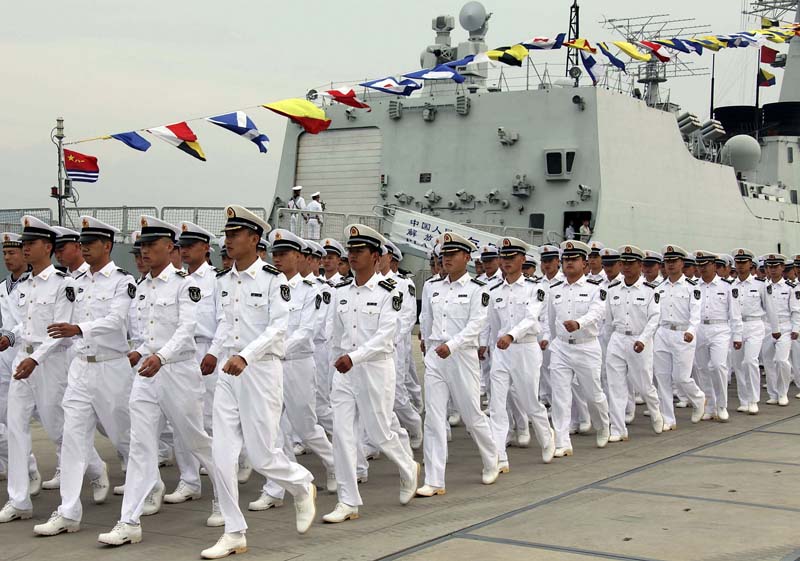
Chinese Navy

Chinese Navy

[by Mark Safranski, a.k. a. “zen“]

The editors of the excellent War of the Rocks invited me to post a short rebuttal to the op-ed “How Not to Go to War With China”, by Scott Cheney-Peters, which appears in their “Hasty Ambush” section:

UNDERSTANDING CHINA: THE REAL KEY TO AVOIDING WAR

….A place to begin our efforts in avoiding war with China might be avoiding engagement in some of the same incorrect mirror-imaging assumptions we once made about the Soviet Union, not least of which was MAD.  As a doctrine, Soviet leaders never accepted MAD and the Red Army general staff ignored it in drafting war plans to fight and prevail in any nuclear war. While the Soviets had no choice but to tackle the logic of deterrence as we did, the operative Soviet assumptions were predicated on a different strategic calculus, a different force structure and above all, different policy goals from their American counterparts.  A dangerous gap between American assumptions of Soviet intentions and the reality of these intentions came to light when in 1983 the Reagan administrationdiscovered to their alarm that Soviet leaders had interpreted the NATO exercise Abel Archer 83 as preparations for a real, imminent nuclear first strike on the USSR and ordered Soviet nuclear forces on high alert.

The military-to-military confidence-building initiatives outlined by Cheney-Peters intended to construct “habits of cooperation” are not entirely useless. There is some value in ensuring that high-ranking American military officers have personal and limited operational familiarity with their Chinese counterparts in the People’s Liberation Army (PLA), but as potential game-changers, they need to be taken with a grain of salt. Such a policy misses the essential strategic and political centers of gravity in the Sino-American relationship.  Namely that for the first time in 600 years, China is building a blue water Navy that will foster power projection as far away as the Indian ocean and Australia.  Secondly, this naval expansion, coupled with a new Chinese foreign policy, aggressively presses grandiose territorial demands on nearly all of its neighbors, including India and Japan.  These are fundamental conflicts with American interests that cannot be explained away or papered over by banquet toasts with visiting delegations of Chinese admirals. […]

Read the rest here.

Also read another WotR  China piece “99 Red Balloons: How War with China would Start” by Matthew Hipple


Switch to our mobile site

