zenpundit.com » war

Archive for the ‘war’ Category

The purpose of war

Saturday, October 12th, 2013

[ by Charles Cameron — breaking the grip of the war and peace, militant vs pacifist duality, with justice as the proposed “missing” third ingredient ]
.
**

The purpose of war is never peace in the beginning, or there’d be no need of it, no starting point.

Similarly, the purpose of war once initiated is generally peace, but with qualifications — peace that’s in the national interest first and foremost among them, especially if you’re willing to include “the Ummah” among the nations in making that statement.

But I keep getting the feeling there’s more that needs to be untangled. As my example of the Ummah shows — and Christendom or the Anglosphere would suit my point equally well — all manner of identifiers from the tribal to the global can be the ones in need of defense (or adduced in favor of aggressive attack).

**

Here, I want to zoom in and look for a global imperative that respects both Western and Islamic sensibilities, and is simple enough to make sense to me, sense of my own basic perplexity.

And I think I have it.

The purpose of war is justice, and the purpose of justice is peace.

That formulation doesn’t admit of wars of aggression — which at the simplistic level I am dealing at are inherently unjust (Jus ad bellum i: Just cause) — but it comprehends that wars (and we arrive on the scene in media res) lead to peace, but with an intervening caveat: with justice.

And it fits the explicit statement in the Qur’an, 2.190:

Fight in the way of Allah against those who fight against you, but begin not hostilities. Lo! Allah loveth not aggressors.

and also this very interesting verse, 57.25, which gives the other one context:

We have already sent Our messengers with clear evidences and sent down with them the Scripture and the balance that the people may maintain [their affairs] in justice. And We sent down iron, wherein is great military might and benefits for the people, and so that Allah may make evident those who support Him and His messengers unseen. Indeed, Allah is Powerful and Exalted in Might.

**

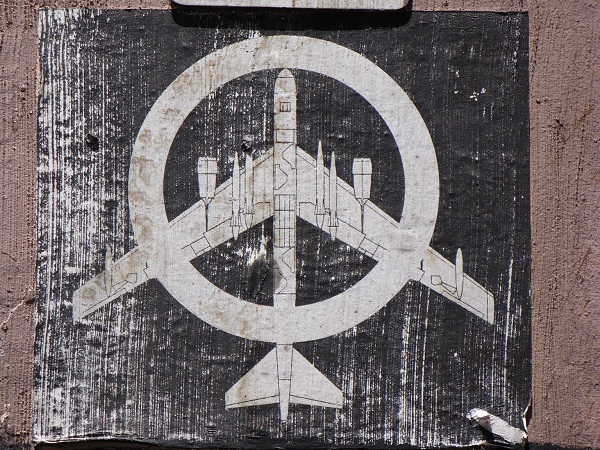
I’m a simple soul, and no doubt these thoughts of mine have been preceded by others — some in agreement, some in opposition to my line of thinking. I’m naturally interested in your own views, and in those of earlier thinkers that you can quote to me either way — but I am posting this here, as my first post in the role of ZP’s managing editor, because I feel far too much thought goes into the dualism of war and peace — from Tolstoy‘s celebrated novel via George Orwell‘s War is Peace in 1984 to Strategic Air Command‘s Peace is our Profession

— when the simplest level at which we begin to understand its loops, recursions and possible exit signs requires a three-fold logic that includes justice along with war and peace on an equal footing.

Have at it, friends!

Two Manea COIN Interviews at SWJ

Thursday, October 10th, 2013

[by Mark Safranski AKA “zen”]

Octavian Manea has two excellent interviews up at SWJ; for those interested in COIN theory and history, these are must-reads:

Learning From Today’s Crisis of Counterinsurgency

SWJ: What is the relevance of post-9/11 counterinsurgency campaigns for future Western expeditionary operations? What are the challenges you expect to see repeated in future campaigns? Is the past a prologue to the future?

Robert Egnell: In a simplified version, General David Petraeus already answered this question: “the counterinsurgency era is not over [because] the insurgency era is not over.” So long as the operating environment looks as it does today, so long as the character of conflict looks as it does today, the lessons at the tactical level of the last ten years remain highly relevant. Even if we can debate the concept of counterinsurgency and its application today and tomorrow, the lessons of operating in urban environments, foreign languages and foreign cultures will be relevant also in the future. Expeditionary powers cannot escape these challenges. It is not going to get easier: how to engage with a civilian population, how to establish and maintain civil order, how to collect and process human intelligence, how to operate in a foreign environment, how to provide basic services. These are challenges that are here to stay with us as we move forward.

David Ucko: Beyond these common operational challenges, one of the most pressing lessons from the cases discussed in the book is the need for greater strategic thinking. This sounds like a cliché these days, and becomes a catchall explanation with little substance. But despite great talk about the need for strategy, I don’t think the term or the art is widely understood. Looking at what happened in the last ten to fifteen years – whether we call it counterinsurgency, war, contingency operations, it doesn’t really matter – the ability to craft and implement a viable strategy is absolute, for any power involved in any kind of expeditionary operations. This is the relevance of the post-9/11 expeditionary operations and our book seems to place counterinsurgency within this strategic context. There are great lessons from these campaigns and we would be absolutely foolish to dismiss them as aberrations just because we don’t like the word “counterinsurgency.”

and

Gangs, Slums, Megacities and the Utility of Population-Centric COIN

SWJ: Are these trends here to stay with us? Are we heading towards a world that provides more opportunity for these dark networks to proliferate, to incubate? On one side, we see concentrated urbanization in coastal, hyper-connected areas that will need to accommodate more and more waves of rural immigrants. Presumably this will put pressure on an already overstretched city infrastructure. On the other side, we see what Moises Naim is talking in his latest book the decline/decay of power, the decoupling of power from size, the decoupling of the capacity to use power effectively from the control of a large Weberian bureaucracy.

VF-B: They will definitely stay and perhaps will intensify, partially for the reason that urbanization is taking place in a way and magnitude with which many governments struggle to cope. Much of Mexico City, a megacity of 20 millions people, for example, is really disconnected from the central government and the central business areas. Another example is Karachi: yes, the blood bath that we see there is partially instigated by state actors, but it is also a phenomenon of a very tenuous and limited control of the state in many areas of the city. I am intrigued by the Moises Naím’s suggestion of the decoupling of the effective exercising of power from the Weberian bureaucracy. I would say that the Weberian construct of power has never been as widespread as we imagine. Many areas in the world, Africa being the prime example, have had a different notion of the state, one much closer to the medieval conceptualization where the purpose of the state and the purpose of power competition for controlling the state apparatus is to make money for oneself as opposed to the public service state whose main raison d’etre is to deliver public goods to citizens in exchange for legitimacy and sustainability. In the end the social contract emerged because the self-interested elites understood that they need to offer something to the population. The notion that the state is weakening and collapsing might not be really appropriate for many parts of the world where the state has always been defined as a mafia bazaar. You take over the state so you can issue exceptions from law enforcement to your friends, so that you and your friends can make money.

In other parts of the world, the state might have also not been quite conceptualized in terms of social contract and Weber like notions.  For example, in parts of Latin America, the state lies somewhere in between the European/Western model and some of the Asian or African states. In Latin America, the state is often captured by and serves a very narrow elite. Many countries in Latin America are still highly exclusionary. Even in places like Colombia with all of its progress over the past decade, there is still a fundamental unequal society. Yes, the middle class is increasingly able to participate in state making, along with the political and economic elites, and being able to demand accountability. But still vast segments of population are really not experiencing the state in any positive manner or not experiencing the state at all. Much of Central America faces massive challenges: tax collection might be as low as 10%, and the political and economic power is enormously concentrated in the hands of narrow  elites.

All that said, the future, if troubling trends are not mitigated now, might bring some fundamental challenges. Imagine if in the long term, there is substantial global warming, major sea level rise, and large parts of Bangladesh, for example, are submerged. This will generate huge waves of immigrants, but also radically empower the non-state actors who are able to provide some sort of protection and public goods to the population.

Read the rest here.

Charles Hill on Freedman’s Strategy: A History

Thursday, October 3rd, 2013

[by Mark Safranski, a.k.a. “zen“]


Charles Hill pens a favorable but also fairly critical review of Sir Lawrence Freedman’s tome-like, Strategy: A History.

The snares of strategizing

.…Sir Lawrence Freedman’s 750-page magnum opus, Strategy: A History, is encyclopedic, although not alphabetical, a pleasure to dip into here and there to get a carefully considered summary briefing on the strategy of the Hebrew Bible, the 1815 Congress of Vienna, Jane Addams, Black Power, or the strange array of social science attempts to redefine human behavior as a contribution to strategy. Everybody talks about strategy, but no one seems to know what it is. But now there are no excuses; it’s all here, at least in chronological array. As with my childhood set of Compton’s, I read it straight through for its several-thousand-years’-long narrative arc; it only remains to try to make sense of the whole thing as one big idea.

Freedman begins by admitting that there is no agreed-upon definition of strategy. When one encounters the word applied to battle plans, political campaigns, and business deals, “not to mention means of coping with the stresses of everyday life,” the concept may begin to seem meaningless. But not so for Sir Lawrence, a most distinguished professor of war studies at King’s College, London, who unapologetically focuses his modern section on American approaches because “the United States has been not only the most powerful but also the most intellectually innovative country in recent times.”

The “origins” of strategy run from David and Goliath to Machiavelli to Milton’s Paradise Lost, a vast stretch of time covered, for this big book, in a relatively short space, as though the author is hurrying to get to strategy in our modern age. All the old warhorses are here. Thucydides is analyzed as the start of “real” strategy and the distortions of language as a cause of Athens’ fall is featured. Plato’s Republic is taken seriously as a “strategic coup” by which philosophy defeats strategy. (I am one of those who read Plato’s Socrates as ironic, playing along with an overnight concoction of a perfect polity—which turns out horribly—as the most effective way of showing us what not to do when thinking strategically.) Sun Tzu is properly portrayed not so much as a strategist as a master of stratagems, a subset of the art in full: To do the opposite of what is expected is not enough to qualify as strategy. Overall, the centuries of “Origins” analyzed here could be characterized as “a series of footnotes to Homer,” a running debate between advocates of force (Achilles) and those who prefer guile (Odysseus). The Trojan Horse was guile personified; it worked, but thereafter could be scorned as a despicable trick unworthy of heroes. The strategic approach of Milton’s Satan to his own demonic team, as well as toward Adam and Eve, was all seductive guile and still seems to be working….

The book comes across as being rather unwieldy in size, scope and definition of strategy, though informative. I disagree with Hill’s interpretation of Sun Tzu as well as Plato ( Socrates was an ironist, Plato? Well, he wandered quite far from his master’s teachings in the fullness of time). Nevertheless, worth a read.

Up the Jihad River with gun and camera

Sunday, September 29th, 2013

[ by Charles Cameron — the belt-fed video camera, & ammo for women ]
.

A brilliant photo juxtaposing war and media in a single image.

Also reminiscent of that Yardley’s “A Woman’s Ammunition” ad from so long ago:

Nairobi tweets 2: Sun Tzu and more

Sunday, September 22nd, 2013

[ by Charles Cameron — further hints from the HSM Press twitter stream, following on from part 1 on bullet-proofing ]

Update:


As of Monday morning 11am California time:

I now think it’s clear that the twitter stream I was commenting on in this post and the first in the series was not an official Shabaab feed, and thus untrustworthy as to its statements — although it’s exact status (fan, mimic, troll, loosely connected?) is undetermined.

I am leaving the post up (a) for the record, and (b) for whatever minor interest it may still have.

Original post:


.

Okay, let’s pick up the thread from my earlier post in this series with this sheer poetry — sheer Anglo-Chinese poetry in fact, the poetry of Sun Tzu from The Art of War — Chapter 7, “Maneuvering”, # 19 in the Lionel Giles translation.

I won’t be presenting the rest of these tweets in graphical form, since that would be labor intensive and I’m trying to be conservative about my labor, but there’s one more Sun Tzu quote I noticed in their stream, and we’ll come to it.

In the meantime, HSM Press tweeted on a variety of topics, all of which seem relevant to them:

**

Let’s note first the importance given to prayer in these tweets:

  • our mujahideen just prayed salat dhuhr! #westgate #alshabaab #Nairobi
  • our mujahideen are preparing to pray salat maghrib! #westgate #AlShabaab #Nairobi
  • The Qur’an is cited:

  • and kill them wherever you find them! ring a bell? #westgate #AlShabaab
  • Their Islam is a religion of peace —

  • yes islam is a religion of peace! thats undebatable. the debate here is who hit first? #westgate #AlShabaab
  • dont blame islam! islam never told you wage war on another country! #westgate
  • — but peace comes arms-in-arms with justice.

    There are matters of logistics:

  • we tweeted arrival of 2 squads and they are replacing our first two now. hooo-ah! #Westgate
  • update: our third mujahideen squad just crossed the border, enroute to #garisa and other undisclosed locations. #Westgate #AlShabaab
  • update: 4th mujahideen squad rendezvous to undisclosed location! brace yourselves #kenya #westgate #AlShabaab
  • Here’s that other Sun Tzu quote, along with a mention of training camps:

  • the first thing they taught us in training camps: know your enemy! #AlShabaab #Westgate
  • and there, making a fine DoubleQuote, is Margaret Atwood‘s nifty variant on Clausewitz:

  • “War is what happens when language fails.” #westgate @nairobi
  • Now, about those “training camps”?

  • have we mentioned we trained in this same building months ago! our mujahideen know every corner of this building! #alshabaab #westgate
  • But also:

  • our mujahideen are all under 25 years old. 7 of them having completed training in black water facility in north california! #Westgate
  • So they train with Blackwater / Academi and in situ, eh? And they’re all under 25 — when they started naming namesa bit later, they identified at least one 27 year old, but you get the drift — and at least one is a young woman:

  • our female combatant took out 15 kenyan soldier! what an amazing woman! #Westgate
  • They count the cost — though unlike AQC in the case of 9/11, they don’t do so to show what a huge ROI they have, just to be glad it wasn’t a flop:

  • the vast amount of time, money and dedication we contributed to this operation were glad it was carried successfully! #westgate #AlShabaab
  • They call it an op here, but their view of its size and importance is pretty flexible as to scale…

    It’s a game — the “war as game meme” once again!:

  • lets see how yall enjoy this game! #westgate #alshabaab #Nairobi
  • They also call it a war:

  • this is a war and its not going to end well. #westgate #AlShabaab
  • It’s not a Jihad, though:

  • #JIHAD is a big word to use for this drill. #kneyans you will know when jihad is happening its unevitable! #westgate #AlShabaab
  • It’s gonna get worse:

  • you call few hundred death a deadly attack. well see what a deadly attack is. brace yourselves #lenya #westgate #AlShabaab
  • — and hey, it looks as though they have their eye on S Africa as a target further down the road:

  • #southafrica gere we come!!! #Westgate
  • **

    Those are the tweets I found interesting on a first read. HSM followed up with the names and home cities of three American participants, and then their feed was suspended and I was invited to return to my home timeline…

    Credit goes to JM Berger for getting Twitter to be a whole lot quicker in disabling their feeds, but it’s all a bit whack-a-mole, and I suspect they’re probably back up by now, under some variant name or other.


    Switch to our mobile site