zenpundit.com » politics

Archive for the ‘politics’ Category

Remarkable

Tuesday, January 11th, 2011

A popular and respected Democratic member of Congress is shot by a lunatic and her partisan colleagues honor her by proposing to restrict political speech, give themselves special privileges at airports and to give all members of Congress and, apparently, the Federal judiciary, the statutory status of the President if the United States.

“We’ve had some incidents where TSA authorities think that congresspeople should be treated like everybody else,” he [ Rep. Clyburn] said. “Well, the fact of the matter is, we are held to a higher standard in so many other areas, and I think we need to take a hard look at exactly how the TSA interact with members of Congress.”

The indignity of it all! A Congressman, treated as if he was under the same laws as his fellow citizens. An outrage. Maybe with that “harder look” Representative Clyburn can take a little time for how his fellow Americans are being treated by TSA as well.

Perhaps granting the Democratic House minority leadership and their children a few hereditary titles of nobility and some estates on Federal lands would cut to the chase for what these people are really after. At a minimum that would be as relevant a response to the shooting of Rep. Giffords as empowering the FCC to censor FOXnews and force Rush Limbaugh off of the airwaves – and it would do our constitutional order a whole lot less harm. I am perfectly content to refer to Rep. Clyburn as Viscout, Prince-bishop or Archduke if he in turn agreed to, say, read the Bill of Rights. Better late than never, I say.

Incidentally, making credible death threats against anyone is already a crime in most jurisdictions I am aware of, albeit one insufficiently prosecuted by DA’s. Threatening USG officials is a Federal offense.

At the turn of another year

Saturday, January 1st, 2011

[ by Charles Cameron ]

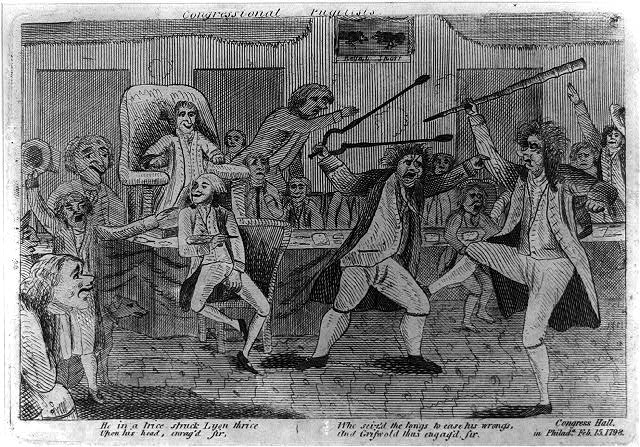
Lyon-Griswold brawl

Reps. Roger Griswold of Connecticut and Matthew Lyon of Vermont practice politics by means of hickory stick and tongs in Congress Hall, 1798

It’s always interesting to watch the way one thing morphs into another, and von Clausewitz’ formulation that war is “a mere continuation of politics by other means” is instructively illustrated in the gallery of a dozen photos on the CBS News site titled Best Parliamentary Brawls of 2010.

Ukraine, Indonesia, Italy, S Korea, Nigeria, Taiwan, Turkey… that’s a pretty fair slice of gepopolitics!

Happy New Year!

image above from the Prints and Photographs Division, Library of Congress.

A Clausewitzian on “Cohesion”

Thursday, December 30th, 2010

Long time ZP readers are probably familiar with seydlitz89, a dedicated Clausewitzian and retired former military officer who comments here occasionally and blogs at Milpub regularly. I first read seydlitz89 at Dr. Chet Richards’ late, great, DNI site and seydlitz89 went on to participate in two extensive events at Chicago Boyz, the Clausewitz Roundtable and the Xenophon Roundtable and also had some of his more extensive writings featured on Clausewitz.com.

I would like to draw attention to one of those articles and seydlitz89’s focus on Clausewtz’s concept of “cohesion” and an implicit “theory of political development”. I am going to excerpt for my own purposes, but suggest that you read seydlitz89’s argument in full:

The Clausewitzian Concept of Cohesion as a Theory of Political Development

….The concept of cohesion comes up in various forms in On War and to lesser extent in Clausewitz’s other writings.   These forms of the overall concept include:

  • Cohesion as the moral (think tribalism, nationalism) and material (think constitution, institutions, shared views of how to define “civilization”) elements that make up the communal/social organizations of political communities, as exemplified in the three ideal types discussed below. Moral cohesion can be seen as the traditional communal values of a political community, what values and motivations guide people in their actions with family, friends and neighbours, whereas material cohesion are the modern cosmopolitan values associated with society or those social actions associated with institutions of various types. The two types exist is a certain state of constant stress and tension with modern values actually being destructive to the retention of traditional values (following Weber). Cohesion here is Clausewitz’s theory of politics which also includes the abstract concept of money. (Book VIII, Chapter 3B & the essay titled “Agitation”)
  • Cohesion provides the process behind which the center of gravities of both participants in a conventional war are formed. Lack of a center of gravity would indicate the inability to win decisively, which would include the target of conventional militaries committed to unconventional/guerrilla warfare. (Book VI, Chapter 27, Book VIII, Chapter 4)
  • Cohesion is the target of strategy in that tactical success is extended by strategic pursuit in order to expand the sphere of victory and bring about the disintegration of the enemy. Cohesion links the whole sequence of decisions (contingency) that allows the political purpose to be achieved through the means of the attained military goal, that is cohesion provides the chain of decisions/outcomes that unite political purpose with strategy and strategy with tactics, or vice versa. (Books II, IV, & Book VI Chapter 8)
  • Cohesion acts within the balance of power among various states – especially in terms of interests – with an aggressor having to contend with all the other states having an interest in maintaining the status quo. This would include the tendency for Clausewitz of a potential hegemon to fail in its attempt to dominate other peer states. (Book VI Chapter 6)
  • Cohesion can also be seen has having an influence in the varying states of balance, tension and movement through which all conflicts proceed. The cohesion (moral and material forces, willingness to take risks, soundness of the military aim in connection with the political purpose, etc) of each side being relatively equal while in balance, but increasing on one side during tension until a release of the tension (attack) and decreasing again during movement until balance is once again achieved or the conflict ends. (Book III, Chapter 18)
  • At the most abstract level the concept of cohesion could be seen as providing the unifying concept which maintains the various elements (the remarkable trinity and the operating principles) of Clausewitz’s general theory as part of a whole, the fields of attraction and tension that provide the general theory with its dynamic quality. (Book I Chapter 1)

Thus cohesion can be seen as a very broad concept, but for my purpose I am using only the first point listed above. 

and later:

….The third type of theory I wish to mention is what I refer to as Clausewitz’s theory of politics, or maybe more accurately, a theory of political development, which I see as inseparable from his concept of cohesion as I described in point one above in discussing the various forms of cohesion. 

For our purposes here we are interested in Clausewitz’s concept of cohesion as it pertains to this first point, the physical and moral cohesive elements of political communities, how cohesion acts in effect as a sliding scale of ever increasing (or deceasing) concentration, integration and organization of a political community. 

This is a very useful elucidation by seydlitz89, regardless if one favors Clausewitz or Sun Tzu or is altogether indifferent to military-strategic concerns and are more interested in broad questions of political philosophy and social policy.

Furthermore, I think Clausewitz’s speculations on cohesion were, like many of his systemic perceptions in On War, remarkably farsighted and intuitively rooted in a scientific reality that was unknown and untestable in his day. The conservative and eponymous scholar, Paul Johnson noted in his book Birth of the Modern that the 1820’s represented a time of great intellectual ferment when the arts, humanities and sciences were not yet compartmentalized, professionalized and estranged from one another. To paraphrase Johnson, it was still an era when a scientist like Faraday and an artist ( probably Harriet Jane Moore) could and did have a productive conversation about the properties of light in complete seriousness. As an intellectual, Clausewitz shared that zeitgeist.

In a military frame of reference,  the concept of “cohesion” brings to mind the Greek-Macedonian Phalanx as a representative example

but the phenomena appears not merely in military tactics or in human social relations but throughout the animal kingdom. Howard Bloom, the popular science writer using a sociobiological perspective, used “Spartanism” and “Phalanx” as metaphors for documented behaviors of creatures as disparate as bacteria, baboons and hard shell Baptists. “Groups under threat, constrict” Bloom wrote in Global Brain and this characteristic of cohesion appears to apply even when the groups are not sentient. Network theorists and scientists can explain collective behavior in terms of “strong” and “weak” ties, nodes and hubs and resilience, including emergent behavior of systems are not even alive.

Cohesion is an aspect of the natural world.

Grand Strategy as Co-Evolution: Being and Becoming

Tuesday, December 21st, 2010

“Our form of government does not enter into rivalry with the institutions of others. Our government does not copy our neighbors’, but is an example to them. It is true that we are called a democracy, for the administration is in the hands of the many and not of the few. But while there exists equal justice to all and alike in their private disputes, the claim of excellence is also recognized; and when a citizen is in any way distinguished, he is preferred to the public service, not as a matter of privilege, but as the reward of merit.” – Pericles, The Funeral Oration

“The President of the United States of America and the Prime Minister, Mr. Churchill, representing His Majesty’s Government in the United Kingdom, being met together, deem it right to make known certain common principles in the national policies of their respective countries on which they base their hopes for a better future for the world.”

– The Atlantic Charter, 1941

Adam Elkus, at Rethinking Security, makes an important point about grand strategy not requiring a great enemy:

Building a Strategy for Chaos?

….The short answer is that grand strategy isn’t something that requires an clear and equal enemy to create. But since grand strategy is something that involves a long time line, a substantially more broad subject area than war strategy, and the utilization of resources in peacetime, it makes more sense to visualize it less as an explicit plan than a collection of practices sustained over a long period of time. The policy of “offshore balancing” which Churchill mentions in this speech is one of those sets of practices. 

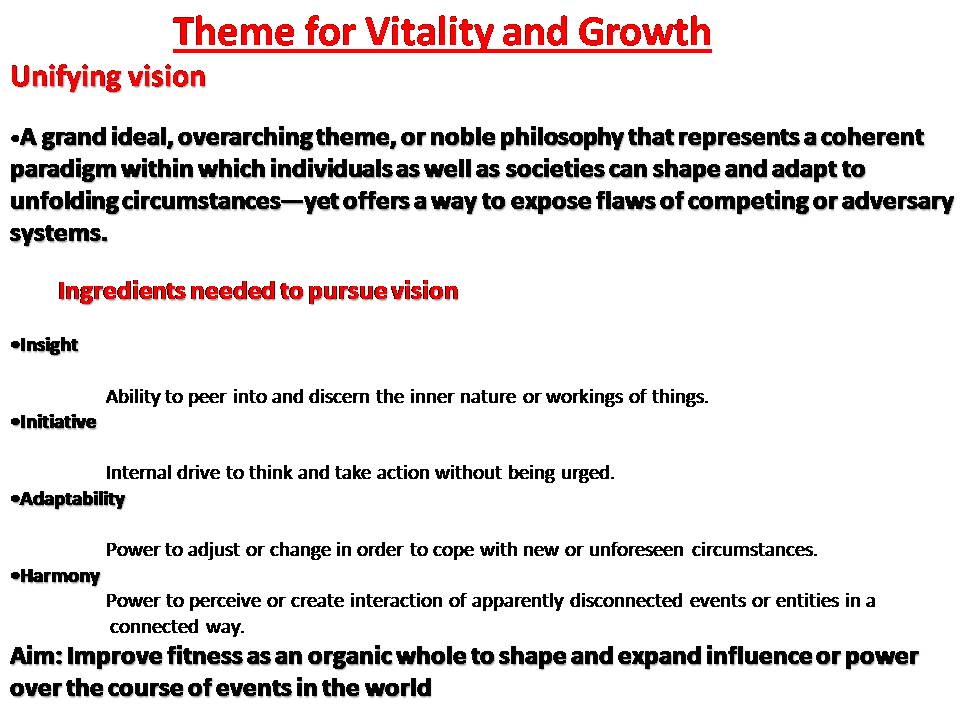
Boyd is commonly misunderstood as a tactically obsessed jet pilot whose insights mainly relate to cycling through a decision cycle faster than the opponent. But the importance of his writings to grand strategy is undeniable. His stress on the importance of forming organizations creative and efficient enough to “destroy and create” perceptions of the external environment, increase our own connectivity and degrade that of our opponents, and the importance of establishing a “pattern for vitality and growth” all point to aspects of strategic design that focus less on marshalling resources against a specific opponent than developing a basic strategic template that can remixed for various situations under a process of “plug and play.”  

In his post, Adam references Colonel John Boyd’s “Theme for Vitality and Growth” from his brief, Patterns of Conflict:
themeforvitality.jpg

Adam went on to make an insightful observation:

The problem is that as societies grow both more structurally and interactively complex, this process grows much more difficult. That is what The Collapse of Complex Societies is about–how, if we view civilizations as computing mechanisms, how growth makes it more difficult to carry out the basic process of response to changing external conditions that is an essential part of data-processing. Moreover, even in eras of relative simplicity, the ability to aggregate enough information together to form a grand strategic design was exceedingly rare for individuals and more difficult for governments than success stories such as 19th century Prussia might indicate

Read the rest here.

I would like to extrapolate Adam’s argument about the difficulty imposed by complexity several steps further.

In considering grand strategy, historically, except for the Romans during their golden age, state actors, even vast empires like the Soviet Union or Great Britain, never approximated a closed system that could operate without reference to rivals who could potentially present an existential threat, singly or in combination. While the Pax Romana represents the rare outcome of a successful grand strategy, most great powers wrestled with imposing their will on both their rivals – but also on the geopolitical environment or “system” in which they operated.

What do I mean by the “system”? The explicit and implicit cultural and diplomatic rule-sets; the “rules of the game” by which powers interacted; the geoeconomic structures and patterns that were larger than any particular political entity and imposed constraints upon them, even the chance-based variables of natural resources and technological level which had a determining effect upon formulation of policy and strategy. The relationship between the architect of a grand strategy, his rivals and the world in which all were forced to operate consisted of a multiple variable feedback loop, not a diktat with a binary set of possible results.

I woud now like to make two points. 

First, to use an analogy from the biological sciences, grand strategy enunciated by a great power is a process of geopolitical co-evolution. There is an effort in grand strategy to impose over time one’s political will upon others to shape the “battlespace”, the sphere of influence, the hegemonic dominion to a state of affairs favorable to the state actor. Often, this is done by military force in times of crisis but over the long term, economic and diplomatic factors, all of DIME really, weigh heavily on the outcome. The process is never a one way street, even for actors who are considered to be largely triumphant. It is coevolutionary. If you gaze into the abyss, the abyss will gaze into you.

The early Roman republicans, much less Cato the Younger, would have been viscerally appalled by the Empire of Late Antiquity with its’ Teutonic Masters of the Horse in place of citizen- Praetors and Imperators. The Founding Fathers would be amazed by the condign dominance of the United States as a global titan but dismayed by the truckling servility, the lack of economic independence and the sheepish passivity of Americans whose citizenship is largely nominal. Ancient Chinese sages might feel much the same about hybrid capitalist-communist China of 2010.

Secondly, sustaining the national or group identity is a critical component of grand strategy that makes it a different, more expressly political/cultural  exercise than crafting strategy as Clausewitzians use the term as being driven by policy. Grand strategy should guide policy formulation because it is not just a set of concrete structural ends, or a laundry list of “vital interests” but a constructive, values-laden, attractive, motivating, civilizational narrative. An ideal or cultural identity for which men and societies are willing to go to war, to stand, fight and die. As Thomas P.M. Barnett once put it, for a “Future worth creating“. Grand strategy is a defiant clarion call of civilizational supremacy, marshalling those who will fight for that which is not, but could be.

But if you gain the whole world, while losing oneself, have you won? Or lost?

A victorious grand strategy shapes others while preserving – or expanding the reach of – the core identity of cultural-political community engaged in the struggle for autonomy for itself  and dominion over the environment. Some changes though are inevitable despite the best of intentions. Exercising power carries with it a price and the piper must be paid.

Following Boyd, the more attractive our vision, the “noble philosophy” we offer up to others and the more consistently we practice that which we preach, the greater our reach while remaining true to ourselves – thus demoralizing our adversaries. The more we trade on our souls, compromise our principles, turn away from threats and contradict our professed ideals, the less we have. Power is useful but it is transient. The exercise sweet, but the cost dear.

Power runs through our fingers like water. What did we give for it? What did we gain? Who are we now?

That is grand strategy.
2081

Sunday, December 19th, 2010

Long overdue yet exceedingly timely. From one of the great short stories of all time.

2081 Trailer from 2081 on Vimeo.


Switch to our mobile site

