zenpundit.com » anthropology

Archive for the ‘anthropology’ Category

Jihad culture: its music, poetry, rituals and dreams

Monday, September 12th, 2011

[  by Charles Cameron – jihadist studies, Hegghammer, culture and influence ]

.

It is the evening of the tenth anniversary: the day is almost over.

*

In an engaging interview with Abu Muqawama posted today, terrorism and violent Islamism expert Thomas Hegghammer discusses his new project about jihad culture, or “the things jihadis do when they don’t fight”.

It is inspired by the observation that militants in the underground spend a lot of time doing things that appear to serve no immediate military purpose, like singing songs, reciting poetry, or discussing dreams. They also do unexpected things like weep on a regular basis, notably when reciting the Qur’an. The infamous Abu Mus‘ab al-Zarqawi, for example, was known among fellow militants as both “the butcher” (al-dhabbah) and “a weeper” (baki). All this “soft matter” of jihadism remains virtually unstudied; one reason, I think, is that it has been considered less consequential than the hard stuff of terror, such as attacks, resources, organizational structures and the like. My hypothesis is that jihad culture is not inconsequential at all; instead I think it may shed important new light on the processes by which jihadi groups recruit, exercise organizational control and make tactical decisions. I am sure that the military men and women reading this blog will find all this rather intuitive, because they have experienced the important role of music and rituals in their own organization.

As a first step in the inquiry, I am currently working with a great team of scholars on an edited volume that will explore various dimensions of jihad culture. I have recruited subject specialists – including a musicologist, an Arabic poetry expert, and an anthropologist of dreams – to help document and decipher al-Qaida’s internal culture.

I hope the book will cover miracle stories and the odor of sanctity, too…

*

Hegghammer is co-author of the forthcoming Meccan Rebellion (Amal 2011), which I very much hope to review here on Zenpundit, and which is likely to be the definitive work on the Mahdist takeover of the Grand Mosque in Mecca in 1979.

Needless to say, I’m delighted at the news of Hegghammer’s upcoming project.

The imagery of religion and war

Friday, September 9th, 2011

[ by Charles Cameron — graphical analysis, selling bibles to teenage boys, tge Mass in time of war ]

.

Following on from my post on the work of Al Farrow, and leading towards a series of posts on ritual and ceremonial, I’d like to show you two very different images at the overlap of war and religion.

The first shows two different covers of the books of Joshua, Judges, Ruth, I & II Samuel, I & II Kings, Ezra and Nehemiah, as featured in a “biblezine” edition of the New Century Version of the Bible pitched at teenage testosterone.

double.png

Each of will have our own sense of whether that’s fun, stupid,  Biblical, unBiblical, enticing, disgusting or simply uninteresting — but whatever your aesthetic and/or belief-based response, there’s a powerful lesson there in the choice of subtitles:

how unstoppable warriors got so awesome…
courage and faith wins the battle…
how to impress the girls!
how to take on giants!
women that seduce…
tons more random cool stuff lists…

I’m not a fan of this kind of thing myself, but I picked up a copy when I saw one at the thrift the other day — the one with Men of the Sword on the cover — and as someone who has done a fair amount of copy-editing in my day, was surprised to see “courage and faith wins the battle” (sic) had slipped past the editorial eyes at Nelson Books

The New Testament in the same series is a bit better — the cover still features “dynamic stories of daring men” –but the, ahem, romantic element has been toned down a bit, with the catch phrase “class act: how to attract godly girls” replacing the Old Testament’s “how to impress the girls”.

* * *

Okay, I’m not as young as I once was, and maybe I’ve been mean enough at the expense of these people who want to market the Bible as though it was an invitation to warfare washed down with sex.

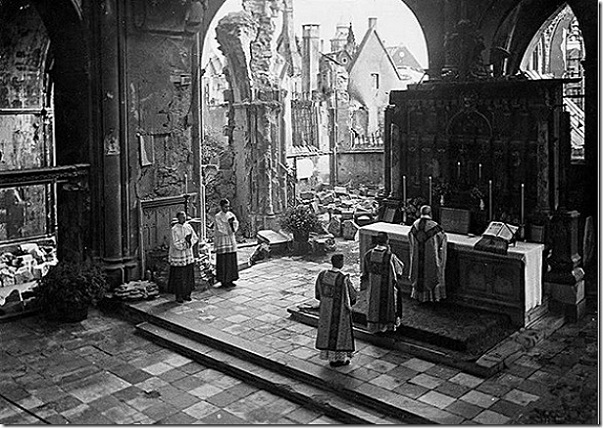
The other image I found recently comes a great deal closer to my own taste, and will serve as an excellent introduction to the idea of religious ceremonial as an oasis of peace in time of war:

missa_thumb3.jpg

Again, I suppose there may be some who will find the idea of religious ritual boring and irrelevant rather than beautiful — but it is its capacity to move us at a deep level — even (and perhaps particularly) when high tides of  circumstance and emotion are breaking over us — that I wish to focus on and, to the extent that it is possible, explore and explain in  some upcoming posts.

In my view, it was this kind of beauty, verging on the austere and the timeless, rather than the snazzy and faddish “impress the girls — draw in the kids” kind, that Pope Benedict XVI had in mind when he said:

Like the rest of Christian Revelation, the liturgy is inherently linked to beauty: it is veritatis splendor. The liturgy is a radiant expression of the paschal mystery, in which Christ draws us to himself and calls us to communion. As Saint Bonaventure would say, in Jesus we contemplate beauty and splendor at their source.

* * *

I am not a Catholic, though my sympathies run in that direction, and my examples of ceremonial will not be drawn only from Catholic or Christian sources — part of what i want to explore is the universal quality of ritual as a powerful source of motivation and inspiration, while another aspect has to do with the interweaving of military, religious and state symbols, but the point I would most like to make in each case is the profound impact that such symbols and rituals can have on the receptive heart.

I hope to touch on a wide range of ritual expressions, from the Requiem for a departed princely Habsburg to the Lakota sweat lodge, and from to the fire-walking ceremonial of the Mt Takei monks of Japan to the Spanish bull-fight, with a close look at the ritual surrounding coronation in my own British tradition.

For those who would like to peer deeper into these matters, I would suggest these four books:

Victor Turner, The Ritual Process
Geoffrey Wainwright, Eucharist and Eschatology
William Cavanaugh, Torture and Eucharist
Josepha Zulaika, Basque Violence: Metaphor and sacrament

The first explains “how ritual works” from an anthropological point of view, the second deals with the purposeful interweaving, accomplished within ritual, of time with the timeless, the third with the way in which sacramental transcendence is the very antithesis of torture, and the fourth with the impact of a sacramental sensibility within terrorism.

Each one is a masterpiece of intelligence and profound feeling.

Anonymous and Master Roger, a review

Tuesday, August 30th, 2011

 by J. Scott Shipman

master-roger.jpeg

Anonymous and Master Roger, Anonymous, Notary of King Béla The Deeds of the Hungarians, Master Roger’s Epistle to the Sorrowful Lament upon the Destruction of the Kingdom of Hungary by the Tartars

 Back in June Zen posted a couple of mini book reviews, and David Schuler posted this comment: 

 “For moderns inclined to romanticize war in antiquity may I recommend The Epistle to the Sorrowful Lament upon the Destruction of the Kingdom of Hungary by the Tartars?  It became available in English translation fairly recently and constitutes a first-hand account of the Mongol invasion of Hungary.  The violence, not only against persons and property, but against the land itself is notable and eye-opening.”

The title was enough to pique my interest, and since I knew very little of this period I went to Amazon UK and purchased a copy (US versions are prohibitively expensive) . That said, I didn’t expect to get around to reading for some time, but if I don’t “buy” a book while it is still on my mind, I’ll likely forget as the pile continues, “without ceasing” (to wax Biblical) to grow. For an obscure text, the introduction drew me in and I was hooked enough to read a few pages a day.

The book has ample and informative introductions to each work. The stories are presented in Latin on one page and English on the facing page.

The narratives are very different, Anonymous was a Notary to King Béla (circa 1196), and he recounts the deeds of Hungarian royalty, and the behind the scenes machinations of the royal court. Anonymous’ account was laced with both biblical and classic texts and was quite tedious, predictably obsequious but while at the same time offering up little snippets here and there—and often in the notes. A note in the section titled 40. The Victory of Prince Árpád, Anonymous wrote: “…for thirty four days and in that place the prince and his noblemen ordered all the customary laws of the realm and all its rights.” The editors included the following footnote with respect to “rights.”

 “The translation of ius (in contrast to lex, “law”) is a problem that is not only linguistic. Translators of Roman legal texts often retain ius, as it implies law, justice, rights along with all their connotations. Modern English does not distinguish lex from ius, Gesetz from Recht, or loi from droit, which may explain the generally supine Anglo-Saxon attitude towards the law and authority in general…”

Schuler was right in his description of Master Roger’s first hand account of the Tartar invasion (1241/42); horrific comes to mind. There is no romance. The brutality and ruthlessness of the Tartars is awe-inspiring and fearful 900 years removed. The tactics of the Tartars are textbook examples of psychological warfare before the term was coined—and their ability to “get inside” their adversaries decision-making loop (OODA, anyone?) was remarkable.

The ancient Sorrowful Lament story was reassuring of the power and resilience of the human spirit. The deprivations experienced by the Hungarians were not unique in human history, but serve to illustrate how resilient a people can be when things truly go to hell in a hand basket. When their leaders failed, the Hungarians found way to live in spite of their feckless unprepared leaders, and in spite of a ruthless, blood and booty thirsty enemy.

Anonymous and Master Roger is recommended to anyone wanting to understand the human condition, whether royalty, peasant, bureaucrat, or barbarian. This is an important book…for a “sorrowful lament” has much to teach us about the human condition and how little man changes. This highly eclectic little title comes highly recommended and many thanks to Dave for sharing.

Postscript: One remarkable thing about this book, printed in Hungary, is the high quality construction using good paper and string.

There are no references to share for this volume, however if this volume is indicative of their work, Central European Medieval Texts are to be commended and followed.

BTW, Joey recommended Millenium by Tom Holland and I’m about half-way through—excellent thus far!

Johnston, Gorka and the need for specialist knowledges

Wednesday, August 10th, 2011

[ by Charles Cameron — religious knowledge, foreign policy, military ]

.

Dr. Douglas M. Johnston just posted a piece titled Religion a crucial tool in U.S. foreign policy in the Washington Post’s On Faith blog, and in it he quoted Dr. Sebastian Gorka‘s recent testimony to the HASC Subcommittee on Emerging Threats and Capabilities:

It is very difficult, if not impossible, to provide the contextual knowledge we need to understand and defeat our enemy if we rely solely upon anthropologists and social scientists…. Today our multi-disciplinary analysis of the enemy and his doctrine just as much requires — if not more so — the expertise of the regional historian and theologian, the specialist who knows when and how Sunni Islam split from Shia Islam and what the difference is between the Meccan and Medinan verses of the Koran. We should ask ourselves honestly, how many national security practitioners know the answers to these questions, or at least have somewhere to turn to within government to provide them such essential expertise.

I do appreciate that this was written by Dr Gorka for an audience that needs to keep up to speed on many, many topics.  What dismays me here isn’t the idea that “national security practitioners” should know these things — they should indeed, and should certainly also know specialists who know a great deal more — but that the bar is set so low, “a specialist” being, for that audience, someone “who knows when and how Sunni Islam split from Shia Islam and what the difference is between the Meccan and Medinan verses of the Koran”.

Let’s back up a bit.  Here’s a report on the Senate hearing on the appointment of GEN. Dempsey as Chief of Staff of the U.S. Army.

Gen. Martin Dempsey, tapped by the White House to be the next top military officer, acknowledged Tuesday that he and other senior officers failed to grasp the power dynamics among Islamic-based groups in Iraq.

After the U.S. military toppled the Saddam Hussein-led regime there in 2003, a powder keg erupted that was driven, in large part, by centuries-old power struggles and distrust among Iraq’s various Islamic sects.

It took American civilian and military leaders years to adapt and understand these dynamics, which experts say played a major role in both the length and violent nature of the Iraq war.

Driving the lack of understanding was a tendency of the military to “take five minutes to understand” an issue while immediately spending the next “55 minutes trying to solve it,” Dempsey said during his confirmation hearing before the Senate Armed Services Committee.

Those “five minutes to understand” might get you the basic difference between the Meccan and Medinan suras — but a specialist knows a little more than that, as one can gather from comments Dr Timothy Furnish posted just the other day on his MahdiWatch blog, commenting on Dempsey’s remarks:

One might reasonably wonder whether the US military and intelligence community (not to mention the State Department) truly does, finally, realize the importance of sectarian differences in the Islamic world. For example, the Syrian case pitting the pseudo-Shi`i Alawi rulers against the country’s Sunni majority only recently came to Washington’s attention; neither Libya’s history of Sanusiyah Sufi jihad against occupation, nor Mua`amar al-Qadhafi’s heretical Islamic teachings and rule, has been fully considered or acknowledged by the American government; and there are still commanders deploying to and from Afghanistan who seem blissfully ignorant of the fact that that country is 19% Shi`i (and that a substantial subset of that is not Twelver but Sevener, or Isma’ili, Shi`i).

But that’s one paragraph from a single blog post, and Furnish has written a book — has written, as they say, “the book” on Mahdism.  And that’s just one book, you don’t suppose Furnish’s knowledge is limited to what he managed to compress into a few hundred pages, do you?

Furnish is a specialist — that’s why I read and correspond with him.  I’m a generalist with, I hope, some decent insights into what to watch for and who to read for background — but Furnish is a specialist.

And the solution isn’t to add “specialist” to a checklist, find one on LinkedIn and check it off — the solution is widespread, ongoing conversation among specialists, with the help of generalists, across all silos and disciplinary boundaries, of the sort we try to promote here from time to time… until there are enough people, with enough parts of the puzzle, that we don’t get blindsided by our ignorances.

Ignorances, plural.  Knowledges, plural.

*

This just in…  Dr Furnish’s second book — The Caliphate: Threat or Opportunity? — is now available for pre-order. I hope to review it at some point here on ZP.

Battlefield magic

Tuesday, August 9th, 2011

[ by Charles Cameron — Africa, military, witchcraft, need for analysis ]
.

From a transcript of yesterday’s CNN News Stream: [h/t @Intelwire]

Rebel fighter Mohammed shows me something else he found on the battlefield, what he says are pages of African witchcraft or black magic designed to protect fighters from enemy bullets. Saturday, he says, he got chills when it appeared to work on an armed Gadhafi soldier casually walking in the open.

Mohammed says he and 10 fellow fighters opened fire on the man from 200 meters.

MOHAMMED, REBEL FIGHTER: We tried to shoot him with different guns — Kalashnikov, 14.5 gun, but no one can hit him. And…

HOLMES: He’s out in the open. You’re putting all kinds of weapons at him, including anti-aircraft guns, and you’re not hitting him.

MOHAMMED: We didn’t hit him and he reached the car. He go in the car and go away.

HOLMES: An obviously unnerved Mohammed says he found these writings in another car next to the one the man escaped in.

This isn’t an area that I’ve been tracking in any detail, so I’d welcome further bibliographic suggestions – but two books I ran across recently might be of background interest, Peter Geschiere‘s The Modernity of Witchcraft: Politics and the Occult in Postcolonial Africa and Christopher Taylor‘s Sacrifice as Terror: the Rwandan Genocide of 1994

I’ve mentioned these before, but so might James R Price and Paul Jureidini‘s 1964 Witchcraft, Sorcery, Magic, and Other Psychological Phenomena and their Implications on Military and Paramilitary Operations in the Congo, and Roger D Hughes‘s 1984 Emergency in Kenya: Kikuyu and the Mau Mau Insurrection.

twins.jpg

Magical bullet-proofing as a spiritual theme turns up all over the place. The Ghost Dance shirts of the Lakota were supposed to make their wearers impervious to attack, and similar mythic powers were attributed to Johnny and Luther Htoo [picture credit: BBC], the twins who led God’s Army in Myanmar…

It would be useful to have a cross-cultural study of magical weaponry and protection, no?


Switch to our mobile site