zenpundit.com » al qaida

Archive for the ‘al qaida’ Category

Which world is more vivid? This, or the next?

Monday, March 19th, 2012

[ by Charles Cameron — bin Laden, Abu Bakr, Bernard of Clairvaux, Qur’an burning, Tora Bora, David Ignatius, Emptywheel, and impassioned belief ]
.


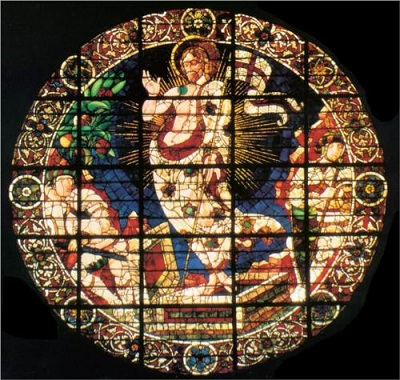
image: Paulo Uccello (1443) depicts the Resurrection
life after the grave, seen through a glass, darkly
We keep on stumbling over this one.

To the western mind, mostly, this world is axiomatically more vivid than the next. But there are those for whom the next life is axiomatically the more vivid – even if their day to day practices are geared to success and continuity in this life.

And this has consequences for our own lives, in the world around us — and for security.

1.

Some who are of this mind – bin Laden in this video among them — may quote or paraphrase Abu Bakr‘s message to Khosru:

I have come to you with an army of men that love death, as you love life.

That particular quote is from the rich tapestry of Islam – but Jewish history speaks also of Kiddush ha-Shem, martyrdom for the glory of God, which became in the time of the crusades “the exemplary answer of Jews threatened in their life and faith” when offered the options of conversion to Christianity or death.

And in Christendom, there is St Bernard of Clairvaux, who is quoted as writing in his letter to the Templars at the time of the Second Crusade:

The Christian who slays the unbeliever in the Holy War is sure of his reward, the more sure if he himself is slain.

and for good measure in his sermon promoting the Crusade:

Christian warriors, He who gave His life for you, to-day demands yours in return. These are combats worthy of you, combats in which it is glorious to conquer and advantageous to die.

2.

It is with this difference in axiomatic understanding in mind, that we should approach such issues as the relative importance – in our own minds, and in those of many Afghans – of the loss of human life in a night raid, as compared with the burning of copies of the Qur’an [In Reactions to Two Incidents, a U.S.-Afghan Disconnect]:

The mullah was astounded and a little angered to be asked why the accidental burning of Korans last month could provoke violence nationwide, while an intentional mass murder that included nine children last Sunday did not.

“How can you compare the dishonoring of the Holy Koran with the martyrdom of innocent civilians?” said an incredulous Mullah Khaliq Dad, a member of the council of religious leaders who investigated the Koran burnings. “The whole goal of our life is religion.”

And a quick note here — this is an issue I’ve raised before, eg in Burning scriptures and human lives, in Of Quantity and Quality I: weighing man against book, and more recently in On fire: issues in theology and politics – ii.

3.

The same understanding also explains bin Laden’s retreat to the Tora Bora caves. As I said in an early guest post here on ZP, with a hat-tip to Lawrence Wright and his book The Looming Tower:

When bin Laden, at the lowest point of his jihadist efforts, leaves the Yemen for Afghanistan and betakes himself to the Tora Bora caves, he will inevitably remind some Muslims of the Prophet himself, who at the lowest point of his prophetic vocation left Mecca for Medina and sought sanctuary in a cave — where by the grace of his God, a spider’s web covered the entrance in such a way that his enemies could not see him.

Our natural tendency in the west is to see Tora Bora in terms of military topography, as a highly defensible, almost impregnable warren of caves deep within some of the world’s most difficult mountain territory. What we miss may be precisely what Muslim piety will in some cases see — that bin Laden’s retreat there is symbolically aligned with the “sunna” or life of the Prophet, and thus with the life of Islam itself — in much the same way that Christians, in the words of Thomas a Kempis, may practice “the Imitation of Christ”.

4.

It was in fact Emptywheel‘s piece about bin Laden’s comment re killing President Obama (and thus promoting Joe Biden) that caught my attention today and prompted this post.

Emptywheel quoted the same passage from David Ignatius that had triggered my own post On the “head of infidelity” and the tale of Abdul-Rahman ibn Awf late yesterday —

“The reason for concentrating on them,” the al-Qaeda leader explained to his top lieutenant, “is that Obama is the head of infidelity and killing him automatically will make [Vice President] Biden take over the presidency… “

— and commented:

OBL was going to kill Obama not for the sake of killing the US President, but because Biden, who served in the Senate for 36 years, almost 12 of which he served as one or another powerful committee Chair, “is totally unprepared for that post, which will lead the U.S. into a crisis.”

I just don’t think that’s right. I think it’s wrong, in fact, but [and here’s the important part] subtly wrong.

I believe that OBL lived at the confluence of worlds — one that we might call mythic or spiritual, and one that’s the one we call the “real” world. I believe that it was his myth, archetype, spirit based reality that was the more vivid to him, the one to which he was entrained, and that he found means in the practical world of strategies and tactics to adhere to the demands of that other world.

A world that was both invisible to us, and to him axiomatically victorious – at least as much so in death as in life.

On the “head of infidelity” and the tale of Abdul-Rahman ibn Awf

Monday, March 19th, 2012

[ by Charles Cameron — linking some late notes of OBL with his 1996 Declaration of War ]
.


photo credit: Maqam of Abdul-Rahman,
Nate Mathews, The Azanian Sea

I was reading David Ignatiusaccount of the forthcoming Abbottabad papers a couple of days ago, and was struck by a phrase bin Laden used in describing Obama:

Before his death, Osama bin Laden boldly commanded his network to organize special cells in Afghanistan and Pakistan to attack the aircraft of President Obama and Gen. David Petraeus.

“The reason for concentrating on them,” the al-Qaeda leader explained to his top lieutenant, “is that Obama is the head of infidelity and killing him automatically will make (Vice President Joe) Biden take over the presidency. … Biden is totally unprepared for that post, which will lead the U.S. into a crisis. As for Petraeus, he is the man of the hour … and killing him would alter the war’s path” in Afghanistan.

Obama is the head of infidelity — that had quite a ring to it.

And so, as I was rereading the text of bin Laden’s 1996 Declaration of War against the Americans Occupying the Land of the Two Holy Places this morning, I couldn’t help but notice his early use of the same phrase in that context:

And the story of Abdur-Rahman Ibn Awf about Ummayyah Ibn Khalaf shows the extent of Bilal’s (may Allah be pleased with him) persistence in killing the head of the Kufr: “the head of Kufr is Ummayyah Ibn Khalaf…. I shall live not if he survives” said Bilal.

Here’s the story of the Companion Abdul-Rahman ibn Awf as bin Laden recounts it, in the paragraph immediately preceding the one just quoted:

Abdul-Rahman Ibn Awf -may Allah be pleased with him- said: (I was at Badr where I noticed two youths one to my right and the other to my left. One of them asked me quietly (so not to be heard by the other) : O uncle point out Aba-Jahl to me. What do you want him for? , said Abdul Rahman. The boy answered: I have been informed that he- Aba-Jahl- abused the Messenger of Allah (), I swear by Allah, who have my soul in His hand, that if I see Aba-Jahl I’ll not let my shadow departs his shadow till one of us is dead. I was astonished, said Abdul Rahman; then the other youth said the same thing as the first one. Subsequently I saw Aba-Jahl among the people; I said to the boys do you see? this is the man you are asking me about. The two youths hit Aba-Jahl with their swords till he was dead. Allah is the greatest, Praise be to Him: Two youths of young age but with great perseverance, enthusiasm, courage and pride for the religion of Allah’s, each one of them asking about the most important act of killing that should be induced on the enemy. That is the killing of the pharaoh of this Ummah – Aba Jahl-, the leader of the unbelievers (Mushrikeen) at the battle of Badr. The role of Abdul Rahman Ibn Awf, may Allah be pleased with him, was to direct the two youths toward Aba-Jahl. That was the perseverance and the enthusiasm of the youths of that time and that was the perseverance and the enthusiasm of their fathers. It is this role that is now required from the people who have the expertise and knowledge in fighting the enemy. They should guide their brothers and sons in this matter; once that has been done, then our youths will repeat what their forefathers had said before: “I swear by Allah if I see him I’ll not let my shadow to departs from his shadow till one of us is dead”.

Bin Laden clearly saw himself, from the time of his Declaration through to the end in Abbottabad, as a modern-day Abdul-Rahman ibn Awf, directing the persevering and enthusiastic youth…

The Hunt for KSM

Thursday, March 15th, 2012

The Hunt for KSM: Inside the Pursuit and Takedown of the Real 9/11 Mastermind by Terry McDermott and Josh Meyer

This courtesy review copy just arrived from Machette Book Group. The authors are investigative journalists, one of whom, Meyer, has extensive experience reporting on terrorism, while McDermott is also the author of the 9-11 highjackers book, Perfect Soldiers. Thumbing through the pages, I note the authors have little time and much contempt for the cherished DoD-State canard that the Pakistani government and the ISI are an ally of the United States, which has already given me a warm feeling.

The review copy index pages are blank, something I usually see only before a book has been finalized for mass printing. Odd.

I will be reading and reviewing this soon – Shlok advises that “it reads like a novel”

Request for help regarding a hadith

Tuesday, March 13th, 2012

[ by Charles Cameron — no extremism in religion, did Muhammad say that? ]
.

1.

Illustrated above is the banner of the Khudi blog from Pakistan, offering a hadith in support of its vision, which it describes as follows:

As a movement Khudi stands against all forms of extremism, including those that use religion to justify a certain agenda. But simply saying ‘no’ to extremism isn’t good enough – it’s essential to challenge and undermine the arguments used by extremists and to refute the religious justifications they put forward.

However, challenging extremism in this way doesn’t mean that Khudi is eligible to comment on religious matters or issue fatwas about the length of the beard or the hijaab. At Khudi we believe religious beliefs are a personal matter that each individual may take guidance on from their respective religious authorities. Thus, our volunteers and friends belong to a variety of faiths and sects and span the religious spectrum, from conservative to liberal. The important thing is that we stand firmly by the principle of respecting each other’s difference.

2.

I’m intersted in Khudi, not least because it seems to be a brainchild of Maajid Nawaz, one of the ex-jihadists who founded the Qulliam Foundation in London:

Quilliam is the world’s first counter-extremism think tank set up to address the unique challenges of citizenship, identity and belonging in a globalised world. Quilliam stands for religious freedom, equality, human rights and democracy.

Khudi appears to be Quilliam’s Pakistan equivalent, more or less.

3.

Here’s the deal. The Khudi blog website header illustrated above cites Bukhari 9.582 as saying:

Beware of extremism in religion, for extremism destroyed those who went before you.

I would like to be able to point to that hadith with confidence in my own writings, and I’d be happy to give appropriate attribution to the Khudi blog. but first I need help in clearing up some questions I have about it.

Specifically, when I went to verify the hadith for scholarly accuracy before quoting it — not being a reader of Arabic, and thus being dependent on what resources in English I can muster — I found to my surprise that the
hadith-search function for MulsimOnline gave the following result for Bukhari 9.582:

Narrated Ibn `Abbas:

(regarding the Verse):– ‘Neither say your prayer aloud, nor say it in a low tone.’ (17.110) This Verse was revealed while Allah’s Apostle was hiding himself in Mecca, and when he raised his voice while reciting the Qur’an, the pagans would hear him and abuse the Qur’an and its Revealer and to the one who brought it. So Allah said:– ‘Neither say your prayer aloud, nor say it in a low tone.’ (17.110) That is, ‘Do not say your prayer so loudly that the pagans can hear you, nor say it in such a low tone that your companions do not hear you.’ But seek a middle course between those (extremes), i.e., let your companions hear, but do not relate the Qur’an loudly, so that they may learn it from you.

“Not too soft, not too loud” bears a kind of family resemblance to “nothing in excess” — but it’s not the same thing, and I rather doubt that the words in Bukhari rendered by one translator as “Neither say your prayer aloud, nor say it in a low tone” would be rendered by another as “Beware of extremism in religion” — and I don’t see anything there that would correspond with the phrase “for extremism destroyed those who went before you”.

4.

Okay, all this set me digging a little further, and I next found a hadith reported at the ProphetEducation site, which reads as follows:

On the authority of Ibn Abbas (May Allah be pleased with him):

“Very early in the morning on the day of ‘Aqabah, the messenger of Allah (blessings and peace of Allah be upon him) while riding on his camel said to me: ‘pick some pebbles for me’. I then picked seven hurling pebbles for him. While dusting them of his hands he said: thou shall not cast except with such pebbles. Then he said: O mankind! Beware of extremism in religion for those before you were destroyed as a result of extremism in religion”

Related by Ibn Majah, Hadith no.(3029).

5.

So.

Did the folks putting the Khudi site together just get the hadith citation wrong — or is there more here than meets my eye? I would very much appreciate any help in explaining what at present seems to me a somewhat confusing picture.

If the hadith is authentic and can be found as stated in Sahih Bukhari, the pre-eminent source for hadith, and can be referenced from the English translation of Bukhari on the USC site, that would itself be a help. If so, it would also be of interest to know what kind of hermeneutic AQ deploys to get around it.

And if it is always found in the original sources, Bukhari or otherwise, in association with the comments about small “hurling pebbles” — why, that raises yet other questions.

6.

TIA — in this case meaning thanks in advance, not transient ischemic attack!

Quite the contrast

Tuesday, March 13th, 2012

[ by Charles Cameron — the Joseph Kony rumpus, and Robert Fowler on the religious zealotry of AQIM ]
.

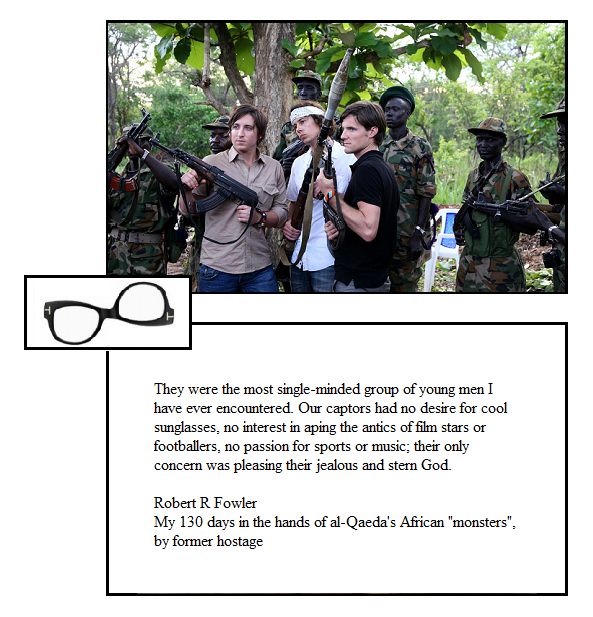
Above:

In the Glenna Gordon photo above the text is Jason Russell, the film-maker who put together the Joseph Kony 2012 campaign, who says of himself:

I am a rebel soul: dream evangelist. I am obsessed with people. I tell stories by making inspiring movies that move people’s emotions, and then I take those emotions and transform them into action. My middle name is Radical. I married my best friend.

— radical, yeah, and looking “tough” — or as one commentator on the Visible Children tumblr said, “posing”:

Here’s a photo of the founders of Invisible Children posing with weapons and personnel of the Sudan People’s Liberation Army. Both the Ugandan army and Sudan People’s Liberation Army are riddled with accusations of rape and looting, but Invisible Children defends them, arguing that the Ugandan army is “better equipped than that of any of the other affected countries”, although Kony is no longer active in Uganda and hasn’t been since 2006 by their own admission. These books each refer to the rape and sexual assault that are perennial issues with the UPDF, the military group Invisible Children is defending.

Below:

By way of contrast: the text below the photo is culled from Robert R Fowler‘s searing account of his al-Qaeda in the Islamic Maghreb (AQIM, but please don’t call it AA-kem) captors. As he also said:

Kidnappings of Westerners have fueled debate among securocrats as to whether our AQIM captors might simply bandits flying an Islamic flag of convenience. I know that to be the wrong answer. Our kidnappers were utterly focused religious zealots who believed absolutely in their cause. They sought to expel Western infidels from Muslim lands and to destroy what they saw as apostate Western-stooge governments who were usurping God’s purposes across the Muslim world. The concepts and ideals we hold most dear were anathema to them: liberty, freedom, justice, democracy, human rights, equality between the sexes — all matters which they considered to be the exclusive province of Allah.

Yes, that contains the popular idea that “they hate us for our freedoms” — but in the context of what I can only call ruthless religious idealism.

Fowler is very clear on that. And no posing.

Sounds like Fowler’s book, A Season in Hell, goes right onto the anti-library lists.


Switch to our mobile site