zenpundit.com » creativity

Archive for the ‘creativity’ Category

Sherlock Holmes, Hannibal Lector and Simonides

Sunday, March 3rd, 2013

[ by Charles Cameron — the art of memory, with a sidelong glance at swans, typhoid and theodicy ]
.

Thomas Harris (and by extension Hannibal Lector) has been interested in memory palaces for a long time. We can begin to infer this this because Lector describes his hobby in Red Dragon (1981) and again in Silence of the Lambs (1988):

So — church collapses?

**

As you can tell from that last comment in the Silence of the Lambs quote — to my mind the most brilliant presentation of the problem of theodicy for our day — if there’s a God worth defending, it has to be a God who allows sparrows to fall, typhoid to accompany swans in the vast ecology of existence, churches to collapse on worshipers, and “bad things to happen to good people” from time to time.

And such things, specifically including collapses of religious buildings atop worshipers, do indeed happen in fact as well as fiction.

And they don’t only happen to Christians, either… Bon is the shamanistic religious tradition of Tibet, prior to — and later, somewhat assimilated by — Buddhism

**

The thing is, when I read that Hannibal Lector collected church collapses, it not only made me start to take note of them myself, it also made me think of Simonides. As Frances Yates tells us in her book, The Art of Memory:

At a banquet given by a nobleman of Thessaly named Scopas, the poet Simonides of Ceos chanted a lyric poem in honour of his host but including a passage in praise of Castor and Pollux. Scopas meanly told the poet that he would only pay him halfthe sum agreed upon for the panegyric and that he must obtain the balance from the twin gods to whom he had devoted half the poem. A little later, a message was brought in to Simonides that two young men were waiting outside who wished to see him. He rose from the banquet and went out but could find no one. During his absence the roof of the banqueting hall fell in, crushing Scopas and all the guests to death beneath the ruins; the corpses were so mangled that the relatives who came to take them away for burial were unable to identify them. But Simonides remembered the places at which they had been sitting at the table and was therefore able to indicate to the relatives which were their dead. The invisible callers, Castor and Pollux, had handsomely paid for their share in the panegyric by drawing Simonides away from the banquet just before the crash. And this experience suggested to the poet the principles of the art of memory of which he is said to have been the inventor. Noting that it was through his memory of the places at which the guests had been sitting that he had been able to identify the bodies, he realised that orderly arrangement is essential for good memory.

And by way of reinforcing my Lector-Simonides conjecture, Lector certainly had a remarkable interest in memory, as we learn from his dialogue with Clarice Starling:

“Did you do the drawings on your walls, Doctor?”
“Do you think I called in a decorator?”
“The one over the sink is a European city?”
“It’s Florence. That’s the Palazzo Vecchio and the Duomo, seen from the Belvedere.”
“Did you do it from memory, all the detail?”
“Memory, Officer Starling, is what I have instead of a view.”

A belvedere, from the Italian, is “a structure (as a cupola or a summerhouse) designed to command a view” — and a beautiful view at that. Belvedere is also, ironically, the name of the town in Ohio where Buffalo Bill, Lector’s serial killer ex-patient, lives…

**

So it didn’t surprise me to discover that in Hannibal (1999), the book that follows Silence, this brilliant man who as we have seen collects church collapses and has an exquisite memory in place of a view, is revealed as a practitioner of Simonides’ art:

The memory palace was a mnemonic system well known to ancient scholars and much information was preserved in them through the Dark Ages while Vandals burned the books. Like scholars before him, Dr. Lecter stores an enormous amount of information keyed to objects in his thousand rooms, but unlike the ancients, Dr.Lecter has a second purpose for his palace; sometimes he lives there. He has passed years among its exquisite collections, while his body lay bound on a violent ward with screams buzzing the steel bars like hell’s own harp.

Hannibal Lecter’s palace is vast, even by medieval standards. Translated to the tangible world it would rival the Topkapi Palace in Istanbul for size and complexity.

We catch up to him as the swift slippers of his mind pass from the foyer into the Great Hall of the Seasons. The palace is built according to the rules discovered by Simonides of Ceos and elaborated by Cicero four hundred years later; it is airy, high-ceilinged, furnished with objects and tableaux that are vivid, striking, sometimes shocking and absurd, and often beautiful. The displays are well spaced and well lighted like those of a great museum. But the walls are not the neutral colors of museum walls. Like Giotto, Dr. Lecter has frescoed the walls of his mind.

Brilliant. And a delight, years later, to have my hunch connecting the church collapses and prison cell with only memory for a view with Simonides and the Art of Memory confirmed by the third book and film in the series…

You’ll note, btw, that the Lector (caveat lector) of the first two books has now become Lecter in alignment with the films starring Anthony Hopkins.

**

I love symmetries, so let’s move from the most monstrous criminal mind in literature, to the greatest detective…

Sherlock Holmes — in his latest television incarnation — builds memory palaces of a sort, though I’m not sure Simonides would recognize them.

I’m posting the clip from the series here to honor my son Emlyn, with whom I have been watching the series…

**

And then there’s the Jesuit whose use of the Art is explored in Jonathan Spence‘s The Memory Palace of Matteo Ricci:

In 1596 Matteo Ricci taught the Chinese how to build a memory palace. He told them that the size of the palace would depend on how much they wanted to remember: the most ambitious construction would consist of several hundred buildings of all shapes and sizes, “the more there are the better it will be,” said Ricci, thought he added that one did not have to build on a gradiose scale right away. One coul create modest palaces, or one could build less dramatic structures such as a temple compound, a cluster of government offices, a public hostel, or a merchants’s meeting lodge. If one wished to begin on a still smaller scale, then one could erect a simple reception hall, a pavilion, or a studio. And if one wanted an intimate space one could use just the corner of a pavilion, or an altar in a temple, or even such a homely object as a wardrobe or a divan.

You’ll note that in this early example of virtual reality as an pedagogical technology, Ricci doesn’t start with the easy stuff, the single wardrobe or divan — he begins with “the most ambitious construction”…

Enough for now. When I want to talk about in a follow up post is detail… the crucial importance of detail.

Profiling Baader-Meinhof

Tuesday, January 15th, 2013

[ by Charles Cameron — fast cars, bumper stickers — and no mention of loose women ]
.

-- I'm not a member of the Baader-Mainhof gang

.
The sentence that drives my title is this one, from How BMW Became A Terrorist Icon In The 1970s (And How It Made Them Cool) on Jalopnik:

police would set up roadblocks and stop only BMWs in an attempt to root out the gang members from the general population.

That’s profiling for you, eh?

**

Here’s a longer excerpt, so you see where this comes from — and how it turned out, at least for as the makers of BMWs:

In the early 1970s, the extreme left wing Baader-Meinhof Gang terrorized the people of West Germany with a campaign of bombings and assassinations aimed at dismantling a capitalist system they considered no better than the Third Reich.

The terrorists’ ride of choice? BMW New Class sedans and coupes, according to this documentary from historian Richard Huffman, an expert on the Baader-Meinhof Gang.

Huffman says cars became so strongly associated with the group’s acts of terror that police would set up roadblocks and stop only BMWs in an attempt to root out the gang members from the general population.

People even started saying that “Bavarian Motor Works” actually stood for “Baader-Meinhof Wagen.” Some BMW drivers even had to slap bumper stickers on their cars specifying that they weren’t terrorists.

You might expect this to have been a major PR crisis for BMW, then a small and nascent regional automaker nowhere near as prominent as it is today. But it wasn’t. That’s because the Baader-Meinhof Gang, later known as the Red Army Faction, enjoyed a surprising amount of support from people in West Germany, especially among young people and members of the left-leaning counterculture. This went a long way toward making the car seem hip in German youth culture.

Then the gang stopped being theoretical revolutionaries and actually started murdering Germans and U.S. soldiers. When the body count began to rise, public support evaporated. As for BMW, they emerged unscathed from the crisis, and started growing into the luxury giant they are today.

**

Now, what kind of analytic model would predict a series of twists and turns and hairpin bends like that?

Infinite in faculty, quintessence of dust

Saturday, January 12th, 2013

[ by Charles Cameron — on the cutting off of hands, the eternal life of martyrs, and the vast and petty nature of we poor amazing humans ]
.

As you know, I love apposite juxtapositions between religious texts – if you’re into cognition, it’s called pattern recognition, in Jung or Plato it would be familiarizing oneself with the archetypes, and in terms of creativity it’s “one swell foop” of analysis and synthesis, an oak in an acorn, insight in a nutshell.

At times, as here, the comparison presents a significant similarity that “sees things” from a very different vantage point from our everyday selves – a refreshing and salutary reminder, perhaps, from high altitude, even if it’s not the street-level view we require to navigate life’s many smaller obstacles and minor goals.

**

Here are two such comparisons that have served a somewhat different purpose for me –- showing me that aspects of another religion’s practice that I find shocking have echoes in my own tradition. I do not claim these correspondences to be exact — but if we allow them to be, I believe we may find them illuminating:

and:

My hope is that such examples can help us to approach the “other” with greater respect and understanding — where we agree, and even where we strongly disagree.

In the way of peace. For it is written in the Injil, in the Gospel (Matthew 5:9):

Blessed are the peacemakers: for they shall be called the children of God.

**

But to return us to the high altitude view from which we began, I’ll give Shakespeare the final word:

   HAMLET: I have of late–but
wherefore I know not–lost all my mirth, forgone all
custom of exercises; and indeed it goes so heavily
with my disposition that this goodly frame, the
earth, seems to me a sterile promontory, this most
excellent canopy, the air, look you, this brave
o’erhanging firmament, this majestical roof fretted
with golden fire, why, it appears no other thing to
me than a foul and pestilent congregation of vapours.
What a piece of work is a man! how noble in reason!
how infinite in faculty! in form and moving how
express and admirable! in action how like an angel!
in apprehension how like a god! the beauty of the
world! the paragon of animals! And yet, to me,
what is this quintessence of dust?

For fans of Daniel Suarez? Iain McGilchrist?

Saturday, January 12th, 2013

[ by Charles Cameron — on, as usual, binocular vision, but this time 2020 as well as 20/20 ]
.


.

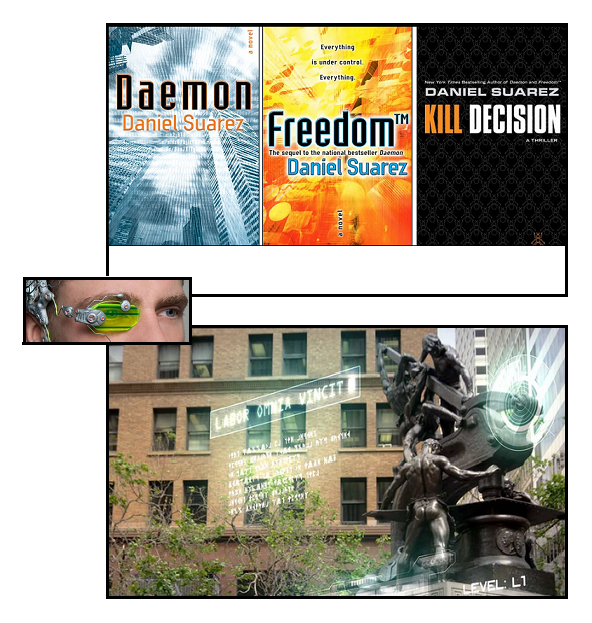
I’m about half way through Freedom(TM), the second of the books in the trilogy by Daniel Suarez which began with Daemon and (I believe) ends with Kill Decision — I’d have finished all three pretty much as fast as I could lay my hands on them if I wasn’t trying to write quite so much myself. As those who have read or are reading the books know, there’s a lot in there about the difference in perspective between those who have and don’t have “augmented reality” glasses.

Since I tend to like to have at least two lenses through which to view things — and am interested in general in what William Blake called “fourfold vision” — the topic itself is of interest me, quite aside from its potential to illuminate some pretty obscure corners of near future possibilities.

Likewise, I’d like to have some roughly parallel universe with which to compare the one Suarez is providing me with — and this video introducing a game called Ingress looks like a suitable “second lens” to set up a stereoscopic inquiry and arrive at a measure of depth:


.

I’m not looking to make a qualitative comparison between the books and the game here, just to ask if anyone with access to both would like to discuss what we can learn from juxtaposing them?

**

Because juxtaposition is key. Because, as Iain McGilchrist says in his speech The Divided Brain and the Courage to Think Differently:

There’s an oddity about the brain, which is that it makes all its everything that happens — the multifarious beauty of the world — come out of connections. It exists only to make connections.

Because, as he also says:

Relations matter more than things.

So that a marvelous counterpoint to Suarez’ fast-paced action-oriented techno-thriller imagination is McGilchrist’s slow-paced psycho-stiller contemplative approach:


.
I hope you’ll find time to appreciate them both.

Two pebbles in the pond of thought

Saturday, January 12th, 2013

[ by Charles Cameron — regarding the idea that Islam might be monolithic as well as monotheistic, and more generally, the patterns created when concentric ripples intersect ]
.


.

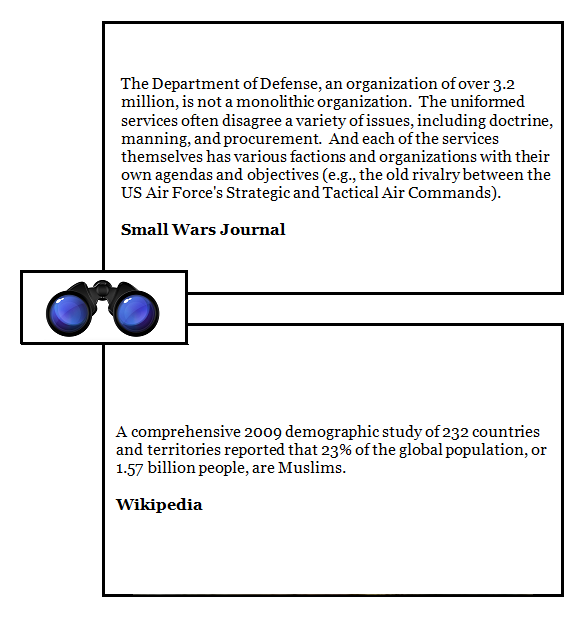
Drop these two pebbles into the pond of thought, and watch the ripples as they intersect, overlap, enhance one another, cancel each other out and continue…

**

It may seem obvious that Islam is not, and could not possibly be, a monolithic entity — but I want to suggest something more than that fairly basic fact.

I want to suggest that just as we have all enjoyed watching the way concentric ripples fan out from the place where a pebble — or a raindrop — hits a pond, and the fascinating ways win which two or more such ripples intersect —

— in much the same way, it can be fascinating — and often illuminating — to watch the way in which ripples of thought in the thought pond intersect.

In fact, that’s the basic “move” behind all creativity.

**

My sources for the two quotes above:

Small Wars Journal, Disruptive thinking
Wikipedia, Islam

My sources for the two images above:

Doodles and jots, ripple effects
David Armano on “ripples of influence”


Switch to our mobile site