zenpundit.com » islamist

Archive for the ‘islamist’ Category

On Islam 1: Reuel Mark Gerecht

Tuesday, November 26th, 2013

[ by Charles Cameron — on an impressive video, featuring Matt Levitt and Reuel Gerecht on Hezbollah ]
.

Matthew Levitt‘s contribution to a recent panel at the International Soy Museum was a tour de force. Levitt, whose work as a CT analyst has included stints with both the FBI and Treasury, was discussing his most recent book, Hezbollah: The Global Footprint of Lebanon’s Party of God — both the book and his talk are strongly recommended.

It is, however, his colleague Reuel Marc Gerecht‘s contribution to that session that I wish to highlight here, because [starting at 44.40] he made a point about Hezbollah from his own CT experience that he still finds it necessary to make in 2013, some two decades after his service with the CIA commenced in the 1990s:

One of the things I was struck by when I came into the Agency, and I was struck by it on the day that I left the Agency, which was: you almost never had officers either on the clandestine side or in the directorate of analysis, the Directorate of Intelligence, talk about God. You just didn’t have that many people sort of put it together and talk about what actually motivated people.

You know, there was almost an assumption out there, Oh, the Iranians were upset with us because of our dealing with the Shah etcetera, but the actual analysis of the Iranian complaint against the United States was distinctly secular. Even the analysis of the Hezbollah was distinctly secular. And it never made any sense, particularly if you started to have some exposure to these individuals, and you suddenly realized that no, their motivations aren’t secular usually, their motivations are actually deeply spiritual, they’re religious, they’re about God.

— and [starting 53.04]:

There is a profound reflex in the West to look at a group like Hezbollah, and to look at their Iranian sponsors, and to take God out of the equation. Don’t do that. We wouldn’t do it with al-Qaida. Don’t do it with these groups either. If you do that, if you neuter them of their religious belief, if you look at it as just an ethnic movement, if you look at it as just a sectarian movement, if you look at it as just the Shi’a getting even in Lebanon, then you’re making an atrocious analytical mistake, which will bushwhack you, I guarantee you, over and over again. You have to keep God in this equation…

The one bright spot in this dismal account of the secular mindset blinding itself to religious passion is Gerecht’s statement: “We wouldn’t do it with al-Qaida”.

**

For more on the way our own worldviews can blind us to the worldviews of others, see my post on Gaidi Mtaani, together with the two follow ups to that post which I shall be posting here shortly.

A certain symmetry in malls

Tuesday, November 19th, 2013

[ by Charles Cameron — Gezi Park and Westgate Mall through the lens of the Garden of Good and Evil ]
.

Sheer madness, I know — but there’s a method to it.

I was watching Clint Eastwood‘s brilliantly funny film Midnight in the Garden of Good and Evil last night, and noted with delight the symmtery between two of his Savannah characters — one a gentleman who walks an invisible dog through a park on a leash [upper panel, above], and the other a fellow who attaches house-flies on threads to his lapels, so that he can walk his pets to the nearby diner for breakfast [lower panel]…

**

Here’s where the sheer madness comes in, and the method it encourages.

With symmetry still on a back burner in my mind, I was reading Michael Klare‘s post Planet Tahrir: The Coming Mass Demonstrations against Climate Change (Klare) on Juan Cole‘s blog this morning, and ran across this sentence:

on May 27th, a handful of environmental activists blocked bulldozers sent by the government to level Gezi Park, a tiny oasis of greenery in the heart of Istanbul, and prepare the way for the construction of an upscale mall.

An upscale mall.

Beth Gill‘s essay, Temples of Consumption: Shopping Malls as Secular Cathedrals details a central analogy of our time, and it’s only fitting that the desire to replace an “oasis of greenery” by building an “upscale mall” was what triggered the Gezi Park uprising, just as the destruction of an “upscale mall” in Nairobi, Kenya, was the recent target and mise-en-scene of al-Shabaab’s recent “martyrdom brigade” and their murderous rampage.

The symmetries and ratios of garden and mall, cathedral and mall, construction and destruction, paradise and consumption are thrown up for our consideration by this juxtaposition of Gezi and Westgate.

What can we learn from them?

Gaidi Mtaani, the greater scheme of things, I: the story

Thursday, November 14th, 2013

[ by Charles Cameron — in a story, in a nutshell, the very different world of al-Shabaab ]
.


.

The third issue of of the pro-Shabaab magazine Gaidi Mtaani, issued a few months back, contained a long piece titled A Greater Scheme of Things, and in it I’d like to zero in on the extraordinary story which is the heart of the piece — and which offers us a fasacinating insight into jihad:

it was luminously evident, for me personally, in one memorable incident in Mogadishu’s frontline last year. Just after Dhuhur prayer, one particular day in March, the Mujahideen received news that the enemy was preparing to mount a large offensive in the Northern parts of the city – in an area that was then newly captured by the Mujahideen.

In no time, the news spread across the entire frontline and the Mujahideen geared up for a protracted battle. New defence posts were erected, the old ones were fortified, trenches were dug, reinforcements were called in, snipers were placed on rooftops and small groups of well-equipped fighters were strategically positioned to guard every street and every alley. Garrisoned in the makeshift base, a short distance behind the frontline, were dozens of young martyrdom seekers, each eager to engage the enemy once called. A flurry of activity engulfed the bullet-battered neighbourhood as sporadic gunfire resonated across the empty streets and a countless number of vehicle-mounted weapons, such as ZU-23 and B-10, Dhshk, Shilka, were all streaming in and out of the base to take their positions. Upon seeing the long line of military vehicles and artillery, one of the fighters erroneously remarked in amazement: ‘today we will defeat these African invaders.’ Materialistically, all possible preparations were made to defeat the encroaching enemy, but were they enough to achieve victory?

Just after Asr that day, the battle began in deadly earnest, with ear-splitting explosions and exchange of gunfire reverberating from all corners from the city. A salvo of mortars ripped through the fragile rooftops, grenades exploded with alarming ferocity, tanks bulldozed buildings and reduced them to rubble and a hail of bullets cracked into the shell-bestrewn streets. In the backdrop of such a frenzied atmosphere, the Mujahideen maintained remarkable inner tranquillity, for the believer’s heart is an island of santy in such a setting. They’ve put up a sturdy defence in all corners, necessary arrangements were made to outflank the enemy and the chants of Takbeer were gradually rising above the cruel cacophony of gunfire. But something strange was also happening: all the artillery brought by the Mujahideen failed to fire a single shot! The guns were cleaned, lubricated, loaded and reloaded, but they still recoiled without firing a round and with the bullet jammed in the barrel. The field commanders hopped from trench to trench, through tunnels, in order to analyse and resolve the situation, but all their efforts were in vain.

‘Today we will defeat these African invaders’ chimed in the memory of one of the commanders and that’s when they had realised that what was happening was in fact a punishment for a grave sin they had committed: trusting in the abilities of their weapons. The certitude with which the statement was expressed proved to be destructive and no sooner had the Mujahideen recognised the mistake and repented than the very same artillery, almost instantaneously, began firing again. The Mujahideen managed to repel the enemy, but those who’ve uttered the statements also learnt a great lesson: that fortifying the bastion of Eeman must take precedence over building a substantial military arsenal; for military arsenal can never bring victory without Eeman.

Such is the clear manifestation of Allah’s absolute control over all affairs that the Kuffar have failed to comprehend.

I’ll comment on this story in a follow-up post: for now, I’d just like to let this very revealing tale hang in the air for your consideration…

Your comments are most welcome.

**

Source:

  • Gaidi Mtaani #3, safe copy available from Jihadology, pp. 12-15
  • Of death and children, one way or the other

    Wednesday, November 13th, 2013

    [ by Charles Cameron — thoughts triggered by the Jeremy Scahill & Lawrence Wright documentaries ]
    .

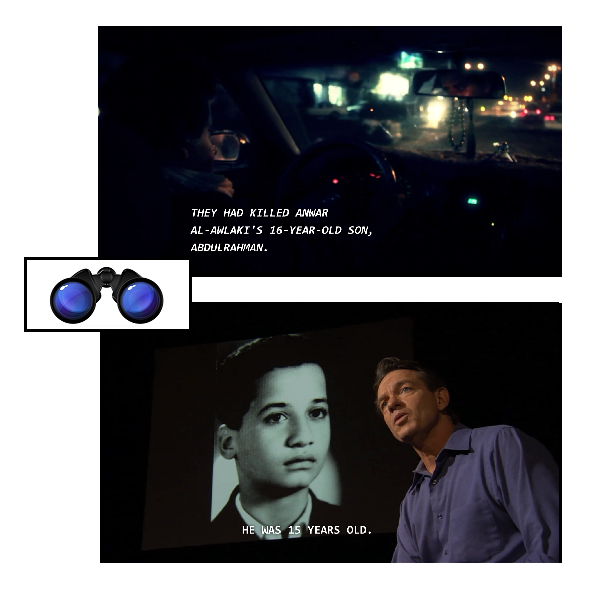
    I don’t really enjoy writing this, because I’m loath to suggest that sixteen year old Abdulrahman al-Awlaki was in fact a combatant, though it seems to me that he might have been. I was viewing documentaries the other night, though, and when Jeremy Scahill‘s Dirty Wars [upper panel, below], which deals with Abdulrahman, was followed directly by Lawrence Wright‘s My Trip to Al-Qaeda [lower panel, below], the age at which Ayman al-Zawahiri began his career as a radical stuck out like a sore thumb:

    Here, then, is Wright’s commentary on the young al-Zawahiri:

    Ayman al-Zawahiri, the man behind Bin Laden, a doctor, product of a distinguished family, from an exclusive suburb of Cairo called Maadi, his father was a professor of pharmacology; his mother — the daughter of a diplomat… Ayman had started a cell to overthrow the Egyptian government in 1966. He was 15 years old.

    How much agency do we believe fifteen and sixteen year olds have, anyway? Do we allow them to drink a beer?

    If we are ever going to have a debate as to the moral high ground in matters of the extrajudicial killing of US citizens, it seems to me that Abdulrahman al-Awlaki rather than his father Anwar should be the test case we focus in on.

    The truth is that young people, sometimes very young people, do on occasion play with fire. I don’t think that means we should “burn” them on suspicion, but I do think it’s part of the larger picture. And in this case, that means “drone warfare” and “targeted killings” aren’t the only relevant categories: we may need to factor the issue of “child soldiers” into our considerations as well.

    **

    Here, to give the Awlaki family’s side of the story, is an ACLU video with Abdulrahman Awlaki’s grandfather:

    **

    And how did I wind up here?

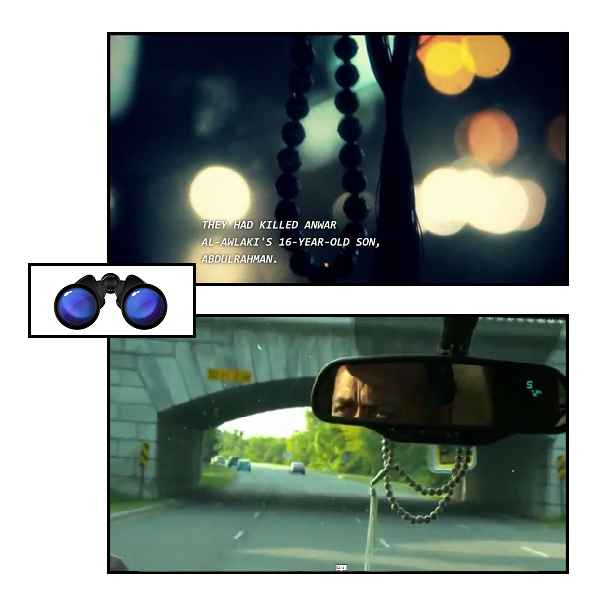
    Well, as I said, I was watching documentaries… but the first thing that caught my eye, to be honest, was this shot from Dirty Wars [upper panel, below], which ineitably reminded me of the rosary-and-rear-view-mirror shot from Manhunt [lower panel]…

    which I’d talked about in an earlier post, Manhunt: religion and the director’s eye.

    I’m beginning to think no documentary about jihad and counterterrorism is complete without one…

    Ayatollah Khameini: Crony Capitalist and Slumlord

    Wednesday, November 13th, 2013

    [by Mark Safranski, a.k.a. “zen“]

    Reuters has begun a remarkable series on the economic dealings of Iran’s Supreme Leader, Ayatollah Khameini who controls a staggering fortune of $ 95 billion dollars through a secretive fund Setad that expropriates the property of poor Iranians and religious minorities. This would put the venerable theocrat in the same superclass as Bill Gates, Carlos Slim, Warren Buffet and the Sultan of Brunei .

    Up until now, former Iranian president Rafsanjani has always been the face of financial corruption in Iran’s clerical hierarchy, but to paraphrase John D. Rockefeller’s comment about J.P. Morgan, compared to Khameini ” he’s not even a rich man”:

    Khamenei controls massive financial empire built on property seizures 

    The 82-year-old Iranian woman keeps the documents that upended her life in an old suitcase near her bed. She removes them carefully and peers at the tiny Persian script.

    There’s the court order authorizing the takeover of her children’s three Tehran apartments in a multi-story building the family had owned for years. There’s the letter announcing the sale of one of the units. And there’s the notice demanding she pay rent on her own apartment on the top floor.

    Pari Vahdat-e-Hagh ultimately lost her property. It was taken by an organization that is controlled by the most powerful man in Iran: Supreme LeaderAyatollah Ali Khamenei. She now lives alone in a cramped, three-room apartment in Europe, thousands of miles from Tehran.

    ….But Setad has empowered him. Through Setad,Khamenei has at his disposal financial resources whose value rivals the holdings of the shah, the Western-backed monarch who was overthrown in 1979.

    How Setad came into those assets also mirrors how the deposed monarchy obtained much of its fortune – by confiscating real estate. A six-month Reuters investigation has found that Setad built its empire on the systematic seizure of thousands of properties belonging to ordinary Iranians: members of religious minorities like Vahdat-e-Hagh, who is Baha’i, as well as Shi’ite Muslims, business people and Iranians living abroad.

    Setad has amassed a giant portfolio of real estate by claiming in Iranian courts, sometimes falsely, that the properties are abandoned. The organization now holds a court-ordered monopoly on taking property in the name of the supreme leader, and regularly sells the seized properties at auction or seeks to extract payments from the original owners.

    The supreme leader also oversaw the creation of a body of legal rulings and executive orders that enabled and safeguarded Setad’s asset acquisitions. “No supervisory organization can question its property,” said Naghi Mahmoudi, an Iranian lawyer who left Iran in 2010 and now lives in Germany.

    The Persian name of the organization that hounded her for years is “Setad Ejraiye Farmane Hazrate Emam” – Headquarters for Executing the Order of the Imam. The name refers to an edict signed by the Islamic Republic’s first leader, Ayatollah Ruhollah Khomeini, shortly before his death in 1989. His order spawned a new entity to manage and sell properties abandoned in the chaotic years after the 1979 Islamic Revolution.

    It used to be said back in the 70’s by Western intellectuals of the tweedy, social democratic, Left variety that the future would be a merging of Communism and Capitalism into a “Third Way”, perhaps, it was optimistically suggested, of the gentle Scandinavian variety with, democracy, universal free child care and quaint, bicycle-riding, constitutional monarchs. I doubt anyone thinks that today. If there is any emerging universal model at all it is that of nasty authoritarian governments being run, sometimes under a facade of elections, by a bareknuckle, crony capitalist Oligarchy that hollowed out the state.

    Sometimes,the crony capitalists are merely the junior partners to the mandarins, siloviki and mullahs and at other times you could look “….from pig to man, and from man to pig, and from pig to man again” and be hard pressed to tell the difference.

    Khamenei’s conglomerate thrived as sanctions squeezed Iran 

    ….The ayatollah’s organization would go on to acquire stakes in a major bank by 2007 and in Iran’s largest telecommunications company in 2009. Among dozens of other investments, it took over a giant holding company in 2010.

    An organizational chart labeled “SETAD at a Glance,” prepared in 2010 by one of Setad’s companies and seen by Reuters, illustrates how big it had grown. The document shows holdings in major banks, a brokerage, an insurance company, power plants, energy and construction firms, a refinery, a cement company and soft drinks manufacturing.

    Today, Setad’s vast operations provide an independent source of revenue and patronage for Supreme Leader Khamenei, even as the West squeezes the Iranian economy harder with sanctions in an attempt to end the nuclear-development program he controls.

    “He has a huge sum at his disposal that he can spend,” says Mohsen Sazegara, a co-founder of the powerful Islamic Revolutionary Guard Corps military force, who is now living in exile in the United States. “When you have this much money, that’s power itself.” 

    Indeed. It insulates Khameini’s core supporters from external financial pressure and allows Khameini to have an arsenal of carrots, not just sticks in dealing with other members of the Iranian ruling elite.

    It is often overlooked how frequently dictators, even those who were known for ruling through terror like Hitler, Stalin and Mao, could be lavishly generous with gifts and financial rewards or indulged the blatant corruption of powerful subordinates like Goering, Abukumov or Kang Sheng. Every Grand Ayatollah and Marja in Shia Islam maintains a charitable trust to which their pious followers donate. I would be extremely surprised if Khameini, whose scholarly credentials share similarities with Leonid Brezhnev’s military decorations, had not made arrangements for substantial contributions over the years from Setad to the trusts of Iran’s most respected senior clerics.

    Baksheesh is an older faith in Iran than is Islam.


    Switch to our mobile site