zenpundit.com » terrorism

Archive for the ‘terrorism’ Category

Wilf Owen on Killing Your Way to Control

Tuesday, July 5th, 2011

Wilf Owen, noted Clausewitzian and Editor of Infinity Journal has a provocative new piece up at SWJ Blog:

 Killing Your Way to Control

The population is not the prize. The population are the spectators to armed conflict. The prize is the control the government gains when the enemy is dead and gone. Control only exists when it is being applied, and it exists via the rule of law. The population will obey whoever exercises the power of law over them. Power creates support. Support does not create power. This is the source
of great confusion.

….In general terms killing the wrong people (civilians) may undermine the political objective being sought. Whether it does or does not will be the policy context. How proportionately, precisely or discriminately lethal force is applied will be dependant on the tactics employed. Thus Rules of Engagement (ROE) are those limitations on lethal force and military activity that armed forces use to ensure that force does not undermine policy.

….All the new counter-insurgency theorists concede, some killing is required but to quote FM3-24 while necessary, especially with respect to extremists [killing] by itself cannot defeat an insurgency. Again this makes no sense, unless as part of a defence mounted to preserve the idea that you cannot kill and capture your way to success. Those who are extremists do not become apparent or may not even exist until the ranks of the enemy have been thinned by death, desertion and surrender. Until lethal force is focused on the enemy, the extremists may not be apparent, and who is and is not an extremist is irrelevant if they are clearly armed and thus a legitimate target within the ROE.

Killing and capturing are important, because lesser forms of operation aimed at disrupting or dislocating while useful, may allow the enemy to survive. Dead and captured cannot return at some later date to re-contest any issue they see fit. Warfare against irregular forces is won in a similar way to warfare against regular forces. The only major differences is that force usually has to be employed far more precisely, discriminately and proportionately. This is because lethal force will be applied close to or within a population that you are politically/legally required to protect. The other difference is that lethal force will be focussed at the individual level. This is a general distinction from that of fighting regular forces where operations would seek to defeat units and formations in part or as a whole.

The case of Algeria, during the 1990’s with the battle between Islamist rebel-terrorists and a radical Arab-socialist dictatorship provides some support for Owen’s ideas regarding killing and the separation of opponents into extremists and moderates. The government, which applied force with minimal constraints, did succeed in killing off the leadership cadres of the FIS, GIA and MIA faster than they could be properly developed, leaving leadership in the hands of either younger, more radical but less experienced men or causing the groups to accept government amnesty. 

Algeria of course enjoyed several advantages that the West lacks in places like Afghanistan – the Algerian rebels were isolated from the outside world and enjoyed minimal foreign support and the Algerian dictatorship conducted operations without regard to the laws of war in a media blackout, getting a pass from the international community because the behavior of the rebels was even worse. In Afghanistan, the center of gravity of the Taliban movement is the support of Pakistan’s ISI whch is using them as proxies to drive ISAF out of Afghanistan and the kind of punitive raiding into Pakistan to decimate Taliban manpower is forbidden by policy.

ADDENDUM:

Spencer Ackerman offers a spirited rebuttal to Wilf Owen:

Please, God, No More Stupid Anti-Counterinsurgency Arguments

…. Where to begin. Sometimes, as in nearly all counterinsurgency fights, the counterinsurgent cannot easily distinguish the insurgent from the civilian. That’s not always because of poor tactical intelligence or ignorance of a foreign culture. It’s because the guy who gives his old cellphone to his cousin so his old neighborhood friend can use it to construct IEDs for the guy paying a good going rate — quick, is he an insurgent or not? If you can’t immediately answer, Owen’s argument falls apart.

Even if you unflinchingly decide the guy’s an insurgent, killing the guy can easily inspire the whole neighborhood to rally to the insurgents’ cause. Quick: do you kill the guy so you can approach the Magic Number of dead insurgents that assures you victory? Or does not killing the guy take you further away from the Magic Number?

I know, I know. Counterinsurgency is OVER. Whatever context, wisdom or experience led people to consider it a least-bad option ought to be ignored. Its unsuitability for Afghanistan has rendered the entire enterprise inert. What, you didn’t read that National Journal piece?  

My only comment here is that Pop-centric COIN is only one brand of COIN that fits some situations better than others. I suspect much of the time in the near future, US military forces will be limiting themselves to FID, largely for budgetary reasons, and the host nation may see COIN differently than our current doctrine prescribes.

Martin van Creveld on The Lebanon War

Monday, June 27th, 2011


Eminent and controversial military historian, Martin van Creveld, analyzes the 2006 Israeli-Hezbollah War in the latest issue of Infinity Journal. Some Excerpts:

The Second Lebanon War: A Re-assessment

….Though the decision to retaliate in force was inevitable, it also meant that the Israel Defense Force (IDF) was taken by surprise and did not have time to prepare properly. Of the entire vast order of battle, only five regular brigades were immediately available. Moreover, these brigades had spent years doing little but carrying out counter-insurgency operations in the Occupied Territories. As a result, they had almost forgotten how to fight a real enemy; he who fights the weak will end up by becoming weak. Some of the burden fell on the Israeli Navy which shelled Lebanon’s coast, imposed a blockade, and cut the country off from the world. In doing so, one of its modern ships was hit by an Iranian-built surface to sea missile, suffering damage and taking some casualties. Since this was the first time in thirty-nine years anything of the kind had happened, it was a considerable propaganda victory for Hezbollah. At the same time it proved how much the crew had underestimated the enemy, since they (perhaps acting on their superiors’ orders) had not even switched on the vessel’s electronic defenses.

….”Stark raving mad” (majnun, in Arabic) was, in fact, the way many people in Lebanon and the rest of the Arab world reacted to the Israeli attack. As the statements of several of Hezbollah’s top leaders indicated, they too were surprised by the strength of the Israeli reaction. None of the organization’s original objectives were achieved. Its fighters remain in prison; the Israeli “occupation” of Shaba Farm continues; and Jerusalem, which it set itself as its ultimate objective to liberate, remains as firmly in Israeli hands as it has been during the last forty-four years. What the war did do was to show that, in case of war, neither Syria nor Iran would necessarily come to Lebanon’s rescue. The country’s infrastructure was left in ruins. Thirty thousand dwellings were destroyed or damaged, and dozens of bridges, underpasses, and gas stations demolished. Hundred of thousands of people were forced to flee, and as many as 2,000 killed.

Free registration required to read the article.

This piece is heavily IDF-centric in the analysis, perhaps reflecting van Creveld’s established authority on command and logistics and his recent work on air power, but I was surprised by the lack of space devoted to Hezbollah’s operations, given the author’s deep influence on 4GW theory and the study of postmodern irregular and asymmetric warfare. That may reflect, in part, the thrust of Infinity as a publication or the need for brevity but there’s an almost Clausewitzian subtext in the conclusion.

Humanity among Monsters: The Descent of Mexico

Thursday, June 2nd, 2011

From Boing Boing:

A kindergarten teacher in Mexico seeks to protect her students and calm their fears as narco-cartel fighters conduct a raging gun battle outside the window of her school. The woman has nerves of iron.

But hey…..Mexico can’t have an “insurgency” because the narcos don’t have “political” goals. Or a unified political goal. Or because there are still good vacation deals there at all-inclusive resorts. Or….Or…Or…. whatever flimsy rationale helps policy makers continue to punt the war next door.


Towards a Pattern Language for CT? III

Tuesday, May 17th, 2011

[ by Charles Cameron — all middle and no end ]

.

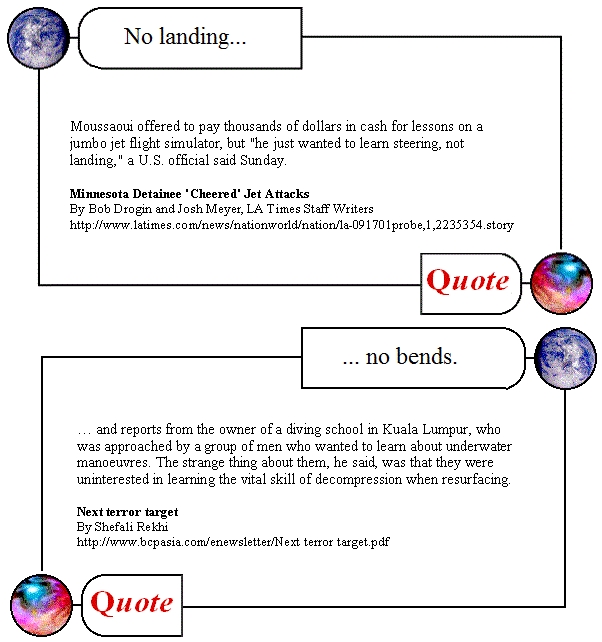
And while I’m at it, I might as well post one of the very first DoubleQuotes I put together when I was first experimenting with the format, sometime between October 2003 and June 2004

quo-pilots-divers.gif

I thought then, and I think now, that a walkway lined with dozens of little plaques presenting odd snippets of fact like either one of those would be a marvelous device for triggering associations in ambulatory analysts…

And it is a recurring pattern, isn’t it?

Ominously, there have been cases of terrorist pirates hijacking tankers in order to practice steering them through straits and crowded sea-lanes-the maritime equivalent of the September 11 hijackers’ training in Florida flight schools. These apparent kamikazes-in-training have questioned crews on how to operate ships but have shown little interest in how to dock them. In March 2003, an Indonesian chemical tanker, the Dewi Madrim, was hijacked off Indonesia. The ten armed men who seized the vessel steered it for an hour through the busy Strait of Malacca and then left the ship with equipment and technical documents.
.
Gal Luft and Anne Korin, Terrorism Goes to Sea, Foreign Affairs, Nov/Dec 2004

It helps to be alert to rhyming between ideas

Pakistan’s ISI On Trial….In Chicago

Friday, May 6th, 2011

As Pakistan’s corrupt military-feudal elite scramble to put out smoke after Osama bin Laden was caught and killed in an ISI safe house in Abbottabad and hire K Street lawyer-lobbyists like Mark Siegel at $ 75,000 a month, there are senior officials in Washington, inside and outside of the DoD, who doggedly championed Pakistan and defended the ISI behind closed doors.  These officials, as one DC correspondent in the know related to me, are now looking extremely foolish to their peers, even as they double-down and attempt to salvage a thoroughly discredited policy by spinning hard.

While attention is focused in Washington and Islamabad, Pakistan’s dreaded ISI is quietly going on trial. In Chicago.

An important post from Pundita:

U.S. government goes to lengths to shield Pakistan’s ISI at Rana trial in Chicago. Once again, keep your eye on the USG’s little cat feet.

This follows on my Tuesday post. The quotes I’ve pulled from ProPublica’s latest report on the upcoming trial of Tahawwur Hussain Rana will be upsetting to anyone who believes the U.S.-Pakistan relationship will change in significant fashion in light of the revelation that Osama bin Laden was quartered in a Pakistan garrison town.The ProPublica report presents clear evidence that all costs, including running roughshod over the American criminal justice system, the United States government will continue to cover for Pakistan’s military and intelligence services, as it’s done for decades. This is a point I emphasized in the Tuesday post so for anyone who thought I was being unduly pessimistic, read on. And be sure to read the rest of the report at the ProPublica site.Note from the report that the U.S. “intelligence community” still refuses to look at the Mumbai massacre in the context of the history of Pakistani military-sponsored terrorism and massacres going back decades. The community, at least according to the source ProPublica quotes, still insists that rogue officers, not the ISI institution, were responsible for the massacre in Mumbai.Before proceeding with the quotes I’ll note that ProPublica is an award-winning nonprofit American investigative journalism organization. It’s been keeping a close eye on Rana’s upcoming trial and other issues related to the 2008 massacre in Mumbai, India — to my knowledge the only U.S. media outlet that’s doing so despite the fact that six Americans were killed in the massacre. Here’s the link to earlier ProPublica reports on the issues.I’ve also included excerpts from a report posted at the Times of India news website that provide additional details about Rana and his trial.May 4, 2011, 5:11 p.m.

Pakistan’s Terror Ties at Center of Upcoming Chicago Trial
by Sebastian Rotella
ProPublica
It may be years, if ever, before the world learns whether Pakistan’s powerful Inter-Services Intelligence Directorate (ISI) helped hide Osama bin Laden. But detailed allegations of ISI involvement in terrorism will soon be made public in a federal courtroom in Chicago, where prosecutors last week quietly charged a suspected ISI major with helping to plot the murders of six Americans in the 2008 Mumbai attacks.The indictment has explosive implications because Washington and Islamabad are struggling to preserve their fragile relationship. The ISI has long been suspected of secretly aiding terrorist groups while serving as a U.S. ally in the fight against terror. The discovery that bin Laden spent years in a fortress-like compound surrounded by military facilities in Abbottabad has heightened those suspicions and reinforced the accusations that the ISI was involved in the Mumbai attacks that killed 166 people.“It’s very, very troubling,” said Congressman Frank Wolf, R-Va., chairman of the House Appropriations sub-committee that oversees funding of the Justice Department. Wolf has closely followed the Mumbai case and wants an independent study group to review South Asia policy top-to-bottom.“Keep in mind that we’ve given billions of dollars to the Pakistani government,” he said. “In light of what’s taken place with bin Laden, the whole issue raises serious problems and questions.”?

Read the rest here.

Read Propublica’s Mumbai Terror Attacks series.

If you have not heard about the Mumbai terrorism trial in Chicago, being carried out by Federal uber-prosecutor Peter Fitzgerald who is also prosecuting the high-profile, politically sensitive, retrial of former Illinois Governor Rod Blagojevic, it is no accident. In deference to State and the DoD, the Department of Justice is not exactly shouting about this terrorism case from the rooftops.

But somebody should.

There’s a lot of angst in this section of the blogosphere about the lack of strategy and the USG not looking at the larger picture. Well, the death of Bin Laden in the heartland of the military power structure that really rules Pakistan has been a wake up call that sent a normally somnambulent Congress into a state of anxiety. Good. Maybe if senators and congressmen hear from their constituents, they will less likely to be lulled to sleep again by Pakistan’s salaam alaikum‘ corner.

It is long past time for a deep, strategic, rethink of what ends America wants to accomplish in Central Asia and some hardheaded realism about who our friends really are.

UPDATE:

Pundita responds –U.S. and Pakistani damage control on Rawalpindi’s involvement in terrorism ignores much history

Christine Fair, an associate professor and Pakistan expert at Georgetown University in Washington DC, said Pakistan’s “record of helping us with al Qaeda is indisputable.”

Indisputable, huh? How about if you and I take a trip down memory lane, Professor Fair? Let’s link arms and skip back along a path piled high on either side with bodies of American dead.

The U.S. government paid their counterpart in Pakistan $25 million for Khalid Sheikh Mohammed. They paid $10 for another top al Qaeda operative, Abu Zubaydah.

Then Rawalpindi showed photographs of dead men with beards to the CIA, told them the corpses were al Qaeda operatives they’d killed, and got paid tens of millions of dollars in bounty. Some of those photographs cost the CIA one million dollars a pop.

I don’t think being skinned counts as receiving indisputable help, particularly when all signs point to top al Qaeda operatives such as KSM being ISI assets that the ISI sacrificed because they wanted the bounty money to keep themselves in business.

If you’d like to review the bounty program in detail, Professor Fair, you can read my November 2009 post, How the U.S. government built a perpetual-motion war machine in Afghanistan and sacrificed American values in the process

The upshot of the bounty program is that together the U.S. and Pakistan built a kind of perpetual motion machine:

At the end of every complex set of transactions between the CIA and the ISI, yet more enemy combatants materialize, to be rounded up or dispatched, leading to yet more enemy combatants to attack ISAF troops and nation-building efforts in Afghanistan, to be rounded up or dispatched, leading to — well, last night CNN reported that “Taliban” now control 80 percent of Afghanistan, even though only 7 percent of Afghanis support the Taliban.

The finding of Chicago-related terrorism plots on Osama bin Laden’s computer drives means that the trial takes on a new significance; Are Rana and Headley part of an operational cell designed to carry out attacks in the Windy City and not just a support team for Mumbai? 

Chicago TribuneTrial will probe alleged Chicago ties to Mumbai attack

While federal prosecutors link the alleged Mumbai plotters only to Lashkar, Headley has told investigators of a co-conspirator known only as “Major Iqbal,” who was working for Pakistan’s largest intelligence service, the Directorate for Inter-Services Intelligence, or ISI.

Further, Rana’s attorneys have also alleged in court documents that Rana believed Headley was working for ISI.


Switch to our mobile site