zenpundit.com » culture

Archive for the ‘culture’ Category

Pity America the Un-Philosophical

Tuesday, March 29th, 2011


I attempted to leave a short amusing response at Foreign Policy.com but was thwarted by their comment system, so I am writing a pedantic post here instead.

Joshua Keating, bursting with admiration for Bernard-Henri Levy, laments the lack of enlightenment of American politicians compared to their much cooler French counterparts:

Libyan intervention: Brought to you by Bernard-Henri Levy?

….I was going to write some kind of quip along the lines of, “Can you imagine President Obama taking phone calls from [American philosopher] in the oval office while he debates whether to send U.S. troops to war,” but I can’t even think of a name for whom that joke would make sense. 

France and Germany have a tradition of publicly engaged philosophers that’s pretty much alien to the United States. The idea of an American BHL or even Jurgen Habermas seems pretty laughable. Economists like Paul Krugman are the go-to public intellectuals here while philosophy has become an increasingly specialized and technical discipline, even within academia. What effect the prominence of philosophers in public life has on a country’s political culture and policies is a pretty promising subject for further research.

Heh. 

Philosophers have never had much of an impact on American public life and the politics of their times except…. maybe…. for William James, Reinhold Neibhur, John Dewey, Leo Strauss, Walter Lippmann, Ayn Rand, Herbert Croly, Sydney Hook, Allan Bloom, James Burnham, John Rawls and Thomas Kuhn. That’s just off of the top of my head. If you want to include economists as philosophers who influenced contemporary American political life – and, frankly, we often should – add Adam Smith, Karl Marx, John Maynard Keynes, Friedrich von Hayek, Ludwig von Mises, John Galbraith and Milton Friedman to the list. It should not need to be said, but America was founded on the ideals of philosophers like John Locke, Baron de Montesquieu and Cicero by men deeply steeped in moral and political philosophy. Some of the founders would have qualified as philosophers themselves.

I don’t know much about Mr. Keating. Pretty sure he is a sharp guy, but I bet he is 35 or younger and was a journalism or polisci grad. Academic philosophy as a profession has been increasingly irrelevant to policy makers or the general public as described, Keating is spot on there, since the early mid-60’s, which is probably the entirety of his life. It was not always this way. Formerly, philosophers wrestled with problems of general interest and were active public intellectuals, the determined self-marginalization of today’s professional philosophers notwithstanding.

It is a symptom of intellectual decline but the problem Keating identifies is not in American society or even in American politicians but in the philosophers.
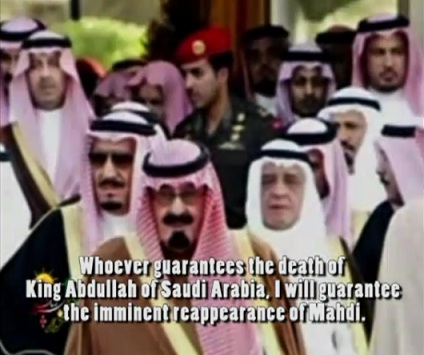
Soon soon coming of the Mahdi?

Monday, March 28th, 2011

[ by Charles Cameron ]

*

Okay, I’d say things are heating up. Here’s a screen grab from what we are led to believe is a recent video from Iran, made with government backing as described below the fold.

death-of-abdullah-sign-of-mahdi.jpg

This does not bode well…

*

The Christian thriller novelist Joel Rosenberg (author of The Twelfth Imam) has a new blog post up, in which he cites a Christian Broadcasting Network story — which in turn refers to a video posted with some introductory materials on his blog by Reza Kahlili (author of A Time to Betray: The Astonishing Double Life of a CIA Agent Inside the Revolutionary Guards of Iran).

According to Kahlili, who has also posted the full video to YouTube, it is a half-hour long program sponsored by the Basij militia and the Office of the President of Iran, affirming the soon-return of the Mahdi.

And containing “inflammatory language” about King Abdullah of Saudi Arabia (see subtitle above)?  Can I say that?

For what it’s worth, the supposed “hadith” about the death of King Abdullah is discussed in some detail at The Wake-Up Project, so it’s definitely “in the air” — but I don’t recall seeing any references to it in Abbas Amanat, Abdulazziz Sachedina, or any of the lists of Signs of the Coming I’ve read, so my suspicion is that this is an opportunistic addition to the corpus rather than a reliable hadith.

Which brings me to my last point:

I am not posting these materials to encourage panic — that’s what terrorism strives for, and it is the very opposite of what I would wish to see.  If anything, these stirrings of Mahdist sentiment should make us more careful and attentive to the serious scholarly work that has been done in this area.  Jean-Pierre Filiu‘s book Apocalypse in Islam, which I reviewed for Jihadology, would be an excellent place to start.

*

There are plenty of other things going on that I would love to track, blog about or comment on these days, but for the next while I shall try to restrain myself and focus in on this particular issue and its ramifications:

  • Contemporary Shi’ite Mahdist expectation
  • The Iranian nuclear program in the light of Mahdist expectation
  • Iranian attempts to use Mahdism to unite Sunni and Shi’a
  • Mahdism and jihad
  • The role of Khorasan in Mahdist rhetoric
  • Christian apocalyptic responses to Mahdist stirrings
  • Joel Rosenberg‘s book, The Twelfth Imam
  • Joel Richardson‘s book, The Islamic Antichrist
  • Glenn Beck‘s increasing focus on Iranian Mahdism
  • The increasing influence of Islamic and Christian apocalyptic on geopolitics

This is a pretty complex and potent mix of topics, and while I’ll post some individual pieces of the puzzle as I see it, I shall also try to put together a “bigger picture” piece with the whole mosaic laid out.

*

Apart from that, I remain deeply committed to questions of chivalry and peace-making, and will continue to monitor developments and write what I can on those topics as time allows…

The integration of religion and popular culture

Friday, March 25th, 2011

[ by Charles Cameron ]

*

Yesterday, I stumbled on the account of pole dancing for Jesus with the accompanying graphic. I was a little taken aback, I’ll admit, but Jesus didn’t confine his ministry to the pious and scholarly, he befriended women of questionable morals and enforcers from the Roman mob as I recall, or “publicans and sinners” to give them slightly more pleasant names – so I sat up, took notice, downloaded the image, and re-sized it to fit in the top position of one of my DoubleQuotes – while wondering if I’d have to wait till Doomsday to find a suitable companion piece.

quopole-dancing.jpg

All in a day’s screen-gazing, I wound up watching the Wong Kar-Wai film, Fallen Angels, last night, and lo: the screen-shot in the lower part of the DoubleQuote revealed itself.

There are interesting paradoxes embedded in each image, of course, pitting what you might call “deep” theology against pious expectation – but they also illustrate another matter of some interest to me, the degree to which religion is now richly integrated into popular culture.

*

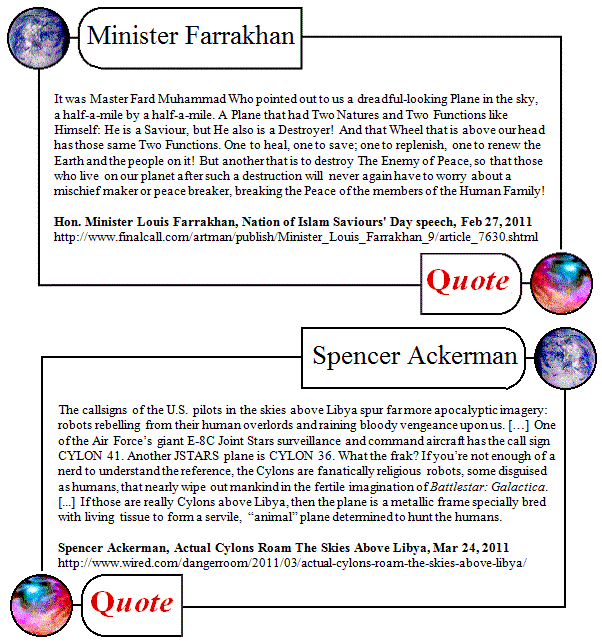
My second DoubleQuote, which contains today’s haul, deals with the same theme, I suppose — this time showing how what used to be the separate realms of science fiction and religion are now intermingled, with Minister Farrakhan speaking of an “end times” space craft that is an integral part of NoI eschatology in his annual Saviours’ Day speech, while alien aircraft flown by religious robots feature in a tongue-in-cheek news report about the war over Libya from Spencer Ackerman at the Wired War Room.

It is perhaps not surprising that Minister Farrakhan also cites Scientology with approval in the same speech, nor that that religion was itself the offspring of science fiction writer L Ron Hubbard. We are in a fertile period for the religious imagination, I believe, grappling to find new ways to answer the age-old questions — and science fiction and “signs in the skies” are among the vehicles, along with new religious movements and old religions renewed, by which we are coming to terms with life in this post-nuclear age…

quosigns-in-the-sky.gif

I’m not much of a prophet, but I predict that the confluence of science fiction with religion will prove to be one of the keys to an understanding of our times…

Book Review: Grand Strategies by Charles Hill

Monday, March 21st, 2011

Grand Strategies by Charles Hill

Charles Hill, senior Cold War diplomat, Hoover Institution fellow and a co-founder of Yale’s popular Grand Strategy Program that amounts to a crash course in the kind of classical liberal education that universities once imparted to undergraduates but today pride themselves in doing so no longer. The popularity of Hill’s program,  therefore, is with the students moreso than campus activists or the faculty:

…Despite whispers of words like “elitist,” “conservative,” and “cult”-words considered synonyms by many at Yale-The Grand Strategy seminar, only a few years old, has become one of the university’s marquee classes. Grand Strategy, like Professor Hill, has its own myth. The liberals on campus call the class Grand Fascism. They are kidding, but only in part. Many Yale students and faculty are suspicious of the program. Students awed or repelled by Grand Strategy are the same ones who are awed or repelled by Professor Hill, and for the same reasons: the aura of power, the whiff of elitism, the promise of an answer to life’s messiest questions.


If the Grand strategy Course at Yale is a distillation of classical liberal education, Grand Strategies: Literature, Statecraft and World Order is Hill’s reification of the course as an education for the reader on how the evolution of the Western civilizational worldview makes possible grand strategy. The book is an intellectual tour de force by Hill, at some times an idiosyncratic one and at all times an interesting one. I have read many, though very far from all, of the classic texts that Hill critiques and uses to shape his argument but having a large library under your belt is not a prerequisite from understanding Grand Strategies. Far from it, one suspects Hill wrote the book with his seminar students in mind.

Hill examines the protean and mythopoetic relationship between cultural foundations and expressions of power and political wills in conflict represented by diplomacy and war, both navigated by grand strategy constructed from cultural vision. A recurring theme in Grand Strategies is the heroic structure of the epic tale, with the descent into the Underworld and revelation of the heroic destiny by the shades and an ascent (not always successful or as ideally envisioned) to a creative, transformative new order. The reader meets Achilles in many guises, marches upcountry with Xenophon, is cast out of Heaven by Milton, confronts Hobbes‘ Leviathan, defies Rosseau’s general will and exorcises the evil represented in Dostoyevskii’s The Possessed. And this only is a tenth of the narrative.

While I frequently found myself in agreement with Hill’s discernments of the texts, some of them struck me as strained or highly debatable, such as Hill’s reading of Plato as a wry ironist ( Hill borrows from Leo Strauss here but goes further, if I recall correctly, than Strauss did), something that Carroll Quigley, Karl Popper or many classicists would have disputed. Hill’s final chapter, “The Writer and the State” is entertaining and contains a laudatory anecdote about Hill’s former boss, the impressive SECSTATE George Schultz , but it lacked some of the gravity of earlier chapters.

Erudite and visionary, Grand Strategies is a grand synthesis by Charles Hill with lessons to learn on every page.

(Special hat tip to J. Scott Shipman who pushed me to read and review this book)

Rationality: Saw this on Facebook

Thursday, March 17th, 2011

Hat Tip to Dan F.

flowchart-to-determine-if-youre-having-a-rational-discussion-e1300206446831-634x882.jpg

If only…..


Switch to our mobile site