Sir Ken Robinson on Educational Paradigms: Animate Version
Saturday, October 16th, 2010I have featured Sir Ken Robinson here previously. I saw this short 11 minute “talk” today in John Hagel’s twitterfeed. It’s great!
I have featured Sir Ken Robinson here previously. I saw this short 11 minute “talk” today in John Hagel’s twitterfeed. It’s great!

John Robb at Global Guerrillas:
Moral decay is often cited as a reason for why empires/civilizations collapse. The slow failure of the US mortgage market, the largest debt market in the world and the shining jewel of the US economic/financial system, is a good example of moral decay at work.
Why is this market failing? It’s being gutted — from wholesale fraud and ruthless profiteering at the bank/servicer level to strategic defaults at the homeowner level — because a relatively efficient and effective moral system is being replaced by a burdensome and ineffective one. What shift? Our previous moral system featured trust, loyalty, reputation, responsibility, belief, fairness, etc. While these features were sometimes in short supply, on the whole it provided us with an underlying and nearly costless structure to our social and economic interactions.
Our new moral system is that of the dominant global marketplace. This new system emphasizes transactional, short-term interactions rather than long-term relationships. All interactions are intensely legalistic, as in: nothing is assumed except what is spelled out in the contract. Goodness is solely based on transactional success and therefore anything goes, as long as you don’t get punished for it.
In this moral system, every social and economic interaction becomes increasingly costly due to a need to contractually defend yourself against cheating, fraud, and theft. Worse, when legalistic punishment is absent/lax, rampant looting and fraud occurs.
Given the costs and dangers of moral decay, it’s not hard to see why it can cause a complex empire/civilization to collapse.
John is drawing on an intellectual tradition goes back to Gibbon, Ibn Khaldun, Polybius, Confucius and Mencius but is mashing it up with modern concepts of social complexity, such as is found in Joseph Tainter’s The Collapse of Complex Societies
When Robert Wright wrote of “ossifying” societies unable to stand the test of barbarians in the ancient and medieval worlds, in Nonzero:The Logic of Human Destiny, he was explicit that a moral critique often correlated with economic/darwinian fitness. Rome, for example, eschewed adaptive technological innovation due to it’s heavy reliance on inexpensive slave labor. Oligarchic societies fit the moral decay theory because oligarchies focus on the zero sum game of extracting existing wealth from the population instead of creating and accumulating it. The extraction process requires an expensive social architecture of control and this is subject to diminishing returns. At a certain point, any system reaches the tipping point on adding the next level of non-productive complexity and begins to unravel.
What if the historical ratchet could be reversed?
What if the excess complexity could be systemically pared back along with the opportunities for corruption and self-aggrandizement that required countermeasures?
Societies are occasionally capable of moral and political renovation, cases in point, the Glorious Revolution and the Meiji Restoration, both of which tied ancient ideals to new political forms while sweeping away a corrupt elite. The American Revolution period, through the adoption of the US Constitution would be another example of societal transformation. These successes, which involve constitutional reforms and a rejuvenated political economy are essentially of a social contractual nature and are rare. Failure is more common, as with Sulla’s bloody reforms that temporarily got rid of bad actors and rebooted the Roman Republic to an older, more virtuous model but failed to address the fact that the structural flaws of the Republic itself were the problem, not the ambition of Marius.
Things are not yet too far gone. There is much that is wrong with the United States but we have a more resilient and coherent foundation upon which to reconstruct than did the Romans of the 1st century BC.
America has many Mariuses but a better Republic.
Another Chicago Boyz colleague, James Bennett, author of The Anglosphere Challenge, had a feature article in National Review, which is now available online:
Admirers and detractors of the United States agree on one point: This country is unusually resistant to the social consensus and set of structures broadly known as “social democracy” or “progressivism.” (Social democracy leans more toward state ownership, progressivism toward state regulation.) Various versions of such schemes have prevailed in Western Europe and Japan, and to a lesser degree in Britain, Canada, and Australia. The characteristics include a wider scope and role for the state, centralization of decision-making in a national bureaucracy, monopolization of power by a set of large institutions, including state-champion corporations and labor unions, and a wide variety of social entitlements for all citizens. This was the classic progressive economic program; since the 1960s, it has also included certain social characteristics, such as official multiculturalism.
Most of these measures were characteristic of some parts of Continental Western Europe from the late 19th century onward, and became generally prevalent there after the Second World War. The English-speaking countries lagged well behind; Britain began to adopt welfarist policies and admit labor unions to the domestic power system before the First World War, but moved to full entitlement systems and substantial state control of the economy only after 1945. Australia and New Zealand adopted entitlement systems early, using their agricultural and mineral export earnings as petro-states now use oil wealth, but remained socially conservative in many other ways. Canada was essentially similar to the U.S. in its domestic systems (despite some greater public ownership, mostly in transportation) until the 1960s. But by the end of the 1970s, America stood virtually alone in a world of seemingly universal consensus for a strong managerial state.
….America had gone some distance down this road by 1980, although not as far as Canada or Britain, and nowhere near as far as Germany or France, which had never been all that laissez-faire in the first place. But 1980 marked the point at which the nation reversed course. Thenceforth it would be headed in the opposite direction, toward a new vision of individualism and decentralism, driven by the computer rather than the plow….
Read the rest here.
Good friend and co-author Michael Lotus, a.k.a. “Lexington Green“ has a feature article as he debuts at The RIGHTNETWORK. Congrats Mike!
Mass political movements often begin with a single, striking event. The Insurgency began in the fall of 2008, when President Bush, Senator Obama, and Senator McCain appeared together to endorse the TARP bailout. At that moment the lights came on for many Americans. It was glaringly obvious that both political parties jointly operated the system, and the system existed to protect the well connected at the expense of everyone else. The public opposed the TARP bailouts; the banks got their money anyway. The Insurgency, long brewing, began.
The Insurgency is a movement of citizens directed against unsustainable government taxation and regulation, and spending, both of which benefit insiders rather than ordinary people. The target of the Insurgency is a leviathan in Washington, D.C. that will ruin us all if it is not dismantled.
The Insurgency is part of a long tradition of mass political movements in our history. It has the potential to make a fundamental change in American life-for the better.
….2. What is the Insurgency? Why now?
For now the Tea Party movement, ignited by Rick Santelli’s “Rant Heard Round the World,” is the dominant component of the Insurgency; Glenn Beck‘s gathering of hundreds of thousands of people in Washington, D.C. is another, overlapping one. The people who have gathered around Governor Sarah Palin form yet another part of the Insurgency, as do the libertarian-minded citizens who read blogs like Instapundit. Many of Rush Limbaugh‘s, Sean Hannity‘s, and Mark Levin‘s listeners are part of it. Various long-established conservative groups that have always opposed big government are now parts of the Insurgency.
There are appear to be three factors that have caused the rise of the Insurgency now, and the particular form it is taking: 1) technology, 2) a new, heightened awareness of the problem, and 3) the shock of the current crisis.
First, new technology allows massive, decentralized and horizontal organizations to form quickly. The Tea Party is the best current example: There is coordination, but no central direction. There is no one in charge, giving orders, but rather many people and groups cooperating. This is only possible due to current technology.
“[Technology] enabled the Insurgency,
but it did not cause it.”
Technology, however, cannot by itself explain the rise of the Insurgency. After all, the political Left actually pioneered in this area: MoveOn was a highly effective internet-based organization, for example. It does seem odd, in retrospect, that a tech-savvy Left would cast its lot with a top-down, government-centric political culture. And there may be some overarching affinity between libertarian-style thinking and the new technology. But that technology is ultimately neutral. It enabled the Insurgency, but it did not cause it.
Read the rest here.
UPDATED:
Michael has published the second part of his essay:
….Mass political movements have come along several times in American history. Some have transformed the country, and others have fizzled out.
The movement that elected Andrew Jackson, against the vicious opposition of the existing establishment, swept through all levels of American government, rewriting state constitutions and extending the franchise to all adult White males. Jacksonian democracy caused a permanent and irreversible change in American life.
The Populist movement looked like it would have a similar impact. Led by the charismatic outsider William Jennings Bryan, this movement held gigantic rallies and seemed like a revolution in the making. It provoked fear and a hostile response from the establishment of its day, in both political parties. Yet the Populists ultimately failed to make a significant impact on national policy, and were absorbed into the Democratic Party.
Today’s Insurgency could go either way. Success is not inevitable.
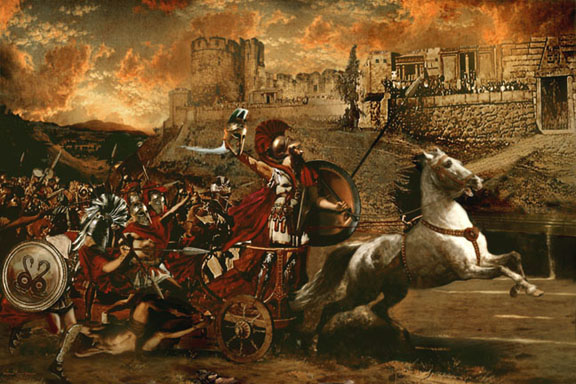
The Illiad by Homer
Sean Meade, in addition to being my good friend, is the Web Editor for Aviation Week’s defense and space content and is the former longtime webmaster/editorial assistant/right-hand of Dr. Thomas P.M. Barnett. Sean blogs at ARES for Aviation Week and at his personal blog, Interact:
ON THE ILLIAD
by Sean Meade
What makes ‘The Iliad’ a classic? Why is it classic?
I think the primary answer is simple: it’s the characters. If you can hang tough through all of the idiosyncratic flourishes and ornaments and repetitions, the characters are compelling: Achilleus, his anger and character; the comparative nobility of Hektor and Patroklos (both of whom we know are doomed); the vagaries of the gods and their adolescent machinations; the supporting cast of Agamemnon, Menelaos the wronged, two very different men named Aias (Ajax), Diomedes, Aeneas, Odysseus, Nestor, Paris, Helen and Priam. Take these characters and others and mix them with an interesting story and you have a classic that reaches out to us from about the eighth century BC (when it was likely ‘composed’ (with heavy use of previous, oral sources) by Homer), maybe from as far back as the 12th century BC (maybe the original setting of what has come down to us as The Trojan War). ‘The Iliad’ still resonates with us today.
One reason ‘The Iliad’ can still move us is that Homer has done a masterful job of relating the ‘accidents’ of life. ‘Time and chance happen to all men’, and people who lived 3000 year ago couldn’t deceive themselves about their ability to control life the way we ‘modern’ people do. Human experience and emotions are often inscrutable. ‘Love’ (baldly called ‘lust’ by Homer) can easily destroy. When it occurs in the most influential levels of society, it can draw whole nations into its whirling vortex. Even the love between men in ‘The Iliad’ can seem illogical (no matter where you come down on the homosexuality question): why does noble Patroklos honor Achilleus literally to the death?
‘The Iliad’, of course, focuses a lot on war in ways that have become shockingly remote for most of us. Nothing is so susceptible to ‘luck’ as war. One ‘good’ soldier gets hit by stray friendly fire and dies instantly. Another ‘bad’ soldier comes through the whole war unscathed. Consider the hazards of love, life and war in ‘The Iliad’. Consider them in our own experience. It makes more sense than many theories to conclude that arbitrary and capricious gods can powerfully affect us.
My final guess (for the purposes of this mini-review) at why ‘The Iliad’ is a classic is that the poetry is timeless. This is, of course, nearly impossible to take in from one read-through in translation. My friend, Jason, listened to the abridged version and talked about its power. The commentators discuss it quite a bit, from what I can tell. Most of us (who aren’t going to pay the price to really test it) are going to have to take this on faith and rate it as we will. Poetry is a dying art, and poetry appreciation is probably in an even worse state.
I wonder what role foreknowledge plays in ‘The Iliad’. Many of us know the broad outline of the story going in. If we don’t, Homer spills it in short order. Does knowing Achilleus dies shortly after this episode in The Trojan War change our view of him? Do we cut him more slack? How does knowing that Hektor and Patroklos die within the bounds of this story affect us? Or that Odysseus lives? Or that Agamemnon will be murdered in his bath by his wife (he had it coming ;-)?
Something else that stands out about ‘The Iliad’ is the graphic war imagery. Homer’s descriptions almost seem gratuitous when he goes into detail about how one soldier killed another, where the spear penetrated and where it came out, what muscles were severed, what happened to the bowels, teeth or brain. It’s probably distasteful to many of us in the 21st century, but I think we can just chalk that up to cultural differences.
My second big question is: what does ‘The Iliad’ mean? I’m very snobbish about exegesis, especially concerning the Bible (my training, as a former pastor), but including any suitably worthy literature (with concomitant training in British Lit and Analytic Philosophy). Exegesis, in principle, is simple: what was the author trying to communicate to the audience? (So why is good exegesis so hard to find? 😉 If we are to make any meaningful connection to the original work, this is where we have to begin. You can deploy your Reader Response Theory on ‘Twilight’ or some such drivel, but keep it off my Homer (I told you I’m a snob ;-).
We come to ‘The Iliad’ at a loss because Homer’s values are very different from ours. His presuppositions are vastly different from ours. I have touched on some of these already. The gods can show up at any time and throw any wrench in the works for almost any imaginable reason. We have to take the role of the gods seriously to take Homer seriously. What did their role say about the responsibility of people? Humans retain some responsibility, almost paradoxically. Helen isn’t completely off the hook for running away with Paris. Achilleus does not get a complete pass for his anger that causes the deaths of so many Achaean comrades. Agamemnon is not excused for his overbearing pride that contributed to the disagreement with Achilleus. And even noble Hektor faces bouts of inaction and cowardice for which he is not wholly exonerated.
Another value we find hard to understand is the ancient Greek concept of nobility. It’s just born there. If you’re a shepherd who’s not the natural-born son of King Priam and Queen Hekabe, that’s all you’ll ever be: a shepherd. The main characters are noble; many are first-generation half-deities and most (all?) have divinity in their bloodline somewhere. From our standpoint, Achilleus behaves like a monster, especially in his repeated attempted-desecration of Hektor’s body (the gods protect Hektor’s body and Achilleus’ ultimate honor by preserving Hektor’s corpse inviolate in almost the perfect proverbial deus ex machina). He’s sacrificed any claim to nobility as far as we’re concerned. Not so for Homer and the ancient Greeks; Achilleus retains his nobility, though it is clouded by sins. He receives partial pardons and rationalizations. From our perspective, we view him as maybe the original anti-hero. Homer’s view is much less ambivalent, and Achilleus gets away with things for which lesser men would go straight to Tartaros without passing ‘Go’. It’s a far cry from our 21st century Western concept of nobility and our love of ‘rags to riches’ fables. It’s only riches to riches here (though maybe no one knew through the rags that you were really rich).
So what is Homer’s message? The conclusion of my barely-better-than-cursory reading is: Given that nobility and greatness are natural, almost literally gifts of fate (the Fates); and that humans are subject to the whims of the gods; it is best to be brave and seek glory (within reason–with a glance forward to Aristotle’s middle-way ethic). How’s that going to help you with your job or family? Not much. It’s fodder for thinking about societal values and a long way from whether or not to stick it out in your mediocre, going-nowhere job. (It might possibly apply to whether or not you should run away with your neighbor’s spouse.)
For most of us, ‘The Iliad’ is probably a test in proper exegesis more than someplace we should or will go to look for meaning. But maybe that’s just my soap box 😉

Zenpundit is a blog dedicated to exploring the intersections of foreign policy, history, military theory, national security,strategic thinking, futurism, cognition and a number of other esoteric pursuits.
Customized Web Site & Blog Design

