Google Ngram Viewer
Wednesday, December 22nd, 2010This amazing visualizing data tool is ready made for analysts, historians and researchers. I just tried Ngoogling “strategy”.
Hat tip to T. Greer and Dr. Robert Mackey
This amazing visualizing data tool is ready made for analysts, historians and researchers. I just tried Ngoogling “strategy”.
Hat tip to T. Greer and Dr. Robert Mackey
“Our form of government does not enter into rivalry with the institutions of others. Our government does not copy our neighbors’, but is an example to them. It is true that we are called a democracy, for the administration is in the hands of the many and not of the few. But while there exists equal justice to all and alike in their private disputes, the claim of excellence is also recognized; and when a citizen is in any way distinguished, he is preferred to the public service, not as a matter of privilege, but as the reward of merit.” – Pericles, The Funeral Oration
“The President of the United States of America and the Prime Minister,
Mr. Churchill, representing His Majesty’s Government in the United Kingdom, being met together, deem it right to make known certain common principles in the national policies of their respective countries on which they base their hopes for a better future for the world.”
– The Atlantic Charter, 1941
Adam Elkus, at Rethinking Security, makes an important point about grand strategy not requiring a great enemy:
Building a Strategy for Chaos?
….The short answer is that grand strategy isn’t something that requires an clear and equal enemy to create. But since grand strategy is something that involves a long time line, a substantially more broad subject area than war strategy, and the utilization of resources in peacetime, it makes more sense to visualize it less as an explicit plan than a collection of practices sustained over a long period of time. The policy of “offshore balancing” which Churchill mentions in this speech is one of those sets of practices.
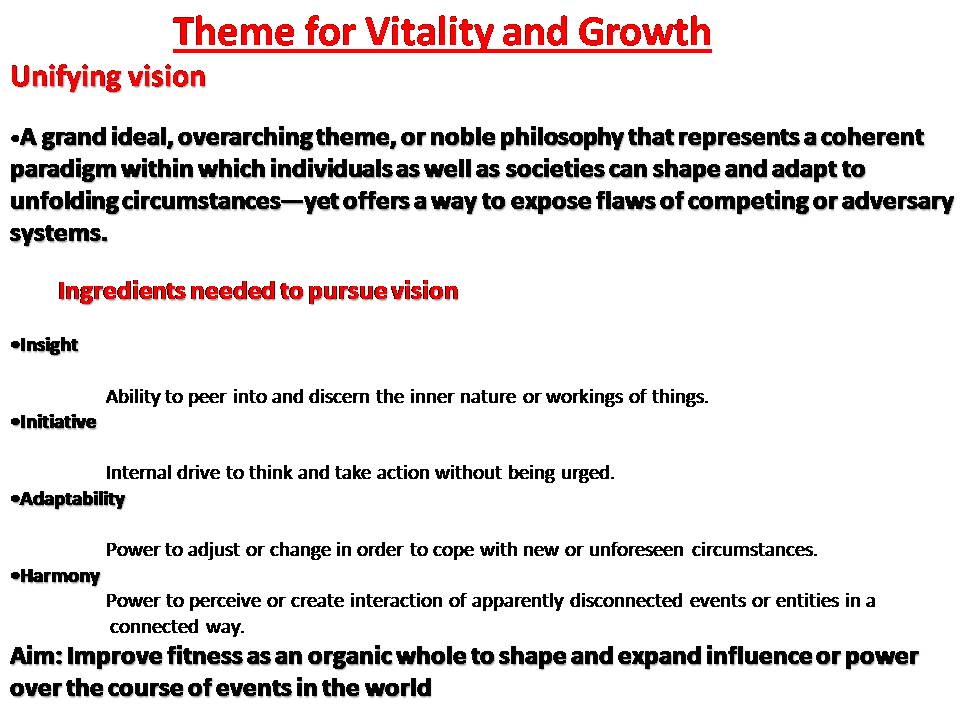
Boyd is commonly misunderstood as a tactically obsessed jet pilot whose insights mainly relate to cycling through a
decision cycle faster than the opponent. But the importance of his writings to grand strategy is undeniable. His stress on the importance of forming organizations creative and efficient enough to “destroy and create” perceptions of the external environment, increase our own connectivity and degrade that of our opponents, and the importance of establishing a “pattern for vitality and growth” all point to aspects of strategic design that focus less on marshalling resources against a specific opponent than developing a basic strategic template that can remixed for various situations under a process of “plug and play.”
In his post, Adam references Colonel John Boyd’s “Theme for Vitality and Growth” from his brief, Patterns of Conflict:
Adam went on to make an insightful observation:
The problem is that as societies grow both more structurally and interactively complex, this process grows much more difficult. That is what The Collapse of Complex Societies is about–how, if we view civilizations as computing mechanisms, how growth makes it more difficult to carry out the basic process of response to changing external conditions that is an essential part of data-processing. Moreover, even in eras of relative simplicity, the ability to aggregate enough information together to form a grand strategic design was exceedingly rare for individuals and more difficult for governments than success stories such as 19th century Prussia might indicate
Read the rest here.
I would like to extrapolate Adam’s argument about the difficulty imposed by complexity several steps further.
In considering grand strategy, historically, except for the Romans during their golden age, state actors, even vast empires like the Soviet Union or Great Britain, never approximated a closed system that could operate without reference to rivals who could potentially present an existential threat, singly or in combination. While the Pax Romana represents the rare outcome of a successful grand strategy, most great powers wrestled with imposing their will on both their rivals – but also on the geopolitical environment or “system” in which they operated.
What do I mean by the “system”? The explicit and implicit cultural and diplomatic rule-sets; the “rules of the game” by which powers interacted; the geoeconomic structures and patterns that were larger than any particular political entity and imposed constraints upon them, even the chance-based variables of natural resources and technological level which had a determining effect upon formulation of policy and strategy. The relationship between the architect of a grand strategy, his rivals and the world in which all were forced to operate consisted of a multiple variable feedback loop, not a diktat with a binary set of possible results.
I woud now like to make two points.
First, to use an analogy from the biological sciences, grand strategy enunciated by a great power is a process of geopolitical co-evolution. There is an effort in grand strategy to impose over time one’s political will upon others to shape the “battlespace”, the sphere of influence, the hegemonic dominion to a state of affairs favorable to the state actor. Often, this is done by military force in times of crisis but over the long term, economic and diplomatic factors, all of DIME really, weigh heavily on the outcome. The process is never a one way street, even for actors who are considered to be largely triumphant. It is coevolutionary. If you gaze into the abyss, the abyss will gaze into you.
The early Roman republicans, much less Cato the Younger, would have been viscerally appalled by the Empire of Late Antiquity with its’ Teutonic Masters of the Horse in place of citizen- Praetors and Imperators. The Founding Fathers would be amazed by the condign dominance of the United States as a global titan but dismayed by the truckling servility, the lack of economic independence and the sheepish passivity of Americans whose citizenship is largely nominal. Ancient Chinese sages might feel much the same about hybrid capitalist-communist China of 2010.
Secondly, sustaining the national or group identity is a critical component of grand strategy that makes it a different, more expressly political/cultural exercise than crafting strategy as Clausewitzians use the term as being driven by policy. Grand strategy should guide policy formulation because it is not just a set of concrete structural ends, or a laundry list of “vital interests” but a constructive, values-laden, attractive, motivating, civilizational narrative. An ideal or cultural identity for which men and societies are willing to go to war, to stand, fight and die. As Thomas P.M. Barnett once put it, for a “Future worth creating“. Grand strategy is a defiant clarion call of civilizational supremacy, marshalling those who will fight for that which is not, but could be.
But if you gain the whole world, while losing oneself, have you won? Or lost?
A victorious grand strategy shapes others while preserving – or expanding the reach of – the core identity of cultural-political community engaged in the struggle for autonomy for itself and dominion over the environment. Some changes though are inevitable despite the best of intentions. Exercising power carries with it a price and the piper must be paid.
Following Boyd, the more attractive our vision, the “noble philosophy” we offer up to others and the more consistently we practice that which we preach, the greater our reach while remaining true to ourselves – thus demoralizing our adversaries. The more we trade on our souls, compromise our principles, turn away from threats and contradict our professed ideals, the less we have. Power is useful but it is transient. The exercise sweet, but the cost dear.
Power runs through our fingers like water. What did we give for it? What did we gain? Who are we now?
That is grand strategy.
Dr. Bernard Finel, explaining his views on COIN theory:
….I am not wholly convinced as a matter of ontology that there exists a coherent phenomena that can be termed “insurgency.” My sense, instead, is that there are various sub-state armed threats that exists to states, several of which we usually lump in together under the rubric of insurgency, but which have very different causes and consequences, and hence require different strategic approaches. I am not just referring, by the way, to the various motivations for “insurgency” – i.e. religious vs. leftist vs. ethnic – but also that there are at least some groups that have strategic orientations quite at odds from the image of an organized group with ambitions to replace the existing government.
Just a few examples: Some of what we call insurgency is simple criminality. There is no desire to replace the state for these groups, but rather just to weaken the state so that it cannot enforce laws, etc. There are also other economically motivated groups – those who profit from the existence of conflict and seek to continue it for that reason. For these groups, promoting conflict is more important than pursuing victory.
Why are submaximum strategic goals (i.e. something < regime change) an indicator of “non-insurgency” ? I think this standard would eliminate most of the popular uprisings in recorded history – for every Taiping Rebellion or Emelian Pugachev, there’s a dozen smaller, hopeless, desperate, peasant revolts.
Why the implicit use of the Maoist model as the defining characteristic of “insurgency”? That is, to the extent Bernard considers insurgency to exist.
I very much like the turn toward the publication of short interviews with experts occurring of late at SWJ BLog, for example the COIN series by FP’s Octavian Manea. To toot my own horn for a moment, I did an early one for SWJ when I interviewed Tom Barnett.
There are two new ones up right now that I recommend:
Octavian Manea – Thinking Critically about COIN and Creatively about Strategy and War An Interview with Colonel Gian Gentile
Q: To what extent should Algeria be a warning for present?
A: The warning it should provide is that you should never think that improved tactics, whether it is a conventional or a counterinsurgency war, can rescue a failed strategy or policy. Sun Tzu offers one of the most profound statements on the relationship between tactics and strategy: Strategy without tactics is the slow road to victory, but tactics without strategy is the noise before defeat. Another historical example comes to mind. The German army up to a certain point in WWII was arguably one of the finest tactically fighting armies in history. But it lost. The warning is to be careful how much faith you place in the idea that better tactics can save a failed strategy or policy (or in the case of the Vietnam War – better tactics rescuing a war that was unwinnable in the first place)
Mike Few –A Conversation with Dr. Douglas Porch Relooking French Encounters in Irregular Warfare in the 19th Century
A: Alas, Arquilla’s representation of these incidents as primitive versions of modern concepts are a stretch, when not total misrepresentations. At worst, his examples are lifted from context, include material factual inaccuracies, and misconstrue reasons for French “success.” (The “successes” themselves are debatable.) Finally, Arquilla perpetuates the fundamental COINdanista heresies that tactics can rescue flawed policy and defective strategy, while “modernizing” Western occupations will be perceived as “liberation” by indigenous societies. I will take each of Arquilla’s examples in turn to explain their context, in the process illustrating why an incomplete history can lead to misleading results.
Under Suchet, Aragon did in fact enjoy the reputation as the most pacified Spanish province in Spain. But Suchet’s achievement was temporary, contingent and a “success” only when contrasted with the overall catastrophic outcome of Napoleon’s Spanish project. Aragon and the sliver of bordering Catalonia over which Suchet had charge only shines in context: The French totally lost the narrative in Spain. Napoleon’s deposition and imprisonment of the Bourbon Ferdinand VII — whom he replaced with his brother Joseph Bonaparte in 1808 — established a government regarded as illegitimate, not only in Spain, but in Europe and Latin America as well. The obligation imposed by the Napoleon that the Spaniards pay the costs of occupation meant high taxes and requisitions of Church lands. “Modern” French secular ideas taken from the French Revolution were an affront to the values of conservative Spaniards, who were horrified that Napoleon had imprisoned two Popes and annexed the Papal States to the Roman Republic. The fact that Napoleon was unable to vanquish Great Britain, and the presence
Kudos to Bill and Dave! Keep’em coming!

This article at SWJ blog has stirred a lively debate in the comments section with some very able practitioner-scholars weighing in.
….Sun Tzu?s ancient military philosophy of indirectness and gradualism runs counter-culture with much of mainstream western military strategy. Western reliance on superior technology and firepower shaped American counterinsurgency doctrine to be largely lethal in nature and enemy focused. Clausewitz instructed generations of military officers that the destruction of the enemy?s army is the primary goal in all combat1; therefore, all political-military conflict results in offensive action where attrition of the enemy force becomes a universal requirement. Clausewitzian war theory „worked? in both world wars in that the Allies did accomplish their desired goals; however critics such as Israeli strategist Shimon Naveh raise valid questions on whether Clausewitz?s fixation on offensive action and attrition warfare helped or hindered the Allied causes2. Despite Clausewitzian strategy?s seemingly illogical structure, application of his theories in the major 20th century conflicts created an enduring military school of war strategy with „On War? taking a sacred position.
In fairness to Clausewitz, this is over the top.
The US military could use more Sun Tzu; it is far more Clausewitzian in the perspective of the officer corps than it is “Sun Tzuite”, but the armed services are not the Children of Clausewitz. Not even the US Army. We’d probably be better off if the American military was more thoroughly one or the other in terms of strategic culture than the industrial age, bureaucratic, ad hoc, legacy thinking non-strategic hodgepode that currently prevails.
I do not expect that to change. American military organizational culture is driven more by appropriations than by ideas.
Some Related Links:
Sonishi.com Interview with Martin van Creveld on Sun Tzu
Sonishi.com Interview with Chet Richards on Sun Tzu and Boyd
Christopher Bassford on Sun Tzu, Jomini and Clausewitz

Zenpundit is a blog dedicated to exploring the intersections of foreign policy, history, military theory, national security,strategic thinking, futurism, cognition and a number of other esoteric pursuits.
Customized Web Site & Blog Design