zenpundit.com » academia

Archive for the ‘academia’ Category

Charles Hill on Freedman’s Strategy: A History

Thursday, October 3rd, 2013

[by Mark Safranski, a.k.a. “zen“]


Charles Hill pens a favorable but also fairly critical review of Sir Lawrence Freedman’s tome-like, Strategy: A History.

The snares of strategizing

.…Sir Lawrence Freedman’s 750-page magnum opus, Strategy: A History, is encyclopedic, although not alphabetical, a pleasure to dip into here and there to get a carefully considered summary briefing on the strategy of the Hebrew Bible, the 1815 Congress of Vienna, Jane Addams, Black Power, or the strange array of social science attempts to redefine human behavior as a contribution to strategy. Everybody talks about strategy, but no one seems to know what it is. But now there are no excuses; it’s all here, at least in chronological array. As with my childhood set of Compton’s, I read it straight through for its several-thousand-years’-long narrative arc; it only remains to try to make sense of the whole thing as one big idea.

Freedman begins by admitting that there is no agreed-upon definition of strategy. When one encounters the word applied to battle plans, political campaigns, and business deals, “not to mention means of coping with the stresses of everyday life,” the concept may begin to seem meaningless. But not so for Sir Lawrence, a most distinguished professor of war studies at King’s College, London, who unapologetically focuses his modern section on American approaches because “the United States has been not only the most powerful but also the most intellectually innovative country in recent times.”

The “origins” of strategy run from David and Goliath to Machiavelli to Milton’s Paradise Lost, a vast stretch of time covered, for this big book, in a relatively short space, as though the author is hurrying to get to strategy in our modern age. All the old warhorses are here. Thucydides is analyzed as the start of “real” strategy and the distortions of language as a cause of Athens’ fall is featured. Plato’s Republic is taken seriously as a “strategic coup” by which philosophy defeats strategy. (I am one of those who read Plato’s Socrates as ironic, playing along with an overnight concoction of a perfect polity—which turns out horribly—as the most effective way of showing us what not to do when thinking strategically.) Sun Tzu is properly portrayed not so much as a strategist as a master of stratagems, a subset of the art in full: To do the opposite of what is expected is not enough to qualify as strategy. Overall, the centuries of “Origins” analyzed here could be characterized as “a series of footnotes to Homer,” a running debate between advocates of force (Achilles) and those who prefer guile (Odysseus). The Trojan Horse was guile personified; it worked, but thereafter could be scorned as a despicable trick unworthy of heroes. The strategic approach of Milton’s Satan to his own demonic team, as well as toward Adam and Eve, was all seductive guile and still seems to be working….

The book comes across as being rather unwieldy in size, scope and definition of strategy, though informative. I disagree with Hill’s interpretation of Sun Tzu as well as Plato ( Socrates was an ironist, Plato? Well, he wandered quite far from his master’s teachings in the fullness of time). Nevertheless, worth a read.

Is Grand Strategy Democratic?

Friday, August 9th, 2013

[by Mark Safranski – a.k.a. “zen“]

Grand strategy in 1941

A very interesting article at Small Wars Journal by Captain Sean F.X. Barrett, USMC on the state of contemporary grand strategy. Definitely worth the time to read the whole thing:, but I am only going to make meandering comments on a few sections:

The Democratization of Grand Strategy 

Calls for a formalized strategic planning process and grand strategy have been mounting for years.  However, those sounding these calls erroneously remember a past that rarely if ever existed and overestimate the importance of a formalized process and a final product.  Most disconcertingly, they assume that government is necessarily the only supplier of grand strategy, while ignoring that those in government are not incentivized to actually produce it.  In fact, the proliferation of communications technology, which provides the means for accessing a wealth of open source intelligence and for disseminating ideas, and the plethora of academics, analysts, and other intellectuals outside of official government communities provide a more effective, democratic, and transparent substitute to the (oftentimes imagined) Project Solariums of the past.  The environment in which these intellectuals operate nurtures “real devils,” who vigorously propose policy and strategy alternatives in which they truly believe and have a stake in seeing implemented, resulting in a de facto strategic planning process, whose merits far exceed those of a de jure one. 

I think the call for a formal process, or at least an institutionalized forum for “doing grand strategy”, derives from both the lack of incentives correctly noted by Barrett and the frequently piss-poor and astrategic performance of American statesmen after the Soviet collapse. That the resulting criticism, proposals, counter-proposals, debates and domestic politics in drag relating to grand strategy are an alternative, open-source and more effective mechanism than formal planning is an intriguing idea.

Certainly, if a statesman or senior policy adviser have not done hard thinking about geopolitics and grand strategy while in the political wilderness then they won’t do it at all. Once in office, there simply is no time even if the inclination is present. Richard Nixon, who thought very seriously on these matters, as POTUS was militant about having Haldeman carve out undisturbed time for him to continue doing so in a secret “hideaway” office in the EOB. This was highly unusual and difficult even for Nixon to maintain – most presidents and senior officials faced with 18 hour days, 6-7 days a week, simply want to unwind in their off hours, see their loved ones or sleep.

….Furthermore, when formalized strategic planning processes and grand strategy have actually existed, their importance has largely been exaggerated.  For example, Richard Immerman debunks some of the myths surrounding Project Solarium, which is often referenced today as a model for grand strategy.  In referencing the intelligence that was ostensibly utilized during Project Solarium to guide the formation of grand strategy, he argues that, even though President Eisenhower—whose highest priority was to exploit the full resources of government to formulate a more effective and sustainable national strategy—was welcoming of CIA input, this input had minimal impact on President Eisenhower’s policies or grand strategy.[viii]  After such a long time serving in the Army, President Eisenhower had already developed highly formed beliefs about national security, and while intelligence has been perceived as playing a critical role by confirming his beliefs, a lack of confirmation would not have significantly impacted or altered his decisions.[ix]  Furthermore, Immerman claims that he has “never been able to locate a scintilla of evidence collected by the CIA and other agencies that changed Eisenhower’s [mind].”[x]   

While Barrett is correct that in discerning grand strategy in historical eras it is often reified and exaggerated retrospectively -that is because grand strategy, much like strategy itself, has a deeply iterative character. In facing the Soviet challenge,  Project Solarium both responded to and built upon a solid foundation laid by the post-warwise menNSC-68, Containment policy, the Marshall Plan, the National Security Act, the creation of the CIA , NSC, NATO, the Department of Defense, the Truman Doctrine, the X Article, the Long  Telegram, Bretton Woods and stretching back to WWII, the geopolitical vision of The Atlantic Charter, Potsdam and FDR’s Four Freedoms. Project Solarium was not ex nihilo but an effort to improve, shape, refine and surpass what the Eisenhower administration had inherited from it’s Democratic predecessors.

Barrett is also on target when he identifies a strong ideological-political predisposition in formulation of grand strategy. Eisenhower had not only operational/experential preferences but a worldview that he brought with him into the White House and his Secretary of State, John Foster Dulles, had even stronger convictions that, especially in regard to his fierce and almost Calvinistic anti-communism, sometimes render him a caricature today. We have to be careful though in parsing public statements and private assessments. Dulles, despite his hardline reputation, was a sophisticated and highly influential figure in American foreign policy as the senior GOP adviser through most of the 1940’s. Despite talk of “rollback”, neither Dulles nor Eisenhower had any appetite for leaping into Hungary militarily to support the anti-Soviet revolt or supporting the Franco-British-Israeli debacle in the Suez. Still less attractive was the prospect of military intervention in faraway Laos. Grand strategic ideas were applied with realism and prudence by the Eisenhower administration.

….It should come as no surprise that three of the first four members of the 2014 QDR’s “independent” panel are those that self-selected into the DOD and conformed and performed so well as to achieve flag officer rank, including retired Marine Corps Gen. James E. Cartwright, former vice chairman of the Joint Chiefs of Staff; retired Air Force Gen. Gregory S. Martin, former commander of Air Force Materiel Command; and retired Army Lt. Gen. Michael D. Maples, former Defense Intelligence Agency director.[xx]  The fourth member, Michele Flournoy, former Undersecretary of Defense for Policy, has been deemed politically palatable enough by both Congress and the Obama Administration, and one must assume the DOD well, since nominations are not made, and consent by Congress not given, without DOD’s at least tacit approval.  That we insist on calling this panel independent should be disconcerting enough in itself.  The first four members were selected by the Senate Armed Services Committee, Defense Secretary Chuck Hagel will appoint the Chairman and Vice Chairman of the panel, and the other panel appointees will be made by the chair and ranking member of the House Armed Services Committee.  This situation is not entirely dissimilar to China under the Ming emperors, wherein the emperors’ concern for stability, obedience, and conformism overlapped with the bureaucracy and their strong aversion to changing the status quo.  The imperial literary examination system of Imperial China helped breed this mutually beneficial conformism, and its effects prove quite relevant in this regard.  While the examination preserved the cultural unity and political stability of China, it also impeded originality and experimentation.[xxi]

Yes.

Arguably, the period of Ming-Q’ing decline may have been superior in the sense that the Confucian classics and the exams upon which they were based that were the gateway to the mandarinate were at least, an objective and respected yardstick, however ossified and ritualized. All we have by contrast are partisan politics, bureaucratic culture and the increasingly oligarchic client-patron networks within the Beltway and Manhattan..

….President Eisenhower commissioned Project Solarium in part to devise a strategy for coping with a lack of knowledge about the Soviets’ intentions and capabilities.  Today, however, more and more strategic intelligence is publicly available.  For example, the National Intelligence Council’s[xxiii] new Global Trends series is unclassified.  We now arguably suffer not from too little information, but from too much. This has increasingly democratized the arena of grand strategy and enabled more and more even amateur analysts to help process the wealth of information in the public domain and formulate it into alternative visions for the future.  One might argue that what these different entities focus on is simply policy or at best strategies for individual instruments of national power.  However, even individual policy or strategy analyses might instead be seen as reflections of the overarching principles that they support (and that are often enumerated in the mission statements of many of these think tanks, institutes, and analysis centers), which as Sinnreich contends, are what in fact help form the basis of an enduring grand strategy

Sort of. There are two other ways to look at this picture.

First, that we have an insufficient consensus bordering on ideological schism within the elite as to what America is and is supposed to become that executing  foreign policy, much less enunciating a grand strategy, cannot get beyond the lowest common denominators between left and right and bureaucratic autopilot. This in turn causes the cacophony of voices on grand strategy. I partially subscribe to this view.

Secondly, that our elite, whatever their divisions over political passions or personalities have a consensus grand strategy ( or at least, an ethos) for generational and class aggrandizement at the expense of the rest of us and American national interest in a way that the former 20th century governing class called the Eastern Establishment would have neither imagined nor tolerated. The resulting ferment of “bottom-up” grand strategy is a result of increasing divergence of interests between rulers and the ruled and an erosion of the former’s legitimacy as a result of their self-aggrandizing game-rigging , abandonment of the ethic of leadership as stewardship for “ubi est mea” and a deficit of competence that contrasts with their enormously inflated collective sense of self-importance.

I partially subscribe to this one as well.

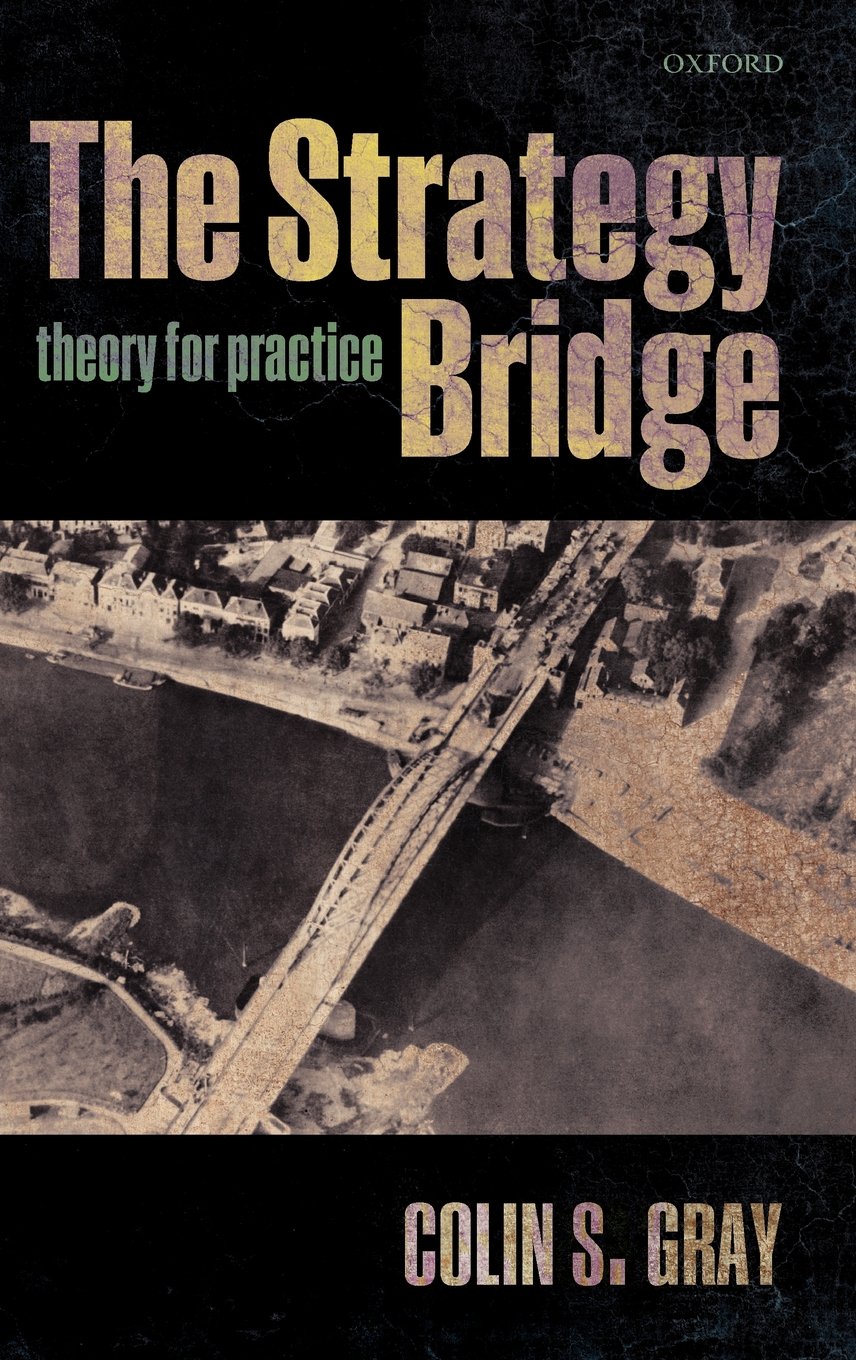
Book Review at Pragati: The Strategy Bridge by Colin Gray

Friday, July 5th, 2013

I have a new book review up at Pragati Magazine this morning, The Strategy Bridge:Theory for Practice by Colin S. Gray which is a must read book for any serious student of strategy.

Pragati, which is a national interest and policy magazine for India is starting to turn greater attention towards the subject of strategy and is also running another article in the same issue on strategy and the Maoist insurgency and recently on Indian grand strategy.

A Bridge over Troubled Waters

The title of The Strategy Bridge is also Gray’s operative metaphor, both for the purpose of strategy and the role of the strategist himself that represents the dialectical dynamic of war and strategy-making, the latter being a shared enterprise, save for some extreme historical outliers where strategy was vested in one man, like the regimes of Napoleon and Adolf Hitler. Strategy is the ‘bridge’ that must be built between policy determined by a national leadership and the operational and tactical behaviors of the military and other arms of national power. The strategist “mans the bridge”, orchestrating all of the elements within a master strategic concept and managing the iterative relationship.

Gray writes “The function of the military strategist, his unique raison d’etre, is to ensure that policy and the military instrument are purposefully connected… The strategist must understand the whole nature of a conflict, including war and warfare if antagonism has escalated thus far, because subject to political control, he has the duty of care over the entire competitive performance of the security community… The mission of the military strategist is to decide how the enemy is to be defeated. It is his task to invent a theory of military victory. That theory has to be expressed in and revealed in plans, which are contingent predictions of an extended kind, and must be commanded by generals to whom the strategist delegates some restricted command authority. Whether or not the strategist wishes or is able to function as a general also, must vary with historical circumstances”

….The Strategy Bridge is subtitled “Theory for Practice” because it is intended as a serious work of theory, a framework for understanding enduring principles of strategy so that a practitioner can thoughtfully apply them in making strategies for the specific context in which they find themselves to provide correct guidance for the operational planners and tacticians who will execute it. Consequently, Gray has not written an introductory text for a novice student but an insightful book for the strategic practitioner of journeyman experience – field grade officers, senior intelligence and foreign policy analysts, academic strategists, think tank researchers and national security advisers to senior government officials – who have a store of knowledge of their own. Hence the repeated invocation of “the bridge” metaphor by Gray; his primary audience are the people “doing strategy” and their success or failure “manning the bridge” will help determine the degree to which government purpose remains connected to action or whether the whole business will go off the rails into a quagmire, as it too often does. 

Read the rest here.

Clausewitz and Center of Gravity

Wednesday, July 3rd, 2013

At Small Wars Journal a provocative essay by Col. Dale C. Eikmeier:

Give Carl von Clausewitz and the Center of Gravity a Divorce

….Because we love Carl von Clausewitz and the center of gravity concept, we need to grant them a divorce- for our sake.  We tried for years to make it work, but it’s time to face reality, together they are just too abstract and confusing for us to embrace.

 The center of gravity concept, a mainstay of the US military “operational art” since 1986[1], has never fully satisfied doctrine’s intent.   According to Dr. Alex Ryan, a former School of Advanced Military Studies instructor, the concept is, “so abstract to be meaningless”[2]  Now if a ‘mainstay’ is so ‘abstract’ that subject matter experts declare it ‘meaningless’ we have a doctrinal problem.  The genesis of this problem is a doctrinal foundation built on dubious authorship and editing, underdeveloped theory, imprecise metaphors, and flawed translations. [3]  This Clausewitzian foundation, which was never very solid, is now collapsing under the weight of 21st century warfare.  For this reason it’s time to end our reliance on Clausewitz’s On War as the authority on the center of gravity concept.

….Crack Four.  Another problem is flawed translations.  Clausewitz never used the term “center of gravity”, or in German, “Gravitationspunkt”, he used the word schwerpunkt, which means weight of focus or point of effort which is different from center of gravity, hubs or sources of power. [9]   But it is easy to understand how an English translator when picturing this point of effort could think of a center of gravity which further illustrates the danger of metaphors.  Milan Vigo in Joint Operational Warfare Theory and Practice provides a detailed analysis of the evolution of schwerpunkt from focus of effort to center of gravity which is summarized below:[10]

  1. Schwerpunkt – main weight or focus or one’s efforts.
  2. Mid 19th century, schwerpunkt is associated with an enemy’s capital as the point of focus. Germans and Austrians used the word schwerpunktlinie to mean a line of main weight or effort that links one’s base of operations to the enemy’s capital. This is where the schwerpunkt as ‘the target’ understanding comes from.
  3. Late 19th century it comes to mean a section of the front where the bulk of one’s forces are employed to reach a decision. Schwerpunkt is now the ‘arrow’ not the target.  This is a subtle shift from the point of focus on a target, to the arrow or what is focused.  Count Alfred von Schlieffen and German military practice used the ‘arrow’ understanding up to WW II.
  4. Colonel J.J. Graham’s 1874 English language translation of On War  mistranslated Schwerpunkt as “center of gravity”[11]
  5. Post World War I German military progressively adds a new meaning using schwerpunkt to mean the focus of planning efforts.  This is a natural evolution of the late 19th century hybrid of ‘the arrow’ and the ‘target’ understandings.
  6. The Bundeswehr (German Army) now uses the English term “center of gravity” while the Austrian Army uses the German term “Gravitationspunkt” which translates to “center of gravity”. 

Hence, English translators took Clausewitz’s “schwerpunkt”, ‘the target or point of focus’ meaning mistranslated it into center of gravity which morphed into the source of power or ‘the arrow’ meaning. 

I’m not understanding Eikmeier’s hostility to the employment of metaphor as a device for learning as it is a conceptual bridge for understanding without which human society would not have made much progress.  Yes, metaphors can be misunderstood or abused but so can just about everything else. Most important ideas were either understood by or are most easily explained by metaphor and analogy.

“Center of gravity” in Clausewitzian theory is often misunderstood by non-experts or incorrectly identified in the enemy in practice in the midst of a war, but the same can be said of many other valuable concepts. Ask people to explain “gravity” itself and see how precisely scientific an explanation you receive, but that hardly means we should abandon the concept.

Regarding translation from On War, Eikmeier may have a more valid point but I am not qualified to assess it. I have a fair grasp of the political-historical context but not the linguistic and cultural nuances of early 19th century German language expression. Maybe Seydlitz89 will care to weigh in here?

Yet More Biographies…..

Monday, June 17th, 2013


Alexander The Great by Robin Lane Fox  

Colonel Roosevelt by Edmund Morris 

Shadow Warrior: William Egan Colby and the CIA  by Randall Woods 

The first, was one of the works cited by Paul Cartledge in his own biography of Alexander the Great. Fox is an eminent historian at Oxford, now emeritus and his biography was a an important work in the field.

The next two were gifts from my own students. Now that I have Colonel Roosevelt, I will have to read the prize-winning trilogy as I have copies of the first two volumes (somewhere). The impression Morris made with his Reagan biography, Dutch, was very strange, but this will probably redeem him.

Not very familiar with Woods, but William Colby was a fascinating, controversial and contradictory DCI whose intelligence career spanned the OSS and much of the Cold War, dying in retirement under mysterious circumstances.

Added to the pile…..


Switch to our mobile site