zenpundit.com » warriors

Archive for the ‘warriors’ Category

Strategy, Power and Diffusion

Monday, November 19th, 2012
“….and therefore, two kinds of reactions are possible on the defending side, depending whether the attacker is to perish by the sword or by his own exertions.

                                                               – Carl von Clausewitz,  On War

 “Again, if the campaign is protracted, the resources of the State will not be equal to the strain.”

                                                                 – Sun Tzu,  The Art of War 

A recent estimate for the cost of the war in Afghanistan by the Congressional Research Office is $443 billion dollars to occupy and fight a Pakistani-supported insurgency in a primitive country whose annual GDP is a mere $ 27 billion. A  figure that itself inflated by $ 3-4 billion is remittances, $ 4 billion in NGO aid and $14 billion in direct US aid (2010 figure); when you then subtract opium smuggling ($ 4 billion), Afghanistan’s legitimate economic activity may only be a miniscule GDP of  $ 2 – 3 billion.

This does not, of course, include the cost of ten years of lavish bribes for Pakistan, a portion of which was used by the ISI to support the Taliban  killing American and ISAF  soldiers  and Afghan civilians.

This is not a cost-effective or strategic way to run a war. In fact, even for a nation as wealthy as the United States there is nothing in Afghanistan worth such an expenditure of blood and treasure, especially when the bulk of our enemies appear to be based in Pakistan, not Afghanistan. You can approach a strategic problem directly or indirectly but to do so indirectly in the most expensive way logistically possible makes little sense. For example:

….Since the ‘war to end all wars’, however, war has not exactly stood still.  Although the US Defense Logistics Agency rather quaintly describes its mission in terms of a supply chain extending ‘from factory to foxhole’, it is, above all, the mobility of military violence that is central to the conduct of late modern war.  But Creveld is adamant that since 1945 the operational freedom of modern ground forces has not markedly increased, not least because their prized mobility is absolutely dependent on supplies of petrol and gasoline.  Since the end of the Second World War the use of petroleum-based fuels by the US military has soared, and as its stripped-down forces have been expected to do more with less (through technological change and outsourcing) so the fuel expended per soldier has increased by 175 per cent to an average of 22 gallons (83 litres) per day. [viii]  As Obama had US forces ‘surge’ into Afghanistan in 2009 so ISAF’s daily fuel consumption rocketed from two million to over four million litres a day. Given these volumes, it is scarcely surprising that the death-dealing capacities of the US military and its allies should have been tied in knots by ‘umbilical cords’ far more convoluted than Creveld could ever have imagined.

There are three main supply networks to be disentangled in turn.  All of them are ground lines of communication.  Air transportation is extremely, usually prohibitively expensive, and only four airports in Afghanistan are accessible to non-military aircraft, so that until 2011 only 20 per cent of cargo was flown in.  Similarly, onward delivery to combat outposts and forward operating bases has usually only involved airdrops if other options are too dangerous. Still, by the start of 2010 around 30-40 per cent of bases were being supplied by air because the Taliban controlled much of Highway 1, the ring road that loops between Afghanistan’s major cities, and its IED attacks on NATO and Afghan forces were increasingly effective.  The high cost of airdropping pallets of fuel, ammunition, water and supplies has imposed all sorts of fuel economies on the military as it attempts to reduce its carbon footprint – ‘troops have learned to sip, not guzzle’ – but it is still the case that, as one US pilot put it, ‘we’re going to burn a lot of gas to drop a lot of gas’.  According to some estimates it can cost up to $400 a gallon to deliver fuel by air. [ix] 

Neither war nor strategy are a hard science like physics. That said, there are fields of study and investigation that while not being a science are, like physics, inherently about systems or systemic relationships. Economics  and engineering are two such examples, strategy is another.  Because of this similarity, it is often profitable to employ metaphors or analogies from physics to illustrate strategic problems, as Clausewitz famously did in On War with “friction” and “center of gravity“.

Diffusion” might be another analogy for statesmen and soldiers to keep in mind.

Military force, or more broadly, national power marshaled and employed toward a vital objective represents a potent concentration of energy like a red hot iron bar. Thrust deeply into a trough of ice water, the surface of the water yields to the mass and heat of the iron bar in a furious burst of steam and boiling turbulence. Keep the bar submerged and every erg of heat will be sapped out of it by the water and the iron will emerge cold, tempered by the experience and inert. Keep the bar submerged long enough and the water will begin to rust the iron away until nothing is left.

Vast spaces, hostile populaces and deeply impoverished environments are like ice water to the molten heat of an invading power, as we have discovered in Afghanistan.

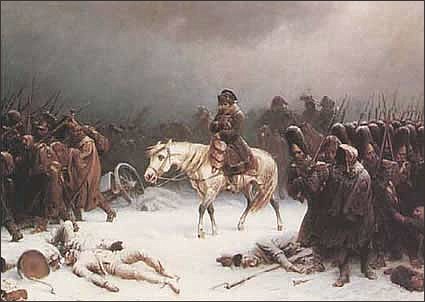
There are already old military maxims that express a warning about the risks of diffusion, notably “Don’t get into a land war in Asia” or “Don’t invade Russia in winter”.  Napoleon Bonaparte marched his vast and fabled Grand Armee of 600,000 men into the endless steppes of Tsar Alexander’s Russia. Everything gave way before Napoleon’s legions, but the Russians were not the Austrians or Prussians, they retreated, savagely burning and destroying as they went:

….Alexander’s proclamation to his people, issued at the time of the French invasion, appealed to these deep seated feelings: Napoleon had come to destroy Russia; the entire nation must rise against ‘this Moloch’ and his ‘legions of slaves’. ‘Let us drive this plague of locusts out! Let us carry the Cross in our hearts and steel in our hands!’ The proclamation was read in all the churches, and the priests supplemented it with embellishments of their own. The Comte de Segur, at this time an aide-de-camp to Napoleon, wrote: ‘They convinced these peasants we were a legion of devils commanded by the Antichrist, infernal spirits, horrible to look upon, and whose very touch defiled”

In Moscow, the city in flames, even Napoleon the Conqueror, the master of Europe, did not have enough men, or material or speed of movement to either digest and rule the immense spaces of Russia or compel Alexander to come to terms:

….Throughout the fall of 1812, Napoleon waited in vain for Alexander’s peace proposals to arrive in the Kremlin. When none came, he made overtures of his own, but Alexander sent no reply. As the days stretched into weeks, Napoleon came to see that he, not Alexander, faced a truly desperate situation, for Russia’s armies grew stronger by the day while his own dwindled from desertions and the ravages of disease. He faced the hopeless prospect of wintering in Russia without adequate food, shelter, or supplies, surrounded by a people so hostile that they burned their grain rather than sell it for French gold. As winter approached, and as the Russian partisans stepped up their attacks on his rear, Napoleon saw that his line of communications, which relied upon a perilously vulnerable corps of couriers who raced from Paris to Moscow in fourteen days, must soon collapse.

Of the Grand Armee, only five thousand returned home from the snowy wastes of Russia alive.

The Wehrmacht did little better. Hitler’s imagined drive to the Urals without a surrender and territorial concession by Stalin was a fantastical ambition. The far-flung distance, roadless mud and icy snow alone were too much for panzer armies and Luftwaffe air wings that proceeded to break down with statistical certainty. Supply lines were too long; gasoline and replacement parts were too few, as were replacements for the men for whom the Eastern Front was a grave. To the dogged resistance of the Red Army, the Germans needlessly added the people’s rage of the Russian partisans by demonstrating to the peasantry that the NKVD held no monopoly on atrocity.  Imperial Japan’s coterminous war in China tells exactly the same unhappy tale.

William Lind and the 4GW school used to like to make the point, regarding your moral and political legitimacy, that ” If you fight the weak, you become weak”. The corollary to that is economic: “If you fight the poor, you become poor”.

Grinding poverty itself  is a tax upon the invading force. There are no resources for your army to comandeer or buy, no skilled manpower to requisition or hire, no infrastructure for them to use. All of that must be imported and built at great expense by the invader whose troops are accustomed to far less spartan environs. The local population is usually malnourished, illiterate, ignorant, suspicious of outsiders and  rife with disease; their living habits and water sources unsanitary and endanger the troops. Caring for the locals, even minimal administration of humanitarian aid, becomes a bureaucratic and logistical burden consuming time and diverting resources away from urgent military needs.

The United States under George Bush the Elder, entered into Somalia, a land beset by violent anarchy and it’s people in the grip of a terrible famine and was driven out shortly thereafter under Bill Clinton. The last scenes there being the emaciated Somali followers of  a two-bit warlord,Mohammed Farah Aidid, gleefully swarming over and looting our military’s former…. garbage dump.

When the enemy has a land so poor that he treasures and makes use of the crap you throw away, the economic spillover of your logistical supply lines will fund his war against you. Used to surviving on bare subsistence, the invader’s presence becomes an economic bonanza for resistance and collaborator alike. Sort of a highly kinetic form of military Keynesianism. The war itself and the occupation become an irreplaceable cornerstone of their economy. They hate you being there, but can’t afford to defeat you and drive you out either – making a “quagmire” irregular conflict their ideal economic equilibrium to maintain.

What lessons can we draw here?

  • Keep your national power concentrated – don’t diffuse it with unmanageable, ill-defined, tasks of unlimited scope
  • Military power is to be used for a clear and articulated policy end with a defined political settlement in mind
  • If a political settlement is impossible because the problem is intractable, avoid involvement.
  • If you cannot avoid getting involved (i.e. -you were attacked) your best option is to engage in a punitive expedition to destroy the war-making capacity of the enemy and impose  ruinous costs and then immediately leave.
  • Keep campaigns short. In operation, military power is a terrible, swift sword and you should sheathe it just as quickly. 
  • Ruling over enemy population is a wasteful, thankless, burden not to be undertaken except in extremis (Reconstruction and occupation of Germany and Japan were in extremis cases).
  • Maximum gains accrue from the most effective use of the smallest possible force in the shortest period of time.
  • Make an army large enough and the enemy will become a secondary or tertiary concern of its leaders.
 

The Battle of Algiers / Black Friday koan

Saturday, November 17th, 2012

[ by Charles Cameron — a tale of two films, two conflicts, two cities ]
.

Are these two positions — take one side, take both sides — reconcilable?

That’s the koan, the paradox that’s facing me, after seeing two terrific films by these two directors again, this time back-to-back. The two films their respective directors are discussing are Gillo Pontecorvo‘s Battle of Algiers and Anurag Kashyap‘s Black Friday.

Elie Weisel triggered this set of reflections for me when I saw his stark statement of the “one side” position:

We must always take sides. Neutrality helps the oppressor, never the victim. Silence encourages the tormentor, never the tormented.

Let’s turn to the films.

**

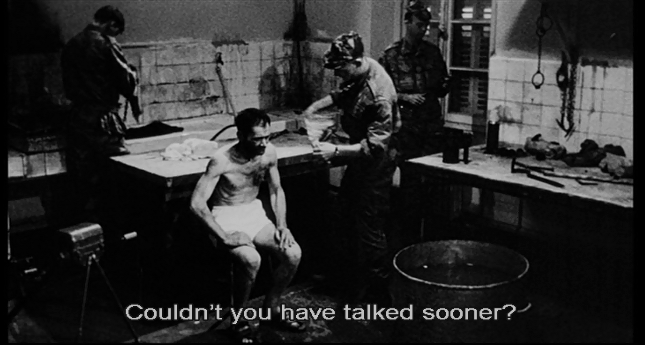
Pontecorvo’s Battle for Algiers is a rightly-celebrated classic, and it’s opening shot confirms the director’s claim to show compassion for both sides:

That’s an unexpected question from torturer to the victim he has just “broken”, and speaks volumes about the director’s intent — as does this quote from the french paratroop commander, Col. Mathieu, speaking of Larbi Ben M’Hidi, a leader of the National Liberation Front (FLN) whom he has captured and questioned — and who in “RL” was in fact murdered, though his death was reported at the time as a suicide:

Pour ma part, je peux seulement vous dire que j’ai eu la possibilité d’apprécier la force morale, le courage et la fidélité de Ben M’Hidi en ses propres idéaux. Pour cela, sans oublier l’immense danger qu’il représentait, je me sens le devoir de rendre hommage à sa mémoire.

For my own part, I can only tell you that I had the opportunity to appreciate Ben M’Hidi’s moral strength, his courage and his loyalty to his own ideas. On that account, and without overlooking the immense danger he represented, I feel obliged to salute his memory.

That reads to me as the respect of courage for courage.

The Pentagon, FWIW, held a screening of Battle for Algiers in September 2003, issuing a flyer indicating their reason to be interested in the film:

How to win a battle against terrorism and lose the war of ideas. Children shoot soldiers at point-blank range. Women plant bombs in cafes. Soon the entire Arab population builds to a mad fervor. Sound familiar? The French have a plan. It succeeds tactically, but fails strategically. To understand why, come to a rare showing of this film.

Yes indeed, it does sound a tad familiar.

**

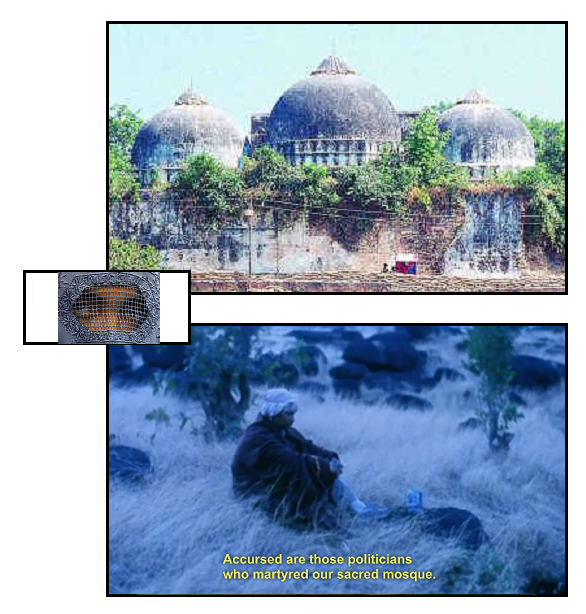
I’ll represent Kashyap’s Black Friday visually with a pair of images, the top one showing the Babri Mosque in Ayodhya / Oudh, which was leveled in December 1992 by an angry Hindu mob who claimed it had been built on the birthplace of Lord Rama, the avatar of Vishnu whose story is told in the Mahabharata

while the lower one represents Muslim rage at that event, making use of voice-over and that remarkable phrase, “martyred our sacred mosque”, to good effect.

Kashyap, then, can understand the feelings behind the horrific series of terrorist bombings that shook Bombay — as well as those of the bombed and terrorized population of that city. As Oorvazi Irani explains in her commentary on the film, Kashyap’s own views are expressed in the voice of DCP Rakesh Maria in the “chapter” on the interrogation of Badshah Khan:

Badshah Khan very proudly takes credit for the bombings and says Muslims have taken the revenge for the atrocities done to their Muslim brothers. That’s when Kay Kay Menon who plays the cop says and speaks in the voice of the director “…Allah was not on your side, on your side was Tiger Memon. He saw your rage and manipulated you. He was gone before the first bomb was even planted. ..he fucked you over. you know why? Because you were begging for it. All in the name of religion. You are a fucking idiot. You are an idiot and so is every Hindu, who murders one of you. Everyone who has nothing better to do … but to fight in the name of religion is a fucking idiot.”

**

Can there be a right side and a wrong side in a game? There can certainly be a winning side and a losing side — but a right side and a wrong side?

I ask, because the connection between wars and games is an ancient one. Can there be a right side and a wrong side in war? Looking at World War II, which was almost certainly the war that Elie Weisel was thinking of, the answer is pretty obviously yes. But what about the reasons given for “our side” being the right side?

Is our cause just because God is on our side? Because might makes right, and the big battalions are on our side? Or simply because it is our side — my country, right or wrong?

And then there is civil war to consider — for all wars are civil wars, when seen within the context of that greater “nationality”, the human race.

Abraham Lincoln, from his Second Inaugural:

Both parties deprecated war, but one of them would make war rather than let the nation survive, and the other would accept war rather than let it perish, and the war came. … Neither party expected for the war the magnitude or the duration which it has already attained. Neither anticipated that the cause of the conflict might cease with or even before the conflict itself should cease. Each looked for an easier triumph, and a result less fundamental and astounding. Both read the same Bible and pray to the same God, and each invokes His aid against the other. … The prayers of both could not be answered. That of neither has been answered fully. The Almighty has His own purposes…

The whole issue of the just war — or of jihad, its Islamic approximate equivalent — revolves around the question of whether there can be a wrong side in war.

**

If there can be a wrong side, it may be shredded. As Mark Twain once prayed:

O Lord our Father, our young patriots, idols of our hearts, go forth to battle — be Thou near them! With them — in spirit — we also go forth from the sweet peace of our beloved firesides to smite the foe. O Lord our God, help us to tear their soldiers to bloody shreds with our shells; help us to cover their smiling fields with the pale forms of their patriot dead; help us to drown the thunder of the guns with the shrieks of their wounded, writhing in pain; help us to lay waste their humble homes with a hurricane of fire; help us to wring the hearts of their unoffending widows with unavailing grief; help us to turn them out roofless with little children to wander unfriended the wastes of their desolated land in rags and hunger and thirst, sports of the sun flames of summer and the icy winds of winter, broken in spirit, worn with travail, imploring Thee for the refuge of the grave and denied it — for our sakes who adore Thee, Lord, blast their hopes, blight their lives, protract their bitter pilgrimage, make heavy their steps, water their way with their tears, stain the white snow with the blood of their wounded feet! We ask it, in the spirit of love, of Him Who is the Source of Love, and Who is the ever-faithful refuge and friend of all that are sore beset and seek His aid with humble and contrite hearts. Amen.

**

There are things to be said for being on the winning side of a conflict: you get to write history. There may be things to be said for being on the losing side: you gain the sympathy that accrues to the underdog. There are things to be said for supporting neither side, for being on the sidelines to pick up the pieces.

Then again, as Buddha observed in the Dhammapada, there are disadvantages to being on either side —

Victory breeds hatred. The defeated live in pain. Happily the peaceful live giving up victory and defeat.

while Christ muddies the simplicity of the whole business with a further contrarian note:

love your enemies.

Peace is not a bad side to be on, but perhaps love is more nuanced.

**

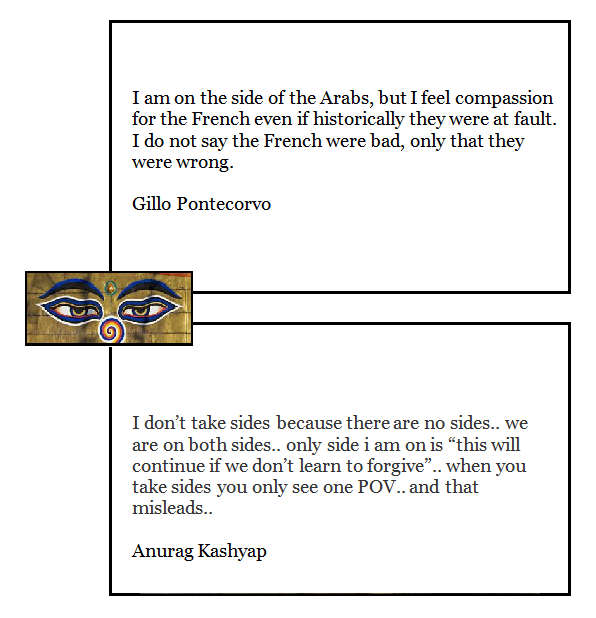
To bring us full circle, here’s another statement of the Elie Weisel position, this time in the words of Dietrich Bonhoeffer, the Lutheran pastor and theologian involved in the plot to assassinate Hitler and executed in one of the concentration camps — together with a response to the question I’ve been posing for myself here which may perhaps providinge some measure of reconciliation, this one from a contemporary Zen Buddhist, someone for whom the appreciation of koans is a way of life:

Book Review: Lords of the Sea by John R. Hale

Tuesday, November 6th, 2012

Lords of the Sea: The Epic Story of the Athenian Navy and the Birth of Democracy by John R. Hale 

“I cannot tune a harp or play a lyre, but I know how to make a small city great.” – Themistocles

Nautical archaeologist Dr. John R. Hale, an expert on bronze age shipbuilding and seafaring, has written a delightful and robust popular history of the navy of ancient Athens, but more importantly, a poignant political history of the Athenian navy’s  intrinsic relationship to radical Democracy and Empire.  A page turner with enough detail about triremes and warfare in the Aegean to leave you crying “The Sea! The Sea!”,  Lords of the Sea will be enjoyed by naval buffs and philo-Hellenes alike.

As you would expect, there is much in Lords of the Sea about the design, construction and care of triremes, Piraeus and the Long Walls, the shipsheds at Zea Harbor, the financing of the Athenian navy, trierarchy, naval tactics, rowers and rowing, superstitions of Athenian sailors on campaign, the deforestation of Athens for ship timber, comparisons with Spartan, Persian and Macedonian naval prowess and the great sea battles of the ancient world. Plenty, in fact, to keep naval aficionados happy while reading Lords of the Sea and all of which I am spectacularly unqualified to comment upon. I can say that in regard to ancient navies, I learned much that was new to me.

What was of greater relevance to me was Hale’s major theme of the political nature of the Athenian navy. That the imperial glory and thalassocracy was irrevocably bound up with democracy itself and bitterly opposed by the wealthy, would-be, oligarchs who consistently preferred a much diminished Athens they controlled as Sparta’s vassals to a democratic Athenian empire where they shared power with the people:

….The resumption of work on the Long Walls jolted Athens’ oligarchs into action. A small group of upper-class citizens still hoped to destroy the radical democracy. These men feared that once Athens was permanently and inseparably linked to its navy by the Long Walls, the common people would never be unseated from their rule. Before the walls had been completed, the oligarchs sent secret messages to a Spartan army that was at that moment encamped not far from the frontiers of Attica. The oligarchs invited the Spartans to attack Athens, promising to assist in the overthrow of the current regime. In their own minds, these men were patriots, pledged to restore the ancestral consitution.

Traitors are always heroic in their own minds.

Hale was a student of Donald Kagan, whom he credits with inspiring him toward an investigation of the naval prowess of Athens, however in covering the history of Athens, including the Persian and Peloponnesian wars, Hale is more evenhanded in his assessments than Kagan. The  faction of oligarchs come off quite badly, except for the rising to the occasion of the Areopagus, patriotism and sacrifice is to be found  by Hale primarily in the demos, especially the thetes and newly freed and enfranchised slaves who rose to the call to defend the city in the hours of Athens’ maximum  danger. However, the demos in the Assembly were not without fault; rule by the people also proved to be impetuous, arrogant, capricious toward Athenian generals and cruel toward allies and enemies alike. The Athenian empire was, in short,  afflicted with hubris and this caused their downfall.

Hale ties both democracy and Athens’ unparalleled cultural creativity to thalassocracy. When the political will to maintain Athenian naval dominance and independence as a power faded among the Athenian upper-classes, the spirit of oligarchy ignominiously surrendered Athens to a foreign king, despite a mighty navy and eagerly betrayed their own countrymen:

….The Assembly sent Phocion and Demades and Xenocrates, the head of the Academy, to ask Antipater [ Alexander the Great”s regent and successor ]  about terms: a war hero, an orator, and a philosopher to negotiate the fate of a once-great city. Antipater demanded a payment of indemnity equal to the full cost of the war, the handing over of Demosthenes and other enemies of Macedon, and the evacuation of Samos. The thetes of the demos, defined as all citizens with a net worth of less than two thousand drachmas, were to be expelled from Athens. The wealthier citizens who remained must surrender the fort on Munychia Hill in the Piraeus to a Macedonian garrison.

…..So the Athenian envoys returned to Athens with the terms of surrender that gave up Athenian independence and, for all practical purposes, Athenian identity. The incredible had happened. Almost three-fifths of the citizens – 12,000 out of 21,000 – failed to pass Antiper’s test of wealth. They were the rabble, the mob, the radical democrats who were everywhere blamed for all the crimes of restless, ambitious, and expansionist Athens. They were now to be banished for the good of all, not merely from Athens but for the most part from Greece itself

The Athenian Assembly would have been far better off keeping Demosthenes, executing the trierachs who had cravenly surrendered to Cleitus the White and his Macedonian fleet, ostracizing Phocion, Demades and Xenocrates and resuming the war. From this defeat, there was no recovery for Athens, nor did the new oligarchy, secure in their power now, seek any. Without the thetes there were no crews to man the ships or skilled laborers to build them at Zea. Athens was broken as a power and a polis forever.

Strongly recommended.

A Light at the End of the Tunnell

Tuesday, October 23rd, 2012


Colonel Harry Tunnell 

Michael Yon recently published a remarkable and courageous letter by US Army Colonel Harry Tunnell to the Secretary of the Army regarding deficiencies in our military operations in Afghanistan.  Colonel Tunnell is now retired, but the letter was sent while he was on active duty in 2010. Yon calls it “stunning” and I wholeheartedly agree. It is a “must read“.

Colonel Tunnell is a controversial figure in the Army. A bluntly outspoken critic of COIN with strong views on military professionalism and tactical leadership, he served as a commander of combat troops in Afghanistan and in Iraq, where he was badly wounded. Overcoming his injury, Colonel Tunnel returned to command a Stryker brigade in Afghanistan and clash with his ISAF superiors over his use of older Army doctrine on counter-guerrilla operations instead of the pop-centric COIN of FM 3-24.  Tunnell aggressively and repeatedly attacked the Taliban in his area of operations, pressing them, which resulted in frequent combat and casualties on both sides – something that was out-of-step with ISAF’s tactical guidance. Several enlisted soldiers in the Stryker brigade were convicted of the infamous “Kill Team” murders which led to Tunnell being investigated and cleared by the Army which found no causal responsibility from Tunnell’s advocacy of aggressive tactics but nonetheless reprimanded him for “poor command climate”.

In light of  Tunnell’s letter to the Secretary of the Army, interpret that administrative action as you wish. Afterwards, Colonel Tunnell continued to be a harsh critic of COIN and the focus of periodic,  extremely one-sided, negative stories in the media.

When Yon published his piece on Tunnell’s letter, I commented to him on a private listserv and he asked permission to use it, which I gave:

Mark Safranski Comments Col (ret.) Harry Tunnell 

The following email came from Mark Safranski subsequent his reading this letter from Colonel (ret.) Harry Tunnell.  The letter.

===Email from Mr. Safranski:===

Interesting, this part in particular:

“”A gross lack of concern for subordinates,” Tunnell wrote, “manifests itself in guidance that ‘zero’ civilian casualties are acceptable and coalition soldiers may have to be killed rather than defend themselves against a potential threat and risk being wrong and possibly resulting in injury or death of a civilian.”
….Tunnell’s memo exhibits particular disdain for British Maj. Gen. Nick Carter, commander of NATO forces in Regional Command South, which includes the Arghandab District where Sitton was killed.

It was Carter, Tunnell wrote, whose verbal order led commanders to risk their own troops rather than Afghan civilians – something Sitton complained about two years later in an email to his wife.”

Very helpful. I finally get it now.

I was always curious, reading threads [on private listserv] here on Afghanistan, how Colonel Tunnell was able to openly pursue counter-guerrilla operations in Afghanistan when pop-centric COIN was the heavy-handed, top-down and rigidly enforced tactical paradigm; Harry, IMHO, could do this because the *verbal* orders being issued went far beyond FM 3-24 theory into an unauthorized and unofficial but *politically desired* British policing model used in Northern Ireland. A kind of tactical guidance that could not be put in writing and enforced through the UCMJ because the American people would have found that guidance to be politically intolerable and morally outrageous – and rightly so.

Unlike Catholics in Ulster who are subjects of the Crown, Afghans are not American citizens and American soldiers and Marines are not cops in a bad neighborhood. Nor is the Taliban the IRA. Minimizing civilian casualties is a good and worthy goal; valuing political atmospherics over American lives is a sign of gross incompetence, at best.

Hence the anonymous leaks and smears about Harry to politically connected  Beltway scribes instead. Tunnell’s superiors were afraid to air their real dispute…..

Read the rest here.

In my view, Tunnell’s letter raises critical questions that every officer has a duty to raise with his superiors in the chain of command if, in their view, operations are not properly being carried out, which endangers the campaign and the lives of the troops. Moreover, if the United States military is to adhere to some bizarre, complicated, unworkable “law enforcement model” ROE not required by the Laws of War, or even our own COIN doctrine, then this is a subject for Congressional hearings and testimony from the administration, not something to be instituted on the sly using allied foreign officers.

Wanting to police the world is hard enough without making our soldiers into policemen.

Twenty-Nine Articles

Tuesday, September 18th, 2012

SWJ Blog has a new post up with an important and all too timely article on transition operations whose authors include an amigo of mine, Pete Turner, a veteran of Iraq and Afghanistan. Turner will also be one of the featured speakers at the Boyd & Beyond Conference in October at Quantico:

Transition Operations: A Discussion with 29 Articles by Richard LedetJeff Stewart and Pete Turner 

….What is Transition?

Currently, there is no accepted definition for Transition in US Doctrine.  For the purpose of this discussion, we will define Transition simply as the transfer of responsibility from Supporting Nations (SN) to the Host Nation (HN). 

How do we go from full-speed-ahead COIN operations where we call all of the shots to a fully functioning sovereign nation that provides security and services for its population?  Although we have concluded one Transition (Iraq) and are in the midst of another (Afghanistan), we are still literally feeling our way forward, one unit at a time, without a coherent strategy, doctrine, or national policy.  Battalion and Company Commanders want to know, “What comes after build?”

As previously stated, our doctrine is remarkably silent on Transition.  FM 3-24 Counterinsurgency acknowledges the requirement for Transition in the late stage of counterinsurgency:  

“The main goal for this stage is to transition responsibility for COIN operations to HN leadership.  In this stage, the multinational force works with the host nation in an increasingly supporting role, turning over responsibility wherever and whenever appropriate.  Quick reaction forces and fire support capabilities may still be needed in some areas, but more functions along all Logical Lines of Operations are performed by HN forces with the low-key assistance of multinational advisors.  As the security, governing, and economic capacity of the host nation increases, the need for foreign assistance is reduced.  At this stage, the host nation has established or reestablished the systems needed to provide effective and stable government that sustains the rule of law” (paragraph 5-6).

That is the sum total of the guidance given in our counterinsurgency manual.

Transition thus appears to be rather nebulous; it is something we desire and anticipate, but do not necessarily know how to achieve, or even understand.  It may occur quickly, or be drawn out over an extended period of time.  Like other operations in COIN, Transition will also occur differently in different locations, with various requirements and assorted timelines.  Our own relief in place/transfer of authority (RIP/TOA) process even affects Transition.  How do we maximize effects at this point, especially considering that the level of international effort is simultaneously in decline?  What are the requirements for Transition, and what is the glide path to a smooth successful hand-off to the host nation?  Is it a phase that comes after “Hold,” or is it part of the “Build” phase, both of which occur sequentially after “Clear?”  One might also argue that once “Transition” has begun, the COIN fight is over for SN forces and the responsibility shifts to the State Department or the UN.  Or does it?  

There is no simple way of answering these questions, or the others which are raised throughout this paper.  The answers may change with each particular case.  However, without a dialogue on the subject these questions will continue to go unanswered and operations are likely to proceed with uncertain or frustrating results. ….

Read the rest here.   I am a particular fan of points 3,4,5,6 and 9.

And now, we interrupt this post for a…….

Public Service Message:

If you enjoy discussions like this one and think that SWJ and SWJ Blog are an important forum for debate on key defense and strategic issues, they could really use your financial support:

Small Wars Foundation Annual Fundraising Campaign

The Small Wars Foundation / Journal / Council’s annual fundraising campaign is now underway and this is easily the most critical funding effort we have conducted since going hot in 2005. We originally envisioned quarterly campaigns but quickly realized that we were likely over-tapping the hard-core few who have kept our head above water all these years. Well, we are currently on life support in many aspects of our operations to include day to day operating costs, upgrades to the site, and providing at least a meager compensation to those who work 24/7 to keep our humble contribution to our Nation’s security and foreign policy alive and well.

There are many ways to support SWF/SWJ and they can be found here. But what we are most in need of right now is hard cash, the more the better. We have over 200 of our popular Small Wars Journal challenge coins remaining and will get one off to those who donate $50 or more or commit to a $25 a month recurring contribution. Donation options are available at the same link.

And for US contributors – your donation is tax deductible. Last year our goal was to raise approximately $20k but we fell far short of that. Our goal this year, and a very optimistic one at that, is $30k and we will keep you posted on our progress. Thanks in advance in helping keep this effort alive and well.


Switch to our mobile site