zenpundit.com » philosophy

Archive for the ‘philosophy’ Category

Of Quantity and Quality II: Holocaust, torture and sacrament

Thursday, April 19th, 2012

[ by Charles Cameron — Yom HaShoah, quality vs quantity, sacramental value of life, continuing from Q&Q I, long, intense ]
.

Today is Yom HaShoah, Holocaust Remembrance Day.
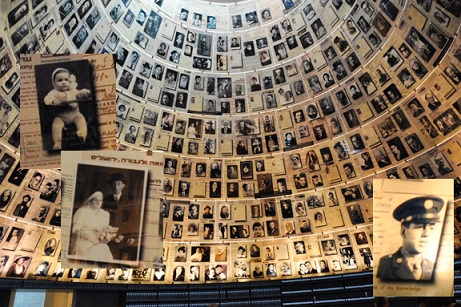

photo credit: Joni B Hannigan

The mind is struck dumb.

Six million individuals is too vast a gathering to contemplate. Even to think of ten people we know well if they are in the room with us requires us to move from face to face, person to person, picking up where we left off with each one, perhaps with this couple or these four colleagues from a remembered journey or project.

Six million.

Six million people is more than a crowd, it’s a blur — it is, approximately, the entire population of Arizona, of Rio or Lahore, of entire nations, El Salvador, Libya or Sierra Leone.

Today we remember those who died in the Shoah, as individuals and together.

*

I believe the Shoah to be one of those topics where we humans need to use the cognitive equivalent of a zoom lens – the capacity to hold magnitude in mind while exploring at the level of the individual, and to feel for the individual while not losing sight of the magnitude of the larger picture.

Consider the rabbinic opinion given in the Babylonian Talmud, Sanhedrin 37a:

For this reason was man created alone, to teach thee that whosoever destroys a single soul of Israel, scripture imputes [guilt] to him as though he had destroyed a complete world; and whosoever preserves a single soul of Israel, scripture ascribes [merit] to him as though he had preserved a complete world.

How do you magnify that “complete world” by six million?

*

Another such topic involving the individual and the group is torture.

Here the issue is, at best, not one of innate cruelty or hatred or disregard for values, but a considered weighing of alternatives — the brutal interrogation of a Khalid Sheikh Mohammed, say, against the chance to avoid a second 9/11. Torture, too, is a matter of the relationship of the many to the one, and I suspect people’s opinion of torture pretty much rests on each person’s understanding of when and indeed whether the need of the group ever trumps that of the individual.

Again, I think we need a cognitive zoom capability, if we are to begin to grasp the subtlety of the issue — and to be able to countenance those who see it differently from ourselves.

*

I suggest that the core question is that of the relationship of quality to quantity — which I have argued before, is essentially the same as the deep question in consciousness, that of the relationship between (subjective) mind and (objective) brain.

Can a sheer quantity of people saved from some hateful end ever really compare to the quality — radiant suchness of the Tathagata (Diamond Sutra), image and likeness of God (Genesis) — of a single willfully tortured human?

For some people this is a no-brainer. Of course: you weigh the likely impacts, and on occasions when torturing one is liable to reveal information that saves thousands of others, do it. Reuel Marc Gerecht, lately of the CIA, posed the issue this way:

… if you had been confronted on 7 September 2001 with a captured Khalid Shaykh Muhammad or Abu Zubaydah and you knew that a major, mass-casualty terrorist strike was about to go down in the United States, and you had plenipotentiary authority for the nation’s security …

For some, it is a no-brainer. Of course not: if you treat others that way, even in the heat of battle, you’ve lost already — you’ve become what you hate. John Kiriakou, lately of the CIA, wrote:

even if torture works, it cannot be tolerated – not in one case or a thousand or a million. If their efficacy becomes the measure of abhorrent acts, all sorts of unspeakable crimes somehow become acceptable. … There are things we should not do, even in the name of national security.

*


.

In the Egyptian scene above — taken from the Papyrus of Ani in the British Museum — judgment is rendered on a single human soul when it is weighed against the feather of Maat:

The goddess Maat, shown as a feather in the scale pan, is the deification of the concept of maat: truth, justice and cosmic order.

Is the heart light enough to balance justice herself?

The jackal-headed Anubis is weighing the heart of the supplicant as the ugly beast Ammit, known as “The Devourer,” “Bringer of the Second Death” — a hybrid monster, part lion, part hippopotamus, part crocodile — crouches by the scales drooling, waiting to gulp down the failed soul. The ibis-headed Thoth is poised to record the verdict on his slate. Various deities are ranged around the scene, serving as Judges or in other roles important to the ritual or the ideology that had developed over the span of many centuries. Overlooking this scene is the Ba — the winged representation of the personality of the deceased — perched and ready but not yet able to take flight as a risen being.

Even though Osiris is pictured at the far end of the Judgment scene, indicating the conclusion of the proceedings, his presence nonetheless dominates the scene, as a confirmation of the ultimate purpose of all this.

*

Mary Qualit and Martha Quant…

A number of significant thinkers have weighed in on the scales which measure human lives… basically asking if a quality can be quantified, added, multiplied.

The philosopher Wittgenstein, in a selection of his posthumous writings, says:

The whole earth cannot be in greater distress than one soul.

The writer CS Lewis concurs:

We must never make the problem of pain worse than it is by vague talk about the “unimaginable sum of human misery.” … There is no such thing as a sum of suffering, for no one suffers it. When we have reached the maximum that a single person can suffer, we have, no doubt, reached something very horrible, but we have reached all the suffering there ever can be in the universe. The addition of a million fellow-sufferers adds no more pain.

And Arne Naess, the “father” of Deep Ecology, in his Philosophy of Wolf Policies says:

We should be careful when talking about greater suffering. Referring to a consciously experienced suffering, including simple pain, we have to do with a quality admitting degrees of intensity, but in an important sense unquantifiable and nonadditive.

Strictly speaking, experienced suffering is not additive.

In my view — or perhaps I should say, with my mind — it is hard even to fully grasp what these three distinguished and diverse folk are saying. And yet I feel as if they are bringing me a truth, bringing it right to the edge of my awareness.

*

Tarek Mehanna wrote in his sentencing statement, given in court last week:

I learned about the American-led sanctions that prevented food, medicine, and medical equipment from entering Iraq, and how – according to the United Nations – over half a million children perished as a result. I remember a clip from a ’60 Minutes’ interview of Madeline Albright where she expressed her view that these dead children were “worth it.”

I can understand that, the reluctance to accept that particular policies are “worth” the loss of children. Where is Maat, to weigh such matters for us?

*

Here are four quotations having to do with the value of sparrows, one way or another:

Are not two sparrows sold for a farthing? and one of them shall not fall on the ground without your Father. But the very hairs of your head are all numbered. Fear ye not therefore, ye are of more value than many sparrows. — Matthew 10.29-31.

Whoever uselessly kills a sparrow, on the Day of Judgment, it will come and shout in front of the throne and say, “Oh my Lord, ask this person why he uselessly killed me.” — Hadith of the Prophet, quoted in Kazemi, Environmental Rights and the Teachings of Mahdism

There is a special providence in the fall of a sparrow. — Shakespeare, Hamlet, V.2

If a sparrow dies in Central Park, I feel responsible. — Mayor Fiorello La Guardia

*

There’s a streak of paradox running through the heart of Christianity, in which two values are simultaneously present: one temporal and moral, the other atemporal / eternal and transcendent. Thus Christ can say “Before Abraham was, I am” — situating himself in both eternal and temporal realms simultaneously. Thus also, he can say of himself and his betrayal by Judas, “The Son of man goeth as it is written of him: but woe unto that man by whom the Son of man is betrayed! it had been good for that man if he had not been born.”

And thus also, in a masterful paradox, St John’s Gospel recounts how the High Priest Caiaphas argued for the death of Christ:

Then gathered the chief priests and the Pharisees a council, and said, What do we? for this man doeth many miracles. If we let him thus alone, all men will believe on him: and the Romans shall come and take away both our place and nation. And one of them, named Caiaphas, being the high priest that same year, said unto them, Ye know nothing at all, Nor consider that it is expedient for us, that one man should die for the people, and that the whole nation perish not. And this spake he not of himself: but being high priest that year, he prophesied that Jesus should die for that nation; And not for that nation only, but that also he should gather together in one the children of God that were scattered abroad. Then from that day forth they took counsel together for to put him to death.

On the one hand, Caiaphas is arguing that one troublesome young rabbi’s life is expendable if it will avoid a Roman crackdown not unlike the one that did in fact occur some forty years later, with the destruction of the Temple in 70 CE. This is, in Christian terms, a vile argument, and one respondible for the death by execution of the Christ.

On the other, though — and the brilliance of the paradox lies in the way that John weaves the two perspectives together — God thinks it preferable that he himself, incarnate, should die as a once-for-all sacrifice to save his many creatures who — and here I can’t help but hear the strains of Handel’s Messiah — like sheep have gone astray…

Putting it mildly.

So, whether you’re Christian or not — and I wouldn’t claim to be, though I’m clearly influenced — the notions of sacrifice and self-sacrifice belong in here somehow.

*

I quoted the Talmudic Tractate Sanhedrin at the top of this post. The Qur’an recalls this passage in Sura 5.32:

Therefore We prescribed for the Children of Israel that whoso slays a soul not to retaliate for a soul slain, nor for corruption done in the land, shall be as if he had slain mankind altogether; and whoso gives life to a soul, shall be as if he had given life to mankind altogether.

It is my suggestion that the difference between Quantity and Quality is as profound (in Bateson’s terms, makes as great a difference as) as the difference between mind and brain, subjective and objective or inner and outer worlds — which itself revovles around the “deep problem” in consciousness.

If I’m right about this — and “right” may not be the best term in any case — then the quality / quantity issue is one facet of the great mystery at the heart of things that religion approaches and derives from, but can never fully define or express.

Morality is our attempt to work in the world with some of the insight gleaned from that mystery, and it may well be that dualistic, propositional thinking is inherently unsuited to the task.

I’d like to return at this point to a quote I’ve used here before, and find very insightful. It’s from Lin Jensen, An Ear to the Ground: Uncovering the living source of Zen ethics, and it tells us:

Judgments on right and wrong are a nearly irresistible enticement to pick sides. And that’s exactly why the old Zen masters warned against becoming a person of right and wrong. It isn’t that the masters were indifferent to questions of ethics, but for them ethical conduct went beyond simply taking the prescribed right side. For these masters, the source of ethical conduct is found in the way things are, circumstance itself: unfiltered immediate reality reveals what is needed.

*

In closing, I would like to return to the issue of torture, and to offer you another quote, this one from one of the most powerful works of theology known to me, William T Cavanaugh‘s Torture and Eucharist: Theology, Politics and the Body of Christ:

by making the seeking of important answers seem like the motive for the torture, the torturer seems able to justify his brutality. No one would think of defending the sheer physical act of torture, the merciless inflicting of pain on a helpless victim. However, once we consider the verbal aspect, the question and answer which seem of such great urgency, the moral contours of torture seem less clear, and utilitarian justifications of torture become thinkable, provided the motive for the questions is of sufficient importance.

Cavanaugh is writing about those who were “disappeared” in Pinochet‘s Chile, and his broader argument is that torture is the antithesis of the sacramental nature of human identity — and here we return full circle to the “image and likeness” of the divine in the mortal, the human.

The deeper we can penetrate into the central mystery, it seems to me, the better we will be enabled to love, to understand, and to forgive.

Simultaneity II: the pictorial eye

Wednesday, April 11th, 2012

[ by Charles Cameron — when sequence becomes simultaneous, the pictorial eye, rethinking thinking, continuing from Simul I ]
.

What better day to begin writing this second post on simultaneity than the day on which Google celebrated the birthday of Eadweard Muybridge with a Google Doodle — not that I’ll get the post finished within those same 24 hours!

The film — sequence of frames? stills? which would you call it? — that Muybridge took of a horse, used in that Google Doodle [view it in motion, here], is celebrated as showing beyond a doubt that when galloping, all four of a horse’s hooves may be in the air at the same time.

But is it — Muybridge’s work product — sequential, ie a film, or simultaneous, ie the presentation of many moments at one time?

That question gets to the heart of an issue that all narrative faces, as we shall see. First, the pictorial side of things.

*

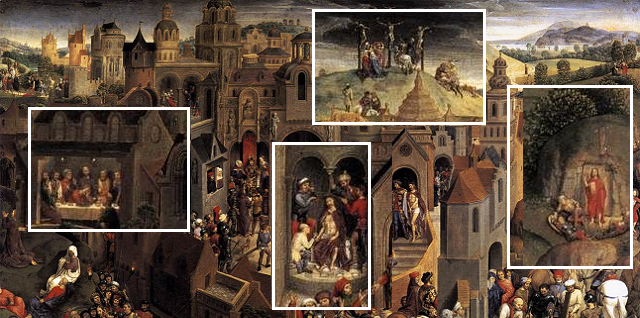
Hans Memling‘s Passion of Christ (above) tells the gospel narrative, from Christ’s entry into Jerusalem and the Last Supper through his crucifixion, entombment and resurrection to his appearances in Emmaus and by the sea of Galilee in one canvas, much as Bach’s Matthew Passion [link is to Harnoncourt video] tells major portions of the same narrative in three hours of unfolding musical drama.

*

David Hockney has recently been working on forms of what I can only call “asynchronous synchrony” — as exemplified here:


Stills from Woldgate 7 November 2010 11:30 AM (left) and Woldgate 26 November 2010 11 AM (right). Credit: ©David Hockney

This image comes from a fascinating article describing Hockney’s current work by Martin Gayford, titled The Mind’s Eye, which you can find in MIT’s Technology Review, Sept/Oct 2011:

We are watching 18 screens showing high-definition images captured by nine cameras. Each camera was set at a different angle, and many were set at different exposures. In some cases, the images were filmed a few seconds apart, so the viewer is looking, simultaneously, at two different points in time. The result is a moving collage, a sight that has never quite been seen before. But what the cameras are pointing at is so ordinary that most of us would drive past it with scarcely a glance.

As with the Muybridge video above, “the viewer is looking, simultaneously, at different points in time”. Here Hockney does this with video cameras — but he achieves something of the same effect of time-displacement with still photos, too, as you can see in his brilliant portrait of the sculptor Henry Moore, hosted on the British Council’s Venice Biennale site.

Here is Gayford’s concluding paragraph, tying Hockney’s work into the larger context of our need for multiple frames of reference:

“Don’t we need people who can see things from different points of view?” Hockney asks. “Lots of artists, and all kinds of artists. They look at life from another angle.” Certainly, that is precisely what David Hockney is doing, and has always done. And yes, we do need it.

*

Memling again — and here I have enlarged and “framed” four of the 23 scenes from the passion of Christ which he has incorporated in the one painting: the Last Supper, the Crowning with Thorns, the Crucifixion, the Resurrection — Thursday evening through Sunday, and from life to death and back again.

*

It was Holy Week for Christians just last week, so perhaps you will forgive my having been preoccupied with images of the passion during the season set aside for such meditations — but what I want to point out to you is timeless, and indeed brings the transcendent into the everyday. Let’s take a look at a Hitchcock film next, then, and see how a contemporary videographer Jeff Desom has remixed the already Hockney-like Rear Window [link to IMDb] to create his own time-lapse telling of the tale [link to Vimeo], from which I took this screen-grab:

*

Time-lapse — simultaneity? The philosopher Alfred North Whitehead once wrote:

The communion of saints is a great and inspiring assemblage, but it has only one possible hall of meeting, and that is the present; and the mere lapse of time through which any particular group of saints must travel to reach that meeting-place, makes very little difference.

And so it is with this other Memling painting — and many others like it, by artists old and new:

Here we see the Virgin Mary and Christ child with Saints Dominic and James — there’s an eleven centuries gap right there, St Dominic lived from 1170 – 1221, more than a millennium after Christ — and Memling has St Dominic presenting his patron, the spice trader Jacques Floreins with his family to Christ, circa 1490. With everyone dressed in late 15th-century fashions…

Whitehead — co-author with Bertie Russell of Principia Mathematica — see how amazing this is? — could have been thinking of Memling: “the mere lapse of time through which any particular group of saints must travel to reach that meeting-place, makes very little difference”.

*

Coming up next: how this affects our understanding of story.

____________________________________________________________________________

For an understanding of the setup David Hockney uses for his multiple-video takes, see here and specifically this and this. For the setup used by Jeff Desom in his Rear Window remix, see here and specifically this.

“Our enemy is adaptable, we must be, too.” Adaptability & Simplicity, Random Thoughts

Saturday, March 17th, 2012

[by J. Scott Shipman]

This is cross-posted at http://tobeortodo.com

Earlier this week I had the privilege of speaking at the Navy Expeditionary Forces Conference (NAVEXFOR 2012) in Virginia Beach, VA. The theme for this year’s conference was “innovation in constrained environments.” In my talk, I focused on potential internal cultural constraints and deliberate actions to mitigate resulting threats. Not surprisingly, other speakers focused on our enemies and the constraints they place on our forces, and the fact those enemies impose constraints with innovative methods and weapons like roadside IEDs.  Yesterday, through a friend on Twitter, I learned that insurgents in Iraq had used cell phone geotags to destroy AH-64’s; innovation, indeed.

One speaker made the comment in this post’s title: “Our enemy is adaptable, we must be, too.” He went on to characterized their adaptations as “simple.”

Using this description, through simple adaptation, our enemies disrupt our activities, destroy our equipment, and kill or maim our service members using cheap, simple, but deadly tools. The resulting affect isn’t limited to physical casualties; their innovations also disrupt our ability to control the initiative, and perhaps just as importantly our sensemaking abilities. The ability to alter an opponent’s sensemaking will inform and increase the complexity of an already complex environment, so adaptability is essential.

In most situations we counter these simple adaptations by employing complex and expensive solutions. This has been accurately called, “adaptation at acquisition speed.” Those expensive and complex solutions must make it through byzantine acquisition processes rife with political maneuvering, operating in a culture of “no,” which results in increased costs, schedule, and ultimately our frequent inability to be responsive to troops in field. Institutional inertia in the defense bureaucracy prevents significant change in the short-run, so these facts must be considered an on-going constraint.

In spite of these constraints, our troops are thinking and acting—they are adapting, using simple tools, like remote control vehicles.  This “toy” was used to inspect vehicles and detect IEDs. Instead of an expensive long lead-time solution, they went to Radio Shack—and the vehicle lasted for several years—so they got another. According to the report, at least six lives were saved as a result. Not surprisingly, the folks closest to the problem produced an effective solution. No doubt there are other stories of ingenuity and adaptation, but this story exemplifies the possible. The underlying point is this soldier was thinking and acting—he was adapting in a way that allowed him and his colleagues to remain more safe.

Sun Tzu and the ultimate in adaptability

The speaker’s quote reminded me of this quote from Sun Tzu’s The Art of War, Chapter VI Weaknesses and Strengths (page 153 in the Samuel B. Griffith translation):

Now an army may be likened to water, for just as flowing water avoids the heights and hastens to the lowlands, so an army avoids strength and strikes weakness.

And as water shapes its flow in accordance with the ground, so an army manages its victory in accordance with the situation of the enemy.

And as water has no constant form, there are in war no constant condition.

Bear with me, as I like word pictures and synonyms and what follows is a bit like “plodding,” but I’ve found adjacencies in language illuminating (if I could draw this, I would). Water as a metaphor for adaptability presents any military force (or any other group) a daunting task. Considering the physical qualities of water several synonyms come to mind:

  • Water is transparent, so to be adaptable, we need to promote and practice clarity in internal communications and actions. Keeping ambiguity to a minimun is one method of promoting clarity, and practicing honesty is a good way to practice.
  • Water is physically cohesive, while being ultimately pliable. Think about it; put water in a jar, it conforms to the jar, pour it out, it follows gravity, and water surrounds whatever is submerged in it. Water moves as one, just as a group adaptability needs to be a key characteristic of any successful team. But in a larger sense, when one considers what I call the “bordering language” of synonyms, one discovers a greater depth to the concept of coherence, words like intelligence, comprehensibility, understandability, intelligibility, decipherability,  conncinity (my favorite),  unity, and harmony—just to name a few. Concinnity is a harmonious arrangement of things; where a culture is arranged and led in such a way as to promote and sustain harmony. My friend Ed H. has the best working definition for harmony that I’ve found. Ed derived his description from the novelist Douglas Adams and French impressionist painter Georges Seurat:

You don’t get harmony when everybody sings the same note. Harmony is the marriage of the contrary and of the similar; marrying discordant elements, regardless of tone, of color, of line, of thought and of purpose…

  • Water as described by Sun Tzu is fluid. Fluidity can be a blessing and a curse. On the one hand, fluidity implies adaptability, flexibility, fluency, smoothness, and ease. On the other, fluidity implies instability, unstableness, fickleness, inconstancy, changeableness, shifting, and flux. For cultures in a competitive environment, having the first form of fluidity is desired, while inflicting the second on the competitor. In addition, fluidity’s synonym fluency implies an eloquent and skillful use of language—or mediums of exchange. Fluency is possible only through practice, lots of practice. So much practice the skill becomes tacit knowledge, thus simple (effortless?)…even intuition.

Simplicity

Articulation in language and action are elements of simplicity. Simplicity implies tacit. As simple as the force of gravity directing water down a hill, going around and engulfing obstacles, thus is the potential of a group that has made their purpose/mission tacit and have the freedom to act. In fact, the sum of the skill sets may be so simple as to defy explanation—and more often than not in these cases, others learn by close association; watching, failing, learning, and making tacit those capabilities needed to cope and adapt. Boyd said as much in the abstract of Conceptual Spiral:

To flourish and grow in a many-sided, uncertain and ever-changing world that surrounds us, suggests that we have to make intuitive within ourselves those many practices we need to meet the exigencies of that world.

“To make intuitive within ourselves those many practices we need” implies the development and nurturing of habits that will enable us to adapt.That which is habitual becomes simple (and as mentioned above, yet another route to tacit).

Close

To the troops using the remote control vehicle mentioned above, the solution was obvious, and seemingly simple. Importantly, they were in a unit where they could act on their idea—and they did so outside the bureaucracy at little cost, and saved six lives (maybe more).

Taking a riff from the conference title, our leaders should be checking to make sure the rules of engagement (ROE) and other rigid rule sets aren’t implicitly making their folks hopelessly incapable of adaptability. As we increase adaptability, the more adaptability becomes a habit—and when it is a habit, it becomes simple. Just a thought.

Postscript:

The best short book I’ve read on tacit knowledge is Michael Polanyi’s The Tacit Dimension, the best long book on the same topic is Personal Knowledge by the same author.

Iran is a classic wicked problem

Saturday, March 10th, 2012

[ by Charles Cameron — Iran, unknown unknowns, Madhyamika philosophy and a blessed unknowing ]
.


.
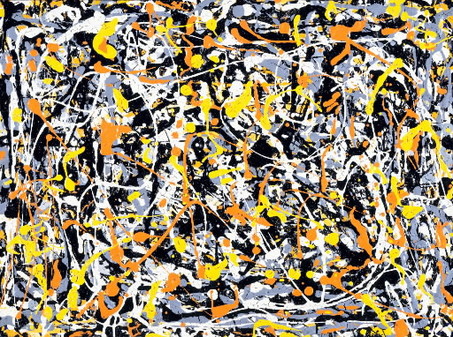
image from Jackson Pollock / AustinKids
an artist’s representation of a wicked problem to be untangled?

1.

Dr. TX Hammes, who will need no introduction to most ZP readers, wrote a few days back in On Bombing Iran, A False Choice:

While there has been some discussion of Iran closing the Straits of Hormuz, there has been no consideration of other Iranian actions – mining harbors overseas (using merchant ships), major attacks on oil production chokepoints globally or major terror attacks using the nuclear equivalent explosive power inherent in many industrial practices. In short, bombing proponents assume Iran will be an essentially supine enemy and not attempt to expand the conflict geographically or chronographically.

Iran is a classic wicked problem. Any “solution” brings a new set of problems. Lacking a solution, the strategist’s job is to think through how to manage such a problem.

My train of thought now departing the National Defense University on Dr Hammes’ platform will make its way with stops at Hans Morgenthau, Jeff Conklin and Richard Feynman to a final destination deep in the heartland of Buddhist Madhyamika philosophy with Elizabeth Mattis-Namgyel.

2.

Drs. Francis J. Gavin and James B. Steinberg‘s recent Foreign Policy piece The Unknown Unknowns carried the subtitle:

If the past half-century of American political history has taught us anything, it’s that we can’t possibly know the consequences of bombing — or not bombing — Iran

and opined:

Based on our experiences — one of us a former senior policymaker, the other a historian of U.S. foreign policy — we are convinced that the “right” answer, but the one you will never read on blogs or hear on any cable news network, is that we simply cannot know ahead of time, with any degree of certainty, what the optimal policy will turn out to be. Why? Even if forecasters could provide probabilities about the likelihood of a narrow, specific event, it is simply beyond the capacity of human foresight to make confident predictions about the short- and long-term global consequences of a military strike against Iran.

3.

It appears that this sense of unknowing has application beyond the specific question of whether or not to bomb Iran. Blog-friend Peter J Munson just the other day quoted Hans Morgenthau in a short SWJ piece titled Gentile: Realities of a Syrian Intervention — using a Morgenthau quote that he also features as an epigraph to his book, Iraq in Transition: The Legacy of Dictatorship and the Prospects for Democracy.

So that’s Iran, Iraq and Syria — but the Morgenthau quote itself, from his Politics among Nations, is even more general in application:

The first lesson the student of international politics must learn and never forget is that the complexities of international affairs make simple solutions and trustworthy prophecies impossible.

Okay?

4.

And it goes further. Love that quote from Laurence J Peters that Jeff Conklin uses as the epigraph to his seminal paper on Wicked Problems:

Some problems are so complex that you have to be highly intelligent and well informed just to be undecided about them

Next up, here’s the Nobel physicist Richard Feynman speaking in The Pleasure of Finding Things Out, a Horizon / Nova interview, illustrating the approach Morgenthau takes to international relations as applicable to the grand issues of philosophy, religion and science:

I can live with doubt and uncertainty and not knowing. I think it’s much more interesting to live not knowing than to have answers which might be wrong. I have approximate answers and possible beliefs and different degrees of certainty about different things, but I’m not absolutely sure of anything and there are many things I don’t know anything about, such as whether it means anything to ask why we’re here, and what the question might mean.

5.

And how far is that from Elizabeth Mattis-Namgyel, student and wife of the lama Dzigar Kongtrul Rinpoche, writing in her book on Madhyamika, The Power of an Open Question (p. 58):

Maybe experiencing complexity brings us closer to reality than does thinking we’ve actually figured things out. False certainty doesn’t finalize anything. Things keep moving and changing. They are influenced by countless variables, twists and turns … never for a moment settling into thingness. So maybe we should question the accuracy or limitations of this kind of false certainty. Conflicting information confuses us only when we’re trying to reach a definite conclusion. But if we’re not trying to reach a conclusion in the first place — if we just observe and pay attention — we may actually have a fuller, more accurate reading of whatever we encounter.

6.

Zen, too, welcomes this “open ended” approach in its working with koans, those mysterious and / or paradoxical riddles and / or poetic statements and / or legal cases for which such teachers as Dogen Zenji had such affection. In the words of Shozan Jack Haubner:

The searching, open-ended nature of koan work yields the kind of answer, however, that frustrates easy analysis, not to mention that most exquisite of all human pleasures: being “right.” For, ultimately, koan practice teaches that as long as a question is alive in the world around us, it should not — indeed, cannot — be settled once and for all within us. Koan practice does not put life’s deepest issues “to bed.” It wakes these issues up within us, waking us up in the process.

or consider this, from Lin Jensen, An Ear to the Ground: Uncovering the living source of Zen ethics:

Judgments on right and wrong are a nearly irresistible enticement to pick sides. And that’s exactly why the old Zen masters warned against becoming a person of right and wrong. It isn’t that the masters were indifferent to questions of ethics, but for them ethical conduct went beyond simply taking the prescribed right side. For these masters, the source of ethical conduct is found in the way things are, circumstance itself: unfiltered immediate reality reveals what is needed.

Policy-makers, of course, can’t suspend judgment indefinitely — but maybe a contemplative approach in general would make them better prepared for snap judgments and sound intuitions when such are called for. Clausewitz [grinning, with an h/t to Zen here]:

When all is said and done, it really is the commander’s coup d’œil, his ability to see things simply, to identify the whole business of war completely with himself, that is the essence of good generalship. Only if the mind works in this comprehensive fashion can it achieve the freedom it needs to dominate events and not be dominated by them.

7.

And let’s go the distance…

Here’s Elizabeth Mattis-Namgyel again, from an online retreat she gave last year for subscribers to Tricycle magazine:

We need to ask, what is love or beauty or pain before we objectify it? what happens when we can abide without conclusions? you know, these are questions for the practitioner, practitioners questions… and I wanted to use one word in Tibetan that I’ve found very useful for myself… and this is the word zöpa.. this translates usually as patience or endurance or tolerance, but there’s this very subtle translation of zöpa, which is the ability to tolerate emptiness basically, which is another ways of saying the ability to tolerate that things don’t exist in one way, that things are so full and infinite and leave you so speechless, and so undefinably grand – and these are just descriptive words, but you have to use some words to communicate, I guess — the ability to bear that, that fullness, like we’ve been talking about, not turning away, not turning away.

We spend far too much time on content, and not enough time on form

Tuesday, December 13th, 2011

[ by Charles Cameron — recursion as form — this one’s for analysts: poets should know it already ]

.

We spend far too much time on content, and not enough time on form.

We spend far too much time on the data, and not enough time on relationships. It is pattern that connects the dots with accuracy, not more dots – quality of insight, not quantity of information.

And pattern is underlying form.

Haiku is a form. The sonnet is a form, the sonata is a form. And just to juxtapose sonnet and sonata is to recognize the formal relationship between them.

1.

Recursion is the form that Doug Hofstadter explores in his book, Godel Escher Bach, and you’ll find it every time one mirror reflects another mirror (what color does a chameleon turn when placed on a mirror?), every time there’s a doll inside a doll inside a Matrioshka doll, often in the form of a paradox (“this sentence is meaningless”) – and when people take photos of themselves holding photos of themselves…

as in the pic of Noam Chomsky and Morris Halle and (in case your politics doesn’t agree so much with Chomsky) the one below them of Jacob Appelbaum and Donald Knuth in my “specs” image at the top of this post.

2.

Content can be powerful, but form really doubles up on the power. Here’s one way of thinking about it: form is what tightens information into meaning.

A couple of news reports in the last couple of days have caught my attention because of their form:

Charter of Open Source Org is Classified, CIA Says

Open Source Works, which is the CIA’s in-house open source analysis component, is devoted to intelligence analysis of unclassified, open source information. Oddly, however, the directive that established Open Source Works is classified, as is the charter of the organization. In fact, CIA says the very existence of any such records is a classified fact.

“The CIA can neither confirm nor deny the existence or nonexistence of records responsive to your request,” wrote Susan Viscuso, CIA Information and Privacy Coordinator, in a November 29 response to a Freedom of Information Act request from Jeffrey Richelson of the National Security Archive for the Open Source Works directive and charter.

“The fact of the existence or nonexistence of requested records is currently and properly classified and is intelligence sources and methods information that is protected from disclosure,” Dr. Viscuso wrote.

This is a surprising development since Open Source Works — by definition — does not engage in clandestine collection of intelligence. Rather, it performs analysis based on unclassified, open source materials.

That’s hilarious, it’s so misguided: I don’t know whether to laugh or barf (not a word I ever expected to use in my writings, but there you go).

3.

That’s sad, this one’s just plain tragic:

Protesters calling for religious tolerance attacked with stones, threatened with death

Police are investigating a violent attack on a ‘silent protest’ calling for religious tolerance, held at the Artificial Beach to mark Human Rights Day.

Witnesses said a group of men threw rocks at the 15-30 demonstrators, calling out threats and vowing to kill them.

One witness who took photos of the attacked said he was “threatened with death if these pictures were leaked. He said we should never been seen in the streets or we will be sorry.”

Killing your enemies for reasons of religion is one thing: killing those who work for peace between you and your religious enemies is no worse of the face of it – it’s religious killing, no more and no less, in both cases — but it drives the point home with considerable, poignant force.

Keep your eye out for recursion, it’s an interesting business. And respect form – it empowers content.

4.

You’ll find recursion right at the heart of Shakespeare: his plays were performed in a round theater (the “wooden O” of Henry V) called the Globe, whose motto was “totus mundus agit histrionem” – roughly, “the whole world enacts a play” – a notion which Shakespeare put into the mouth of the melancholy Jaques in As You Like It:

All the world’s a stage,
And all the men and women merely players.
They have their exits and their entrances,
And one man in his time plays many parts…

A martial version of this idea, indeed, can be found in the philosopher Plotinus, who wrote in his Enneads (3.ii.15):

Men directing their weapons against each other — under doom of death yet neatly lined up to fight as in the pyrrhic sword-dances of their sport — this is enough to tell us that all human intentions are but play, that death is nothing terrible, that to die in a war or in a fight is but to taste a little beforehand what old age has in store, to go away earlier and come back the sooner. So for misfortunes that may accompany life, the loss of property, for instance; the loser will see that there was a time when it was not his, that its possession is but a mock boon to the robbers, who will in their turn lose it to others, and even that to retain property is a greater loss than to forfeit it.

Murders, death in all its guises, the reduction and sacking of cities, all must be to us just such a spectacle as the changing scenes of a play; all is but the varied incident of a plot, costume on and off, acted grief and lament. For on earth, in all the succession of life, it is not the Soul within but the Shadow outside of the authentic man, that grieves and complains and acts out the plot on this world stage which men have dotted with stages of their own constructing.

5.

I thought it would be interesting to see if recursion had power, too, in the field of religion, and this passage from Ephesians (4.8) sprang to mind…

When he ascended up on high, he led captivity captive, and gave gifts unto men…

That’s a lovely recursion, “leading captivity captive”. But I think we can go deeper. John Donne‘s sonnet Death be not proud reaches to the very heart of the Christian message, it seems to me –it parallels the passage from Ephesians closely, while focusing in on the hope of resurrection with its stunning conclusion:

Death, thou shalt die.

Here’s the whole thing: profound content in impeccable form:

Death be not proud

Death be not proud, though some have called thee
Mighty and dreadfull, for, thou art not so,
For, those, whom thou think’st, thou dost overthrow,
Die not, poore death, nor yet canst thou kill me.
From rest and sleepe, which but thy pictures bee,
Much pleasure, then from thee, much more must flow,
And soonest our best men with thee doe goe,
Rest of their bones, and soules deliverie.
Thou art slave to Fate, Chance, kings, and desperate men,
And dost with poyson, warre, and sicknesse dwell,
And poppie, or charmes can make us sleepe as well,
And better then thy stroake; why swell’st thou then;
One short sleepe past, wee wake eternally,
And death shall be no more; death, thou shalt die.

6.

What do you think?


Switch to our mobile site