[ by Charles Cameron — childhood memories, computer history, creative thinking, analogy, bead game ]
.
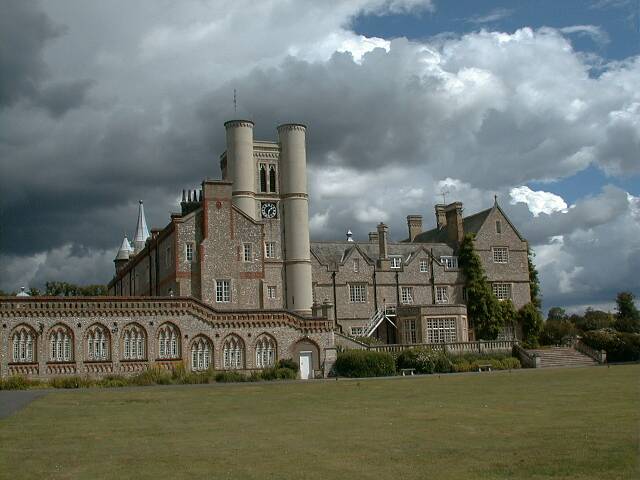
This menacing old pile, Horsley Towers — John Julius Norwich said of it in his Architecture of southern England, “The over-riding idiom seems to be vaguely Italianate Gothic, but in reality East Horsley is like nothing but itself, a grotesque Victorian Disneyland which has to be seen to be believed – and may not be even then” — was home to Ada, Countess of Lovelace, daughter of the poet Lord Byron.
Today is Ada Lovelace Day, and I have special reasons to honor her.
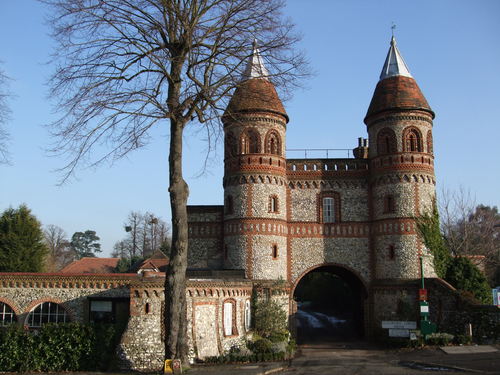
For one thing, I grew up inside these gate-towers, in the last little house before the Lovelace estate proper began, and certain features of the first fields on the way to the big pile were my childhood haunts, the old oak with its dark and mysterious hollow wound, the clovered grass and cow pats, the small mound for boyish climbing, the bramble bushes with their delicious blackberries…
*
But it is as a devotee of Hermann Hesse‘s great Bead Game that I want to celebrate Ada Lovelace today —
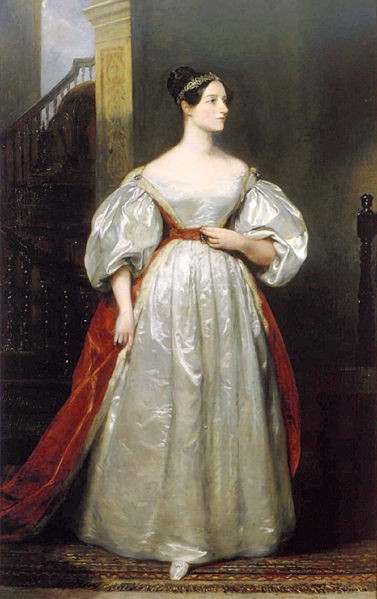
for she illustrates to perfection the importance of cross-disciplinary analogies in creativity.
*
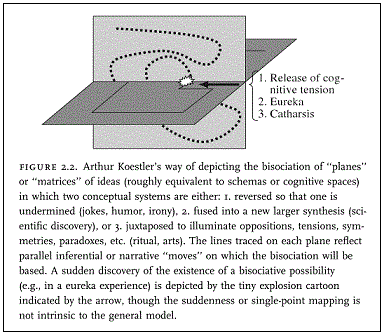
Consider this diagram from Mark Turner‘s The artful mind: cognitive science and the riddle of human creativity, based on those in Arthur Koestler‘s The Act of Creation (eg those on pp 35 and 37):
Hesse proposes — in his Nobel-winning novel, the Glass Bead Game (aka Magister Ludi) the building of an architecture of ideas in which the great works of human culture are linked — bound together — by analogies between them.
Beginning players of his Game, he writes, learn “how to establish parallels, by means of the Game’s symbols, between a piece of classical music and the formula for some law of nature.” As I wrote elsewhere, on a more complex level, Hesse speaks of scholars proposing materials for inclusion in the Game Archives, and specifically mentions someone who had been studying “the rhythmic structure of Julius Caesar’s Latin and discovered the most striking congruences with the results of well-known studies of the intervals in Byzantine hymns”… Hesse couldn’t possibly have known about it when writing that particular sentence, of course, but there is actually a book by Jane-Marie Luecke, OSB, entitled Measuring Old English Rhythm: an Application of the Principles of Gregorian Chant Rhythm to the Meter of Beowulf, (Literary Monographs, vol 9, U. Wisconsin Press, 1978).
Hunh? So?
*
Consider what Ada, Countess of Lovelace hath wrought.
She perceived just such an analogy — comparing Charles Babbage‘s Analytical Engine with Jacquard‘s mechanical loom, and writing:
The Analytical Engine … weaves algebraic patterns, just as the Jacquard-loom weaves flowers and leaves.
That analogy between weaving and algebra was the great creative leap: from there to the adoption and adaptation of Jacquard’s punched card system in computation was the lesser step from insight to application.
And think about it: her mind moved unerringly between “art” and “science” — or more exactly, craft and mathematics — in 1843, to deliver a technological insight on which the mainframes of the 1970s still relied…
That, my friends, was a superb move in the spirit of the Glass Bead Game — and impossible without a well-furnished and agile mind.




