zenpundit.com » biography

Archive for the ‘biography’ Category

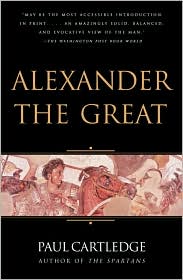
Book Review: Paul Cartledge’s Alexander the Great

Sunday, April 19th, 2009

” …he was one of the most extraordinary individuals to have ever walked the earth. He above all others deserves to be called, “the Great’.”

Alexander the Great by Paul Cartledge

Cambridge classicist Paul Cartledge has the rarest of talents among professional historians – the ability to write books that simultaneously appeal to academics and popular audiences alike. Alexander the Great has his trademark “concise depth” that Cartledge also brought to bear in The Spartans and later to Thermopylae: The Battle That Changed the World; there is enough historiographic “meat” for the scholar and the casual student of history or of war will enjoy Cartledge’s depiction of Alexander as a “ruthless pragmatist”, engaging in calculated gestures of epic magnaminity and brutal murder of his closest comrades in arms with equal certitude. One who, despite his mysticism and growing tyranny, had imperial ambitions that “….can symbolize peaceful, multi-ethnic coexistence”.

Cartledge, despite the above quotation, is not an Alexander-worshipper but a realist or a mild skeptic, rejecting hyperbole and hidden agendas in the ancient sources, which he discusses in detail, along with the more extreme portraits painted of Alexander by modern historians, such as “…the titantic and Fuhrer-like Alexander of Fritz Schachmeyer“. Cartledge’s Alexander is a military genius and an inspirational visionary to be sure, but his icy ruthlessness of calculated murder of potential opponents and superannuated followers like Callisthenes or Parmenion is never far away. Cartledge uses the term “purges” several times in the text and it is appropriate; Alexander, with his suspicions aroused, had the same irrevocable instinct for savage reprisal as did Joseph Stalin. Alexander running through Cleitus the Black with a spear in the midst of a banquet, a man who had saved Alexander’s life, or who ordered the destruction of Thebes was the same Alexander who honored the religions and customs of his conquered subjects and tried to build his Overlordship of Asia on a fusion of Pan-Hellenism and ancient Persia:
“Alexander’s importation and integration of oriental troops into the Macedonian army was a crucial and controversial issue. by the end of 328 he had units of Sogdian and bactrian cavalry, so presumably he was drawing also upon the excellent cavalry of western and central Iran. In 327 he recruited more than thirty thousand young Iranians. Since Greek was to be the lingua franca of the new Empire, replacing the use of the Achaemenids use of Aramaic, he arranged for them to be taught the Greek language as well as the demonstrably supeior Macedonian infantry tactics. when they arrived at Susa in 324, he hailed them as ‘ successors’ – to the Macedonian soldiers understandable consternation” [ 204 ]

Cartledge discusses Alexander’s generalship and his abilities as an adaptive military innovator, building on a his father Philip’s original military reforms or improvising when faced with unexpected difficulties at river crossing or in siege warfare. He misses though an opportunity to explain the dreadful effectiveness in Alexander’s hands of the Macedonian phalanx, a more heavily armed, lightly armored, mobile and deadly version of the original Greek Hoplite formation.  While Alexander and his cavalry garnered most of the glory, the ordinary Macedonian phalanx cut through Persian ranks like an implacable meat grinder, mowing down enormous numbers of the enemy and trodding their dead and dying bodies underfoot. Understandably though, this is a biography of Alexander and not a history of his wars but the real scale of the slaughter Alexander inflicted is given far less attention than the skill with which he inflicted it, or his political and religious policies that came in their wake.

Alexander’s religious sentiments and his mysticism, which spilled over in to his political vision for Asia and for himself as a semi-divine ruler are given much consideration by Cartledge, ranging from his at a distance dealings with subject state Athens, to his “contracting” a relationship with the Egyptian god Ammon, to his ideation with Achilles as a model for himself.  There appears to have been something of a feedback loop between Alexander’s military acheivments, which were truly superhuman, and his growing religious superstitions, both of which fed a kind of megalomania according to Cartledge, and led to Alexander’s unsuccessful demand that his Greek and Macedonian soldiers adopt proskynesis in the Persian style. A more or less blasphemous act of hubris ( though not quite absolutely, as Cartledge explains, given the precedent of the deification of Lysander) that led to a break between Alexander and his most loyal followers. This craving for divinity later was expanded posthumously to fabulous extremes in the traditions of the Alexander Romance, where Alexander the Great becomes a symbolic and heavily mythologized figure for dozens of peoples and regimes. Alexander himself began cultivating the myths.

Cartledge has done an excellent job demystifying one of the archetypal figures of Western history, the man whom other would-be world conquerors had to measure themselves against – reportedly, Julius Caesar wept in despair because Alexander’s glory was beyond his reach. He has also brought out the extent to which Alexander saw himself not as a Westerner, or a Hellene, but as a bridge to the East, a synthesizer of civilizations.

Book Review: The Mind of War

Sunday, April 5th, 2009

The Mind of War: John Boyd and American Security by Dr. Grant T. Hammond

The Mind of War went on to my “must read” list after attending the Boyd 07 Conference at Quantico, where I heard Dr. Frans Osinga deliver a keynote presentation on the theories of Colonel John Boyd, based on Osinga’s exhaustive study of Boyd’s personal papers, which culminated first in a PhD dissertation and then later was published as Science, Strategy and War: The Strategic Theory of John Boyd. Col. Osinga credits Boyd associate Dr. Grant Hammond and The Mind of War with introducing him to the ideas of John Boyd and inspiring him in his own intellectual journey as a student to try to understand and explain Boyd’s strategic theories.

Unlike Osinga or Robert Coram, author of the celebrated biography, Boyd: The Fighter Pilot Who Changed the Art of War, Hammond enjoyed the advantage of having had a personal and intellectual relationship with Col. Boyd, one that Hammond called “Transforming”. This gives Hammond’s shorter biography insights into how Boyd’s mind worked that Coram and Osinga miss (or more properly, could not have known), including  the “perverse glee” Boyd felt in discovering and exploring the Darwinian mismatch between perception and unfolding reality. While Robert Coram wrote about the demanding aspect that collaborators sometimes felt when dealing with the relentlessly autodidactic John Boyd, who could call at any time of the day or night and talk for hours, Hammond was actually on the receiving end of this treatment for six years:

“Let me illustrate by going through my notes of three telephone calls in the space of a single week in november 1995….He went through differences in his work,the portion that dealt with static or fixed data (energy manuverability) and that dealt with potential….He prefers potentialities. He then proceeded to review his latest reading. In rather short order, I was instructed to read Konrad Lorenz’s Behind The Mirror, Ernst Mayer’s The Growth of Biological Thought, Gerard Radnitsky and W.W Bartley’s edited collection entitled Evolutionary Epistemology (focus on particularly on Karl Popper’s essay and that of Donald T. Campbell) and Stuart A. Kauffman’s The Origins of Order.

….From biology to chaos, future defense scenarios to information war, Sun Tzu and Musashi to the Ames Spy Case, genetic algorithms to how one thinks and learns, airbase security and police to the Japanese art of war, evolutionary epistemology and the growth of biological thought – to Boyd, they are all clearly interrelated.” [ 184-186]

Note that Hammond’s description of just three phone calls with John Boyd ran over three pages of text and the above excerpt reveals only a fraction of the concepts and source material discussed. From Hammond’s The Mind of War the reader gains a good appreciation of how Boyd’s analogically oriented, synthesizing, pattern recognizing, fluidly connective mind worked in practice with a personality or character that could make Boyd competitive, confrontational, admirable, brusque, antagonizing or heroic at different turns.

The Mind of War also puts Boyd’s role in the “military reform movement” into greater clarity and sheds more light on Boyd’s retirement years of declining personal health, intellectual epiphanies, and partial rehabilitation with the Air Force brass that continued to nevertheless inflict slights and insults on the rebel who had repeatedly “bucked the system. While The Mind of War is primarily an intellectual biography of John Boyd, the human dimension is far from absent in Hammond’s writing.

For the serious student of modern strategy or aficianados of Col. John Boyd, Grant Hammond’s The Mind of War is a must read book. It forms a necessary bridge between Robert Coram’s classic style, popular, biography and Osinga’s strictly military-academic treatise on Boydian strategic theory. The Mind of War helps the reader better comprehend either book while remaining a great and highly informative work in it’s own right. Strongly recommended.

D’Este on Churchill at HNN

Saturday, January 31st, 2009

Military historian Carlo D’Este had an inspiring piece up at HNN last week on Sir Winston Churchill, drawn from his book Warlord: A Life of Winston Churchill at War, 1874-1945:

The Power of Oratory: Why Churchill is Still Relevant

….From the time he became prime minister, until December 1941, when Pearl Harbor brought the United States into the war, Churchill’s strongest weapon was oratory. As a young army officer stationed in India in 1897 he wrote that: “Of all the talents bestowed upon men, none is so precious as the gift of oratory.”

His speeches of 1940 become legendary, not only for their magnetism but more importantly for their effect on public morale. To counter both the disastrous news in France and to put to rest any notion that Britain might capitulate, Churchill delivered one of his many patriotic speeches to Parliament on June 18 that was also broadcast by the BBC. He made no effort to sugarcoat the extent of the dire situation Britain faced. The struggle that lay ahead from the air and likely from invasion would be met with every means and would be rebuffed. Of Hitler and the nations now under the Nazi jackboot, he said, “If we can stand up to him, all Europe may be free . . . But if we fail, then the whole world, including the United States . . . will sink into the abyss of a new Dark Age … Let us therefore brace ourselves to our duties, and so bear ourselves that, if the British Empire and Commonwealth last for a thousand years, men will say, ‘This was their finest hour.’

Read the rest here.

Churchill was an inordinately creative military leader, deeply interested in all facets of warfare from intelligence to technological innovations in armaments ( famously a proponent of the development of the tank in WWI) to military tactics. The amphibious landing at Gallipoli was a disaster but Normandy a generation later, despite Churchill’s misgivings, was a providential success. When in political disgrace – mostly undeserved – as a result of Gallipoli, Churchill did not retire to the shadows but donned a uniform and went to the Western Front ! Moreover he demonstrated there exemplary bravery under fire.

Can anyone imagine a politician doing that today? Or the public expecting him to do so ?

In the Second World War, in 1940 -1941, Churchill was the  indomitible rock upon which Western civilization rested. A lesser man as Prime Minister would have taken easy terms from Hitler and made Great Britain a satellite empire of the Greater German Reich, akin to the Phonecians’ relationship to ancient Persia. Few people alive today realize how dire the situation was in the Spring of 1941 and how close liberal democracy came to vanishing from history. 

Thanks to Churchill and the bravery of the RAF, the West had a chance to catch it’s breath.

Munzenberg’s Viral Post: What is in your Antilibrary?

Thursday, March 27th, 2008

The other day, I was having a conversation in the comments section regarding ancient Chinese philosophers with my learned friend Lexington Green, when I had cause to quote Nassim Nicholas Taleb, from his most recent book The Black Swan: The Impact of the Highly Improbable:

The writer Umberto Eco belongs to that small class of scholars who are encyclopedic, insightful, and nondull. he is the owner of a large personal library ( containing thirty thousand books), and separates vistors into two categories: those who react with ‘Wow! Signore professore dottore Eco, what a library you have! How many of these books have you read?’ and others – a very small minority- who get the point that a private library is not an ego boosting appendage but a research tool. Read books are far less valuable than unread ones. The library should contain as much of what you do not know as your financial means, mortgage rates, and the currently tight real estate market allow you to put there. You wil accumulate more knowledge and more books as you grow older, and the growig number of unread books on the shelves will look at you menacingly. Indeed, the more you know, the larger the rows of unread books. Let us call the collection of unread books an antilibrary.

A passage that immediately made me feel better about having resigned myself to falling further and further behind in reading the books that I keep purchasing ( I’m now also periodically finding myself going to IKEA to buy shelf extensions. I’ve resigned myself to that too).

The obscurely named Munzenberg of Soob, also enjoyed Taleb’s take on the proper function of a book collection and has begun a viral post What is in your Antilibrary?:

I’d like to pose a question to those who read this blog entry: What are three to five books on your shelf that lay unread and what knowledge do you hope to retrieve from them? [ ed.- see Munzenberg’s antilibrary here]

….I suppose I may have to tag people to get a widespread antilibrary booklist going. Feel free if you are reading this blog entry to start your own entry (the more books the better right?). I’ll link to you here if I catch it. I shall tag:

Tdaxp
Ortho
Zenpundit
Adam Elkus
Ymarsakar

As Munzenberg has graciously “tagged” me, here is a fraction of my current antilibrary (the antilibrary appears to be a dynamic state with a definite phase transition to library status) I decided to avoid those recently acquired books at the top of my pile and use some finely-aged examples:

On the Origins of War: And the Preservation of Peace by Donald Kagan

Bought it after I enjoyed reading his revisionist The Peloponnesian War with the intent of getting into Kagan’s head on strategy and military history in general. I was reading a flood other military books at the time and it was lost in the shuffle

HO CHI MINH: A LIFE by William J. Duiker

This is a critically acclaimed biography by a highly respected scholar which I intended to read in tandem with recent biographies of Chiang Kai-Shek and Mao ZeDong, in order to get a feel for the interlocking social networks these leaders shared (Zhou Enlai was a hub for each man for a time). I finished those books but have not begun this one yet.

The Growth of the Mind: And the Endangered Origins of Intelligence by Stanley Greenspan, MD

I actually started this one but it was thrown into a packing box during a year I was building a house, selling another and moving several times. It then spent several years in storage before making it back on to a shelf. The purpose was to learn more about cognitive development in children.

Pillar of Fire : America in the King Years 1963-65 (America in the King Years) by Taylor Branch

Refresher on social, African-American and political history. Like the Kagan book, it was crowded out of the must-read bookpile by the deluge of military history and strategy books that I was reading at the time

The House of Rothschild: Volume 2: The World’s Banker: 1849-1999 by Niall Ferguson

As I am one of those freaks who actually enjoys economic history, I read Ferguson’s first volume years ago and thought it was lucidly written. This book too, fell victim to the packing box

It’s a rare opportunity to be on the ground floor of one of these viral posts and to be able to watch how far afield it travels, so I am selecting my “tags” with great care:

Sean Meade

Pundita

Brad DeLong

Valdis Krebs

Dave Dilegge

Dave Schuler

UPDATE:

Younghusband opines on The Traveller’s Library

Book Note

Friday, December 28th, 2007

One of the pleasures of  Christmas is that a majority of my friends and relatives with whom I exchange gifts save themselves trouble and get me something I can actually use, i.e. – gift cards for new books.  That, coupled with accumulated Amazon gift certificates from the past year, means I will be on a book-buying bonanza next week. Huzzah!

Helpfully, Dr. Barnett has been on a reading marathon lately in preparation for writing the body of Book III and has published an extensive bilbiography of his effort with micro-reviews of most of the books. Worth checking out if you are a bibliophile like me:

More and more books

Four more books

More books

Blowing through books

Taking August to read …

ADDENDUM:

Ha! Could not wait, so I just ordered the following from Amazon:

The Black Swan: The Impact of the Highly Improbable by Nassim Nicholas Taleb

Globalized Islam: The Search for a New Ummah  by Olivier Roy


Switch to our mobile site

