Archive for the ‘cognition’ Category
Obscurely Related but Interesting Nonetheless
Friday, December 12th, 2008Time to juxtapose.
Dr. John Nagl at Democracy Journal – Intellectual Firepower New threats require new think tanks
….He proposes, instead, creating a Federally Funded Research and Development Corporation, or FFRDC, dedicated to thinking about the Islamic terror threat in the same way that RAND thought about the Soviet nuclear threat. Stevenson suggests the Defense Advanced Research Projects Agency (DARPA) as a model. It is undeniably a good and long-overdue idea, with likely payoffs hugely exceeding the few hundred million dollars such an organization would cost the taxpayer every year. But beyond the basics, Stevenson is working from the wrong mould. RAND was so influential not least because it was the brains behind an enormously large and powerful set of muscles called the Strategic Air Command, where peace was a profession and war just a hobby; DARPA provides thinking that feeds the mammoth U.S. defense industry. Stevenson’s proposed think tank would need similar need bone and muscle. But unlike the Strategic Air Command or the Department of Defense, the muscle we need today would motivate soft power, rather than hard steel.
It is not for me, a scribbler in a think tank, to denigrate the idea of creating another one. In fact, an underreported cause of the recent turnaround in Iraq has been General David Petraeus’ creation of his own brain trust consisting of many of the military’s brightest strategic thinkers on the challenges of insurgency [See Rachel Kleinfeld, “Petraeus the Progressive,” on page 107 of this issue]. If Petraeus could do so much on his own, just with thinkers he knew personally, imagine what the nation could do with a call to service by a president who valued thinking hard about problems?
I’m certainly in favor of a foreign policy DARPA – glad the wonks are catching up to my early, amateurish, efforts at blogging – and I also agree that a “new kind of think tank” is in order too. Hopefully these ideas that originated in the blogosphere will gain currency and become a reality before 2016 or 2020. 🙂
Rialtas.Net -Government 2.0 – Stigmergic Collaboration
I have just finished reading Mark Elliot’s PHD dissertation entitled “Stigmergic Collaboration- A Theoretical Framework for Mass Collaboration” and I found it to be inspiring and profound.
This is one of the most scientific and rigorous examinations of mass collaboration and social networking technologies and their interactions that I have come across, and I highly recommend reading it. In fact reading this paper has reinforced my interest in 2.0 technologies and my view that they are just the beginning of a new mode of working and of communicating. In fact I am now totally fascinated by research in the area of stigmergy and emergence, thank you Mark.
One element covered by Elliot (and I hope he will correct me if I am misinterpreting him) is that the whole web 2.0 collaborative technology framework is an human emergent (stigmergic) structure, emerging spontaneously through the simple actions and interactions of many individuals self-organising and evolving more complex structures as the social and technological conditions necessary for these types of structure to emerge become more prevalent (just as termite mounds and ant hills arise out of the simple behaviour of individual insects). This is essential reading for anyone interested in the future of the web and collaborative work (and of course collaborative art, and entertainment, and play…)
Dr. Mark Elliot’s blog is here, just FYI. Seems to be on hiatus.
Collaborative learning and organizational/collective learning are going to be the “next big thing” on the horizon, leaping off of the Web 2.0 tech community, epitomized by figures like Clay Shirky, Jason Calcanis, Scobleizer and Howard Rheingold ( who has a book on the works on this very subject or related to this subject). I’ve previously linked to “Minds on Fire” by John Seely Brown and Richard P. Adler; if you have not read it, you should. They are on target.
The obscure tie in here is that Dr. Nagl had issued a strong, even passionate, call to rebuild the military as “learning organizations” at the the end of his excellent book Learning to Eat Soup with a Knife: Counterinsurgency Lessons from Malaya and Vietnam
A wikinomic , “medici effect“world is coming.
The Elite as a Tribe
Tuesday, December 9th, 2008It’s not often that I cite a MSM piece for it’s balance and thoughtfulness but I will recommend this one, from Alec MacGillis of MSNBC:
Academic elites fill Obama’s roster
All told, of Obama’s top 35 appointments so far, 22 have degrees from an Ivy League school, MIT, Stanford, the University of Chicago or one of the top British universities. For the other slots, the president-elect made do with graduates of Georgetown and the Universities of Michigan, Virginia and North Carolina.
While Obama’s picks have been lauded for their ethnic and ideological mix, they lack diversity in one regard: They are
almost exclusively products of the nation’s elite institutions and generally share a more intellectual outlook than is often the norm in government. Their erudition has already begun to set a new tone in the capital, cheering Obama’s supporters and serving as a clarion call to other academics. Yale law professor Dan Kahan said several of his colleagues are for the first time considering leaving their perches for Washington.
“You know how Obama always said, ‘This is our moment; this is our time?’ ” Kahan said. “Well, academics and smart people think, ‘Hey, when he says this is our time, he’s talking about us.'”
Indeed. The Obamas may be moreso part of the bipartisan elite than were the Clintons whom academia overwhelmingly cheered, as Bill Clinton never could ( as Alec MacGillis duly notes) shed his ties to the Southern, good ol’ boy, wheeler-dealers of the courthouse clique. To an extent, Clinton reveled in winking at the corruption of his hambone cronies in wry TV soundbites. President-elect Obama is in far less of a hurry to bring Chicago’s more colorful political personalities to Washington and probably will not do so for several years until after Federal trials of Tony Rezko and investigations into city hall and the governor’s mansion and likely Federal trial of Governor Rod Blagojevich (D-IL) in Illinois have run their course.
I’m not unhappy with Obama’s appointments, finding them so far to be well qualified and I’ll offer high praise for Obama’s selection of General Jones and Secretary Gates. The Small Wars/COIN bloggers are jumping for joy and the national security bloggers, along with the conservative political bloggers, should be pleased; the next Defense Secretary or Secretary of State might easily have been Anthony Lake. It’s a more conservative national security group than any time during the Clinton administration. Count your blessings folks.
What strikes me as amusing though is the entirely visceral, euphorically emotive and almost tribal “he’s one of us” support from the elite for the President-elect. Reactions that run against the supposedly cerebral and “reality based” pretensions of empiricism and skepticism for which they make a claim but seldom practice because most of them are highly-trained, vertical thinking, experts. When you are accomplished within a domain and have built a reputation by operating within its’ often complex (to laymen) rule-sets, the price is often an acquired blindness that prevents you from challenging the cherished shibboleths of the group. To look across domains and question fundamental premises in horizontal thinking fashion is to be the bull in the china shop. Or the skunk at the garden party. Or both.
Thorstein Veblen, who saw primitivism re-enacted in advanced capitalist societies would have understood this very well. So would Thomas Kuhn. The Bush administration, with its CEO-ex-jock mentality, was accurately criticized for it’s arrogant insularity and dismissal of critics and contrary evidence. I don’t know about you but I’ve been around an awful lot of very smart academics, including relatives and while their cognitive prowess is admirable, the unwillingness of many of them to reconsider assumptions in light of evidence ( or even notice that they need to do so) can be every bit as stubborn as that of a Wall Street “master of the universe”.
It’s great that Obama is appointing brilliant academics to high posts. Just throw some divergent, unorthodox, thinkers into the mix to keep them honest.
Welcome Stumbleupon.com Members
Sunday, December 7th, 2008And thank you to whomever “Yroc123” on Stumbleupon.com who linked to this prior post on perception. Much obliged!
Perception Pyramid vs. OODA Loop
Friday, November 7th, 2008Design guru David Armano had a graphic up that was intriguing from a psychological point of view:
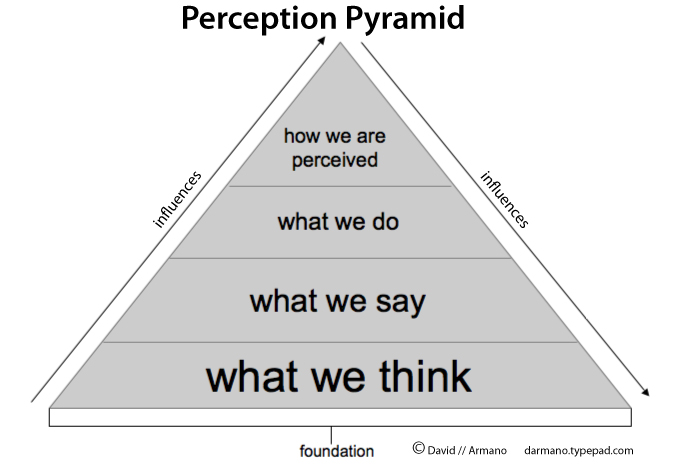
My instant impression on seeing Armano’s visual was a reminder from Western philosophy and Eastern religion:
“We are what we frequently do” – Aristotle
“What we think, we become” – Buddha
The second impression from the graphic was it’s simultaneous representation as both a feedback loop and a hierarchy. As a hierarchy, I’m not certain I would put “what we say” as a more fundamental tier than “what we do” as Armano did. Actions would appear to be less subjective as events occuring in time and space than words but words moreso than the perceptions of others which we can neither control nor reliably audit, yet they very much influence us, as Armano suggests.
Compare the flow of information/action in Armano’s pyramidical graphic with John Boyd’s OODA Loop:
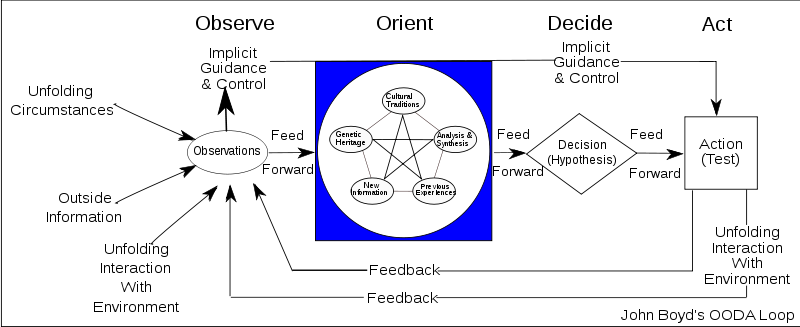
Boyd’s conception is not hierarchical or sequential, though many people view OODA as a deliberative step by step process, running through it in such a manner instead would slow the cycle considerably. Armano’s consideration of the perceptions of others would be important to Boyd as “outside information” and “unfolding interaction with environment”. It would address the mental and moral levels of conflict and competition:
- Mental (against individuals and groups): surprise, deception, shock, and ambiguity
- Moral (against groups): menace, uncertainty and mistrust, resulting in disintegration of cohesion and the moral fragmentation of the opponent into many non-cooperative centers of gravity, which pumps up friction.
It would also measure our ability to attract support from or positively influence third parties or allies.
Interested in any thoughts the readership might have on the comparison or from any of my numerous co-authors….


